DEAL POINTS The Newsletter of the Committee on Mergers and - - PDF document

deal points
SMART_READER_LITE
LIVE PREVIEW

DEAL POINTS The Newsletter of the Committee on Mergers and - - PDF document

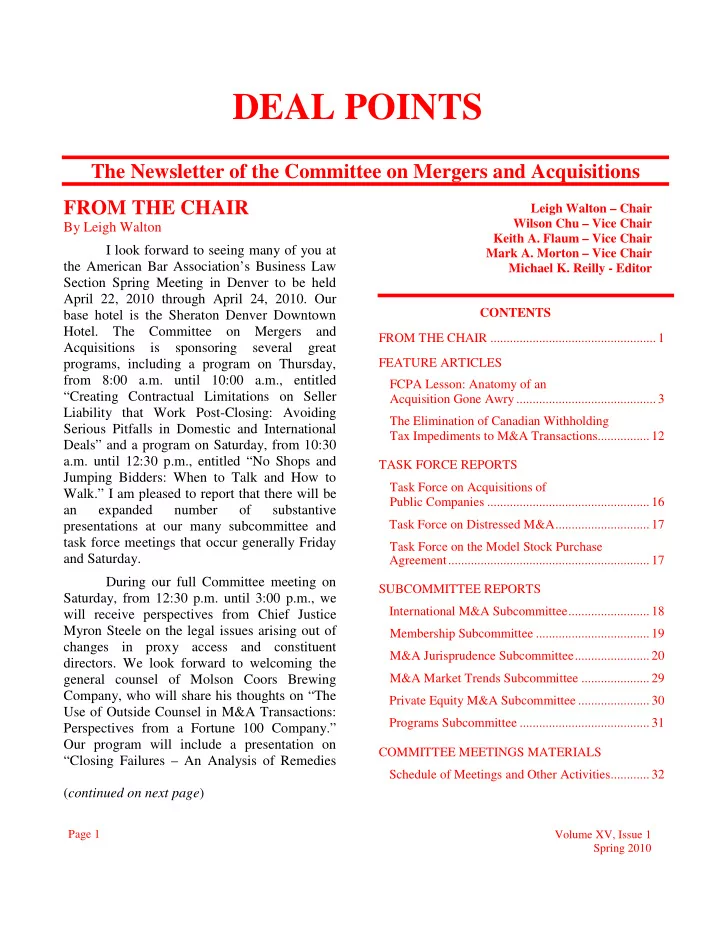
DEAL POINTS The Newsletter of the Committee on Mergers and Acquisitions FROM THE CHAIR Leigh Walton Chair Wilson Chu Vice Chair By Leigh Walton Keith A. Flaum Vice Chair I look forward to seeing many of you at Mark A. Morton


slide-1
SLIDE 1

Volume XV, Issue 1 Spring 2010 Page 1

DEAL POINTS

The Newsletter of the Committee on Mergers and Acquisitions FROM THE CHAIR

By Leigh Walton I look forward to seeing many of you at the American Bar Association’s Business Law Section Spring Meeting in Denver to be held April 22, 2010 through April 24, 2010. Our base hotel is the Sheraton Denver Downtown

  • Hotel. The Committee on Mergers and

Acquisitions is sponsoring several great programs, including a program on Thursday, from 8:00 a.m. until 10:00 a.m., entitled “Creating Contractual Limitations on Seller Liability that Work Post-Closing: Avoiding Serious Pitfalls in Domestic and International Deals” and a program on Saturday, from 10:30 a.m. until 12:30 p.m., entitled “No Shops and Jumping Bidders: When to Talk and How to Walk.” I am pleased to report that there will be an expanded number

  • f

substantive presentations at our many subcommittee and task force meetings that occur generally Friday and Saturday. During our full Committee meeting on Saturday, from 12:30 p.m. until 3:00 p.m., we will receive perspectives from Chief Justice Myron Steele on the legal issues arising out of changes in proxy access and constituent

  • directors. We look forward to welcoming the

general counsel of Molson Coors Brewing Company, who will share his thoughts on “The Use of Outside Counsel in M&A Transactions: Perspectives from a Fortune 100 Company.” Our program will include a presentation on “Closing Failures – An Analysis of Remedies (continued on next page)

Leigh Walton – Chair Wilson Chu – Vice Chair Keith A. Flaum – Vice Chair Mark A. Morton – Vice Chair Michael K. Reilly - Editor CONTENTS FROM THE CHAIR ................................................... 1 FEATURE ARTICLES FCPA Lesson: Anatomy of an Acquisition Gone Awry ........................................... 3 The Elimination of Canadian Withholding Tax Impediments to M&A Transactions ................ 12 TASK FORCE REPORTS Task Force on Acquisitions of Public Companies .................................................. 16 Task Force on Distressed M&A ............................. 17 Task Force on the Model Stock Purchase Agreement .............................................................. 17 SUBCOMMITTEE REPORTS International M&A Subcommittee ......................... 18 Membership Subcommittee ................................... 19 M&A Jurisprudence Subcommittee ....................... 20 M&A Market Trends Subcommittee ..................... 29 Private Equity M&A Subcommittee ...................... 30 Programs Subcommittee ........................................ 31 COMMITTEE MEETINGS MATERIALS Schedule of Meetings and Other Activities ............ 32

slide-2
SLIDE 2

Volume XV, Issue 1 Spring 2010 Page 2

Available to Target Companies” by Stephen M. Kotran, and a presentation on “Modernizing the Approach to Due Diligence” by Ben Longoria, founder of WizDocs. Our full Committee meeting will be followed by a Committee Forum moderated by Neal Brockmeyer entitled “Measuring Damages in an M&A Dispute.” The dial-in information for the full Committee meeting and Committee Forum is as follows: US: 888-209-3912 International: 416-620-2799 Passcode: 5380339 Dial-in information for subcommittee and task force meetings will be circulated by the respective Chairs. While on the subject of the schedule for the Spring Meeting, I would encourage those of you attending (in person or by conference call) to use the schedule printed in this issue of Deal Points as a guide. There have been an unprecedented number of changes recently due to travel schedules and speaker preferences. Some of the materials you receive from the ABA may be dated. The Committee dinner is scheduled for Saturday evening at Palettes in the Denver Art Museum, 100 West 14th Avenue Parkway. We would like to thank our friends at Practical Law Company for the sponsorship of our dinner. The reception begins at 7:00 p.m., followed by dinner at 8:00 p.m. Following the Denver conference, our next meeting will be at the ABA’s Annual Meeting in San Francisco to be held from August 6, 2010 through August 9, 2010. The Business Law Section hotels are the Fairmont/Intercontinental and the Mark

  • Hopkins. Our stand-alone meeting will be held

in Miami at the Ritz Carlton Coconut Grove from January 28, 2011 through January 29,

  • 2011. Please mark these dates so you can

minimize conflicts with these important events. Most issues of Deal Points congratulate

  • ur significant achievements (many as they

are). In this message, I’d like to take a slightly different approach by challenging you. I believe we can do a better job of delivering our content. Admittedly, if we deliver the revised Model Stock Purchase Agreement and the Public Company Model Merger Agreement in 2010 – we will have produced impressive content. Very few disagree that our works have been the most significant ever authored by the M&A

  • community. The hours of effort, the diversity of

contributors, and the quality control have been combined to showcase our amazing talent. But these works have taken upwards of a decade to produce. I believe we need to continue to diversify our output. We need quality, practical content that is delivered

  • quickly. We need to be more relevant to less

experienced lawyers. We need to be more relevant to in-house counsel. Perhaps our website needs to be more accessible, our content more approachable, our ideas more

  • innovative. Your Committee leadership is

beginning to explore these issues, led by our Membership Committee headed by Mireille Fontaine, Tracy Washburn, and Ryan Thomas. Please reach out to us with your ideas as we strategize about attaining these goals. On another front, I am proud to report that it is time to transform our Task Force on Acquisitions of Public Companies into a

  • Subcommittee. For those of you not steeped in

ABA tradition, Task Forces are for “short-term”

  • projects. Since our Public Company Model

Merger Agreement is now in the editorial process, the leadership of the Committee determined that it is appropriate to add permanence to our public company efforts by denominating it a Subcommittee.

slide-3
SLIDE 3

Volume XV, Issue 1 Spring 2010 Page 3

The only choice to lead the Committee for its first year is Diane Holt Frankle. She has invested innumerable hours of her professional time in the Model Merger Agreement. It only makes sense that she should launch the

  • Subcommittee. She will have the reigns through

the end of 2010, supported by Vice Chairs Jim Griffin and Lorna Telfer. If you have ideas, approach them. We are very appreciative of the fine job that Diane and Steve Knee have done in leading the Task Force throughout its entire

  • existence. The work product that this Task

Force is about to publish is nothing short of remarkable. As a closing note, most view the Committee as a family. We participate in this Committee not only to learn, but also to

  • network. And when we network, we form
  • friendships. During this process, most of us

have formed a friendship with George Taylor of Burr & Forman in Birmingham, and his lovely wife Honey. Their son Clinton died recently when in an accident as a passenger in a car returning from a debate tournament. I am sad that we lost a person who I am confident would have been a future member of our Committee. Our sincere condolences go out to George, Honey, and their extended families. * * *

FOR A SCHEDULE OF OUR MEETINGS AND OTHER ACTIVITIES IN DENVER PLEASE SEE PAGE 32 OF THIS ISSUE OF DEAL POINTS

FEATURE ARTICLES

FCPA Lesson: Anatomy of an Acquisition Gone Awry By James T. Parkinson and Lauren R. Randell1 Most companies understand that they run afoul of the Foreign Corrupt Practices Act (“FCPA”) if they pay bribes to foreign officials. But the caution with which most companies conduct their own operations does not always match the practices at companies they plan to

  • acquire. In the harried moments surrounding a

new acquisition, it may be tempting for an acquiring company to defer inquiry into the on- the-ground practices of its target, or perhaps even turn a blind eye to a representation that seems too good to be true. An FCPA violation by the target of an acquisition can, and will, become the acquirer’s problem if the acquirer fails to conduct adequate pre-acquisition due diligence and follow through on whatever it finds. That was certainly the case for an ill-fated telecom acquisition in 2007, when eLandia International Inc. (“eLandia”) bought Latin Node Inc. (“Latin Node”). Just months after closing on the acquisition, eLandia’s attempts to integrate Latin Node’s operations revealed millions of dollars in improper payments to agents and

  • fficials
  • f

foreign government-owned

1 Mr. Parkinson is a partner at Mayer Brown LLP whose

practice focuses on FCPA representations. Ms. Randell is an associate with the firm. Both practice in the firm’s Washington, D.C. office. The views expressed are those

  • f the authors and may not be representative of those of

the firm or its clients.

slide-4
SLIDE 4

Volume XV, Issue 1 Spring 2010 Page 4

  • companies. Disclosure to the Department of

Justice (“DOJ”) and the Securities and Exchange Commission (“SEC”) followed. Before Latin Node pleaded guilty to violating the FCPA in 2009 and agreed to pay a $2 million penalty, the following events occurred: (i) its senior management had been fired and its assets sold; (ii) eLandia had sued the former

  • wners and taken a $20.6 million charge to
  • perations; and (iii) the governments of Yemen

and Honduras initiated their own investigations into the same conduct. In this article, we first set forth the basic contours of the FCPA. We then describe three FCPA enforcement actions in which improper conduct was discovered by an acquiring company either before or after the acquisition

  • closed. Finally, we examine the eLandia-Latin

Node deal in greater detail to identify (i) lessons that may be learned from that transaction, including potential indicators of FCPA risk, and (ii) actions M&A counsel may consider after discovering potential FCPA problems. The FCPA The Foreign Corrupt Practices Act of 19772 was enacted in response to the discovery during the Watergate investigation that US companies had paid hundreds of millions of dollars in bribes to foreign officials. The FCPA has two main components: (i) the anti-bribery provision, prohibiting bribery of foreign public

  • fficials; and (ii) the accounting provisions,

which require accurate books and records and adequate internal accounting and compliance controls. Anti-Bribery Provisions The FCPA prohibits an issuer of securities, or an officer, director, employee, or agent of that issuer, any US citizen or US

2 Pub. L. No. 95-213, 91 Stat. 1494 (codified at 15 U.S.C.

§§ 78m, 78dd-1, 78dd-2, 78dd-3, 78ff, as amended).

private company, or anyone else while on US soil, from (i) offering, paying, promising to pay,

  • r authorizing the payment of (ii) money or

things of value to (iii) foreign officials (iv) for the purpose of obtaining or retaining business.3 A few notes about the expansive nature

  • f each of these elements may be helpful. A

“foreign official” is defined broadly as “any

  • fficer or employee of a foreign government or

any department, agency, or instrumentality thereof, or of a public international organization,

  • r any person acting in an official capacity for
  • r on behalf of” such an entity.4 The DOJ has

interpreted this provision as meaning that any employee of a foreign state-owned company is a foreign official, an interpretation which rears its head in many of the M&A-related FCPA cases we describe below. No money needs to change hands; the mere offer of money or a thing of value is enough to trigger the anti-bribery provision.5 Passing money or offers to pay through agents is the equivalent of directly paying the bribe, and deliberately shielding

  • neself from knowledge about the conduct of

agents or other third parties does not prevent liability.6 Criminal penalties for corporations include fines of up to $2 million per violation or twice the benefit obtained.7 Individuals can face up to five years imprisonment and fines up to $250,000 per violation or twice the benefit

3 15 U.S.C. § 78dd-1(a) (issuers); id. § 78dd-2(a)

(domestic concerns); id. § 78dd-3 (anyone else “while in the territory of the United States”).

4 Id. § 78dd-1(f)(1). 5 Id. § 78dd-1(a). 6 Id. § 78dd-1(a)(3) (prohibiting such pass-throughs

“knowing that all or a portion of such money or thing of value will be offered, given, or promised, directly or indirectly, to any foreign official”).

7 Id. § 78ff(c)(1); Alternative Fines Act, 18 U.S.C. §§

3571(c), (d).

slide-5
SLIDE 5

Volume XV, Issue 1 Spring 2010 Page 5

  • btained.8 Civil fines and disgorgement are also

possible penalties. A violation of the anti- bribery provisions carries with it significant collateral effects, including potential debarment from contracting with the US government or the European Union. Mindful of that fact, as in the recent prosecution of BAE Systems, the DOJ has in many cases permitted pleas to violations

  • f the accounting provisions or conspiracy, with

no substantive bribery count.9 Accounting Provisions The accounting provisions of the FCPA require issuers to “make and keep books, records, and accounts, which, in reasonable detail, accurately and fairly reflect the transactions and dispositions of the assets of the issuer,” and to “devise and maintain” an adequate “system

  • f

internal accounting controls.”10 “[K]nowingly circumvent[ing] or knowingly fail[ing] to implement a system of internal accounting controls or knowingly falsify[ing] any book, record, or account” is a violation of the FCPA.11 A parent company that consolidates the financials of its subsidiaries can find itself in violation of the accounting provisions if its subsidiary’s books were

  • misstated. Criminal penalties for corporations

8 15 U.S.C. § 78ff(c)(2); Alternative Fines Act, 18 U.S.C.

§§ 3571(b), (d).

9 The BAE Sentencing Memorandum, for example,

stated: “European Union Directive 2004/18/EC, which has recently been enacted in all EU countries through implementing legislation, provides that companies convicted of corruption offenses shall be mandatorily excluded from government contracts. . . . Mandatory exclusion under EU debarment regulations is unlikely in light of the nature of the charge to which BAES is pleading.” United States v. BAE Sys. PLC, No. 10-00035 (D.D.C. Feb. 22, 2010), available at http://www.justice.gov/criminal/pr/documents/03-01- 10%20bae-sentencing-memo.pdf.

10 Id. §§ 78m(b)(2)(A), (B) 11 15 U.S.C. § 78m(b)(5).

violating the accounting provisions include fines up to $25 million or twice the benefit

  • btained.12 Individuals can face up to twenty

years imprisonment and fines up to $5 million

  • r twice the benefit obtained.13

The FCPA in M&A Practice – Case Examples FCPA enforcement in general has vastly increased in the last decade, and so too have the number of enforcement actions triggered by the discoveries of acquirers of companies with FCPA problems. Some acquiring companies discovered the issues during pre-acquisition due diligence, affording them the opportunity to walk away or amend the deal. Others failed to detect the underlying violations until after the acquisitions had closed. Below we describe just a few such actions. The Titan Corporation / Lockheed Martin Corp. The Titan Corporation (“Titan”) was a military intelligence and communications company that in 2003 executed a merger agreement with Lockheed Martin Corp. (“Lockheed”). In the merger agreement, Titan represented that it and its subsidiaries were not in violation of the FCPA. Lockheed proceeded to conduct due diligence, which uncovered conduct calling into question the adequacy of Titan’s FCPA representation. Lockheed reported what it had found to the DOJ and SEC, reduced its offered price for Titan, and finally terminated the merger agreement in 2004. What sunk the merger? While developing a telecommunications project in Benin, Titan had paid over $3.5 million to an agent who was also the business advisor of the president and his

  • ccasional

personal

12 Id. § 78ff(a); Alternative Fines Act, 18 U.S.C. §§

3571(c), (d).

13 15 U.S.C. § 78ff(a); Alternative Fines Act, 18 U.S.C. §

3571(d).

slide-6
SLIDE 6

Volume XV, Issue 1 Spring 2010 Page 6

ambassador abroad. The payments were falsely documented as consulting services. Titan also had paid both a Benin official for travel expenses and a World Bank analyst for assistance with its telecommunications project, in addition to numerous instances worldwide of under-reporting commissions and falsifying

  • documents. On March 1, 2005, Titan pleaded

guilty to three felony counts, including violating both the anti-bribery and accounting provisions

  • f the FCPA, and aiding and abetting the filing
  • f a false income tax return.14 Titan agreed to

pay a $13 million fine and implement an FCPA compliance program. On the same day, Titan settled with the SEC for an additional $15.5 million in disgorgement and prejudgment interest, and agreed to retain an independent consultant to review its FCPA compliance and procedures.15 Later in 2005, Titan was instead acquired by L-3 Communications. Delta & Pine Land Co. / Monsanto Co. Delta & Pine Land Co. (“Delta & Pine”) was a cotton seed company with operations worldwide, including in Turkey through its wholly owned Turk Deltapine subsidiary. In 2006, Monsanto Co. (“Monsanto”), which was in talks to acquire Delta & Pine, discovered during pre-acquisition due diligence that in

  • rder to obtain government certifications and

pass field inspections, Turk Deltapine allegedly paid $43,000 in cash or things of value to

  • fficials at a Turkish government agency. In the

context of the $1.5 billion Monsanto offered for Delta & Pine, $43,000 might have been easy to downplay as de minimus or immaterial. The payments were not correctly recorded on Turk Deltapine’s books and records. Monsanto required Delta & Pine to disclose the violations.

14 United States v. Titan Corp., No. 05-00314 (S.D. Cal.

  • Mar. 1, 2005).

15 SEC v. The Titan Corp., No. 05-0411 (D.D.C. Mar. 1,

2005).

Delta & Pine and Turk Deltapine ultimately settled with the SEC on July 25, 2007 and, without admitting any charges, agreed to pay $300,000 in penalties and accept a corporate monitor.16 While the action against Delta & Pine was still pending, Monsanto completed the acquisition. Syncor International Corp. / Cardinal Health, Inc. In June 2002, Cardinal Health, Inc. (“Cardinal Health”), a large pharmaceuticals wholesaler, agreed to acquire Syncor International Corp. (“Syncor”), a radiopharmaceuticals and medical imaging

  • company. In the course of conducting pre-

acquisition due diligence, Cardinal discovered that Syncor’s wholly

  • wned

Taiwanese subsidiary (“Syncor Taiwan”) had for five years made improper commission payments to doctors at state-owned hospitals. Syncor Taiwan then sold radiopharmaceuticals to hospitals employing those doctors. The subsidiary also made separate payments to doctors for referring business to the subsidiary’s medical imaging

  • centers. The payments were recorded as

“promotional and advertising expenses” in Syncor Taiwan’s books. Syncor Taiwan pleaded guilty on December 10, 2002 to a single violation of the FCPA’s anti-bribery provision, and paid a $2 million fine. Syncor simultaneously settled with the SEC and agreed to pay a $500,000 penalty.17 Cardinal ultimately delayed the closing of the acquisition, at a reduced purchase price, until a month after Syncor’s plea.

16 SEC v. Delta & Pine Land Co. and Turk Deltapine,

Inc., No. 07-01352 (D.D.C. July 25, 2007).

17 SEC v. Syncor Int’l Corp., No. 02-02421 (D.D.C. Dec.

10, 2002); United States v. Syncor Taiwan, Inc., No. 02- 1244 (C.D. Cal. Dec. 4, 2002). Syncor’s founder settled with the SEC five years later and paid a $75,000 penalty. SEC v. Monty Fu, No. 07-01735 (D.D.C. Sept. 28, 2007).

slide-7
SLIDE 7

Volume XV, Issue 1 Spring 2010 Page 7

As these examples demonstrate, FCPA violations within a target company can have a significant bearing on the success of a

  • transaction. In the next case, we describe in

greater detail the possible consequences from

  • ne deal gone very much awry.

Anatomy of a Deal Gone Awry – Latin Node Inc. and eLandia International Inc. eLandia’s acquisition of Latin Node in June 2007 had a lot of promise. Latin Node was a small telecommunications company bringing “Voice

  • ver

Internet Protocol” (“VoIP”) services to countries in South America, the Caribbean, and the Middle East. eLandia was a larger provider

  • f

telecommunications, networking, infrastructure, and internet services in Latin America and the South Pacific. As eLandia said in its April 18, 2007 10-K, it was enthusiastic that Latin Node can “provide us with an excellent telecommunications service delivery platform throughout major areas of Latin America.” Two months later, eLandia acquired Latin Node preferred stock convertible into 80% of the issued and outstanding shares of its common stock, for a total of $26.8 million. At the time of the acquisition, eLandia

  • btained certain standard representations and

warranties from the president of Latin Node as well as Retail Americas Voip LLC (“RAV”), the then-owner of all of Latin Node’s common

  • stock. Among them was a representation that

“[n]either [Latin Node] nor any of its Subsidiaries has offered or given, and [Latin Node] is not aware of any Person that has

  • ffered or given, on [Latin Node’s] or

Subsidiaries’ behalf, anything of value to, in violation of any law, including the Foreign Corrupt Practices Act of 1977, as amended: (i) any official of a governmental body . . .; (ii) any customer or member of any governmental body;

  • r (iii) any other Person, for the purpose of any
  • f the following . . .”, including assisting Latin

Node or its subsidiaries in obtaining or retaining business.18 A boilerplate representation such as this may be familiar to many M&A practitioners. The ink on the closing documents was barely dry before eLandia realized it had bought more trouble than it bargained for. eLandia began conducting a post-acquisition review of Latin Node’s finance and accounting departments, and in particular their internal controls and legal compliance procedures. It is unknown to what extent eLandia had conducted pre-acquisition due diligence into Latin Node’s

  • perations, but later pleadings suggest that little

was done pre-acquisition to assess potential FCPA exposure. eLandia quickly discovered irregularities in Latin Node’s relationships with consultants and counterparties in one or more countries in Central America. A Special Committee of eLandia’s Board of Directors initiated an internal investigation, conducted by a law firm, which uncovered details of payments to officials of government-owned companies in Honduras and Yemen, made by Latin Node either directly or through consultants. By November 2007, eLandia had fired Latin Node’s senior management and voluntarily disclosed what it discovered to the Department

  • f Justice.

What was eventually discovered was a web of improper payments totaling more than $2 million over three years, according to the criminal Information filed by the DOJ.19 Latin Node, as an internet-based telecom provider, was dependent on accessing existing networks belonging to local telecom companies. As in many countries around the world, in both Honduras and Yemen these telecom companies

18 See Complaint at 8, eLandia Int’l, Inc. v. Granados et

al., No. 08-37352CA20 (Fla. Cir. Ct. June 27, 2008).

19 Information, United States v. Latin Node, Inc., No. 09-

20239 (S.D. Fla. Mar. 24, 2009), available at http://www.justice.gov/criminal/fraud/fcpa/cases/docs/lat innode-info.pdf.

slide-8
SLIDE 8

Volume XV, Issue 1 Spring 2010 Page 8

were state-owned, and Latin Node needed to reach agreement with them to gain access to the networks, as well as on the rate that would be charged to Latin Node for that access (the “interconnection rate”). In 2005 in Honduras, Latin Node negotiated with Hondutel, the state-owned telecom, and was awarded an interconnection agreement under which Latin Node would pay Hondutel a certain rate per minute for access to its network. Contemporaneous emails show Latin Node executives admitting that a “prize” would be needed to win over a Hondutel

  • fficial. Latin Node’s Guatemalan subsidiary

had set up a nominally independent company

  • stensibly to sell refurbished cell phones;

instead, this “independent” company signed a sham consulting agreement with a company controlled by the brother of a Hondutel

  • executive. Checks eventually totaling over

$500,000 were cut by Latin Node executives and sent to the “independent” company over the next two years. According to the Information, Latin Node executives knew that some of that money would end up in the pockets of Hondutel

  • fficials. When Latin Node later wanted to

lower the rate it paid to Hondutel, emails spelled

  • ut the bribe payments that would be required

and included bank account information for Hondutel officials. Latin Node began making direct payments to the Hondutel officials’ bank accounts, and obtained a verbal agreement to lower the rate pursuant to the interconnection agreement, as well as to conceal the preferential rate by falsifying the number of minutes it was buying each month. Latin Node later agreed to make payments to additional Hondutel employees to conceal the falsification. In total,

  • ver a million dollars passed from Latin Node’s

bank account in Miami to Hondutel officials, directly

  • r

through the “independent” Guatemalan company. Latin Node also hired

  • ne of the officials after she left Hondutel.

Latin Node was simultaneously seeking to penetrate the Yemeni telecom market, controlled by the state-owned TeleYemen. Rather than obtain its own interconnection agreement with TeleYemen, Latin Node partnered with a private businessman who already had such an agreement on extremely favorable terms due to his past and continuing payment of bribes to officials at TeleYemen and his close relationship with the family member of a Yemeni government official. Latin Node made

  • ver $1 million in payments either to the private

businessman, or directly to Yemeni officials. According to the Information, Latin Node executives knew that some of the money paid to the businessman would be in turn paid to TeleYemen officials. In March 2009, twenty months after eLandia made its voluntary disclosure to the government, Latin Node pleaded guilty in Miami federal court to a single violation of the FCPA and agreed to pay a $2 million fine. As we discuss further below, eLandia was able to confine the effect of the guilty plea to its subsidiary through its extensive cooperation with the government. By that point, though, Latin Node’s operations in Latin America were terminated, and eLandia had taken $20.6 million

  • f the $26.8 million it paid to acquire Latin

Node as a charge to operations.20 Most of Latin Node’s remaining assets were sold in July 2008, and litigation is ongoing over the proceeds of the sale of the assets. Invoking the purchase agreement, and in particular the FCPA representation and warranty, eLandia sued RAV and Latin Node’s former president in Florida state court for, inter alia, indemnification, breach of contract, breach

  • f the obligation of good faith and fair dealing,

and fraud.21 The case settled in February 2009

20 eLandia Form 10-Q/A, Sept. 5, 2008. 21 eLandia Int’l, Inc. v. Granados et al., No. 08-

37352CA20 (Fla. Cir. Ct. June 27, 2008).

slide-9
SLIDE 9

Volume XV, Issue 1 Spring 2010 Page 9

with the release of a number of escrowed eLandia shares back to eLandia.22 The fallout from the discovery of the Latin Node bribery schemes went far beyond the economic impact to eLandia. The Yemeni government began investigations in 2009 into the recipients of the payments. In Honduras, the alleged corruption at Hondutel contributed to the arrest of a number of former Hondutel

  • fficials, including the nephew of the now-

deposed President

  • f

Honduras. Both investigations can be expected to continue well into the future. Conclusion – Lessons Learned Pre-Acquisition Due Diligence—Looking Beyond FCPA Representations The first lesson learned is the most

  • bvious—regardless of the representations and

warranties obtained from the target, there is no substitute for pre-acquisition due diligence. In the above examples, Lockheed, Cardinal, and Monsanto all took this step, and reacted to what they found by amending the merger agreements

  • r walking away entirely. In contrast, eLandia

relied on what turned out to be an empty representation from the former owners of Latin Node, and was stuck with potential successor liability, a criminal fine to be paid on Latin Node’s behalf, and a worthless acquisition. In addition to detecting existing problems, thorough pre-acquisition due diligence allows the acquiring company to stop FCPA violations from continuing post-

  • acquisition. While an acquiring company may

be able to distance itself from past bribes paid by a target, it is unlikely that bribery that remains undetected at the time of the acquisition will stop at the moment of acquisition, possibly leaving the acquirer on the hook for bribes made after that point. Once potential problems are

22 eLandia Form 10-Q, Nov. 16, 2009.

detected, companies need to reassess the accuracy of any FCPA representations that have been given to that point, especially if they have been incorporated into a public filing.23 Know your target and its risk profile – examples

  • f FCPA red flags

While no list of potential red flags can be exhaustive, in the FCPA context it is important to at least look at the following indicators of the target’s risk profile:

  • In which countries do the target or its

subsidiaries do business? Extra investigation may be required when companies do business in certain hot spot countries.24

  • Does any of the target’s revenue come

from contracts with foreign governmental entities or state-owned companies?

  • How frequently must the target interact

with foreign regulators? For example, do the target’s business affairs require

  • btaining numerous licenses, or are

governmental inspections required?

  • Are any former regulators or employees
  • f state-owned companies employed by

the target?

23 Following Titan’s plea, the SEC issued a Report of

Investigation regarding the incorporation of Titan’s FCPA representation into the merger agreement, which had been appended to the filed proxy statement. Report

  • f Investigation, SEC Release No. 51283 (Mar. 1, 2005).

Titan had not withdrawn or amended its FCPA representation even after the FCPA violations came to light and were reported to the SEC. The SEC warned that it would “consider bringing an enforcement action . . . if we determine that the subject matter of representations or

  • ther contractual provisions is materially misleading to

shareholders because material facts necessary to make that disclosure not misleading are omitted.” Id.

24 Organizations such as Transparency International

provide useful indices of corruption around the world.

slide-10
SLIDE 10

Volume XV, Issue 1 Spring 2010 Page 10

  • How many agents, consultants, sales

representatives, and distributors does the target use in each country, and can the target produce contracts with each intermediary, and in particular contracts that include an FCPA clause

  • r

certification?

  • Does the target have an FCPA policy,

and can it produce evidence of that policy being enforced, with FCPA training given to employees around the world? Titan, for example, lacked a company-wide FCPA policy despite

  • perating in numerous countries and

working with over a hundred agents and consultants.25

  • How robust are the target’s accounting

and compliance systems? Latin Node lacked an internal auditor, and its accounting staff had “limited familiarity with reporting requirements under US GAAP and SEC Rules and Regulations.”26 Titan’s and its subsidiary’s auditors had already noted the African subsidiary’s lack of an accounting system or internal controls.27

  • Does the target have an account for

facilitating payments? These are some of the questions that should be asked on pre-acquisition due diligence, but these should also be tailored and extended for the industry, region(s), and business operations of the company.

25 Information at 10, United States v. Titan Corp., No. 05-

00314 (S.D. Cal. Mar. 1, 2005). Titan also never gave its employees information or training regarding FCPA

  • compliance. Id.

26 eLandia Form 8-K/A, Sept. 14, 2007. 27 Information at 11, United States v. Titan Corp.

Consider seeking a DOJ Opinion One option to consider after discovering potential violations is the DOJ’s FCPA Opinion Procedures, which allow companies to petition the DOJ for an opinion on whether a particular proposed transaction would “conform[] with the Department’s present enforcement policy regarding the antibribery provisions of the” FCPA.28 While a positive opinion is not a guarantee of non-prosecution, it creates a rebuttable presumption that the transaction complies with the FCPA.29 Several opinions

  • ver the years have been issued in response to

requests by acquiring companies eager to know whether they will be taking on FCPA liability if they consummate their acquisitions. After it discovered potential FCPA violations at Syncor Taiwan, Cardinal is believed to have requested what became DOJ Opinion Procedure Release 2003-01 (Jan. 15, 2003), in which the DOJ laid

  • ut the remedial steps that Cardinal promised to

undertake if the transaction closed, and concluded that “the Department does not presently intend to take any enforcement action against the Requestor for the pre-acquisition conduct [] described in its request.”30 In a different posture, in 2008 Halliburton requested an opinion regarding its bid to acquire U.K.- based Expro International Group PLC because it was unable to conduct sufficient pre-acquisition due diligence to find potential latent FCPA problems.31 Halliburton agreed to an extensive

28 28 C.F.R. § 80.1; 15 U.S.C. § 78dd-1(e). 29 28 C.F.R. § 80.10; 15 U.S.C. § 78dd-1(e). 30

http://www.justice.gov/criminal/fraud/fcpa/opinion/ 2003/0301.pdf. For other Opinion Procedure Releases touching on M&A issues, see Release 2004-02 (available at http://www.justice.gov/criminal/fraud/fcpa/opinion/ 2004/0402.pdf), and Release 2008-01 (available at http://www.justice.gov/criminal/fraud/fcpa/opinion/2008/ 0801.pdf).

31 DOJ Opinion Procedure Release 2008-02, available at

http://www.justice.gov/criminal/fraud/fcpa/opinion/2008/ 0802.pdf. Halliburton was also bound by a confidentiality

slide-11
SLIDE 11

Volume XV, Issue 1 Spring 2010 Page 11

series of periodic reports to the DOJ on any FCPA, accounting, or internal controls issues it discovered, as well as to an internal investigation utilizing external counsel and forensic auditors, revamping how Expro contracted with agents or intermediaries, and agreeing not to divest Expro until any DOJ investigations were over. The DOJ, in return, gave a green light to Halliburton’s continuing the bid, as well as assurances that it did not intend to take enforcement action on improper payments made by Expro for a short period of time after the acquisition. The DOJ recognized that in certain situations, “there is insufficient time and inadequate access to complete appropriate pre-acquisition FCPA due diligence and remediation.” Voluntary Disclosures and Cooperation Possibly the smartest thing that eLandia did upon discovery of Latin Node’s improper payments was to walk into the DOJ and SEC and voluntarily disclose what it had learned. It has been clear for many years that the DOJ’s default position is that acquiring companies are responsible for FCPA liabilities

  • f

the companies they acquire. Unlike companies that discovered problems with their targets before the acquisitions closed, eLandia faced the possibility

  • f

a much more punishing enforcement action against it personally. Its decision to promptly voluntarily disclose and cooperate throughout the government’s subsequent investigation appears to have been a critical factor in the government’s decision to accept a plea from a by-then empty subsidiary.

agreement that prohibited it from disclosing to the DOJ what it already knew about potential FCPA violations at Expro. Unsurprisingly, the DOJ “discourage[d] companies wishing to receive an FCPA Opinion Release in the future from entering into agreements which limit the information that may be provided to the Department.” Id.

The DOJ’s subsequent recognition of eLandia’s cooperation reads like a checklist for a company seeking cooperation credit, lauding “Latinode’s and eLandia’s commendable efforts to uncover evidence of corrupt activities, its authentic cooperation with the Government throughout the investigation, and its significant remedial efforts upon discovery by eLandia of the misconduct.” The efforts included the following: (i) immediately initiating an internal investigation, including witness interviews and review of documents; (ii) making a prompt voluntary disclosure; (iii) producing “thousands

  • f

non-privileged documents to the Government”; (iv) terminating culpable senior Latin Node officers and employees; (v) strengthening eLandia’s own anti-corruption compliance program; (vi) committing to pre- acquisition due diligence in any future transactions; and (vii) most importantly to the DOJ, “dissolv[ing] Latinode from an operational perspective, at a cost to eLandia of millions of dollars, and … ceas[ing] doing business relating to the tainted contracts.”32 * * *

32 Sentencing Memorandum at 6-7, United States v. Latin

Node, Inc., No. 09-20239 (S.D. Fla. Apr. 3, 2009), available at http://www.justice.gov/criminal/fraud/fcpa/ cases/docs/latinnode-govt-sent.pdf.

slide-12
SLIDE 12

Volume XV, Issue 1 Spring 2010 Page 12

The Elimination of Canadian Withholding Tax Impediments to M&A Transactions By Brent Kerr1 A long standing tax irritant in Canada- US M&A transactions is now being eliminated. The recent Canadian federal budget included the removal of the requirement, in many circumstances, for US investors to obtain clearance certificates and to pay Canadian withholding tax on the sale of shares of a private Canadian corporation. Many industry groups have lobbied for years for such a change since it was widely thought that US investment into Canada was impeded by the rules and the

  • nerous tax and administrative requirements

they impose, both on purchasers and sellers. In some cases, the rules have led to the use of complex exchangeable share structures and

  • ther arrangements to address these problems.

M&A transactions in Canada should be considerably simpler under the new rules. If the new rules are passed into law, the elimination of the requirement to obtain a clearance certificate and to pay Canadian withholding tax will apply retroactively to transactions occurring after March 4, 2010 to shares in private Canadian corporations and certain other interests which do not derive their value principally from real or immovable property situated in Canada, Canadian resource property, or timber resource property. As a result, the change will be particularly beneficial to the high tech and life sciences sectors. The new rules will apply to all non-residents of Canada, and as a consequence US investors that

1 Brent Kerr practices law in the Canadian law firm of

Gowling Lafleur Henderson LLP. He is the leader of Gowling’s National Tax Group.

have made direct investments in Canada, as well as US investors that have used international structures to hold their Canadian investments and US investors that are not entitled to treaty protection in Canada, should all benefit. Background Previously, under Canadian tax rules the shares of a private Canadian corporation were “taxable Canadian property.” As a result, a US investor was taxable in Canada on any gain from the sale of those shares, unless treaty protection was available. A withholding tax mechanism existed to facilitate collection of this tax, so any purchaser buying shares of a private Canadian corporation from a US or

  • ther non-resident seller was liable to withhold

tax from the sale proceeds.2 This withholding tax requirement applied whether or not the purchaser was resident in Canada. For example, a US resident buying shares of a private Canadian corporation from another US resident was subject to this Canadian withholding tax requirement. The Canadian withholding tax was significant – in the absence of a clearance certificate issued by the Canada Revenue Agency (“CRA”), purchasers were required to withhold 25% of the gross selling price for shares of a private Canadian corporation. Since this withholding tax was based on the gross selling price, in some situations it could exceed the gain. The withholding tax liability could be reduced, but only if the seller obtained a suitable clearance certificate from the Canadian tax authorities. As many US investors discovered, obtaining a clearance certificate was a long, cumbersome process. It was not uncommon for the parties to wait three to six

2 The liability imposed on purchasers and the provisions

regarding clearance certificates are set out in section 116

  • f the Income Tax Act (Canada).
slide-13
SLIDE 13

Volume XV, Issue 1 Spring 2010 Page 13

months, or even longer, to obtain a clearance certificate, and it was rare to see a clearance certificate issued to the seller prior to closing. As a result, purchasers would usually withhold funds at closing to satisfy their liability for withholding tax. This in turn necessitated escrow or trust arrangements for the funds withheld pending delivery of the certificate. Obtaining a clearance certificate also imposed a significant administrative burden on non-resident sellers. The seller could be required to obtain a Canadian business number for reporting purposes (which might then subsequently be cancelled to avoid receiving

  • ngoing demands to file Canadian income tax

returns) and the seller was required to provide detailed information to CRA regarding itself and the property. For US venture capital funds, many of whom are structured as a limited partnership or as a limited liability company (“LLC”) comprising hundreds or even thousands of individual investors, the compliance burden has been a serious issue and has resulted in real restrictions for Canadian businesses accessing foreign capital. The compliance burden was

  • ften cited by US VCs as a sufficient reason to

look elsewhere for investment opportunities. The problem was not limited to the Canadian technology and life sciences sectors, but efforts to raise funding in these sectors were especially hampered by the withholding tax requirements. Traditional Deal Mechanics The long process required to obtain a clearance certificate not only resulted in cash flow problems for sellers, but also required special mechanisms to be drafted in the related M&A documents. Provision had to be made for computing and withholding the required tax, for the application and delivery of a suitable clearance certificate, and for the holding and investment of funds pending receipt of a clearance certificate. A relatively short statutory deadline applied for remitting the withholding tax after closing, but clearance certificates were almost never available before remittance of the tax was required. Therefore, many purchase and sale agreements also contained special provisions permitting the remittance of the tax to be deferred if a clearance certificate application was in progress and if CRA provided an acceptable comfort letter. Consideration usually had to be given to the entitlement to interest on the tax withheld while invested pending the delivery of the clearance certificate, and the taxation of the resulting interest income in Canada and the US had to be

  • considered. The drafting became even more

complex for a sale that involved an earn-out or

  • ther special feature.

For many US investors, these costs, delays and administrative burdens were particularly objectionable where protection from Canadian tax was available under the Canada-US Tax Convention, 1980 (the “Canada-US tax treaty”). An investor that is resident in the US for purposes of the Canada- US tax treaty is generally exempt from Canadian tax on the gain from the sale of shares

  • f a private Canadian corporation as long as the

value of those shares is not derived principally from real property situated in Canada. In principle, such a US investor should not be subject to tax in Canada on the sale of its shares in these circumstances. Nevertheless, a recent decision of Canada’s Federal Court of Appeal3 confirmed the long-standing view that the Canadian withholding tax and clearance certificate requirements can apply even where the underlying gain is not taxable in Canada by virtue of a tax treaty. In that case, the Court

  • bserved that the withholding tax requirements,

no matter how inconvenient or costly, are the

3 Minister of National Revenue v. The RCI Trust, 2009

FCA 373.

slide-14
SLIDE 14

Volume XV, Issue 1 Spring 2010 Page 14

procedures Parliament established and must be respected. The result is that even where a US seller is not taxable by virtue of the Canada-US tax treaty, it may nevertheless have 25% of the gross sale proceeds held in trust for an extended period of time while CRA processes its application for a clearance certificate. In the end, even if CRA ultimately agrees that the sale is not taxable in Canada and issues a clearance certificate without requiring any payment of tax, both the purchaser and the seller will have been put to considerable delay, expense, and administrative inconvenience. In practice, the situation can sometimes be even worse because CRA takes the position that certain US investors are not entitled to protection under the Canada-US tax treaty. For example, an LLC which is disregarded for US tax purposes is not considered to be a US resident for purposes of the Canada-US tax treaty and therefore is not entitled to treaty protection per se on the sale of shares of a private Canadian corporation. As a result, such an LLC could generally be taxable in Canada

  • n any gain it realizes from the sale of those

shares, and withholding tax and clearance certificate requirements would apply at the time

  • f sale, subject to the new “look-through”

provisions in the Canada-US tax treaty. Canadian tax paid by the LLC in these circumstances could represent an additional, non-recoverable cost to the US parties who invested through the LLC if they are unable for any reason to obtain a corresponding foreign tax credit in the US for the Canadian tax paid. This often occurred, for example, where a US tax exempt entity invested in a Canadian corporation through an LLC. 2008 Attempt to Address the Problem In 2008, Canada finally recognized that the withholding tax and clearance certificate mechanism was a problem for US investors, and a number of technical amendments were made in an attempt to make the rules more

  • workable. The approach was to ease the

requirements for certain “treaty-exempt property.” Unfortunately, in most M&A transactions, the 2008 amendments had little impact. The main effect

  • f

the 2008 amendments was to place a burden on purchasers to determine whether the seller was entitled to protection under the Canada-US tax treaty and whether the shares or other property being sold met the conditions for treaty-exempt

  • property. Some parties attempted to take

advantage of the 2008 amendments by drafting new closing mechanisms. These typically included extensive representations and warranties regarding both the seller and the property being sold, as well as tax indemnities, and sometimes security for the purchaser’s potential tax liability. These mechanisms were necessary because the entitlement to treaty benefits can be difficult for a purchaser to ascertain, especially in light of the extensive limitation of benefit provisions in the current Canada-US tax treaty. Often, potential tax liability would remain with the purchaser. In many arm’s length situations, purchasers are not prepared to take the risk of tax liability. Therefore, despite the 2008 amendments, many investments and M&A transactions continued to be structured to require withholding tax, clearance certificates, trust accounts for the tax withheld, comfort letters, and all the traditional deal mechanics. For these reasons, it was widely felt that the 2008 amendments did not go far enough and the need to obtain a clearance certificate remained a practical reality.

slide-15
SLIDE 15

Volume XV, Issue 1 Spring 2010 Page 15

2010 Changes to Eliminate the Tax The changes announced by Canada on March 4, 2010 adopt a much simpler approach by taking many Canadian investments entirely

  • ut of the withholding tax and clearance

certificate regime, thereby providing long- awaited administrative relief for all US investors, whether or not they are entitled to relief under the Canada-US tax treaty. The new rules will eliminate altogether the liability of non-residents for Canadian tax, as well as the related withholding tax and clearance certificate requirements, for shares of private Canadian corporations and certain interests in partnership and trusts – unless more than 50% of the value of the shares or other interests is derived from real or immovable property situated in Canada, Canadian resource property, or timber resource property. As a result, US investors in private Canadian corporations who meet this test will no longer be subject to tax or handicapped by the administrative requirements that have existed. To prevent abuse, shares and other interests will remain taxable in Canada if at any time within 60 months prior to the sale, more than 50% of their value was derived from real

  • r immovable property situated in Canada,

Canadian resource property, or timber resource property. A special feature of the new rules is that they will apply to all non-resident investors whether or not they are protected from Canadian tax by a tax treaty. This is good news for LLCs and other US investors who are not eligible for treaty protection per se. Implications for M&A Transactions The new rules will apply retroactively to transactions occurring after March 4, 2010. As a result, regardless of when the initial investment was made, if the new rules are passed into law, Canadian withholding tax and clearance certificates generally will not be required on the sale of shares of private Canadian corporations (and certain other interests) which occur after that date, provided the shares do not derive their value principally from real or immovable property situated in Canada, Canadian resource property, or timber resource property. Where the new rules apply, closing documents should be simplified by eliminating the need for the detailed withholding tax mechanisms that were previously required. US investors who have already implemented more complex investment arrangements, such as exchangeable share structures, may wish to consider whether those structures can be unwound or simplified. In some situations, maintaining those structures results in costs and administrative complexity that is not desirable. Special situations may arise where additional Canadian tax considerations apply. For example, the sale of shares in a private Canadian corporation which were obtained under an employee stock option may result in the application of special rules which affect the seller and purchaser. As well, a sale of shares back to the issuing corporation or on a redemption of those shares can give rise to a deemed dividend which is subject to another Canadian withholding tax that is not eliminated by the new rules. In many circumstances, a purchaser will have sufficient information about the target corporation, partnership or trust and its

  • perations and assets during the 60 months

prior to closing to determine whether the shares

  • r other interests derive more than 50% of their

value from real or immovable property situated in Canada, Canadian resource property, or timber resource property. However, purchasers will still be at risk under the new rules if there

slide-16
SLIDE 16

Volume XV, Issue 1 Spring 2010 Page 16

is uncertainty regarding this valuation issue. For example, if there was a point in time during the 60 months prior to a sale of shares when more than 50% of the value of the shares was derived from real property situated in Canada, then the shares will continue to be taxable Canadian property and all the usual withholding tax and clearance certificate requirements will apply. Therefore, in some circumstances it may be prudent for purchasers to obtain protection, by way of indemnities or otherwise, with respect to the target’s asset mix during the preceding 60 months. The government’s announcement indicated that the new rules would be effective retroactively to apply after March 4, 2010. However, until the new rules have actually been passed into law, caution is recommended. A number of alternative strategies could be considered for transactions in the interim. As a result of these and other considerations, it is usually recommended that Canadian tax advice be sought regarding the consequences of the new rules. * * *

TASK FORCE REPORTS

Task Force on Acquisitions

  • f Public Companies

Our Task Force last met in Washington, D.C. in December 2009. Many of our Task Force members joined

  • ur

meeting by conference call. We were honored to have the SEC’s Chief of the Office of Mergers and Acquisitions, Michelle Anderson, as well as two of her senior deputies, Nicholas Panos and Melissa Duru, attend our Task Force meeting. Michelle and her team discussed the September 14, 2009 release of updated CD&Is on the Williams Act, as well as both the Tracinda enforcement action and an enforcement action against Perry Corporation. We also revisited the new CD&I on the use of voting agreements, the use of written consents, and the mechanics using the new Delaware statute permitting the setting of two record dates – one for notice and

  • ne for the vote. Our Editorial Board met and

worked through the commentary on the termination and meeting covenants sections and began the review of the commentary on the no shop covenant. Editorial Board Report We had a two day drafting session in Dallas in January, courtesy of Jim Griffin. We finished the no shop commentary and the exchange ratio article. We also now are quite close to finishing the representations and

  • warranties. We had two calls in March to

finalize additional comments

  • n

the commentary to the no shop and meeting covenants commentary and the termination

  • section. We have continued work on the

representations and warranties and we have received revisions to Section 1. We are sending

  • ut a revised draft Model Merger Agreement to

the entire Task Force prior to our Denver meeting and will be taking comments at that

  • meeting. We will have stand-alone Editorial

Board meetings in May and June, with a small group scheduled to review the final Model Merger Agreement in July. We are on track to publish by the end of 2010! Subcommittee Status Granted Come help make plans! We learned from Leigh Walton that the ABA has granted Subcommittee status to the Task Force effective at the Denver meeting. This is a testament to the hard work of the Task Force, and especially the Editorial Board, in pushing the Model Merger Agreement to completion this year! Our first Subcommittee meeting will be held Friday, April 23, from 1:30 p.m. until 2:30 p.m. – the current schedule puts us in Directors’ Row I, Lobby Level, Plaza Building, but check the

slide-17
SLIDE 17

Volume XV, Issue 1 Spring 2010 Page 17

schedule to confirm location. The call-in number for the meeting is as follows: US: 212-271-4758 Toll Free: 800-348-6433 Passcode: 9671863 Our agenda for the meeting will be to review the plans for completion of the Model Merger Agreement, take comments on the current draft of the Model Merger Agreement, and then make plans for the Subcommittee’s initial projects. We hope you will attend and we welcome ideas for new public company M&A projects! Dinner in Denver Our first Subcommittee dinner will be held Friday, April 23. We are dining at Strings

  • Restaurant. Hendrick Jordaan tells us: “Great

food, nice setting and a very short cab ride from the Sheraton.” Cocktails are at 6:30 p.m. and dinner at 7:30 p.m. This will be a celebration of all we have accomplished as a Task Force! Diane H. Frankle Stephen H. Knee Co-Chairs

Task Force on Distressed M&A

The Task Force on Distressed M&A held a successful meeting at the Committee’s stand-alone meeting in Washington D.C. We featured J. Patrick Cave of The Cypress Group, who gave a unique presentation on how legislative changes may impact distressed M&A in 2010 and beyond. In addition, Sylvain Vauclair of McCarthy Tétrault discussed issues that non-Canadian acquirers should consider when purchasing a Canadian business. Jennifer Muller from Houlihan Lokey gave a distressed M&A update. Finally, we discussed, and enlisted members in, our new deal point analysis of 363 asset purchase agreements and sale orders. We plan to have a robust discussion on distressed dealmaking at our meeting in Denver

  • n Friday, April 23, from 8:30 a.m. until 9:30

a.m. (dial-in will be available, please contact my assistant at laura.vanerp@hro.com for the specifics). We will discuss the following topics: (i) the 363 Study; (ii) an update on the state of the distressed M&A market presented by Peter Fishman of Houlihan Lokey; (iii) In re Philadelphia Newspapers, In re DBSD North America, Inc., and other recent cases; and (iv) a case study

  • n

the Canwest bankruptcy presented by John Clifford of McMillan. See you in Denver! Hendrik Jordaan Chair

Task Force on the Model Stock Purchase Agreement

The Editorial Committee has completed its work on Volume 1 (the Revised Model Stock Purchase Agreement with Commentary and Seller’s Response) and Volume 2 (Exhibits, Ancillary Documents and Appendices). Both volumes are now being reviewed by senior leadership of the Committee. We anticipate publication in time for the ABA Annual Meeting this August with an appropriate celebratory dinner in San Francisco. We look forward to seeing everyone at the meeting in Denver. Robert T. Harper Murray J. Perelman Co-Chairs

slide-18
SLIDE 18

Volume XV, Issue 1 Spring 2010 Page 18

SUBCOMMITTEE REPORTS

International M&A Subcommittee

The International M&A Subcommittee met on Saturday, December 5, 2009, in connection with the stand-alone meeting of the Committee in Washington, D.C. The Foreign Corrupt Practices Act and Cross-Border M&A The meeting began with a presentation by Jamie Parkinson of Mayer Brown LLP and Chuck Duross of the Department of Justice on current Foreign Corrupt Practices Act developments affecting cross-border M&A, which was followed by an extended Q&A

  • session. Daniel Rosenberg referred to the UK’s

new Bribery Bill, which would in effect require companies to develop anti-bribery procedures, and agreed to circulate a note on it to the Subcommittee. The Committee’s Proposed Model International JV Agreement Project Daniel Rosenberg summarized the current state of play on the Committee’s proposed Model International JV Agreement project, which had been led by the late Alison

  • Youngman. The project took the form of a

questionnaire which had been sent to twenty- four jurisdictions, with responses received to date from sixteen. There was discussion on whether the Subcommittee should take over the

  • project. During and following the meeting, a

number of members of the Subcommittee volunteered to take on roles within the project. The Subcommittee’s Public Company Takeovers Project Daniel Rosenberg also summarized the current status on the Subcommittee’s proposed International Public Company Acquisition Due Diligence project. This had been progressed to the point of an advanced stage questionnaire during the period 2000 to 2003 but had been put

  • n hold pending the completion of the Model

Merger Agreement project by the Task Force

  • n Acquisitions of Public Companies. Given

the likelihood that the Task Force will complete their project during 2010, it is now time to revive the Subcommittee’s project, which is likely to involve ten major takeover

  • jurisdictions. Daniel will be liaising with Lorna

Telfer of the Task Force on Acquisitions of Public Companies as to the appropriate jurisdictions and contributors for our project. Foreign Direct Investment Laws Project Frank Picciola summarized the current state of play on the Subcommittee’s Foreign Direct Investment Laws project and agreed to circulate a progress report, including details of the jurisdictions where input is needed. Post-Closing Dispute Resolution Project In the absence of Guy Harles and Katrien Vorlat, Jim Walther summarized the current status on the Subcommittee’s Post- Closing Dispute Resolution project. Programs It was noted that the Subcommittee was proposing a program on post-closing dispute resolution issues at the 2010 ABA Annual Meeting in San Francisco. There is also a possibility of our co-sponsoring a program on cross-border distressed M&A at the same meeting. Current Developments Discussion The meeting concluded with

  • ur

customary general discussion by Subcommittee members regarding legal developments in their jurisdictions relevant to M&A practice. Points raised included:

  • Nick Dietrich updated the meeting on a

number of Canadian foreign investment

slide-19
SLIDE 19

Volume XV, Issue 1 Spring 2010 Page 19

issues, including an update on the Canadian government’s proceedings against a US investor under the Investment Canada Act.

  • Barry Horne updated the meeting on the

use of hybrid instruments in US acquisitions of Canadian entities.

  • Jorge Yáñez updated the meeting on

certain Mexican developments relating to antitrust and tax. Subcommittee Website The Subcommittee website can be accessed at the following address: www.abanet.org/dch/committee.cfm?com=CL5 60016. Our Subcommittee website contains the following information:

  • The slides from the presentation to the

Subcommittee on the Foreign Corrupt Practices Act and cross-border M&A.

  • A memorandum by Daniel Rosenberg
  • n the new UK Bribery Bill referred to

in the meeting.

  • A note prepared by Nick Dietrich

summarizing Canadian developments he raised at the meeting.

  • A note prepared by Barry Horne

summarizing the developments he raised at the meeting on the use of hybrid instruments in US acquisitions of Canadian entities.

  • A note prepared by Jorge Yáñez

summarizing the Mexican developments he raised at the meeting.

  • Details
  • f

the Subcommittee’s publications, future meetings, work-in- progress and past program materials. We look forward to seeing you in Denver. Daniel P. Rosenberg James R. Walther Co-Chairs

Membership Subcommittee

Since our prior report, we have seen membership numbers unfortunately decrease. Our total Committee membership is at 3,682 compared to a membership of 3,765 as of November 2009. Although only a slight 1% decrease, it is a reflection nonetheless of our economic situation and therefore our efforts are doubled in trying to maintain and increase membership in different areas. Our membership is still throughout 49 states but went up from 44 to 45 countries! Our in-house counsel members have slightly grown from 362 to 366 but our “associate” members (non-lawyers) have decreased from 304 to 296. Again only a slight decrease of 2%, but we need to keep our energy focused on those “associate” members and that is exactly what the Membership Subcommittee has been doing. We have been working diligently with the Business Law Section of the ABA to renew relationships and expand and seek opportunities with others such as ACG. Our efforts are consistent and we believe in the added value of

  • ur Committee! We invite you to spread the

word and involve new people and let us know how we can seek out new opportunities, better involve in-house counsel but also “associate” members, as we value their opinion and needs. The M&A Market Trends Subcommittee is still our largest group with 1,352 members. Here is a list of a few of the

  • ther larger subcommittee and task force

membership numbers:

slide-20
SLIDE 20

Volume XV, Issue 1 Spring 2010 Page 20

  • Private Equity M&A

1,149

  • Acquisitions of Public

Companies 728

  • International M&A

1,149

  • Model SPA Revisions

664

  • M&A Jurisprudence

596 We should also mention that The Task Force on Distressed M&A, which is our newest task force, has also grown by 12% and is now comprised of 288 members. Also to be noted is the 49% growth of the International M&A Sub- Committee under the guidance of Daniel Rosenberg and Jim Walther. The economy and

  • ur

deals are becoming increasingly international, which brings challenges but great rewards and interesting work. We are grateful for the contributions of our international members, and we look forward to welcoming even more international members in the future! Women represent 17% of the total membership of the Committee which is great

  • news. This percentage is an improvement but

the Committee continues to push forward to involve others and substantially increase this number. Also to be noted are our Canadian members still represent almost 5% of all our members and involvement continues to grow. Remain involved and bring us your ideas! The new growth is beginning, market trends are evolving, and the deal approaches are as well…Stay tuned! Mireille Fontaine Ryan Thomas Tracy E. Washburn Co-Chairs

M&A Jurisprudence Subcommittee

The M&A Jurisprudence Subcommittee has two working groups. The Annual Survey Working Group identifies and reports to the Committee on recent decisions of importance in the M&A area, and prepares the Annual Survey

  • f Judicial Developments Pertaining to Mergers

and Acquisitions, which is published annually in The Business Lawyer. The Judicial Interpretations Working Group examines and reports to the Committee

  • n

judicial interpretations

  • f

specific provisions

  • f

acquisition agreements and ancillary documents, looking not only for recent M&A cases of special interest, but also examining the entire body of case law on the specified type of

  • provision. The work product of the Judicial

Interpretations Working Group consists of memoranda summarizing

  • ur

findings regarding these acquisition agreement provisions and M&A issues. The memoranda are posted in an extranet library, to which only M&A Jurisprudence Subcommittee members have access currently, but which we are preparing to make available to all members of the Committee. The Annual Survey Working Group will meet in Denver on Friday, April 23, from 10:30 a.m. until 11:30 a.m., in the Denver Room, Mezzanine Level, Tower Building, in the Sheraton Denver Downtown Hotel. The Judicial Interpretations Working Group will meet immediately thereafter, from 11:30 a.m. until 1:00 p.m., in the Century Room, Mezzanine Level, Tower Building. Annual Survey Working Group The seventh Annual Survey of Judicial Developments Pertaining to Mergers and Acquisitions was published in the February 2010 issue of The Business Lawyer. We thank all Committee members who have suggested

slide-21
SLIDE 21

Volume XV, Issue 1 Spring 2010 Page 21

  • cases. At the Committee and Working Group

meetings in Denver we will discuss, among

  • thers, the three cases summarized below. The

Working Group will also begin planning the 2010 annual survey. We are asking all members of the Committee to send us significant judicial decisions for possible inclusion in the survey. Submissions can be sent by email either to Jon Hirschoff at jhirschoff@fdh.com or to Michael O’Bryan at mobryan@mofo.com. You may fax cases to Jon at (203) 325-5001 or to Michael at (415) 268-7522. Please state in your email or on the fax cover sheet why you believe the case merits inclusion in the survey. The first criterion for inclusion is that the decision must involve a merger, an equity sale of a controlling interest, a sale of all or substantially all assets, a sale of a subsidiary or division, or a recapitalization resulting in a change of control. The second criterion is that the decision must (i) interpret or apply the provisions of an acquisition agreement or an agreement preliminary to an acquisition agreement (e.g., a letter

  • f

intent, confidentiality agreement

  • r

standstill agreement), (ii) interpret or apply a state statute that governs one of the constituent entities (e.g., the Delaware General Corporation Law or the Louisiana Limited Liability Company Law), (iii) pertain to a successor liability issue, or (iv) decide a breach of fiduciary duty claim. We are currently excluding cases dealing with federal law, securities law, tax law, and antitrust law. But if you feel a case dealing with an M&A transaction is particularly significant please send it, even if it does not meet the foregoing criteria. To join our working group, please email Jon Hirschoff, jhirschoff@fdh.com, with a copy to Michael O’Bryan, mobryan@mofo.com, or simply attend the working group meeting in Denver. Decisions to be Discussed at the Denver Committee Meeting Boyer v. Crown Stock Distribution, Inc., 587 F.3d 787 (7th Cir. 2009). Boyer v. Crown Stock Distribution, Inc. involved claims by a Chapter 7 trustee of the buyer in an asset acquisition, some 3-1/2 years after the closing of the acquisition, to recover amounts distributed to the stockholders of the seller in connection with the acquisition, on the basis that the price exceeded what the business was worth and the sale was a fraudulent conveyance in violation of Ind. Code sec. 32- 18-2-14(2) (sec. 4(a)(2) of the Uniform Fraudulent Transfer Act (the “UFTA”)). Crown Unlimited Machine, Inc. (“Old Crown”) designed and manufactured machinery for cutting and bending tubes. In January 1999, Old Crown and its stockholders agreed to sell all of Old Crown’s assets to Kevin Smith, for $6 million. The transaction closed on January 5,

  • 2000. Old Crown received from a new

corporation formed by Smith (“New Crown”), which bore the same name as Old Crown, $3.1 million in cash (the “Cash Payment”) and a $2.9 million promissory note (the “Old Crown Note”). The Cash Payment was borrowed from a bank, and the loan, at a floating interest rate initially exceeding 9 percent, was secured by all

  • f the assets of New Crown. The Old Crown

Note bore interest of 8 percent, but the agreement of sale limited New Crown’s payments on the note to $100,000 per year unless New Crown’s sales exceeded a “specified high threshold.” The Old Crown Note was secured, but Old Crown’s security interest was subordinated to the bank’s security

  • interest. Smith contributed only $500 of his
  • wn money toward the purchase.

Just before the closing, Old Crown transferred $590,328 from its corporate bank account to a separate account and then to its stockholders (the “Dividend”).

slide-22
SLIDE 22

Volume XV, Issue 1 Spring 2010 Page 22

As described in the 7th Circuit’s

  • pinion, per Judge Posner, “New Crown was a
  • flop. It declared bankruptcy in July 2003, and

its assets were sold pursuant to 11 U.S.C. sec. 363 . . . for $3.7 million. The buyer was a new company of which Smith is now the president. Most of the money realized [went to pay off] the bank; very little was left over to pay the claims of [N]ew Crown’s unsecured creditors, who were owed some $1.6 or $1.7 million and

  • n whose behalf the trustee in bankruptcy

brought the adversary action.” Judge Posner noted that the action was timely as coming within the four-year “look back” period of the UFTA and within the periods specified in the Bankruptcy Act. Bankruptcy Court Decision The bankruptcy judge ruled that the Cash Payment plus the Old Crown Note, aggregating $6 million, had been paid “without [New Crown’s] receiving a reasonably equivalent value in exchange,” and that as a result New Crown had embarked on “a business . . . for which [its] remaining assets . . . were ‘unreasonably small in relation to the business,’” in the language of the UFTA. The bankruptcy judge thought that $4 million was the highest value that could be assigned to the business of Old Crown, including intangible assets such as good will. He regarded New Crown as having been on “life support” from the closing date. Accordingly, he held that Old Crown and its stockholders could not enforce the Old Crown Note and could not keep the Cash Payment or the two $100,000 interest payments that New Crown had made on the Old Crown Note (the only payments ever made on that note). The bankruptcy judge held, however, that the Dividend was legitimate because it had been paid out of cash belonging to Old Crown. He rejected the trustee’s argument that the transaction had been a leveraged buyout (“LBO”) that should be “collapsed” and recharacterized as a sale by the stockholders of Old Crown, a characterization of the transaction under which the Dividend would be seen as an asset of the debtor’s estate, available for the unsecured creditors. The bankruptcy judge’s opinion was affirmed by the District Court, 2009 WL 418275, and appeals were taken to the 7th Circuit. Appeals Court Decision Judge Posner began his analysis by pointing out that in a conventional LBO, an investor buys the stock of the target with the proceeds of a loan secured by the target’s

  • assets. A transaction is “fraudulent” within the

meaning of the UFTA (even if there is no fraudulent intent) “if the corporation didn’t receive ‘reasonably equivalent value’ . . . and as a result was left with insufficient assets to have a reasonable chance of surviving indefinitely.” Judge Posner points out that some courts have been reluctant to apply the UFTA to LBO’s, because minority stockholders have no power to prevent the deal, and because many LBO’s (where the company is publicly held and managers have a relatively low equity stake) have the beneficial effect of making the managers owners and thus fusing management with control. But in this case, the stockholders were apparently all members of one family, and Old Crown was not publicly held. And, the

  • pinion states, “this LBO was highly likely to

plunge the company into bankruptcy.” Judge Posner thought it “not critical” whether one uses the LBO terminology, but that in any event the analysis applicable to conventional stock LBO’s is equally applicable to an asset deal, citing Douglas Baird, Elements

  • f Bankruptcy, 153-54 (4th ed. 2006) for the

proposition that “[f]raudulent conveyance doctrine . . . is a flexible principle that looks to substance, rather than form, and protects

slide-23
SLIDE 23

Volume XV, Issue 1 Spring 2010 Page 23

creditors from any transactions . . . that have the effect of impairing their rights . . . .” In addition, the Court rejected the argument that the acquisition had been structured as an asset acquisition, rather than as an acquisition of stock: “The purchase was nominally of the assets of [O]ld Crown but actually of the ownership of the company; for [O]ld Crown distributed money it received in the sale . . . and from then on existed only as a

  • shell. New Crown operated under the same

name as its predecessor, and its trade creditors and other unsecured creditors were not even told about the transaction.” The Court also rejected the argument that because New Crown did not declare bankruptcy until 2003 it might have avoided doing so if not for mistakes Smith made in running the company. The amount

  • f

intervening time was “pertinent evidence.” Critical to the Court’s analysis, however, was that New Crown from the outset had insufficient capital and no collateral to offer to lenders, since all of its assets were encumbered for both the Cash Payment and the Old Crown Note, and that the Dividend had depleted the working cash of the business being sold. New Crown was forced to engage in continual borrowing on unfavorable terms. Seven months before it declared bankruptcy it had run up $8.3 million in debt and its assets were worth less than half that amount, according to the opinion. The bankruptcy court’s finding that New Crown was on “life support” from the beginning, starting life with almost no assets at all and thus meeting the UFTA condition for a fraudulent conveyance, were findings of fact to which the Court of Appeals deferred. The Court thought that the defendants could not “sketch a plausible narrative in which [N]ew Crown could have survived indefinitely” but for Smith’s mistakes. “Everyone makes mistakes. That’s one reason why businesses need adequate capital to have a good chance of surviving in the Darwinian jungle that we call the market.” The Court reversed the bankruptcy judge’s conclusions with respect to the Dividend, concluding that it was “an integral part of the LBO,” as family corporations rarely pay dividends, at least four of the stockholders were officers or directors and presumably salaried, the Dividend represented 50% of Old Crown’s 1999 profits, an unreasonably high dividend given the cash needs of the business, and the Dividend drained the business of cash unbeknownst to the corporation’s past and future unsecured creditors, so that the defendants had the burden (which they did not carry) of producing evidence that the Dividend was a bona fide dividend. The defendants argued that the Old Crown Note was really worth very little from the outset, because there was no reasonable expectation that it would be paid, and that therefore they were really selling the company for only the Cash Payment, and it was worth that much. Judge Posner rejected that argument summarily: “This is virtually a confession that the purpose of the [Old Crown Note] was to make sure that the unsecured creditors would never be able to get at the corporation’s assets in the event of bankruptcy.” The Court also addressed issues relating to the restoration to New Crown of the money it had paid for the assets. This involved issues under Section 550(b)(2) of the Bankruptcy Code (in sum, the Court concluded that because the transaction was “collapsed” in the LBO analysis, the stockholders are initial, not subsequent transferees, and do not get the protection of that section). In addition, the Court had to deal with the defendants’ argument that even if their receipt of the Dividend and the Cash Payment was voidable, they shouldn’t have to return any

  • f it because that would give the trustee a
slide-24
SLIDE 24

Volume XV, Issue 1 Spring 2010 Page 24

  • windfall. The assets were sold in the sec. 363

transaction for $3.7 million. Thus, the defendants argued, if Old Crown gets no credit for the initial transfer, the debtor’s estate will have received the amount of the judgment ($3.295 million), plus the Dividend (almost $600,000), plus the proceeds of the sec. 363 sale ($3.7 million), aggregating in excess of $7.6 million, all to pay (besides administrative expenses) total debts of only $5.2 million or $5.3 million. The opinion states, in response to this argument: “There will be no windfall. . . Although the debtor is [N]ew Crown rather than [O]ld Crown, the fact that the debtor receives any surplus . . . doesn’t mean that the money stays there. It can’t stay there for long, since the estate is dissolved at the conclusion of the bankruptcy proceeding. . . . [S]hould all the unsecured creditors of [N]ew Crown be paid in full the only other potential claimants to any surplus money in its estate will be the original

  • stockholders. The LBO was fraudulent only

with respect to the unsecured creditors. If and when they are paid in full, the wrong committed by the stockholders will have been righted and there will be no reason to deny their claims to whatever money is left over.” The judgment of the district court was affirmed in part and reversed in part and the case remanded for further proceedings consistent with the opinion. NACCO Industries, Inc. v. Applica Incorporated, 2009 WL 4981577, Laster, V.C. (Del. Ch. Dec. 22, 2009). The Delaware Court of Chancery, in NACCO Industries, Inc. v. Applica Incorporated, denied defendants’ motion to dismiss several claims arising from a bidding contest between NACCO and Harbinger to purchase Applica, a Florida corporation. Factual Background Applica and NACCO signed a non- disclosure agreement in 2005, and amended it in early 2006 to include a standstill provision. Thereafter, Applica and NACCO signed a stock-for-stock merger agreement, governed by Delaware law, on July 23, 2006. The agreement contained a typical no shop provision limiting Applica’s consideration

  • f

competing transactions to unsolicited offers deemed reasonably likely to become “Superior Proposals” and a covenant requiring Applica to promptly notify NACCO of any such offer. Harbinger began purchasing Applica shares in February 2006, and filed several Section 13 filings disclosing ownership but indicating no intent to effect a change of

  • control. A Schedule 13D filed in May stated

that shares were held for “investment purposes

  • nly,” while a filing in late June disclosing a

32% stake stated that shares were held “for investment” (notably dropping the word only). Meanwhile, Harbinger had been in contact with Applica management about a potential transaction and had been tipped about the NACCO discussions. Moreover, immediately after the NACCO merger agreement was announced, Applica management contacted Harbinger to signal that an all-cash bid for Applica would likely succeed. Around this time, Harbinger learned that its acquisition of Applica’s stock had triggered the Florida Control Shares Act, under which it lost the right to vote its shares. Although an Applica officer indicated to Harbinger that Applica did not intend to invoke the statute, Harbinger asked Applica to seek a stockholder vote to restore its voting rights. When Applica advised NACCO of Harbinger’s request, it assured NACCO that Harbinger planned to vote for the NACCO merger. On August 17, Harbinger filed a Schedule 13D disclosing ownership of a 39%

slide-25
SLIDE 25

Volume XV, Issue 1 Spring 2010 Page 25

stake and stating that the shares were held for “investment purposes” without any control

  • intent. On September 14, Harbinger announced

a bid to acquire all remaining Applica shares for $6.00 per share, topping NACCO’s July agreement. Harbinger also amended its Schedule 13D to state that shares had been purchased to acquire control of Applica. Pursuant to its obligations under the merger agreement, Applica notified NACCO that it was engaging in discussions with Harbinger with respect to its bid. In October, Applica terminated the agreement with NACCO, paid the contractual $4 million termination fee plus $2 million in expense reimbursement, and entered into a merger agreement with Harbinger. Through January 2007, NACCO and Harbinger engaged in a bidding contest. Eventually, Harbinger offered $8.25 per share and, on January 24, Applica stockholders approved the Harbinger merger proposal. The Merits Breach of Contract The Court held that the alleged facts supported a claim that Applica violated the no shop and prompt notice provisions of the NACCO merger agreement by signaling to Harbinger that an all-cash offer would likely succeed, tipping Harbinger regarding the NACCO merger prior to public announcement, and failing to notify NACCO when Harbinger contacted Applica in July with a bid. The Court noted the different motivations Applica’s management may have with respect to a potential acquisition by NACCO, a strategic bidder likely to replace Applica management, and Harbinger, a financial bidder likely to keep current management in place. The Court also held that Applica’s mere three communications with NACCO regarding Harbinger’s offer, one

  • f which was its notice of termination of the

merger agreement, constituted a failure to use “commercially reasonable efforts to keep [NACCO] informed,” as required by the agreement. Rather, Applica should have “regularly picked up the phone” to keep NACCO updated. The Court rejected defendants’ argument that there were no damages because NACCO ultimately lost its bidding war with

  • Harbinger. The Court noted that buyers bargain

for provisions in acquisition agreements in

  • rder to have meaningful protection against

“being used as a stalking horse” and are entitled to expectancy damages for breach of such

  • provisions. The argument for reliance damages

was more tenuous given that NACCO received a termination fee and expense reimbursement, but the Court noted that a “willful and material breach” by Applica would preclude its right to terminate with limited liability. The Court declined to address an exact measure of damages, but stated that NACCO is entitled to make a case that it should receive full expectancy damages or, in the alternative, its reliance interest. Fraud The Court also held that NACCO sufficiently alleged common law (state) fraud claims against Harbinger based on statements in its Section 13 filings indicating that Applica shares were acquired for investment purposes without any control intent. Harbinger argued that its June filing in which it dropped the word

  • nly after stating that purchases were for

investment sufficiently signaled a change of

  • intent. The Court, however, found this to be too
  • subtle. The Court likewise rejected Applica’s

stated reservation of the right to take specified actions to be insufficient when it was actively pursuing those actions. The Court also rejected the argument that in the hedge fund community it is not necessary to disclose any intent other than investment intent until a bid is actually

  • made. The Court noted that prior cases have

rejected this “self-serving” interpretation.

slide-26
SLIDE 26

Volume XV, Issue 1 Spring 2010 Page 26

The Court concluded that, while a “close call,” NACCO was entitled to rely on Harbinger’s Section 13 disclosures in deciding how to negotiate with Applica. The Court also found it reasonable to infer that Harbinger drafted its disclosures “with NACCO in mind,” hoping to hide its true plans for a takeover. Had NACCO been aware of Harbinger’s plan, before executing the merger agreement it could have asked Applica to take responsive action, possibly through modification of the standstill

  • r adoption of a rights plan. After executing the

merger agreement, it could have moved earlier to enforce the merger agreement. Despite allegations that Applica management was tipping Harbinger, the Court noted that the interests of NACCO and Applica’s board would have been to some extent aligned. The Applica board had a “powerful interest in retaining control of its process and creating a competitive dynamic to maximize price,” an interest that may have been furthered by allowing NACCO to buy shares and achieve a balancing position in the company or by capping Harbinger with a rights plan to avoid a creeping takeover. With respect to causally-related damages, the Court recognized it was a “close” question, given that NACCO may not have been able to close the merger even without Harbinger’s fraud, but it allowed the claim at this stage. NACCO argued that the fraud enabled Harbinger to amass a nearly 40% stake in Applica prior to the bidding war at a time when NACCO was restricted by its standstill

  • agreement. Thus, Harbinger was essentially

“bidding with 60 cent dollars.” Tortious Interference with Contract The Court held that the alleged facts supported a claim for tortious interference with contract against Harbinger. The Court considered Harbinger’s communications with Applica despite its knowledge of the no shop and notice provisions in the NACCO merger agreement as well as its fraudulent Section 13 disclosures. Recognizing that tortious interference claims must be balanced against the right to legitimately compete, the Court found that Harbinger’s false statements did not constitute “legitimate vehicles of competition.” The Court drew on prior cases that addressed acts which failed to qualify as legitimately competitive, such as making false and misleading statements about a counter-claimant and using confidential information obtained in violation of a contract. Civil Conspiracy for Fraud The Court dismissed the claim for civil conspiracy to the extent it asserts that Harbinger and Applica conspired to breach the NACCO merger agreement or to commit tortious interference with contract, based on the concept

  • f “efficient breach,” which allows parties to

contract around tort liability for acts short of

  • fraud. However, to the extent NACCO asserts

Applica conspired with Harbinger to commit fraud, the Court held that Applica’s communications with Harbinger before and after executing the NACCO merger agreement and its failure to keep NACCO reasonably informed as to the status of discussions with Harbinger supported the claim at the pleadings stage. Selectica, Inc. v. Versata Enterprises, Inc., 2010 WL 703062, Noble, V.C. (Del. Ch. Feb. 26, 2010). In Selectica, Inc. v. Versata Enterprises, Inc., the Delaware Court of Chancery upheld the triggering of a stockholder rights plan (“rights plan”) adopted by Selectica, Inc. (“Selectica”) that contained a 4.99% triggering threshold designed to help protect Selectica’s net operating losses (“NOLs”) against an

  • wnership change under Section 382 of the

Internal Revenue Code. The case resulted from the intentional triggering of Selectica’s rights plan by Trilogy, Inc. and its affiliate Versata Enterprises, Inc. (collectively, “Trilogy”), after

slide-27
SLIDE 27

Volume XV, Issue 1 Spring 2010 Page 27

which Selectica filed an action for declaratory relief seeking the Court’s determination of the validity of its rights plan, the actions of its board of directors in responding to the triggering of the plan, and the subsequent “reloading” of the plan. Selectica originally adopted its rights plan with a 15% triggering threshold. In November 2008, after discussing the potential value and vulnerability of the NOLs with

  • utside accounting and financial experts and

rejecting several unsolicited takeover offers from Trilogy, Selectica’s board lowered the threshold to 4.99%. Trilogy, a longtime stockholder and competitor

  • f

Selectica, already

  • wned

approximately 6.1%

  • f

Selectica’s stock, but was exempted as an existing large stockholder under the plan, so long as it did not acquire more than an additional 0.5% thereafter. However, in December 2008, Trilogy acquired additional shares to bring it to an ownership position of 6.7%, and acknowledged that it was purportedly an “acquiring person” under Selectica’s amended rights plan. Selectica’s plan provided that the rights would be triggered ten days following the announcement that a person had crossed the triggering threshold, and permitted the board to exempt an acquiring person from the rights plan during that same ten day window, if the board determined that the acquiror did not jeopardize the company’s NOLs. During the ten day grace period, Selectica’s board held seven meetings, including several discussions with its outside financial and accounting experts, and repeatedly offered Trilogy the opportunity to enter into a standstill agreement in exchange for exemption, which Trilogy declined. Selectica’s board ultimately chose not to declare Trilogy exempt under the rights plan, and elected to exercise the plan’s “exchange” feature, in which each outstanding right (other than rights held by Trilogy) would be exchanged for one new share of Selectica common stock. At the same time, Selectica declared a new rights dividend under the rights plan, essentially “reloading” the original rights plan. Application of Unocal Because the actions of Selectica’s board have potential antitakeover effects, the Court analyzed them under the two-pronged test established in Unocal Corp. v. Mesa Petroleum

  • Co. Under Unocal, in order for the board to be

afforded the protection of the business judgment rule with respect to its adoption of a defensive measure, the board must show both that (i) it had reasonable grounds to believe a threat to corporate policy and effectiveness existed, and (ii) the defensive action taken was reasonable in relation to that threat. In order to be reasonable, a defensive action cannot be either coercive or preclusive, as the Delaware Supreme Court explained in Unitrin, Inc. v. American General Corp. Cognizable Threat The Court first found that the preservation of Selectica’s NOLs was a valid corporate objective, and that the potential loss

  • f NOLs constituted a cognizable threat under

Unocal, concluding that even though the value

  • f NOLs is inherently incapable of being

determined, and might ultimately be zero if a company fails to realize future profits, the board may nevertheless determine they are worth protecting where it does so reasonably and in reliance on expert advice. The Court also noted that the principal function of Selectica’s rights plan was to “prevent the inadvertent forfeiture of potentially valuable assets, not to protect against takeover attempts.” Preclusiveness and Reasonableness The Court then determined that the Selectica board’s actions were a reasonable response to the threat of impairing the company’s NOLs. Citing Unitrin, the Court

slide-28
SLIDE 28

Volume XV, Issue 1 Spring 2010 Page 28

stated that a defensive measure is disproportionate and therefore unreasonable if it is draconian, being either coercive

  • r
  • preclusive. The Delaware Courts long ago in

Moran v. Household International determined that a rights plan with a 20% trigger was not per se preclusive because it did not strip stockholders of the right to receive tenders, provide an impenetrable barrier to control acquisitions, or restrict proxy contests. Selectica argued, and the Court agreed, that the lower triggering threshold is not sufficiently different to reach a different result. The Court found no evidence that an insurgent starting below 5% could not realistically hope to prevail in a proxy contest at Selectica. It is not enough, the Court stated, that a defensive measure would make a proxy contest more difficult, even considerably more difficult – preclusiveness requires that it be “‘mathematically impossible’

  • r

‘realistically unattainable.’” The Court then determined whether the defensive actions, taken as a whole, were in the “range of reasonableness.” In light of the gravity of the threat to Selectica reasonably perceived by the board, the Court found the 4.99% threshold in the original rights plan and the reloaded rights plan both well-tailored to confronting the threat, especially since the 4.99% threshold was based on the Section 382 rules for calculating a “change of ownership,” not arbitrarily chosen by Selectica. The Court also found the board’s use of the rights plan’s exchange feature to be reasonable, as it was less

  • nerous

than the alternative “flip-in” mechanism, which would have resulted in much greater dilution to Trilogy. In this regard, the Court noted Trilogy’s refusal to enter into the standstill agreement offered by Selectica in exchange for a declaration of exemption, as well as its public declaration that it intended to acquire even more shares of Selectica stock. Further, the Court found that the board conducted its decision-making process in good faith and with reasonable investigation, and that it discharged its fiduciary duty of due care, in part by relying reasonably on expert opinions in analyzing the potential value of its NOLs. The Court also noted, “[m]ost importantly,” that Trilogy had not suggested alternatives that the Selectica board could have used to protect the NOLs, and that the reasonableness” of measures ought to be construed broadly: “the board is not constrained to repel the threat to just beyond the castle walls.” The Selectica decision shows that a rights plan with a trigger below 15% is not per se invalid and will be upheld if it is a reasonable response to a legally cognizable threat under Unocal (here, the potential loss of the company’s NOLs, which were a valuable asset despite their inherent inability to be currently quantified). Further, the board’s action to lower the trigger threshold in the face

  • f an ongoing hostile attack was not per se

invalid, especially in light of the careful decision-making that followed the triggering

  • event. However, the Court also noted that

NOLs could be used as a “convenient pretext” for board actions, and that NOL rights plans thus “must be subject to careful review.” Judicial Interpretations Working Group The Judicial Interpretations Working Group has thus far completed memoranda summarizing our findings regarding the judicial interpretation of the following: (i) financial statement representations; (ii) no undisclosed liabilities representations; (iii) full disclosure (“10b-5”) representations; (iv) material adverse change clauses; (v) survival clauses and contractual statutes of limitations; (vi) tortious interference claims in M&A transactions; and (vii) attorney-client privilege and conflicts issues in M&A transactions. Currently we have working group teams in various stages of preparation of thirteen memoranda regarding additional acquisition agreement provisions and M&A issues. The completed memoranda are

slide-29
SLIDE 29

Volume XV, Issue 1 Spring 2010 Page 29

posted in an extranet library, to which only M&A Jurisprudence Subcommittee members have access at this time. Our goal for 2010 is to make available to all members of the Committee an on-line research library of memos on acquisition agreement provisions and M&A issues. To do this, we are seeking the help of all interested Committee members. Because extensive M&A transactional experience is not necessary, and we have a virtually unlimited pool of topics to work on, the Judicial Interpretations Working Group is a good way to become involved in the Committee. The Judicial Interpretations Working Group met during the ABA stand-alone meeting in Washington, D.C. During the meeting we had a spirited discussion on the choice of law paper being authored by Cecilia Cordova and Shima Roy. We also joined the M&A Market Trends Subcommittee and had a joint discussion regarding financial statements representations, based on the memo on that topic authored by Gabe Saltarelli from our Working Group, and the data on financial statements representations that is included in the Deal Points Study prepared by the M&A Market Trends Subcommittee. As indicated above, the Denver meeting

  • f the Judicial Interpretations Working Group

will be held on Friday, April 23, from 11:30 a.m. until 1:00 p.m., in the Century Room, Mezzanine Level, Tower Building in the Sheraton Denver Downtown Hotel. We plan to discuss the paper on exclusivity agreements being authored by John Houston, the paper on best efforts/reasonable efforts clauses being authored by Arthur Wright and Carl Ravinsky, the paper on non-reliance clauses being authored by Pat Leddy and Joe Kubarek, and review the paper by Cecilia Cordova and Shima Roy on choice of law provisions. We will also discuss some of the other memoranda in progress, and our plans for rolling out our on- line library. To join our working group, please send an email either to Scott Whittaker at swhittaker@stonepigman.com

  • r

to Jim Melville at jcm@kskpa.com or simply attend the working group meeting in Denver. Jon T. Hirschoff Subcommittee Chair Michael G. O’Bryan Chair, Annual Survey Working Group Scott T. Whittaker James C. Melville Co-Chairs, Judicial Interpretations Working Group

M&A Market Trends Subcommittee

We want to thank everyone for their participation at our meeting in Washington, D.C. in December. At that meeting Jennifer Muller of Houlihan Lokey provided updated data on the state of the M&A market. In addition, Hal Leibowitz and Hendrik Jordaan discussed the buy and sell side arguments in the public and private target contexts, respectively, relating to the representations regarding no undisclosed liabilities in financial statements and full disclosure. Scott Whittaker, from the Judicial Interpretations Working Group of the M&A Jurisprudence Subcommittee, also joined us to discuss relevant judicial decisions. The members of the M&A Market Trends Subcommittee have kept busy since our meeting in Washington, D.C. We have accomplished the following:

  • We released the 2009 Private Target

M&A Deal Points Study in December – congratulations and many thanks to that working group on all of their hard work! As always, all published studies are posted on the M&A Market Trends

slide-30
SLIDE 30

Volume XV, Issue 1 Spring 2010 Page 30

Subcommittee website. We hope you are finding the new data useful out there in the trenches.

  • Members
  • f
  • ur

Subcommittee participated in a mock negotiation at Stanford Law School of an M&A transaction, which featured statistics from both the 2009 Private Target M&A Deal Points Study and the 2009 Strategic Buyer/Public Target Deal Points Study.

  • In March, we held an extremely well-

attended ABA-sponsored telecast entitled “Negotiating Indemnification Provisions in Acquisition Transactions: A Drill-Down Featuring the Private Target Deal Points Study,” which was moderated by Steven Tonsfeldt and consisted of panelists Abigail Bomba, Kristen Kercher, Thomas Queen, Mark Seneca, and John E. Stoddard III. Our next meeting will be held in Denver, on Friday, April 23, from 12:00 p.m. until 1:30 p.m. Please make a note of this, as this was a change from earlier versions of the

  • schedule. At this meeting:
  • Mark Danzi will show us how the

statistics in the 2009 Private Target M&A Deal Points Study change when you compare sellers with financial (or

  • ther dominant) backing to those

without.

  • Jennifer Muller and Rick Lacher of

Houlihan Lokey will discuss updated data on the state of the M&A market.

  • Steve Kotran will give a presentation on

behalf of Practical Law Company entitled “Reverse Break-up Fees and Specific Performance: Remedies for Buyer Breach.”

  • We will get an update on the status of

the next round of studies. The dial-in number and passcode for the meeting for those of you who cannot attend in person is as follows: US: 800-865-0780 International: 212-271-4754 Passcode: 7573104 We look forward to seeing you in Denver. Jim Griffin Jessica Pearlman Co-Chairs

Private Equity M&A Subcommittee

The Private Equity M&A Subcommittee met in Washington, D.C. on Friday, December 5, 2009 in connection with the Committee’s stand-alone meeting. At the gathering, the Subcommittee received materials and discussed events and developments affecting the Private Equity markets during the past six to twelve months. Two guest speakers joined the session to share their perspectives. Scott Smith, Managing Director, Lazard Frères, provided an update on current market data and themes related to the Private Equity and M&A markets generally. In addition, David Marchick, Managing Director, The Carlyle Group, discussed the changing policy and regulatory landscape for Private Equity given the increased moves in Washington, the EU, and elsewhere on any number of policy and regulatory-related fronts that could affect Private Equity firms and their portfolio companies. The Subcommittee meeting was well- attended, and the Subcommittee thanks all attendees and participants for contributing to the session. John K. Hughes Chair

slide-31
SLIDE 31

Volume XV, Issue 1 Spring 2010 Page 31

Programs Subcommittee

The Committee will sponsor two programs and a Committee Forum at the Business Law Section’s Spring Meeting in Denver. Creating Contractual Limitations on Seller Liability that Work Post-Closing: Avoiding Serious Pitfalls in Domestic and International Deals Thursday, April 22nd 8:00 a.m. - 10:00 a.m. This program will cover recent case law and practitioner perspectives on how to limit sellers’ contractual and extra-contractual liabilities in M&A transactions, including: (i) how to protect the seller through the auction and negotiating processes; (ii) the intersection

  • f fiduciary duties and deal protections; and

(iii) exclusive remedy and extra-contractual representation waiver provisions. The speakers will address, among other things, the ABRY Partners case and the ability of a seller to cut

  • ff

tort based fraud and negligent misrepresentation claims as end runs around the exclusive remedies provisions of an acquisition

  • agreement. The program will be co-chaired by

Glenn D. West, Patricia O. Vella, and Byron F. Egan. No Shops and Jumping Bidders: When to Talk and How to Walk Saturday, April 24th 10:30 a.m. - 12:30 p.m. This panel, which includes transactional, litigation and Delaware counsel and the Chief Justice of the Delaware Supreme Court, will walk the audience through the full panoply of issues to be considered when a deal is “jumped.” Merger agreements for public deals generally include carefully negotiated no shop provisions that detail the way in which a target should respond to a jumping bidder. However, since very few public deals are “jumped,” many deal counsel have never had to counsel a client, in real time, on how to navigate through the host of issues presented by no shop clauses. This program will be chaired by Mark Morton, who will be joined by a knowledgeable and experienced panel, featuring Myron T. Steele, Chief Justice, Delaware Supreme Court, Diane Frankle, William Savitt, and Jim Griffin. Committee Forum: Measuring Damages in an M&A Dispute Saturday, April 24th 3:00 p.m. - 4:00 p.m. Immediately following

  • ur

Full Committee meeting, a Committee Forum will be held entitled “Measuring Damages in an M&A Dispute.” The Committee Forum will be moderated by the Committee’s own Neal Brockmeyer and feature G. William Kennedy and Jeff Litvak, Forensic and Litigation Consulting, FTI Consulting, and Kevin Shannon. The Program Subcommittee has begun developing programs for the 2010 ABA Annual Meeting in San Francisco. Ground work is underway for a program featuring the soon to be published Revised Model Stock Purchase Agreement and headed up by the Task Force on the Model Stock Purchase Agreement, as well as for a second program for which the International M&A Subcommittee will have primary responsibility. The Program Subcommittee is interested in receiving suggestions for programs and Committee Forums alike. We encourage you to forward suggestions for topics to any of the members of our subcommittee: Yvette Austin-Smith at yaustinsmith@cral.com, David Albin at dalbin@fdh.com, or Bob Copeland at rcopeland@sheppardmulliln.com. David I. Albin Robert G. Copeland Yvette Austin Smith Co-Chairs

slide-32
SLIDE 32

Volume XV, Issue 1 Spring 2010 Page 32

COMMITTEE MEETING MATERIALS

ABA BUSINESS LAW SECTION SPRING MEETING SHERATON DENVER DOWNTOWN HOTEL DENVER, CO APRIL 22-24, 2010 SCHEDULE OF MEETINGS AND OTHER ACTIVITIES

Thursday, April 22, 2010 Program: Creating Contractual Limitations

  • n Seller Liability that Work Post-Closing:

Avoiding Serious Pitfalls in Domestic and International Deals 8:00 a.m. – 10:00 a.m. Governor’s Square 15 Concourse Level Plaza Building Friday, April 23, 2010 Editorial Committee of the Task Force on the Model Stock Purchase Agreement 7:30 a.m. – 8:30 a.m. Tower Court D Second Level Tower Building Task Force on Distressed M&A 8:30 a.m. – 9:30 a.m. Vail Room Majestic Level Tower Building Annual Survey Working Group of the M&A Jurisprudence Subcommittee 10:30 a.m. – 11:30 a.m. Denver Room Mezzanine Level Tower Building Private Equity M&A Subcommittee 10:30 a.m. – 12:30 p.m. Tower Court D 2nd Floor Tower Building Judicial Interpretations Working Group of the M&A Jurisprudence Subcommittee 11:30 a.m. – 1:00 p.m. Century Room Mezzanine Level Tower Building M&A Market Trends Subcommittee 12:00 p.m. – 1:30 p.m. Denver Room Mezzanine Level Tower Building Acquisitions

  • f

Public Companies Subcommittee 1:30 p.m. – 2:30 p.m. Director’s Row 1 Lobby Level Plaza Building International M&A Subcommittee 2:30 p.m. – 4:30 p.m. Silver Room Mezzanine Level Tower Building Meeting of the Committee Chair and Vice Chairs, Subcommittee, Task Force and Working Group Chairs 4:30 p.m. – 5:30 p.m. Spruce Room Mezzanine Level Tower Building

slide-33
SLIDE 33

Volume XV, Issue 1 Spring 2010 Page 33

Saturday, April 24, 2010 Task Force on the Dictionary of M&A Terms 8:30 a.m. – 10:30 a.m. Century Room Mezzanine Level Tower Building Program: No Shops and Jumping Bidders: When to Talk and How to Walk 10:30 a.m. – 12:30 p.m. Plaza D Concourse Level Plaza Building Full Committee Meeting 12:30 p.m. – 3:00 p.m. Plaza Ballroom ABC Concourse Level Plaza Building Dial In: US: 888-209-3912 International: 416-620-2799 Passcode: 5380339 Committee Forum: Measuring Damages in an M&A Dispute 3:00 p.m. - 4:00 p.m. Plaza Ballroom ABC Concourse Level Plaza Building Dial In: US: 888-209-3912 International: 416-620-2799 Passcode: 5380339 Committee Dinner Palettes at the Denver Art Museum 100 W. 14th Avenue Parkway Denver, CO 80204 7:00 p.m. – Cocktail Reception 8:00 p.m. – Dinner Sponsored by Practical Law Company * * *

slide-34
SLIDE 34

Non-Profit Organization American Bar Association U.S. Postage Paid 321 N. Clark Street American Bar Association Chicago, IL 60610 American Bar Association, Section of Business Law, Committee on Mergers and Acquisitions. The views expressed in the Committee on Mergers and Acquisitions Newsletter are the authors’ only and not necessarily those of the American Bar Association, the Section of Business Law or the Committee on Mergers and Acquisitions. If you wish to comment on the contents, please write to the Committee on Mergers and Acquisitions, Section of Business Law, American Bar Association, 321 N. Clark Street, Chicago, Illinois, 60610.