DCP3: Improving Health and Reducing Poverty DCP3 Volume Topics 1. - - PowerPoint PPT Presentation

dcp3 improving health and reducing poverty
SMART_READER_LITE
LIVE PREVIEW

DCP3: Improving Health and Reducing Poverty DCP3 Volume Topics 1. - - PowerPoint PPT Presentation

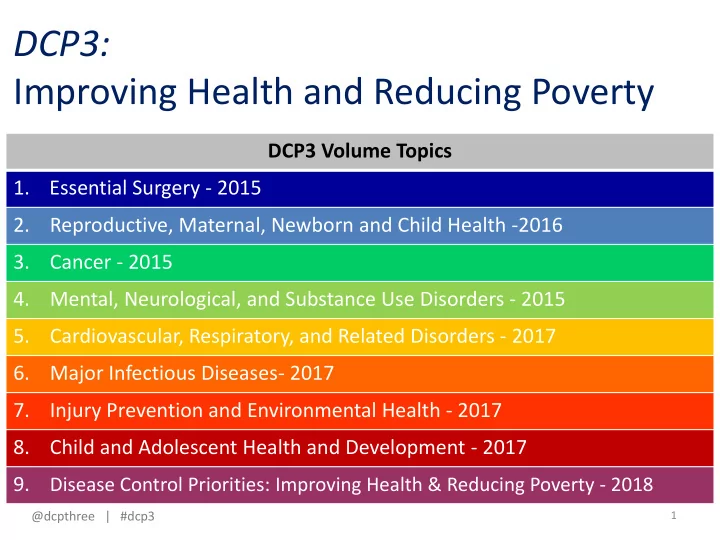
DCP3: Improving Health and Reducing Poverty DCP3 Volume Topics 1. Essential Surgery - 2015 2. Reproductive, Maternal, Newborn and Child Health -2016 3. Cancer - 2015 4. Mental, Neurological, and Substance Use Disorders - 2015 5.


slide-1
SLIDE 1

1

@dcpthree | #dcp3

DCP3: Improving Health and Reducing Poverty

DCP3 Volume Topics 1. Essential Surgery - 2015

  • 2. Reproductive, Maternal, Newborn and Child Health -2016
  • 3. Cancer - 2015
  • 4. Mental, Neurological, and Substance Use Disorders - 2015
  • 5. Cardiovascular, Respiratory, and Related Disorders - 2017
  • 6. Major Infectious Diseases- 2017
  • 7. Injury Prevention and Environmental Health - 2017
  • 8. Child and Adolescent Health and Development - 2017
  • 9. Disease Control Priorities: Improving Health & Reducing Poverty - 2018
slide-2
SLIDE 2

Disease Control Priorities History

2

  • 1993 World Development

Report

  • Disease Control Priorities in

Developing Countries, Second Edition 2006 (DCP2)

  • Disease Control Priorities, 3rd

Edition 2015-2018 (DCP3)

slide-3
SLIDE 3

DCP3 by the Numbers

3

9 Volumes 5 Years 33 Editors 172 Chapters 500+ Authors

slide-4
SLIDE 4

Policies for Health

12/18/2017 4

Intersectoral policies

Health sector policies

(including financial protection policies)

slide-5
SLIDE 5

DCP3 cluster of essential packages

5

slide-6
SLIDE 6

Financial Risk Protection

12/18/2017 6

slide-7
SLIDE 7

Extended Cost-Effectiveness Analysis (ECEA)

  • Includes CEA to assess value-for-money in

achieving health outcomes

  • Extends CEA by assessing value for money in

purchasing FRP

  • Extends CEA by explicitly considering equity in

distribution of health and financial outcomes

12/18/2017 7

slide-8
SLIDE 8

Intersectoral Action for Health

  • Risk Factors Reduction (71 policies)

– Behavioral – Environmental

  • Non-health Sector Costs (examples):

– Household time (Particularly women’s issue) – Long-term care (some aspects) and disability insurance – School feeding

  • Need for ‘Inclusive National Health Accounts’

12/18/2017 8

slide-9
SLIDE 9

The Health Sector: EUHC & HPP

12/18/2017 9

(218 interventions) (108 interventions)

slide-10
SLIDE 10

Health Systems and UHC

12/18/2017 10

Global Health 2035 DCP3 WHO 2017 Estimated additional costs Lower-middle- income countries US$(2011) 61 billion annually between 2016 and 2030 HPP: US$(2012) 97 billion in 2030; EUHC: US$(2012) 190 billion in 2030 US$(2012) 185 billion in 2030 Estimated deaths averted Lower middle- income countries 5.8 million deaths averted per year between 2016 and 2030 4.2 million deaths averted in 2030 6.1 million deaths averted in 2030

slide-11
SLIDE 11

HPP Costs: Platforms and Temporal Characteristics

12/18/2017 11

Low-income countries Lower-middle- income countries Incremental costs by platforms (percentage of totals) Population-based 0.6% 0.6% Community 18% 12% Health Center 50% 57% First-level hospital 25% 22% Referral & specialty hospitals 6.4% 9.1% Incremental costs by intervention urgency (percentage of totals) Urgent 35% 27% Chronic 41% 50% Time-bound (non-urgent) 24% 23%

The cost and diseases structures differ between and within income levels. This is illustrated by considering two income strata, but the analyses reported here can serve only as a starting point for national and subnational analyses. Sources: Watkins et al (2017), Watkins et al (2018)

slide-12
SLIDE 12

www.dcp-3.org info@dcp-3.org

THANK YOU

Download for free at: dcp-3.org For a free hardcopy of any volume, please e-mail info@dcp-3.org