DATA PROTECTION ACT 2017 Tuesday 06 March 2018 from 08.30 hrs 15.30 - - PowerPoint PPT Presentation

data protection act 2017
SMART_READER_LITE
LIVE PREVIEW

DATA PROTECTION ACT 2017 Tuesday 06 March 2018 from 08.30 hrs 15.30 - - PowerPoint PPT Presentation

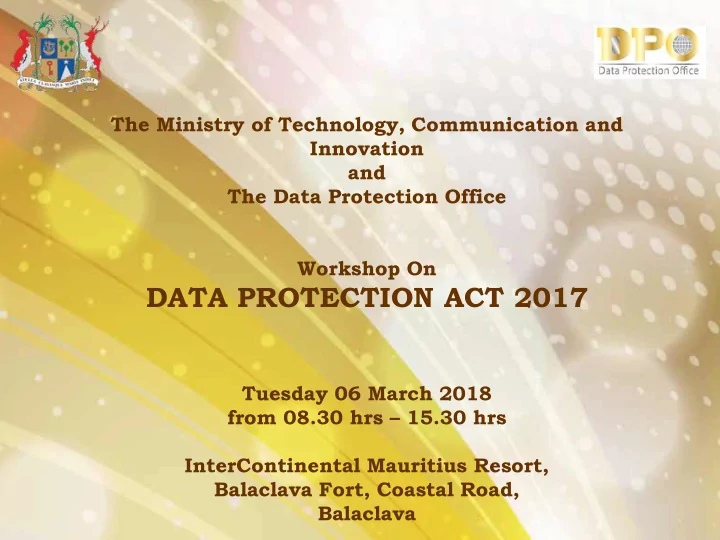
The Ministry of Technology, Communication and Innovation and The Data Protection Office Workshop On DATA PROTECTION ACT 2017 Tuesday 06 March 2018 from 08.30 hrs 15.30 hrs InterContinental Mauritius Resort, Balaclava Fort, Coastal Road,


slide-1
SLIDE 1

The Ministry of Technology, Communication and Innovation and The Data Protection Office Workshop On

DATA PROTECTION ACT 2017

Tuesday 06 March 2018 from 08.30 hrs – 15.30 hrs InterContinental Mauritius Resort, Balaclava Fort, Coastal Road, Balaclava

slide-2
SLIDE 2

Topics

  • Registration
  • Principles relating to Processing of

personal data

  • Roles and Responsibilities of Controllers
  • Roles of Data Protection Officer

Mrs Jasbir B. HAULKHORY Data Protection Officer/Senior Data Protection Officer

slide-3
SLIDE 3

Registration

3

Part III, Section 14

slide-4
SLIDE 4

Why to Register?

‘‘... no person shall act as controller or processor unless he or it is registered with the Commissioner...’’

4

Part III, Section 14: Legal Requirement to Register

slide-5
SLIDE 5

Who should Register?

Controller

  • A person who or public body which, alone or jointly with
  • thers,
  • determines the purposes and
  • means of the processing of personal data and
  • has decision making power with respect to the processing.

Processor

  • A person who, or public body which, processes personal data
  • n behalf of a controller

5

Medical Practitioner, Barrister, Ministry, private companies Company A manages and hosts servers of Company X

slide-6
SLIDE 6

Process of Registration

6

Fill in Application Form and submit documents Effect Payment Approval by DPC Issuance of Certificate

slide-7
SLIDE 7

Registration Form

7

Controller / Processor details Data Protection Officer details Types of personal data Special Categories

  • f

personal data Purpose Disclosure Transfer of personal data abroad Risks and security measures

slide-8
SLIDE 8

Only 1 form for Registration and amended fee structure Validity of Registration Certificate: 3 Years Renewal Deadline: 3 months prior to Expiry Date Notify the Commissioner about the change in particulars within 14 days Cancellation and variation of Terms of Registration Certificate

8

Amendment to Registration / Renewal

With the coming of the New Regulation

slide-9
SLIDE 9

9

For providing any false or misleading information in the particulars of information A fine not exceeding 100,000 rupees Imprisonment for a term not exceeding 5 years

Offence

slide-10
SLIDE 10

10

Offence

Failure to notify about change in particulars A fine not exceeding 50,000 rupees

slide-11
SLIDE 11

Principles relating to Processing of Personal Data

Section 21

6 Privacy Principles for Controllers and Processors

slide-12
SLIDE 12

Principles relating to Processing

  • f personal data (1)
  • Employer to disclose salary details
  • f employees to tax authorities,

without consent. Lawfulness, fairness and transparency

  • A

General Practitioner cannot disclose patients details to his wife who owns a travel agency. Purpose limitation

Explicit, specified and legitimate purposes and not processed in a way incompatible with the purposes

  • Specific questions about health

conditions are queried to only relevant manual occupations.

Data minimisation

Adequate, relevant and limited to what is necessary, in relation to the purposes

12

slide-13
SLIDE 13

Principles relating to Processing

  • f personal data (2)

13

  • A

mis-diagnosis

  • f

a medical condition is still kept as it is relevant for the treatment given to the patient

  • r to additional health problems.

Accuracy:

Accurate and, where necessary, up-to-date. Erasure and rectification without delay.

  • Deletion of emergency numbers for

staff who have left the organisation. Storage limitation:

Storage of personal data permitting Identification of data subjects for no longer than necessary

  • Rectification of an incorrect address

Data subjects‟ rights:

Processing in accordance with data subject’s rights

slide-14
SLIDE 14

TO-DO List

Review internal policies and audit procedures Update these policies and procedures where necessary to ensure that they are consistent with the revised principles. Provide appropriate training to ensure that the business is thinking about data protection issues at all levels.

14

slide-15
SLIDE 15

Roles and Responsibilities of Controllers

Part IV

slide-16
SLIDE 16

Ensure verification and effectiveness of these measures Adopt policies and implement appropriate technical and organisational measures to demonstrate compliance for processing of personal data

16

Roles and Responsibilities of Controllers/Processors (1)

slide-17
SLIDE 17

Roles and Responsibilities of Controllers/Processors(2)

Collection of data for a lawful purpose and is necessary for that purpose Bear the burden of proof for data subject‟s consent for the processing

  • f personal data

Notify and Communicate about for Personal Data Breach Ensure appropriate data security and

  • rganisational

measures Duty to destroy personal data as soon as purpose lapses Ensure the lawfulness of processing of personal data Comply with the requirements to process Special Category of Personal Data Consent for the processing of personal data of children Keep records of all processing

  • perations under

his or its responsibility Perform data protection impact assessment for high risks

  • perations

Comply with the requirements for prior authorisation

  • r consultation

from DPO Designate an

  • fficer responsible

for data protection compliance issues

17
slide-18
SLIDE 18

Collection of Personal Data

Section 23

For a lawful purpose connected with a function or activity of the controller Necessary for that purpose

slide-19
SLIDE 19

Collection of Personal Data

Identity and Contact details of the controller and its representative Purpose of the personal data Intended Recipients

  • f the data

Whether the collection is voluntary or mandatory Existence of the right to withdraw consent at any time Existence of right

  • f rectification,

restriction, erasure

  • f personal data

and to object to processing Existence of Automated decision making, and the consequences of such processing Period for storing personal data Right to lodge a complaint with the Commissioner Transfer of personal data abroad and the adequacy of protection by that country Further information necessary to guarantee fair processing of the personal data

19

Direct or Indirect Collection – Requirement to inform data subjects about:

slide-20
SLIDE 20

Exemption

  • The data subject already has the information.

Indirect Data Collection

  • The provision of such information proves

impossible or would involve a disproportionate effort.

  • The recording or disclosure of the data is laid down

by law.

20

slide-21
SLIDE 21

Role of Data Protection Officer

Section 22

slide-22
SLIDE 22

Who can be a Data Protection Officer?

22

Professional with experience and knowledge of data protection laws Existing Employee New Employee External Officer

As long as there is no conflict of interest with professional duties Mandatory appointment of an officer responsible for data protection compliance issues. As long as there is a rigorous contract for appropriate safeguards

slide-23
SLIDE 23

Roles of Data Protection Officer

Inform and advise the controller/processor and the employees about the

  • bligations to comply with the DPA 2017

Monitor compliance with the DPA 2017 Advise on data protection impact assessments Train staff Conduct internal audits Be the point of contact for the Data Protection Office and for individuals whose data are processed

23

slide-24
SLIDE 24

Determine whether to appoint a Data Protection Officer Enable DPO to work Independently Ensure that DPO reports to the highest management Provide adequate resources to fulfill the

  • bligations

under the DPA 2017

24

Obligations of Controllers/Processors

slide-25
SLIDE 25

25

Thank you

slide-26
SLIDE 26

Date: 06 March 2018 Venue: Intercontinental Hotel, Balaclava Fort

slide-27
SLIDE 27

27

By Mrs Pravina Dodah Data Protection Officer/Senior Data Protection Officer

Consent  Notification of personal data breach and Communication of personal data breach to data subject

slide-28
SLIDE 28

28

What is consent?

slide-29
SLIDE 29

29

Freely Given Specific Informed Unambiguous by statement or a clear affirmative action

Indication signifying agreement to processing

Consent

slide-30
SLIDE 30

30

Freely given Provide genuine choice Not penalised for refusing consent Specific Concise on the processing operation and purpose/s. Informed Provide clear information and in plain language , at minimum containing:

  • The controller‟s identity,
  • The purpose/s of the processing,
  • The processing activities,
  • The right to withdraw consent at any time

Amount of information depends on circumstances and context of a case Unambiguous indication (by statement or a clear affirmative action) To avoid implied form of actions by the data subject such as pre-ticked opt-in boxes

Elements of valid consent

slide-31
SLIDE 31

31

How is consent in DPA 2017 different from DPA 2004 ?

slide-32
SLIDE 32

32

Differences

Definition

Unambiguous by statement

  • r a clear

affirmative action

Conditions

Controllers have the burden of proof for establishing consent Data subject can withdraw his consent anytime Consent is presumed not to be freely given if the performance of a contract, including the provision of a service, is dependent on the consent which is not necessary for such execution of the contract/service.

Suppose a customer has a contract with a bank for ordinary bank account

  • services. In the contract, the bank asks customers consent to use their

payment details for marketing and customer‟s refusal would lead to the denial

  • f banking services.
slide-33
SLIDE 33

33

Why should consent matter to me?

slide-34
SLIDE 34

34

Is one criterion to demonstrate that you are processing data lawfully

slide-35
SLIDE 35

When is consent not appropriate?

35

Other lawful criteria for processing where consent is not appropriate:

A contract with the individual Compliance with a legal obligation Vital interests Tasks carried by public authority / public interest Legitimate interests unless outweighed by harm to the individual‟s rights and interests Historical, statistical or scientific research

slide-36
SLIDE 36

36

Example: A company sells goods online. A customer purchases a refrigerator and has a contract with the company where he has to provide his address for delivery of the refrigerator. The processing of address by the company is necessary for the service, i.e., purchase and covered under „for performance of a contract to which the data subject is party‟.

slide-37
SLIDE 37

37

  • If you would still process the personal data without

consent, asking for consent is misleading.

Example A financial institution provides credit facilities to its customers and asks them to give consent for their personal data to be sent to MCIB (Mauritius Credit Information Bureau). However, if a customer refuses or withdraws his consent, the company will still send the data to MCIB on the basis of „for compliance with any legal obligation to which the controller is subject‟.

When is consent not appropriate?

slide-38
SLIDE 38

38

  • If you make „consent‟ a precondition of a service which

goes beyond the execution of the service, consent is unlikely to be the most appropriate lawful basis.

Example: A mobile app for photo editing asks its users to have their GPS activated for the use of its services. Since users cannot use the app without consenting to GPS, the consent is unlikely to be appropriate.

When is consent not appropriate?

slide-39
SLIDE 39

To do list

Make an assessment whether consent is the appropriate lawful ground for the envisaged processing. Ensure consent is valid. Implement simple and easy-to-access ways to withdraw consent. Keep evidence of consent – who, when, how, and what you told people.

39

slide-40
SLIDE 40

40

Consent Notification of personal data breach and Communication of personal data breach to data subject

slide-41
SLIDE 41

41

What is a personal data breach?

slide-42
SLIDE 42

42

Personal data breach

“a breach of security leading to the accidental or unlawful destruction, loss, alteration, unauthorised disclosure of,

  • r access to, personal data transmitted, stored or
  • therwise processed”

A person gains access to a controller‟s customer database and discloses the information to an unauthorised person. A controller is hit by a Denial of Service attack causing disruption to the normal service and unavailability of personal data. An attacker modifies the database of credit information held by a company.

Examples

slide-43
SLIDE 43

43

When does a controller/processor becomes „„aware‟‟ of a personal data breach ?

slide-44
SLIDE 44

When do you become aware?

44

Associated to a point where the controller has a reasonable degree of certainty that a breach has occurred Clear or quick preliminary investigation required Take prompt action to investigate whether a breach has occurred or not

slide-45
SLIDE 45

Example

45

A controller suspects that his network has been accessed by an intruder. He quickly verifies and finds that his data has been compromised.

slide-46
SLIDE 46

46

What should a processor do? Notify the controller without any undue delay as soon as the processor becomes aware of the personal data breach.

slide-47
SLIDE 47

47

What should a controller do?

slide-48
SLIDE 48

48

Notify the Data Protection Commissioner Communicate the personal data breach to the data subject where it is likely to result in a high risk to the rights and freedoms of the data subject

Without undue delay and where feasible not later than 72 hours after being aware of it Without undue delay after notifying the Data Protection Commissioner

PERSONAL DATA BREACH

slide-49
SLIDE 49

49

What happens if I cannot meet the timing delay of 72 hours to report to the Data Protection Commissioner? Reasons for delay have to be provided to the Data Protection Commissioner

slide-50
SLIDE 50

How to report a personal data breach?

50

Personal Data Breach Notification Form

Nature of the breach Categories and number

  • f data

subjects and personal data records Contact Point Measures to address and to mitigate the adverse effects of the breach

slide-51
SLIDE 51

Are there circumstances where communication to data subjects is NOT required?

51

Appropriate security measures were already applied before the breach such as encryption which rendered the data unintelligible; The controller has taken subsequent measures to ensure that the breach is unlikely to result in a high risk to the rights and freedoms of the data subjects. It would involve disproportionate effort and the controller has made a public communication or similar measure whereby a data subject is informed in an equally effective manner.

slide-52
SLIDE 52

To do list

Make sure you have appropriate technical and organisational protection measures to protect data. Determine whether to set up a breach response team. To regularly review and update all procedures for addressing breaches. Be careful not to destroy evidence that may be valuable in determining the cause

  • r allow you to take appropriate

corrective action. Determine whether any other external third party/ies need to be notified to limit the potential impact.

52

slide-53
SLIDE 53

53

slide-54
SLIDE 54

TOPICS: Lawful Processing, Personal data of children and Security of processing.

By Mr R. Mukoon Data Protection Officer/Senior Data Protection Officer

Date: 06 March 2018 Venue: Intercontinental Hotel, Balaclava Fort

slide-55
SLIDE 55

Lawful Processing S28

55

slide-56
SLIDE 56

Lawful Processing S28

56

slide-57
SLIDE 57

Lawful Processing S28

57

slide-58
SLIDE 58

Lawful Processing S28

58

slide-59
SLIDE 59

Lawful Processing S28

59

slide-60
SLIDE 60

Lawful Processing S28

60

slide-61
SLIDE 61

Lawful Processing S28

61

slide-62
SLIDE 62

Lawful Processing S28

62

slide-63
SLIDE 63

Lawful Processing S28 Marketing to do lists

63

slide-64
SLIDE 64

Lawful Processing S28

64

slide-65
SLIDE 65

Children Under DPA 2017

65

slide-66
SLIDE 66

Children Under DPA 2017

66

slide-67
SLIDE 67

Children Under DPA 2017

67

slide-68
SLIDE 68

Children Under DPA 2017

68

slide-69
SLIDE 69

Security of Processing S31

69

slide-70
SLIDE 70

Security of Processing S31

70

slide-71
SLIDE 71

Security of Processing S31

71

slide-72
SLIDE 72

Security of Processing S31 Security controls ISO27002:2013

72

slide-73
SLIDE 73

Security of Processing S31 Security Controls ISO27002:2013

73

slide-74
SLIDE 74

Security of Processing S31 Security controls ISO27002:2013

74

slide-75
SLIDE 75

Security of Processing S31 Security controls ISO27002:2013

75

slide-76
SLIDE 76

Security of Processing S31 Security controls ISO27002:2013

76

slide-77
SLIDE 77

Security of Processing S31

77

slide-78
SLIDE 78

Security of Processing S31

78

slide-79
SLIDE 79

Security of Processing S31

79

slide-80
SLIDE 80

Lawful Processing, Personal data of Children and Security of processing

Thank You

80