Data Hazards Consider the data dependencies in the following - - PowerPoint PPT Presentation

data hazards
SMART_READER_LITE
LIVE PREVIEW

Data Hazards Consider the data dependencies in the following - - PowerPoint PPT Presentation

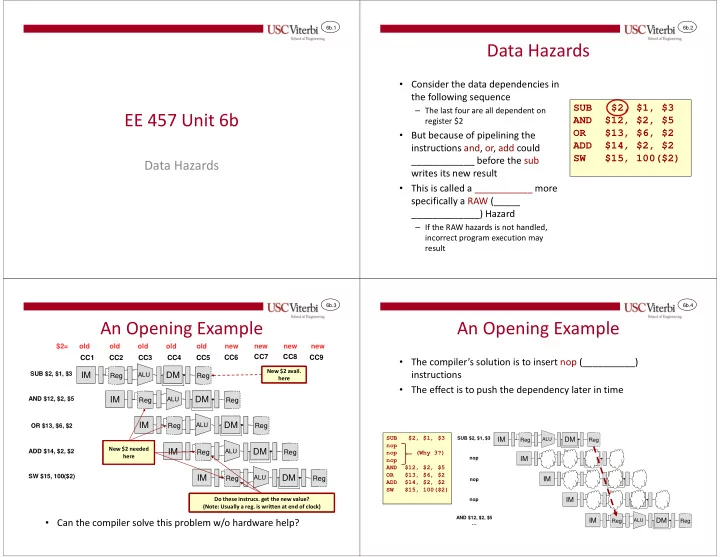
6b.1 6b.2 Data Hazards Consider the data dependencies in the following sequence SUB $2, $1, $3 The last four are all dependent on EE 457 Unit 6b AND $12, $2, $5 register $2 OR $13, $6, $2 But because of pipelining the ADD


slide-1
SLIDE 1

6b.1

EE 457 Unit 6b

Data Hazards

6b.2

Data Hazards

  • Consider the data dependencies in

the following sequence

– The last four are all dependent on register $2

  • But because of pipelining the

instructions and, or, add could ____________ before the sub writes its new result

  • This is called a ___________ more

specifically a RAW (_____ _____________) Hazard

– If the RAW hazards is not handled, incorrect program execution may result

SUB $2, $1, $3 AND $12, $2, $5 OR $13, $6, $2 ADD $14, $2, $2 SW $15, 100($2)

6b.3

An Opening Example

  • Can the compiler solve this problem w/o hardware help?

CC1 CC2 CC3 CC4 CC5 CC6 CC7 CC8 CC9

IM

Reg

ALU

DM

Reg

IM

Reg

ALU

DM

Reg

IM

Reg

ALU

DM

Reg

IM

Reg

ALU

DM

Reg

IM

Reg

ALU

DM

Reg

SUB $2, $1, $3 AND $12, $2, $5 OR $13, $6, $2 ADD $14, $2, $2 SW $15, 100($2) New $2 avail. here New $2 needed here Do these instrucs. get the new value? (Note: Usually a reg. is written at end of clock)

$2=

  • ld old
  • ld
  • ld
  • ld

new new new new

6b.4

An Opening Example

  • The compiler’s solution is to insert nop (__________)

instructions

  • The effect is to push the dependency later in time

SUB $2, $1, $3 nop nop (Why 3?) nop AND $12, $2, $5 OR $13, $6, $2 ADD $14, $2, $2 SW $15, 100($2)

IM

Reg

ALU

DM

Reg

IM

Reg

ALU

DM

Reg

IM

Reg

ALU

DM

Reg

IM

Reg

ALU

DM

Reg

IM

Reg

ALU

DM

Reg

SUB $2, $1, $3 nop nop nop AND $12, $2, $5 …

slide-2
SLIDE 2

6b.5

Control for Data Hazards

  • Two hardware solutions

– __________________________ – __________________________

  • Stall Strategy:

– Detect the hazard and stall the dependent instructions in the pipeline until the _________________________ – Stalling is achieved by sending _____________ forward into the pipe and not updating the stalled stage registers

6b.6

Stalling Strategy

  • Since we must be careful not to

read a ________ register value from the register file, we should detect hazards in the ID stage and stall the instruction there!

– If an instruction stalls, all instructions behind it ________ – All instructions in front of it are _________________________ – Insert “bubbles” into the _________________ (set all control signals to 0 so no incorrect behavior takes place)

Fetch Decode Exec. Mem. WB C1 LW C2 ADD LW C3 i ADD LW C4 i ADD LW C5 i ADD LW C6 i ADD C7 i+1 i ADD C8 i+2 i+1 i ADD

Using Stalls to Handle Dependencies (Data Hazards)

nop nop nop nop nop nop nop nop nop

LW $t1,4($s0) ADD $t5,$t1,$t4

6b.7

Detecting Data Hazards

  • Need to stall if an instruction in the last 3 stages is going to

write a register the currently decoding instruction wants to read (i.e. READ-AFTER-WRITE)

  • How would we know if an instruction in the pipe is going to

write a register than an instruction in ID wants to read?

– By comparing register ID values!!

Cases for Detecting Data Dependecies

  • 1a. ID/EX._________ and ID/EX.WriteRegister == IF/ID.ReadRegister1
  • 1b. ID/EX._________ and ID/EX.WriteRegister == IF/ID.ReadRegister2
  • 2a. EX/MEM._________ and EX/MEM.WriteRegister == IF/ID.ReadRegister1
  • 2b. EX/MEM._________ and EX/MEM.WriteRegister == IF/ID.ReadRegister2
  • 3a. MEM/WB._________ and MEM/WB.WriteRegister == IF/ID.ReadRegister1
  • 3b. MEM/WB._________ and MEM/WB.WriteRegister == IF/ID.ReadRegister2

6b.8

Hazard Detection Unit I/O

  • Only stall if a Write register in one of the last 3 stages matches one of the read

registers in the ID stage

IF/ID I-Cache PC Addr. Instruc. Instruction Register Register File Read

  • Reg. 1 #

Read

  • Reg. 2 #

Write

  • Reg. #

Write Data Read data 1 Read data 2 Sign Extend

Pipeline Stage Register

ALU

Res. Zero 1 Sh. Left 2

+

Pipeline Stage Register D-Cache

Addr. Read Data Write Data

Pipeline Stage Register

1 16 32 5 5 1 Con trol

Ex

Mem WB Mem WB WB

ID/EX EX/MEM MEM/WB Hazard Detection Unit

EX.RegWrite Mem.RegWrite WB.RegWrite EX.WriteReg Mem.WriteReg WB.WriteReg ID.ReadRegA ID.ReadRegB PCWrite IRWrite Stall

slide-3
SLIDE 3

6b.9

HDU Operation

Hazard Detection EX Hazard

ID/EX RegWrite and ((ID/EX.WriteRegister = IF/ID.ReadRegister1) or (ID/EX.WriteRegister = IF/ID.ReadRegister2))

MEM Hazard

EX/MEM RegWrite and ((EX/MEM.WriteRegister = IF/ID.ReadRegister1) or (EX/MEM.WriteRegister = IF/ID.ReadRegister2))

WB Hazard

MEM/WB RegWrite and ((MEM/WB.WriteRegister = IF/ID.ReadRegister1) or (MEM/WB.WriteRegister = IF/ID.ReadRegister2))

6b.10

HDU Implementation

  • How long do we stall

– If the hazard exists in the EX stage, we need to insert ___ bubbles (wait ________) before restarting the pipeline – If the hazard exists in the WB stage we only need to insert __ bubble (wait _____ cycle)

  • So since the delay is time dependent does the HDU require a

counter or state machine?

– _____ The producer instruction will keep ____________ and eventually clear. The HDU works by simply checking if _____ hazard exists in the forward stages and inserts a bubble into the ID/EX stage register – If an EX hazard exists it will take 3 cycles to clear and thus the HDU will detect an EX hazard in one clock, a MEM hazard in the next, and a WB hazard in the third inserting a bubble for each of these cycle = 3 bubbles

6b.11

HDU Logic

  • Detection logic requires _______ __-bit

comparators along with some AND and OR gates

  • Upon detection, HDU inserts a bubble into the

ID/EX stage register

– Bubble = HW generated NOP = Turn all control signals to zeros

6b.12

HDU Implementation

  • What if two hazards exist at the same time

– Again, any hazard should cause a bubble – The producing instructions will continue to move forward and eventually clear

SUB $2, $1, $3 AND $4, $2, $5 OR $8, $2, $6 ADD $9, $4, $2 SLT $1, $6, $7

Fetch Decode Exec. Mem. WB C1 SUB C2 AND SUB C3 OR AND SUB C4 C5 C6 C7 C8 C9

slide-4
SLIDE 4

6b.13

REDUCING DATA HAZARDS

Register Forwarding/Bypassing

6b.14

Key Idea

While $2 is not written until WB stage, the subtraction result is available at the end of the ___ stage (beginning of the ____ stage) and can be _______________ to dependent instructions

IM

Reg

ALU

DM

Reg

IM

Reg

ALU

DM

Reg

IM

Reg

ALU

DM

Reg

IM

Reg

ALU

DM

Reg

IM

Reg

ALU

DM

Reg

SUB $2, $1, $3 AND $12, $2, $5 OR $13, $6, $2 ADD $14, $2, $2 SW $15, 100($2) New $2 ____ ___________ Register file can be designed such that the value being written can immediately be forwarded to read ports

6b.15

Register File Internal Forwarding

  • Internal Forwarding:

– Value read = Value being written

1

$0

31

$1 $31

1 31

Read data 1 Read data 2 Write data

1

$0

31

$1 $31

1 31

Read data 1 Read data 2 Write data

1 1

Read Reg #1 Read Reg #2 Read Reg #1 Read Reg #2 Read data 1 Read data 2 Register File without Internal Forwarding Register File with Internal Forwarding

6b.16

Forwarding Unit

Instruction Register Register File

Read

  • Reg. 1 #

Read

  • Reg. 2 #

Write

  • Reg. #

Write Data Read data 1 Read data 2 Sign Extend

Pipeline Stage Register

ALU

Res. Zero 1 Sh. Left 2

+

Pipeline Stage Register D-Cache

Addr. Read Data Write Data

Pipeline Stage Register

1 16 32 5 5 1

rs rt rs rt rd 1 2 1 2

Forwarding Unit

ALUSrc ALUSelB ALUSelA

Mux Control Source Explanation ALUSelA & ALUSelB = 00 ID/EX

The first (if ALUSelA) and/or second (ALUSelB) ALU input comes from the normal ID/EX stage register

ALUSelA & ALUSelB = 01 EX/MEM

The first (if ALUSelA) and/or second (ALUSelB) ALU input comes from the prior ALU result in the EX/MEM stage reg.

ALUSelA & ALUSelB = 10 MEM/WB

The first (if ALUSelA) and/or second (ALUSelB) ALU input comes from the data memory or earlier ALU result

Regwrite & WriteReg# Regwrite, WriteReg# Data Mem. or ALU result Prior ALU Result

slide-5
SLIDE 5

6b.17

Forwarding Unit Addition

  • Remove the old HDU in the ID stage
  • Add a new Forwarding Unit (FU) in the EX

stage

– Like HDU it services dependent instructions – Compares write register ID’s in later stages to read register ID’s in earlier stages

6b.18

Forwarding Unit vs. HDU

  • Since the HDU stalled instructions in the ID stage it

needed to compare 2 source ID’s with 3 destination ID’s

  • Because we let instructions fetch stale register values

and just replace them in the EX (or MEM) stage, the forwarding Unit compares 2 source ID’s with 2 destination ID’s

  • HDU had 6 comparators while the FU requires 4

6b.19

Hazards

  • EX Hazard

– HDU: Hazard occurs if data dependence between ID and EX stages – FU: Between EX and MEM stage

  • MEM Hazard

– HDU: Hazard occurs if data dependence between ID and MEM stages – FU: Between EX and WB stages

  • Idea: Hazard is named based on who ________ the

data the dependent instruction needs

6b.20

Hazard Definitions

  • EX Hazard

If [_____________________ and (EX/MEM.WriteReg != 0) and (____________________________________)] Then EX1 = True If (EX1 = True) then ALUSelA = ___ If [____________________ and (EX/MEM.WriteReg != 0) and (____________________________________)] Then EX2 = True If (EX2 = True) then ALUSelB = ___

slide-6
SLIDE 6

6b.21

Hazard Definitions

  • MEM Hazard

If [MEM/WB.RegWrite and (MEM/WB.WriteReg != 0) and (MEM/WB.WriteReg = ID/EX.ReadReg1) and (__________)] Then ALUSelA = ___ If [MEM/WB.RegWrite and (MEM/WB.WriteReg != 0) and (MEM/WB.WriteReg = ID/EX.ReadReg2) and (__________)] Then ALUSelB = ___

An EX Hazard should prevail

  • ver a MEM hazard since the

EX hazard has the latest data

6b.22

EX Priority Example

Instruction Register Register File

Read

  • Reg. 1 #

Read

  • Reg. 2 #

Write

  • Reg. #

Write Data Read data 1 Read data 2 Sign Extend

Pipeline Stage Register

ALU

Res. Zero 1 Sh. Left 2

+

Pipeline Stage Register D-Cache

Addr. Read Data Write Data

Pipeline Stage Register

1 16 32 5 5 1

rs rt rs rt rd 1 2 1 2

Forwarding Unit

ALUSrc ALUSelB ALUSelA

Instruction

Explanation (Assume init value of $2 = 0x03 and $1 = 0x01)

1 Add $2,$2,$1

New $2 should equal 0x04

2 Add $2,$2,$1

New $2 should equal 0x05

3 Add $2,$2,$1

New $2 should equal 0x06

4 sub $4,$2,$1

Regwrite & WriteReg# Regwrite, WriteReg# Data Mem. or ALU result Prior ALU Result

4 3 2 1

Who should help instruction 3?

  • Instruc. 2 or 1

6b.23

Different Forward Sources

Instruction Register Register File

Read

  • Reg. 1 #

Read

  • Reg. 2 #

Write

  • Reg. #

Write Data Read data 1 Read data 2 Sign Extend

Pipeline Stage Register

ALU

Res. Zero 1 Sh. Left 2

+

Pipeline Stage Register D-Cache

Addr. Read Data Write Data

Pipeline Stage Register

1 16 32 5 5 1

rs rt rs rt rd 1 2 1 2

Forwarding Unit

ALUSrc ALUSelB ALUSelA

Instruction 1 Add $2,$1,$3 2 Or $4,$2,$5 3 And $8,$2,$4

Regwrite & WriteReg# Regwrite, WriteReg# Data Mem. or ALU result Prior ALU Result

3 2 1

Who should help instruction 3?

6b.24

Don’t Declare Success Yet

Instruction Register Register File

Read

  • Reg. 1 #

Read

  • Reg. 2 #

Write

  • Reg. #

Write Data Read data 1 Read data 2 Sign Extend

Pipeline Stage Register

ALU

Res. Zero 1 Sh. Left 2

+

Pipeline Stage Register D-Cache

Addr. Read Data Write Data

Pipeline Stage Register

1 16 32 5 5 1

rs rt rs rt rd 1 2 1 2

Forwarding Unit

ALUSrc ALUSelB ALUSelA

Instruction 1 LW $2, 100($4) 2 And $12,$2,$1 3 Sub $8,$2,$4

Regwrite & WriteReg# Regwrite, WriteReg# Data Mem. or ALU result Prior ALU Result

2 1

Is the new value of register $2 available for forwarding when ‘and’ needs it?

LW $2, 100($4) And $12,$2,$1

slide-7
SLIDE 7

6b.25

Understanding the Problem

  • What can we do to solve this problem? _________

CC1 CC2 CC3 CC4 CC5 CC6 CC7 CC8 CC9

IM

Reg

ALU

DM

Reg

IM

Reg

ALU

DM

Reg

IM

Reg

ALU

DM

Reg

IM

Reg

ALU

DM

Reg

IM

Reg

ALU

DM

Reg

LW $2, 100($1) AND $12, $2, $5 OR $13, $6, $2 ADD $14, $2, $2 SW $15, 100($2) New $2 avail. here New $2 needed here (earlier than it is produced) You cannot forward data “back” in time. In these time space diagrams, forwarding must be “forward” in time

$2=

  • ld old
  • ld
  • ld
  • ld

new new new new

6b.26

Back to the HDU

  • Re-introduce the HDU to handle the case of a

LW immediately followed by a dependent instruction

  • EX Hazard:

If (ID/EX.RegWrite and ID/EX.RegDst = 0 and (ID/EX.WriteRegRt = IF/ID.ReadReg1

  • r

ID/EX.WriteRegRt = IF/ID.ReadReg2)) Then Stall the Pipeline

Fetc h Decod e Exec. Mem. WB C1 LW C2 AND LW C3 OR AND LW C4 C5 C6 C7

LW $2, 100($1) AND $12, $2, $5 OR $13, $6, $2 ADD $14, $2, $2 SW $15, 100($2) Note: We use RegDst = 0 to indicate the instruction in ID/EX is an LW. We could also use ____________

  • r even _____________

6b.27

Back to the HDU

Instruction Register Register File

Read

  • Reg. 1 #

Read

  • Reg. 2 #

Write

  • Reg. #

Write Data Read data 1 Read data 2 Sign Extend

Pipeline Stage Register

ALU

Res. Zero 1 Sh. Left 2

+

Pipeline Stage Register D-Cache

Addr. Read Data Write Data

Pipeline Stage Register

1 16 32 5 5 1

rs rt rs rt rd 1 2 1 2

Forwarding Unit

ALUSrc ALUSelB ALUSelA Regwrite & WriteReg# Regwrite, WriteReg# Data Mem. or ALU result Prior ALU Result

I-Cache PC

.

PCWrite IRWrite

Simplified HDU

(LW + dependent instruc.)

Control

Ex

Mem WB

EX.RegWrite Stall EX.RegDst (i.e. LW)

Mem WB WB Could also use MemToReg = 1 or even MemRead=1

6b.28

One More Consideration

  • Consider the sequence shown to

the right

  • Is there a dependency?
  • Do we have the forwarding paths

to handle this dependency?

– At first glance ____ – But we can _________________ ______________ and use our __________________________

Fetch Decode Exec. Mem. WB C1 SUB C2 SW SUB C3 i SW SUB C4 i+1 i SW SUB C5 i+2 i+1 i SW SUB

SUB $2, $1, $3 SW $2, 40($6)

Fetch Decode Exec. Mem. WB C1 SUB C2 SW SUB C3 i SW SUB C4 i+1 i SW SUB C5 i+2 i+1 i SW SUB

slide-8
SLIDE 8

6b.29

Dealing with Memory Dependency

Instruction Register Register File

Read

  • Reg. 1 #

Read

  • Reg. 2 #

Write

  • Reg. #

Write Data Read data 1 Read data 2 Sign Extend

Pipeline Stage Register

ALU

Res. Zero 1 Sh. Left 2

+

Pipeline Stage Register D-Cache

Addr. Read Data Write Data

Pipeline Stage Register

1 16 32 5 5 1

rs rt rs rt rd 1 2 1 2

Forwarding Unit

ALUSrc ALUSelB ALUSelA Regwrite & WriteReg# Regwrite, WriteReg# Data Mem. or ALU result Prior ALU Result

I-Cache PC

.

PCWrite IRWrite

Hazard Detection Unit

Control

Ex

Mem WB

EX.RegWrite Stall EX.RegDst (i.e. LW)

Mem WB WB

2 1

SUB $2, $1, $3 SW $2,40($6)

1. We should take the output of the forwarding mux as our write data 2. In this way sub can forward its data using our forwarding HW in the EX stage