
SLIDE 1
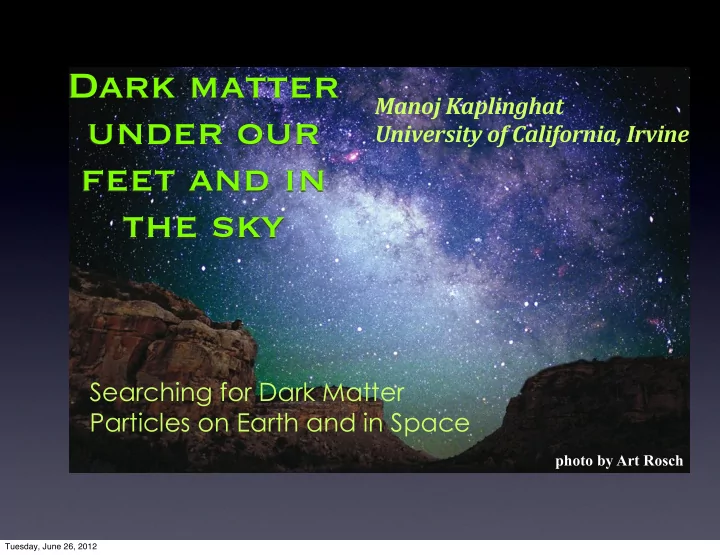
photo by Art Rosch
Dark matter under our feet and in the sky
Manoj Kaplinghat University of California, Irvine
Searching for Dark Matter Particles on Earth and in Space
Tuesday, June 26, 2012
Dark matter ManojKaplinghat under our - - PowerPoint PPT Presentation
Dark matter ManojKaplinghat under our UniversityofCalifornia,Irvine feet and in the sky Searching for Dark Matter Particles on Earth and in Space photo by Art Rosch Tuesday, June 26, 2012 dark matter searches are
photo by Art Rosch
Manoj Kaplinghat University of California, Irvine
Searching for Dark Matter Particles on Earth and in Space
Tuesday, June 26, 2012
experiments capable of “seeing” WIMP dark matter are finally operational
have to extend the cold dark matter model
Tuesday, June 26, 2012
Background: The Hubble Ultra Deep Field
normal matter but so far we no concrete evidence that it interacts with anything else)
energy (that does not behave gravitationally like normal matter)
Tuesday, June 26, 2012
fact, we would have been wondering why there isn’t any dark matter if all of matter was “normal”!
matter candidates. Just not heavy enough to make up all of the dark matter we see. Particles of the standard model of particle physics that have been seen in the laboratory
Tuesday, June 26, 2012
10 kpc
Stellar nurseries Galaxies Clusters of galaxies 10 pc 1 Mpc pc (parsec) is 3 light-years or 30 trillion km or 200,000 AU
Tuesday, June 26, 2012
Sloan Digital Sky Survey Filaments of structure -- the “cosmic web”
Gigaparsecs
Tuesday, June 26, 2012
About half gram of dark matter in a cube with side 1000 km in the solar neighborhood T y p i c a l s p e e d
d a r k m a t t e r p a r t i c l e s i s a b
t 2 k m / s n e a r t h e s
a r n e i g h b
h
.
Tuesday, June 26, 2012
U G C 7 5 2 4 / N G C 4 3 9 5
Rotation supported by dark matter Close-by and faint
Tuesday, June 26, 2012
Note the linear rise in rotation speed close to the center.
Note the plateau in speed as the distance from the center increases. This universal feature is the primary case for dark matter in galaxies.
Tuesday, June 26, 2012
Arcs are distorted images of background galaxies: “strong gravitational lensing”
Tuesday, June 26, 2012
Bullet cluster
Composite Credit: X-ray: NASA/CXC/CfA/ M.Markevitch et al.; Lensing Map: NASA/STScI; ESO WFI; Magellan/U.Arizona/ D.Clowe et al. Optical: NASA/STScI; Magellan/U.Arizona/D.Clowe et al.;
Blue: matter from “weak” gravitational lensing red: gas in x-rays
Tuesday, June 26, 2012
Bell labs (1964)
2.7 degree Kelvin The Universe is not perfectly smooth -- very small variations are needed to make galaxies.
COBE (1990)
Discovered in 1990s with the COBE satellite
WMAP (2003)
WMAP : (a) universe is close to flat, and (b) about 5 times more dark matter than normal matter
Tuesday, June 26, 2012
We have looked at some of strongest lines of evidence for dark matter. The next section is about the basic questions we may ask about dark matter particles.
Tuesday, June 26, 2012
Cold/Warm: main distinction is (of course) temperature Temperature: measure of random (thermal) motion before dark matter particles are bound into halos (galaxies) As the universe cools, this thermal motion decreases Operational definitions Cold dark matter: thermal motions irrelevant for galaxy formation Warm dark matter: thermal motions (a) cut-off formation of small-galaxies
dark matter in the central parts of galaxies
Tuesday, June 26, 2012
Tuesday, June 26, 2012
Matches data on cosmological scales (CMB) down to scales of order Mega-parsec (Galaxies) Zero-parameter fit (not counting the cosmological parameters) from the astrophysical point of view
Observations Theory
Tuesday, June 26, 2012
Should we really expect dark sector to be so simple (so much simpler than the visible sector)? Cold dark matter model is clearly right (on large scales) but will it need modification as we probe smaller scales? If yes, what are the motivations? What sort of modifications? How may we test them? How does computing play into this?
Tuesday, June 26, 2012
(i) Warmer
(ii) Stronger self-interaction Actually... (i) much much ... warmer
(ii) much much ... stronger self-interaction How does warmness or strong self- interaction manifest itself in astrophysics? Next ...
Tuesday, June 26, 2012
Milky Way stars
Via Lactea: Diemand et al 2006
Tuesday, June 26, 2012
Radius (distance from center of clump or “subhalo”) Density
Via Lactea Radius (distance from center of clump or “subhalo”) Mass enclosed
Tuesday, June 26, 2012
Distance from center of halo Halo Density Self-interaction strength is dialed up Number of halos
Mass M Warmer
Tuesday, June 26, 2012
LIGHT AXION
Behaves like normal matter except it does not shine. Interacts very weakly with normal matter.
M A C H O Particles from extra-dimensions
SM
Self-annihilating Self-interacting
Hidden sector dark matter
SuperWIMP WIMP (Weakly Interacting Massive Particle) Light Gravitino
warm
Tuesday, June 26, 2012
WIMP Hidden sector DM
S e l f i n t e r a c t i
Damping Warmness
Sterile ν SuperWIMP Central density of halos is lowered
Mass of smallest halos H a l
m
e s p h e r i c a l a n d b i g g e r c
e s
Tuesday, June 26, 2012
Hidden Sector SM Hidden Connector SUSY
if our sector is supersymmetric imagine proton and neutron-like particles here
Tuesday, June 26, 2012
self-annihilation smaller the present abundance (e.g., WIMP , x-dim)
parent particle’s abundance is set via the freeze-out mechanism (e.g., SuperWIMP)
sterile neutrino)
tuned (e.g., WIMPZILLA)
Weak scale dark matter
Right abundance! Successful cosmological predictions on large scales Hints for new physics at the weak scale (~1000 proton masses)
Tuesday, June 26, 2012
are varied and they make differing predictions for:
galaxy
matter -- Direct detection, Indirect detection, Direct production. Coming up next...
Tuesday, June 26, 2012
Tuesday, June 26, 2012
effectively “dark”. The weak interactions also endow the dark matter with the right cosmological abundance.
despite the weak interactions
the standard model of particle physics
Tuesday, June 26, 2012
Fermi (gamma-rays) PAMELA (antimatter)
DM anti-q, anti-e q, e DM protons, anti-protons, electrons, anti-electrons, photons
Stay tuned for results from AMS-02
Tuesday, June 26, 2012
Not all these clumps light up (form stars)! But some have to and we can look towards them.
Milky Way stars Satellites of the Milky Way Both the center of the Milky Way and satellites of the Milky Way have large concentrations of dark matter. So look towards them for indirect signatures of dark matter (other than gravitational).
Tuesday, June 26, 2012
DM proton proton DM
Cryogenic Dark Matter Search (Soudan)
Xenon Dark Matter Search Gran Sasso
recoils with energy
mass)(200 km/s)2 number of events depends on: (a) how strongly DMP couples to protons and neutrons, and (b) how many DMPs per meter3 in the solar neighborhood
DAMA COGENT CRESST
Tuesday, June 26, 2012
Large Hadron Collider
DM quarks anti- quarks DM
Make dark matter!
Tuesday, June 26, 2012
and we have seen why they are (deservingly) the most favored candidates
Cold Dark Matter model
Milky Way
galaxies
Tuesday, June 26, 2012
Discovered in SDSS Pre-SDSS
CARI DRAC FORN LEO1 LEO2 SCUL SEXT UMIN BOO1 CVN1 CVN2 COMB HERC LEO4 SEG1 UMA1 UMA2
50 100 150 200 250 2 3 4 5 6 7 Distance to dwarf kiloparsec
10 10 10 10 10 Luminosity (solar luminosities)
Tuesday, June 26, 2012
10 10 10 10 10
CARI DRAC FORN LEO1 LEO2 SCUL SEXT UMIN
Lines are satellites in Aquarius simulation Filled circles are observed bright satellites
200 400 600 800 1000 5 6 7 8 9 Radius parsec Masses of bright Milky Way satellites Mass solar masses
subhalos
Tuesday, June 26, 2012
10 10 10 10 10 Massive satellites missing! Thousands more with lower masses that are not seen!
CARI DRAC FORN LEO1 LEO2 SCUL SEXT UMIN
Lines are satellites in Aquarius simulation Filled circles are observed bright satellites
200 400 600 800 1000 5 6 7 8 9 Radius parsec Masses of bright Milky Way satellites Mass solar masses
subhalos
Could be solved by self‐ interacting
dark matter
Tuesday, June 26, 2012
Distance from center of halo Halo Density Halos with self-interacting dark matter
Linear rise in rotation speed
Rotation speed (km/s) Distance from center (kilo-parsec)
Tuesday, June 26, 2012
experiments capable of “seeing” WIMP dark matter are finally operational
have to extend the cold dark matter model
(a) understanding feedback from star formation and (b) simulating alternative dark matter cosmologies
Tuesday, June 26, 2012