September 2016, Director Office of Sustainability, Rochelle Owen
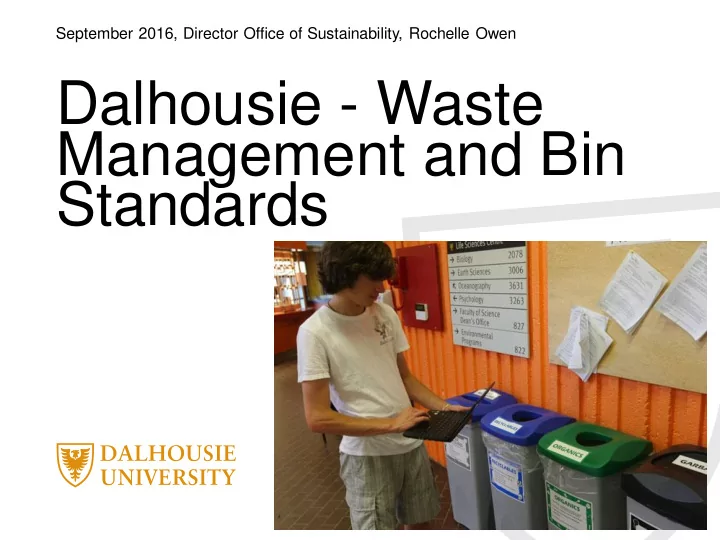
Dalhousie - Waste Management and Bin Standards Dalhousie - - PowerPoint PPT Presentation
September 2016, Director Office of Sustainability, Rochelle Owen Dalhousie - Waste Management and Bin Standards Dalhousie University Campus 150+ buildings/houses in downtown Halifax and Truro, Nova Scotia, Canada. Includes 5.5 million gross
Dalhousie University Campus
150+ buildings/houses in downtown Halifax and Truro, Nova Scotia, Canada. Includes 5.5 million gross square feet of building space. A campus population of approximately 25,000 (18,500 students, 6500 faculty and staff). Four Campuses: Studley, Carleton, Sexton, Agricultural Two District Heating Systems
A Look at Approaches
Four Rs
Conservation- use less Maximize high value use Ultimate aim no disposal
Circular economy
Focus on using disposal items as a resource – no waste High value use Recovery Sharing
Observations
Sharing and recovery are a method of conservation Focus on disposal items as product Similar concepts in energy world
Strategy Focuses
- A. Reduce amount of commodities (waste
efficiency)
- B. Improve recycling and compost rates
- C. Tracking and Promotion of accurate weights
and progress
- D. Education – Awareness to Knowledge
Common Commodities
Stationary Travel/Fleet Professional Services Custodial Energy/Water Equipment/supplies Appliances Food Services IT/Telecom/AV Furniture Textiles Building/Supplies
Commodities
- Can be a number of items in commodity
clusters
- Need to focus on some key ones
- Strategies focus on reduction, selection (avoid
products that can’t be composted/recycled), compliance/education (it is easier when small number of decision makers control the decision in a controlled environment) – cups in residence and cups at retail
Reduce amount of commodities (waste efficiency)
- Reuse: ex. surplus goods, dump and run, support produce
take back and reuse programs (lab chemicals)
- Sharing: ex. chemical stores (bulk dispensing), car share,
- Use Less of it: ex.
- Paper (policy, MFD, computer software – double-sided)
- Concentrated cleaners
- Energy & Water Efficiency
- Building Renovation/C&D labs-workshops, projects
- Food services packaging and food (catering/retail/events)
residences – trayless, weighing food waste, china, organics
- ITS – review of who needs workplace handheld device
Improve recycling and compost rates
- Reduce contamination
– Waste Bin Standardization and Implementation (half way through); all
- utdoor bins re-stickered – pre and post audits
– Clear bags – In-house pick-up and delivery to central warehouse- [more education, re-sort and compliance] We see it now. – Addressing illegal dumping – locked boxes, moving C&D bin and making it bigger and adding metal recycling
- Change products types – metal cutlery (first); if no go – wood
instead of plastic as an example
- Adding new streams – EPS pilot continues – adding a few
more options
11
Process for Developing Bin Standards (2010-2016)
1. Initial Bin ratio audits and waste audits (OS) 2. Development and Issue of standard for all spaces all campuses(OS – variety
- f versions – focus groups with different stakeholders) testing and revising
3. Bin Tender Created (Issued) (OS&FM) 4. Creation of Stores Sheet (OS) 5. All campuses space audits and reports (compares all spaces with standard), (OS) 6. Pre- bin waste audits in sample blds (OS&FM) 7. Custodial supervisor and staff training (OS) 8. Building Administrators Sessions and Prep (OS) 9. Communications
- 10. Bin Implementation/removal/repurposing (OS &FM)
- 11. Post-audits (OS &FM)
- 12. Maintenance (FM)
Pilot Buildings
- Auditing history – 2008-2011 (online) – correlates to recent
audits (2016)
- 10 blds – mix of types – residence and food services areas
more contaminated
- Ranges of contamination:
– Garbage: 45-80% (norm 60-70%) – Recyclables: 2-30% (norm 20%) – Paper: 0-30% (norm 10%) – Organics: 3-12% (norm 5%)
- Post testing have to wait until similar time period
Results of Bin Ratio Audit
Paper 19% Organics 12% Waste 48% Recyclables 21%
Overall Indoor Bin Ratio for Hallways (three campuses) – Before Recommendations Paper Organics Waste Recyclables Totals 383 255 984 426 2048
Examples of Bins removed/upgraded
New Bin Standards
- Issued by FM and Office of Sustainability –
covers twelve space types
- Objectives:
- 1. reduce contamination (currently garbage streams are 40-70%
contaminated): Overall total diversion rates are 60% diversion from landfill
- 2. provide clarity on what goes where
- 3. drive material to the Paper, Recyclable, Organics, and Garbage sets
- 4. save garbage bags
Objectives
- 5. meet municipal and provincial legislative, policy, and waste
management plan requirements [Dalhousie has received bylaw enforcement tickets in the past]
- 6. be aligned with our reputational sustainability objectives. The
Office has received recent emails from external stakeholders (Environment Canada) and the municipality about the lack of proper sorting and bins for composting in Dalhousie facilities
Bin Standard Implementation
– Developed with guidance of stakeholders – Compared to other universities – Three summer research projects – Presented to President’s Advisory Council on Sustainability – Strategic Initiatives Business Case and Approval(one- time funding) for process, bins, and signage – Re-purposed existing bins
Offices
- Replace separate garbage and recycling bins with transfer bins (picture
below)
- Office employees/students responsible for sorting waste at Paper,
Organics, Recyclable, Garbage stations which are serviced by facilities management
- No organics component to limit time of food in room
- A waste management – what goes where guide is in each bin
Bin Standard Implementation Briefing
Lunchrooms, Catered Spaces
- Four bin system (10-16 gallon)
- Also in LMP suites
Non-catered Classrooms, Meeting Rooms
- No waste bins
- Pack It Up, Pack It Out Sign
- Importance of hallway bins
Residence Rooms
- Small waste bin and recycling
- Paper bag maybe provide to support organics
sorting
- Office staff/students responsible for sorting waste
at hallway stations
- No organic bin component to limit time of food in
- rooms. Organics Bin provided in Suites.
Hallway Stations
- Four bin systems (Paper, Recycling, Organics,
Garbage) in hallways
- Goal of standard to promote funneling of waste to
these bins
- Same design for
auditoriums
Lunchrooms, Catered Spaces
- Four bin system (10-16 gallon)
- Also in LMP suites
Non-catered Classrooms, Meeting Rooms
- No waste bins
- Pack It Up, Pack It Out Sign
- Importance of hallway bins
Residence Recycling Rooms
- (Usually) 32 gallon PROG bins (depends on
volume)
- Also, refundables and broken glass bin
(cardboard box with signage)
Commercial Kitchens
- No stand-alone garbage bins
- Organics bins at every work station
- Central recycling cart
- 16 gallon Paper and Recycling bins for stations as
needed
Dining Halls
- 32 gallon organics bin and 10 gallon garbage
at dish-scraping stations
- 10 gallon garbage at serving station for
peanut butter waste
- No bin lids needed
Washrooms (Halifax & AC)
- 32 gallon garbage bin(s) in each washroom,
size depends on volume (Halifax). HRM does not allow composting of washroom paper towel
- Compost and garbage bin at the AC in
- washrooms. Paper towel is allowed to be
composted by the municipality.
Laboratories
- Laboratories request specific bins in response to
email sent from the OS
- Labs will receive weekly service from custodial and
will be provided (if needed; depends on material in the labs) PROG sets from re-purposed bins on
- campus. PROG sets have Lab specific stickers.
- Labs can also receive a smaller bin to be used as a
“transfer bin” if they need to empty bulky items like glass bottles during the week
- A lab health and safety protocol for preparing solid
waste related lab containers is provided.
Maintaining the Standard
- Bins should be in PROG order
- Proper stickers facing out
- Eye level signage above proper bin
- Contact your foreperson to provide bins and
signage/stickers as required
Additional signage developed
- Seven Construction and Demolition waste
signs-stickers being implemented now
- Multi-lingual signage – to be piloted in key
areas
Understanding What Goes Where
- Basic bin signage provides a general guide
- ‘Complete’ list as Waste Management Guide
FAQs
- Are you taking the office garbage cans away? If so, what if our department paid for it? What are you going
to do with them? – Yes, the office garbage cans will be taken away and be repurposed for recycling and organics bins in
- ther areas such as labs or recycled. The new recycling and side-saddle bins are provided free as part of
this program to make the switch. Office waste is currently a highly contaminated stream. If a person used their personal finances to purchase a garbage bin then that is their property. This bin would not be serviced. If the department purchased extra recycling and organics bins to address volume needs then this will remain and will continued to be serviced. Facilities Management will be servicing more four-bin stations under this change.
- Is this Office standard unique to Dalhousie?
– No, other organizations including local universities have made the switch to similar standards to help reduce contamination and meet waste management by-laws and provincial bans. The office standard has been adopted by departments like Facilities Management and has been implemented in new buildings since 2011. The full implementation will standardize the spaces across all campuses.
- Are you going to be doing more waste education sessions on what goes where?
– Yes, upcoming webinars and promotions will be planned and the waste management guide posted at: http://www.dal.ca/dept/sustainability/resources/Reports_and_Policies.html - is kept up-to-date. Contact Facilities Management for any specific questions about composting, recycling, and waste management.
Implementation
- Two smaller campuses – OS and FM teams
- ver a period of a month
- Repurpose bins for Lab sets – separate
communication to Labs
- Large campuses: Reading Week: The Big
Switch (another ppt): Six teams: coordinated logistical effort – Four days. Involve 30-40 people
Preliminary results
- Ratio of bins will be one-to-one except in
particular spaces (labs where standard is implemented based on material and need)
- Less contamination and positive feedback
- More education requested Post audits will
happen soon – we had to wait until a replicable time period
Metrics
- Testimonials from employees and students
- Bag number reductions before and after (removing
single bins, changing office bin, residence rooms)
- Contamination rates – %, tonnage, costs (haulage
fees, tip fees)
- Promotion for bookings
- Reduced compliance notices / complaints
Overall Plan
- The university has a solid waste management plan. Bin standards
implementation is one of the many projects highlighted in the plan. Other key projects include: – Catering, residence, and food service education and compliance programs – Elimination of waste dumpsters, controlling volumes and compacting at the warehouse – Better tracking of weights by stream by vendors and Facilities. Tracking through FAMIS and Tableau reporting – Enhance construction and demolition diversion – Ongoing research – *Since 2010, every year, the Office of Sustainability has had been successful in receiving student waste research grants. Many students
from different faculties have participated in waste audits.
Key Takeaways
- Prepare Business case: Bin Ratio analysis,
audits, bag numbers (costs saved, reputation, compliance, stewardship)
- Build on the work of others: feel free to
adapt and build on this work. Creating a standard is also an important communication and roles document
- Start with a pilot