D13.40 Sub-committee on Sustainability in Textiles 1 st Meeting - - PowerPoint PPT Presentation

d13 40 sub committee on sustainability in textiles
SMART_READER_LITE
LIVE PREVIEW

D13.40 Sub-committee on Sustainability in Textiles 1 st Meeting - - PowerPoint PPT Presentation

D13.40 Sub-committee on Sustainability in Textiles 1 st Meeting Jayanti Mishra Jayanti Mishra Jan 31 st 2012 1 2 Introduction of attendees 3 Rising temperature & Disappearing Rain forests Rising temperatures affecting Disappearing


slide-1
SLIDE 1

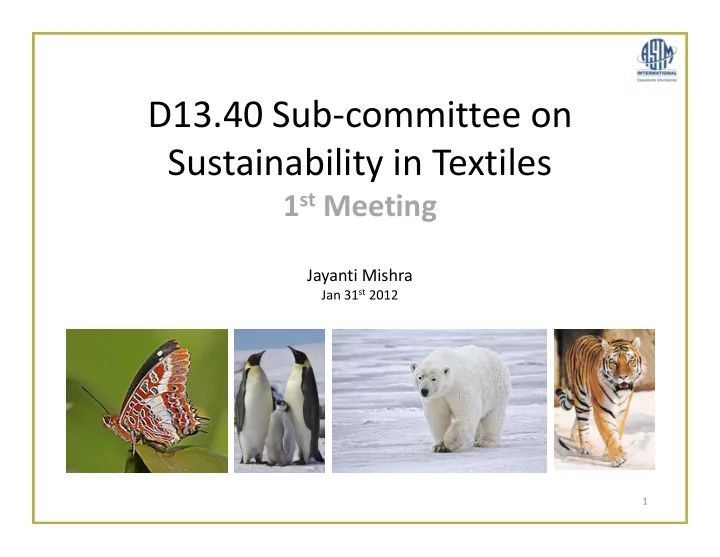
D13.40 Sub-committee on Sustainability in Textiles

1st Meeting

Jayanti Mishra Jayanti Mishra

Jan 31st 2012

1
slide-2
SLIDE 2

2

slide-3
SLIDE 3

Introduction of attendees

3

slide-4
SLIDE 4

Rising temperature & Disappearing Rain forests

Disappearing Rainforest

  • .

Rising temperatures affecting Fresh water availability

4

slide-5
SLIDE 5

Species migration and extinction

  • Gray Whale
  • Birds
  • Frogs
  • Fishes
  • Fishes

5

slide-6
SLIDE 6

World scenario

  • Climate change
  • Toxic chemicals
  • ‘fast fashion’
  • ‘fast fashion’
  • Water consumption

6

slide-7
SLIDE 7

World scenario contd..

  • Recycling
  • Consumer choice.
  • Technology.

7

slide-8
SLIDE 8

Water consumption

14000 to 20000 1450-1750

8

slide-9
SLIDE 9

World scenario contd..

  • Social concern
  • Environmental performance dependency
  • Energy Use
  • life of the product

9

slide-10
SLIDE 10

Impact of textiles

  • Resource depletion
  • Pollution
  • Energy use

Biological Environment

  • Biological Environment

10

slide-11
SLIDE 11

11

slide-12
SLIDE 12

The Growing Importance of Sustainability in Textiles

slide-13
SLIDE 13

Eco labels out there

  • 430 ecolabels in 246 countries, and 25

industry sectors.

13

slide-14
SLIDE 14

Agenda

  • Meeting Agenda

D13.40 on Sustainability of Textiles

  • Mishra, Jayanti
  • Date:January 31,2012 Time: 8.30 am to 10.30am
  • Place: Atlanta, GA
  • Call to order and introduction of attendees 10minutes
  • Approval of Agenda 2 minutes
  • Approval of Previous Meeting Minutes Presentation 25 minutes
  • Membership Updates 5minutes
  • Membership Updates 5minutes
  • Ballot Results (since last meeting)
  • a) Main/Concurrent Items

*** None ***

  • b) Subcommittee Items

*** None ***

  • Outstanding Negatives Needing Resolution (prior to last meeting)
  • Main/Concurrent Items

*** None ***

  • Subcommittee Items

*** None ***

  • Standards Requiring Review

*** None *** 14

slide-15
SLIDE 15

Agenda contd..

  • New Standard and Reinstatement Work Items (Not Currently on Ballot)

– WK33688 New Standard Guide For Fibers Sustainability (Technical Contact: Mishra, Jayanti )

  • To discuss the members interested and discuss the objectives of the Task Group
  • Revision and Withdrawal Work Items (Not Currently on Ballot)

*** None ***

  • Task Group Reports (Other than Work Items) None yet
  • Liaison Reports
  • With Textile Exchange and Sustainable Apparel Coalition 5 minutes presentation

Old Business

  • Old Business
  • Workshop in June . To discuss the agenda and outline of the workshop and Speaker confirmations. Presentation 10 minutes
  • New Business/Committee Correspondence
  • TRSA Proposed Standard Discussion 10 minutes
  • Administrative Deadlines
  • Open to discussion and feedback- 30 minutes
  • Future Meetings
  • Event Name: June 2012 Committee Week

Dates: Sunday, June 24th 2012 - Wednesday, June 27th 2012 Location: Sheraton San Diego Hotel & Marina; San Diego, CA US. 15

slide-16
SLIDE 16

Agenda contd..

Planned conference to cover;

  • General Objectives –The Objectives laid down are -

– To draw the technical minds already associated with D13 for a focused workshop on sustainable fiber standards development. – To attract Senior Management/ Buyers / Designers to associate with ASTM D13 and D13.40 through a highly interactive, strategic workshop on sustainable business. The workshop can be called “Vision in Action” and will include two exclusive workshops

  • On Sustainable textile fiber standards - An Insight into available global sustainable fiber guidelines and standards and future
  • development. Participation of Subject matter experts, material specialists, technologists from producers, retailers, testing

agencies, industry organizations & research analysts & From Concept to consumption- Create a powerful, holistic, integrated sustainable textile business strategy. Lead management consultants will facilitate a unique, highly interactive workshop bringing together business strategists, brand managers, buyers, designers, material specialists, technologist and CSR to create a blueprint for success.

  • Event Name: January 2013 Committee Week

Dates: Sunday, January 27th 2013 - Wednesday, January 30th 2013 Location: Hyatt Regency Jacksonvile Riverfront; Jacksonville, FL US

  • Meeting Adjournment
  • For a complete list of standards see

http://www.astm.org/COMMIT/SUBCOMMIT/D1340.htm 16

slide-17
SLIDE 17

The earlier defined objective were

  • The need of sustainability in production and

consumption of Textiles.

  • Provide a venue for networking among participants

and sharing of best practices

  • To draw the technical minds already associated with

D13 for a focused workshop on sustainable fiber standards development. standards development.

  • To attract Senior Management/ Buyers / Designers to

associate with ASTM D13 and D13.40 through a highly interactive, strategic workshop on sustainable business.

17

slide-18
SLIDE 18

Objectives Today

  • Currently established standards, test methods, specifications

Cotton and polyester- 2 most consumed fibers- Need to study the standards in depth and work on establishing the test methods/filling in gaps in existent standards Review GRS Standard and establish guidelines/test methods filling gaps in the existent standard

  • Test Methods for recycle content

18

  • Measuring footprint
  • Rating basis
  • Organic seed cultivation Test methods
  • SAC/Nike Fiber grading and rating methodology
  • Why the scoring is the way it is and are test methods identified/specifications

laid down

  • Review current certifications, training certifiers help create/improve standards
  • New standards for Polyester Recycling and Organic Cotton
slide-19
SLIDE 19

Gaps today

1) No measurement /rating of the processes involved 2) Current ensure traceability and basic environmental compliances

  • Organic Cotton

3) No scoring/evaluation of the integrity- currently based on audit system max twice a year 4) No test methods to confirm authenticity- adulteration not traceable in current standard

19

slide-20
SLIDE 20

Recycle Standard

1) Stress on traceability 2) No rating or measurement of processes 3) Current standard asks for basic environmental performance of organization but does not performance of organization but does not evaluate the efficiency or performance of the manufacturing process specific to recycle 4) No scoring/evaluation 5) No test methods to confirm authenticity- adulteration not traceable in current standard

20

slide-21
SLIDE 21

Long Range Planning

  • Standards on Fibers

– A look at the Material Index By Nike – Eco Index by Sustainable Apparel Coalition

  • Standards on Processes-

Identifying the major impacts and Identifying the major impacts and devising standards to improve them.

  • Sharing Of Best Practices
  • Regular Conferences
  • Not duplicating work being done
  • utside ASTM

21

slide-22
SLIDE 22

22

slide-23
SLIDE 23

23

slide-24
SLIDE 24

24

slide-25
SLIDE 25

25

slide-26
SLIDE 26

Three Index Building Blocks

Sustainable Apparel Coalition V1.0 Apparel Index Sustainable Apparel Coalition V1.0 Apparel Index OIA Eco Index OIA Eco Index Materials Sustainability Index Materials Sustainability Index Social/Labor Indicators* Social/Labor Indicators*

* Under development; based on best available frameworks

26

slide-27
SLIDE 27

OIA Eco Index

27

slide-28
SLIDE 28

PRODUCT MODULE Section Score (out of 100) W ei gh t Weighted Score Materials X of 100 16 .6 7 % Y of 16.67 Packagin g X of 100 16.67% Y of 16.67 Manufac turing X of 100 16.67% Y of 16.67

28

turing Transpor tation X of 100 16.67% Y of 16.67 Use & Service X of 100 16.67% Y of 16.67 End of Life X of 100 16.67% Y of 16.67 Total 100% Z of 100

slide-29
SLIDE 29

ASTM Committee D134000 Membership Report

NAME COMPANY CLASS VO TE Amardeep, Dheendayal ASK Consulting Inc General Interest Yes Basheer, Abul Hassan Global Resources Mgmt Group General Interest Yes Berg, Becky M Costco Wholesale General Interest Yes Bhajekar, Vidyadhar Texanlab Laboratories Pvt. Ltd. General Interest Yes Bide, Martin University Of Rhode Island General Interest Yes Boyter, Henry A CESTAB General Interest Yes Carrier, Jeffrey The Carpet and Rug Institute Producer Yes Cendrowska, Teresa J ASTM International General Interest Yes Chaudhary, Shreyaskar Pratibha Syntex Pvt. Ltd Producer Yes Clarke, Dena Aegis Environmental Management Producer Yes Cole, Timothy R FORBO INDUSTRIES INC Producer Yes Cox, Cecele Alsco Inc. General Interest Yes Dempsey, Patrick J Dempsey Uniform General Interest Yes Gillespie, Anne Textile Exchange General Interest Yes Gopalakrishnan, Jayakumar General Interest Yes Gramp, Gary D Textile Rental Services Association General Interest Yes Guy, Henry Eec General Interest Yes Hashemi, Nastaran Intertek General Interest Yes

slide-30
SLIDE 30

NAME COMPANY CLASS VOTE Helmstetler, Doug ARAMARK Uniform Services General Interest Yes Ichhaporia, Pratik K INTERTEK CONSUMER GOODS Unclassified Yes Ji, Won-Ha Fiti Testing & Research Inst General Interest Yes Joshi, Mayank

Changed Employer

Producer No, NV Kallenbach, Steve American Dawn Inc. Producer Yes Kirke, Bob J Caf General Interest Yes Kubler, Charley G&K Services, Inc. General Interest Yes Leukhardt,III, Howard A Safariland, LLC Producer Yes Lewis, Mark L Dempsey Uniform Unclassified No, PD List, Jennifer Nike, Inc User Yes Madsen, Eric L Extended Producer Responsibility General Interest Yes Madsen, Eric L Extended Producer Responsibility General Interest Yes Mehta, Vishal General Interest Yes Mishra, Jayanti Pratibha Syntex Pvt. Ltd Producer No, NV Pariti, Siva Rama Kumar DyStar India Private Limited Producer Yes Ryan, David T Wearbest Sil-Tex Mills Producer Yes Schneider, Joanna Z 3m Producer Yes Shaw, Anugrah

  • UNIV. OF MARYLAND EASTERN SHORE

General Interest Yes Simonson, Steve Burlington Industries Inc Producer Yes Smith, Ian C Coloursmith, Ltd General Interest Yes Somasundaram, Jaganathan M/S India Dyeing Mills P Ltd Producer Yes Sperduto, Kathleen H General Interest No, NV

slide-31
SLIDE 31

NAME COMPANY CLASS VOTE Srinivasan, Srivatsa E&T Textiles General Interest Yes Subramaniam, Sundari Global Resources Mgmt Group General Interest Yes Taylor, Vicky J INVISTA Company Producer Yes Thangavelu, Ramkumar Intertek General Interest No, RI Tibbitts, David General Interest Yes Trivedi, Rahul Pratibha Syntex Pvt. Ltd Producer No, NV Turner, Richard Mohawk Ind. Producer Yes Wallace, Michele L Cotton Incorporated General Interest Yes zhuo, zhang Guangdong Inspection and Quarantine Technology Center General Interest Yes Carrasco, Sherry Carhartt Producer Yes Carrasco, Sherry Carhartt Producer Yes Delhom, Chris USDA General Interest Yes Lake, Barbara ASTM International Unclassified No, NV Rodgers, Jennifer ASTM International Unclassified No, NV Producer User Consumer General Interest Unclassified Total Official Voting Member 13 1 28 1 43 Non official Voting Member 3 2 1 6 Total 16 1 30 2 49 Committee Balance Producer Votes Available: 16

slide-32
SLIDE 32

Liaison report

  • Textile Exchange
  • Sustainable Apparel Coalition

32

slide-33
SLIDE 33

Ballot result

  • Nothing To ballot Yet

Outstanding –ve ballots

  • Nothing in Ballot Yet

33

  • Nothing in Ballot Yet

Standard requiring review

  • No standard made as yet
slide-34
SLIDE 34

Revision and withdrawal of work item

  • Not applicable

34

slide-35
SLIDE 35

Task group report

  • Suggested New Task Group To Be Formed on studying

available Standards on Sustainable Textile Fibers and gaps in the same

  • Task Group Formation

– Interested members – Interested members

  • Matthew Thurston (REI sustainability analyst)
  • Jing Chung (Dupont)
  • Tim Cole (Forbo Flooring System, Director-Envo Initiatives
  • Beth Jenson (Outdoor Industry)
  • Pratik Ichhporia (Intertek USA)
  • Anne Gillespie (TE)
  • Michele Wallace

35

slide-36
SLIDE 36

Workshops in June’12

2 Workshops

  • On Sustainable textile fiber standards
  • From Concept to Consumption

36

slide-37
SLIDE 37

Potential Identified Speakers

  • Earlier we had outlined speakers as follow from ;

– Textile Exchange – USA’s EPA – Nike Representative – Walmart Representative – Toyota – AATCC – AATCC – NCSU – Outdoor Industry Association/Sustainable Apparel Coalition – WWF – Apple – FTC

  • Considering representations from leading consultants to

moderate the workshops and experts on fibers

37

slide-38
SLIDE 38

New Business: TRSA

Purpose To identify, define, and rate Green Best Management Practices (BMPs) which are used in commercial laundry facilities. Reason/Need for proposed standard The commercial laundry industry has made a commitment to sustainability. We are looking to further reduce our carbon footprint and enhance our environmental stewardship by developing this voluntary

  • standard. Our goal is to encourage the implementation of these green BMPs at all laundry facilities.

Scope of proposed work This standard describes a methodology for assessing and rating green BMPs used in the commercial laundry industry. The proposed BMP list includes water reuse technology, boiler heat recovery, wastewater heat recovery, environmentally friendly detergents, wastewater pre-treatment (mechanical), advanced wastewater treatment, energy efficient lighting, solar energy, recycling, fleet optimization, spill- prevention plan, and preventative boiler maintenance. Stakeholder Groups Commercial laundry facilities Users of reusable textiles, e.g. companies in the hospitality, healthcare, and industrial industries

38

slide-39
SLIDE 39

Case studies

  • Patagonia
  • Pratibha Syntex

39

slide-40
SLIDE 40

1% For the Planet

  • Policy of contributing 1% of all sales to environmental organizations since 1985,

the 1,486 members of 1% For the Planet each contribute 1% of their total sales to

  • ver 2,000 different environmental organizations every year.
  • Patagonia has committed ;
  • Social Activism- USD 243,976
  • Social Activism- USD 243,976
  • Water Marine –USD 720,217
  • Sustainable Agriculture- USD 71,240
  • Forests- USD 170,314
  • Alternative Energy-USD 24,408
  • Resource Extraction-USD 34,630
  • Toxics /Nuclear-USD103,559
  • Biodiversity USD 704,798
  • GRANTS: USD 4,280,585 in 2011

40

slide-41
SLIDE 41

Carbon, Water & Waste Profile Footprints

slide-42
SLIDE 42
slide-43
SLIDE 43

Pratibha Syntex

  • Is one of the world’s largest full vertically integrated textile supplier.
  • Works with over 20 renowned brands worldwide.
  • Commitment to Sustainability & Social Responsibility is unquestionable with active involvement

in many initiatives.

  • Certifications include: OHSAS 18001, Oe100, GOTS, NOP, USDA, Fair Trade, Oeko Tex 100,

WRAP, NPOP, ISO 14001 WRAP, NPOP, ISO 14001

* Source: Pratibha; Info unverified by Cool Earth

slide-44
SLIDE 44

Pratibha Syntex Initiatives – Farm side *

  • Initiated in 1999.
  • Conscious Choice taken with foresight of helping People, Planet and better

Profits.

  • Pratibha see themselves as pioneers in the country , initiating this even

before the international demand arose.

Organic Cotton Farming

Fair Trade

  • Was also Initaited in 1999
  • Was also Initaited in 1999
  • Encouragement & support provided to Farmers registered as Fair Trade

Cotton Producer Group.

  • Initially had 26 villages with 126 farmers grown in 2011 to 140 villages with

3885 farmers

  • Majority of the farmers are experienced in organic cultivation practices.

Better Cotton Initiative

  • Initiated in one of the backward & poorer regions of India

(Rayagarha,Orissa), 2011 in areas inhabited by Tribal societies.

  • First step in direction of Organic Farming.
  • Slowly converts farmers and their mindsets from conventional to Clean

cotton and then move towards in transition organic to gradually Organic farming.

* Source: Pratibha; Info unverified by Cool Earth

slide-45
SLIDE 45
  • 19000 farmers in Organic Cotton, Fair Trade & BCI practices.
  • Farmers are provided with expert support, advice on organic cotton farming

practices (five out of six regions).

  • Farmers are supervised to ensure that no conventional fertilizers, pesticides,

insecticides are used and only organic methods which help conserve the ecology are followed.

  • Farmers are provided with training to produce and procure these organic

implements

Pratibha Syntex Initiatives – Farm side *

Organic Fertilizers PSL Farm Team on inspection A demonstration of a Farm Bug trap for a farmer. Used in place of spraying pesticides on the crop

* Source: Pratibha; Info unverified by Cool Earth

slide-46
SLIDE 46

Good Initiatives from Pratibha *

  • Zero discharge facility and makes good efforts to

conserve water. Rain Water Harvesting

  • Training to manufacture organic manures.
  • Some farmers have been trained to even generate power
  • n a small scale from a cow dung gas plant (seen in pic)

* Source: Pratibha; Info unverified by Cool Earth

slide-47
SLIDE 47

Pratibha Syntex’s New Initiative & Vision

  • embraced the concept of Sustainability

Management whole-heartedly.

  • pledged to go ‘Carbon Neutral’ in the near future.
  • Other areas of concern include – reducing Water

consumption and waste generation.

slide-48
SLIDE 48

Factory Units

  • Pratibha Syntex is a vertically integrated Textile company having Spinning, Knitting, Dyeing & Garmenting

sections.

  • Each of these sections require energy, usage of fossil fuels, consume water & generate waste.

Spinning Knitting Dyeing Garmenting

Energy, Raw Material Emissions, Water Use, Waste

slide-49
SLIDE 49

Carbon Footprint

  • The Carbon Footprint of any entity is a measure of

the total set of Greenhouse gases that are released into the atmosphere, as a result of existence of a country, company, event or person.

  • A number of materials contribute to GHG emissions,

some of which are fossil fuels and refrigerant gases. Emission Factors for each contributor, maintained in the verified database was used for the calculations.

  • In this exercise, the Carbon Footprint was calculated

as per the Greenhouse Gas Protocol using a CDP certified Tool ‘Our Impacts‘.

slide-50
SLIDE 50

Carbon Footprint

  • As per guidelines laid down in the GHG Protocol, the Carbon Footprint measurements there are various scopes of a Carbon
  • Footprint. The diagram helps explain:

Production of electricity, heat & steam Onsite All Business Travel Transport of purchased goods*

Scope I Scope II Scope III

Direct Emissions Indirect Emissions Supply chain; other indirect emissions

Own Transport Process & Fugitive Emissions Consumption of Electricity, Heat & Steam Distribution of products* Waste Disposal Use of products Staff commute

  • n non-company
  • wned transport

* from / to point of ownership Companies shall account & report Scope I & II emissions at a minimum

slide-51
SLIDE 51

Snapshot of Tool

  • The Carbon Footprinting for Pratibha Syntex was done using a CDP certified

software called ‘Our Impacts’. Snapshots of the tool below

slide-52
SLIDE 52

Cool Earth Ideate

Key Performance Indicators: Carbon Footprinting and Sustainability Metrics are a new concept, and while the norm in the industry is to measure Scope I, II & III of the Carbon Footprint, absolute measurements are not a true measure year on year. If the Carbon Footprint were to increase it may also be due to expansion of the

  • rganisation and is unavoidable. If any reduction activities have been

undertaken, they fail to get highlighted. In such cases KPI’s help provide a per unit basis measurement of the Carbon footprint of an entity and help discern whether the reduction activities are reflecting in the performance of an organisation.

slide-53
SLIDE 53

Carbon Footprint

~Factory*~

* Only Scope I & II

slide-54
SLIDE 54

Carbon Footprint

~per T-shirt~

slide-55
SLIDE 55

Carbon Footprint

~Farm~

slide-56
SLIDE 56

Water Footprint

  • Water Footprinting is a novel concept which is slowly gaining acceptance among a

number of companies across the globe.

  • The corporate community is yet to give its broad based consensus of performing

Water Footprints as there are different methods of performing calculations.

  • However the guidelines for a water footprint developed by the Water Footprint
  • However the guidelines for a water footprint developed by the Water Footprint

Network (University of Twente & United Nations Environment Programme) is slowly gaining more recognition and acceptance. It is also more complex in performing.

  • The Components of calculation include Green, Blue and Grey Water Footprints.

WFproc = WFproc,green + WFproc,blue + WFproc,grey

slide-57
SLIDE 57

Water Footprint

  • Green Water Footprint – Rainwater consumed so far as water doesn’t become run-off
  • Blue Water Footprint – Water consumed from surface sources
  • Grey Water Footprint – Water consumed in assimilating load of pollutants from the plant

Water footprint

Green water footprint Blue water footprint Grey water footprint

Water consumption Water pollution

Return flow Water withdrawal The traditional statistics

  • n water use
slide-58
SLIDE 58

WFBusiness = WFBusiness-Operations + WFBusiness-Supply chain WFBusi –Ops = WFBusi- Op Inputs + WFBusi- Op Overheads

Water Footprint

~Factory Units~

WFPratibha – Syntex Busi Ops = WF Blue = 1150296.549 Kl

As we can see from above the Water footprint of a Business Unit is given by the summation of the Water Footprint of business operations and Supply Chain (which includes water footprint of all the products / ingredients used by the Business – excluded from this study) The Water Footprint of the business operations is the summation of the water footprint directly associated with the operations of the organisation and overheads Related to consumption in Kitchens, Toilets, gardening, etc.

slide-59
SLIDE 59

Water Footprint

~Factory Units Break-up~

slide-60
SLIDE 60

Water Footprint per Tonne of Garment

(Total Consumption)

Unit Wise Break-up WF (ops) – L/Kg

(WFSpinning)+(WFKnitting)+(WFDyeing)+ WFGar.

WF (ops) - Litres/Kg

Unit Wise Break-up WF (ops) – L/Kg Spinning 9.86 Knitting 11.61 Dyeing 150.95 Garmenting 27.50 Total 199.92

Spinning 5% Knitting 6% Dyeing 75% Garmenting 14%

WF (ops) - Litres/Kg

slide-61
SLIDE 61

Water Footprint per Tonne of Garment

(Freshwater Use Only)

Unit Wise Break-up WF (ops) Freshwater - L/Kg

(WFSpinning)+(WFKnitting)+(WFDyeing)+ WFGar.

WF (ops) - Freshwater Litres/Kg

Unit Wise Break-up WF (ops) Freshwater - L/Kg Spinning 8.63 Knitting 10.09 Dyeing 34.56 Garmenting 24.03 Total 77.31

Excluding Recovered Water Spinning 11% Knitting 13% Dyeing 45% Garmenting 31%

WF (ops) - Freshwater Litres/Kg

slide-62
SLIDE 62

Water Footprint

~per T-shirt~

Total Water consumption (L) Freshwater Consumption only (L)

WF bus ops / T-Shirt WF bus ops / T-Shirt

50.98 19.71

slide-63
SLIDE 63

Waste Profile

There are no laid down guidelines or methodology for waste profile footprinting, so Cool Earth has helped broadly bifurcate the waste content into different Components:

slide-64
SLIDE 64

Waste Profile

slide-65
SLIDE 65

Improvements

~Factory~

The Improvements that we suggest for Pratibha Syntex are three–fold: a. Process Changes / Efficiency Improvements b. Energy Efficiency Improvements c. Sustainability Switches

slide-66
SLIDE 66

Energy Efficiency

The ideas for energy efficiency can be subdivided into two components:

  • Ideas obtained by the Energy Auditors on a walk through all three facilities of

Pratibha Syntex at Pithampur (Main Factory, PSL-4 & SEZ) – Part A

  • Additional ideas that we have obtained information upon from external sources &
  • ther observations – Part B
slide-67
SLIDE 67

Part B

Research Ideas:

  • Steam Traps
  • Heat Recovery Systems
  • Lighting Solutions
  • Air Conditioning Solutions
slide-68
SLIDE 68

Steam Traps

  • Mechanical type Steam Traps discharge steam condensate to the return system.

These traps must continually cycle between open and closed positions in order to properly release condensate to the return system.

  • With this opening and closing cycle typically taking place thousands of times a

day, wear and corrosion of moving parts take their toll, resulting in high maintenance; a need to purchase spare parts and replacements to reduce steam maintenance; a need to purchase spare parts and replacements to reduce steam loss.

slide-69
SLIDE 69

Steam Trap Solution

Use of Orifice Steam Trap:

* As claimed by Vendor

slide-70
SLIDE 70

Steam Trap Case Study

* As claimed by Vendor

slide-71
SLIDE 71

Heat Recovery Systems

Heat Recovery Systems hold immense potential:

  • Indigenous Technology developed by prestigious IIT, Bombay
  • Technology developed in collaboration with Union Textile Ministry, India
  • Used from heat sources: Exhaust of Engines & Gensets Diesel / Gas / FO / Biogas, Turbines Gas / Biogas,

Furnaces, Stenters, etc.

  • Practically deployed so far ranging from 50 kW to 7.5 MW Gas Turbines, 135 kW to 6 MW DG Sets
  • Applications: Heating Air / Water / Thermic Fluid, Generating Steam / NH3/H2O Solution / Liquid

Desiccants

  • Multi-Utility – Water Heating, Potable Water Cooling, Air Conditioning
slide-72
SLIDE 72

Lighting Solutions

  • LEDs & Induction Lamps
  • Nano Reflectors
  • Light Pipes
slide-73
SLIDE 73

Discussions

73

slide-74
SLIDE 74

Questions

74

slide-75
SLIDE 75

75