D Answer 600 m/s 600 m/s C C 0.003 m/s 0.003 m/s D D [This - - PDF document

d
SMART_READER_LITE
LIVE PREVIEW

D Answer 600 m/s 600 m/s C C 0.003 m/s 0.003 m/s D D [This - - PDF document

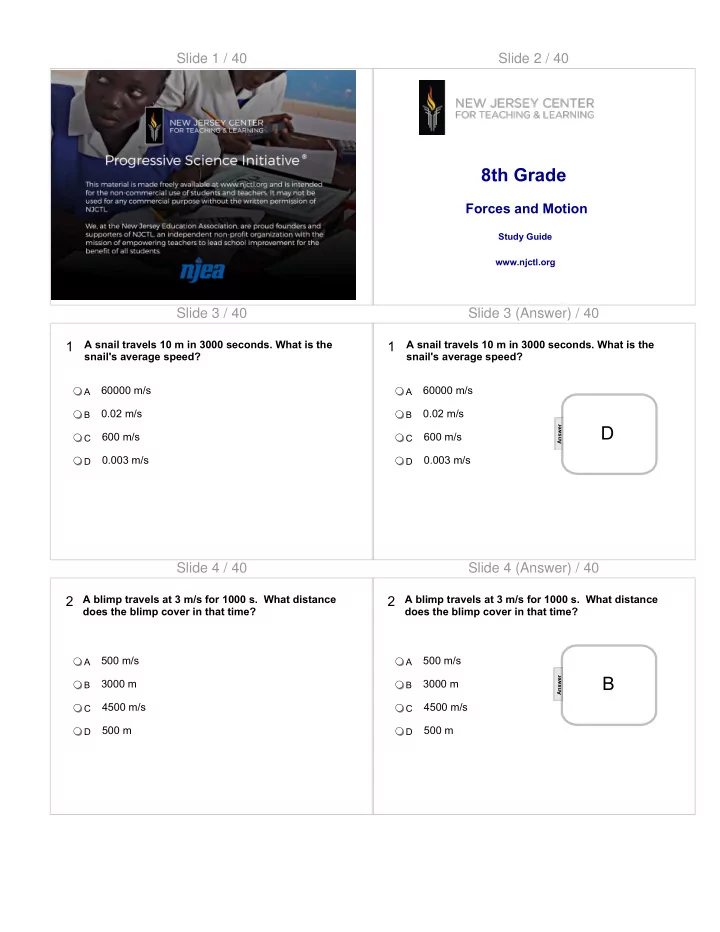
Slide 1 / 40 Slide 2 / 40 8th Grade Forces and Motion Study Guide www.njctl.org Slide 3 / 40 Slide 3 (Answer) / 40 1 A snail travels 10 m in 3000 seconds. What is the 1 A snail travels 10 m in 3000 seconds. What is the snail's average


slide-1
SLIDE 1

Slide 1 / 40 Slide 2 / 40

8th Grade

Forces and Motion

Study Guide www.njctl.org

Slide 3 / 40 1

A snail travels 10 m in 3000 seconds. What is the snail's average speed?

A

60000 m/s

B

0.02 m/s

C

600 m/s

D

0.003 m/s

Slide 3 (Answer) / 40 1

A snail travels 10 m in 3000 seconds. What is the snail's average speed?

A

60000 m/s

B

0.02 m/s

C

600 m/s

D

0.003 m/s

[This object is a pull tab]

Answer

D

Slide 4 / 40 2

A blimp travels at 3 m/s for 1000 s. What distance does the blimp cover in that time?

A

500 m/s

B

3000 m

C

4500 m/s

D

500 m

Slide 4 (Answer) / 40 2

A blimp travels at 3 m/s for 1000 s. What distance does the blimp cover in that time?

A

500 m/s

B

3000 m

C

4500 m/s

D

500 m

[This object is a pull tab]

Answer

B

slide-2
SLIDE 2

Slide 5 / 40

3 When your teacher times your mile run at 8.2

minutes, that means your speed was 0.12 mi/min. Was this your average speed or your instantaneous speed?

A Average Speed B Instantaneous Speed

Slide 5 (Answer) / 40

3 When your teacher times your mile run at 8.2

minutes, that means your speed was 0.12 mi/min. Was this your average speed or your instantaneous speed?

A Average Speed B Instantaneous Speed

[This object is a pull tab]

Answer

avg speed = 8.2mi/min

Slide 6 / 40

4 Does a speedometer measure the average speed or

the instantaneous speed?

A Average Speed B Instantaneous Speed

Slide 6 (Answer) / 40

4 Does a speedometer measure the average speed or

the instantaneous speed?

A Average Speed B Instantaneous Speed

[This object is a pull tab]

Answer

Instantaneous Speed

Slide 7 / 40

5 A swordfish travels for two hours. The first hour he covers 110 kilometers, and the second hour he covers 110 kilometers. What is the average speed of the swordfish? A 55 km/h B 84 km/h C 110 km/h D 194 km/h

Hint: Remember that average speed is total distance travelled divided by total time

Slide 7 (Answer) / 40

5 A swordfish travels for two hours. The first hour he covers 110 kilometers, and the second hour he covers 110 kilometers. What is the average speed of the swordfish? A 55 km/h B 84 km/h C 110 km/h D 194 km/h

Hint: Remember that average speed is total distance travelled divided by total time

[This object is a pull tab]

Answer

C

slide-3
SLIDE 3

Slide 8 / 40

6 A dog walks outside to go the bathroom every day. If she walks outside at a speed of 3 meters per second and walks 150 meters before she uses the bathroom, how long does it take her? A 50 seconds B 2 minutes C 188 seconds D 90 seconds

Slide 8 (Answer) / 40

6 A dog walks outside to go the bathroom every day. If she walks outside at a speed of 3 meters per second and walks 150 meters before she uses the bathroom, how long does it take her? A 50 seconds B 2 minutes C 188 seconds D 90 seconds

[This object is a pull tab]

Answer

A

Slide 9 / 40

7 Carlos and Gina are riding on their horses to go into

  • town. They travel 140 meters in 14 seconds going
  • west. What is their velocity?

A 490 m/s west B 10 m/s west C 490 m/s D 10 m/s

Slide 9 (Answer) / 40

7 Carlos and Gina are riding on their horses to go into

  • town. They travel 140 meters in 14 seconds going
  • west. What is their velocity?

A 490 m/s west B 10 m/s west C 490 m/s D 10 m/s

[This object is a pull tab]

Answer

B

Slide 10 / 40

8 A car travels 200 km/h west for 2 hours. The car then travels 150 km/h east for one hour. What is the car's position relative to its starting position? A 50 km west B 150 km west C 250 km west D 50 km east

Slide 10 (Answer) / 40

8 A car travels 200 km/h west for 2 hours. The car then travels 150 km/h east for one hour. What is the car's position relative to its starting position? A 50 km west B 150 km west C 250 km west D 50 km east

[This object is a pull tab]

Answer

C

slide-4
SLIDE 4

Slide 11 / 40 9

A nitro-methane powered top fuel dragster launches from rest to race against an opponent. Why did the car accelerate?

A

increased speed

B

decreased speed

C

changed direction

Slide 11 (Answer) / 40 9

A nitro-methane powered top fuel dragster launches from rest to race against an opponent. Why did the car accelerate?

A

increased speed

B

decreased speed

C

changed direction

[This object is a pull tab]

Answer

A

Slide 12 / 40

10 A driver hits the brakes to slow down at an

  • intersection. As the car's speed is decreasing it has

A positive acceleration B negative acceleration C no acceleration D more information is needed

Slide 12 (Answer) / 40

10 A driver hits the brakes to slow down at an

  • intersection. As the car's speed is decreasing it has

A positive acceleration B negative acceleration C no acceleration D more information is needed

[This object is a pull tab]

Answer

B

Slide 13 / 40

11 Which of the following graphs depicts the

acceleration of a runner speeding up to pass someone. A B C

x

Y

Speed (m/s) Time (s) x

Y

Speed (m/s) Time (s)

x

Y

Speed (m/s) Time (s)

D

x

Y

Speed (m/s) Time (s)

Slide 13 (Answer) / 40

11 Which of the following graphs depicts the

acceleration of a runner speeding up to pass someone. A B C

x

Y

Speed (m/s) Time (s) x

Y

Speed (m/s) Time (s)

x

Y

Speed (m/s) Time (s)

D

x

Y

Speed (m/s) Time (s)

[This object is a pull tab]

Answer

C

slide-5
SLIDE 5

Slide 14 / 40

12 Which of the following speed vs time graphs corresponds to the position vs time graph shown in the graph below?

A B C

Slide 14 (Answer) / 40

12 Which of the following speed vs time graphs corresponds to the position vs time graph shown in the graph below?

A B C

[This object is a pull tab]

Answer

A

Slide 15 / 40

13 A ball is traveling down a hill at 4 m/s. If the ball increases in speed to 8 m/s in 4 seconds, what is the acceleration of the ball? A 4 m/s B 4 m/s/s C 1 m/s D 1 m/s/s

Slide 15 (Answer) / 40

13 A ball is traveling down a hill at 4 m/s. If the ball increases in speed to 8 m/s in 4 seconds, what is the acceleration of the ball? A 4 m/s B 4 m/s/s C 1 m/s D 1 m/s/s

[This object is a pull tab]

Answer

D

Slide 16 / 40

14 Forces are all around us. Which of the following do you think are examples of forces? (choose all that apply) A Gravity B Friction C Muscles D Wind

Slide 16 (Answer) / 40

14 Forces are all around us. Which of the following do you think are examples of forces? (choose all that apply) A Gravity B Friction C Muscles D Wind

[This object is a pull tab]

Answer

A & B

slide-6
SLIDE 6

Slide 17 / 40

15 What is the SI unit for force? A Pounds B Kilograms C Newtons

Slide 17 (Answer) / 40

15 What is the SI unit for force? A Pounds B Kilograms C Newtons

[This object is a pull tab]

Answer

C

Slide 18 / 40 16 A +20 N force acts on a car and at the same time,

a -30 N force acts on the car. What is the net force acting on the car and is it balanced? A

  • 30 N unbalanced

B

  • 10 N unbalanced

C

  • 10 N balanced

D + 30 balanced

Slide 18 (Answer) / 40 16 A +20 N force acts on a car and at the same time,

a -30 N force acts on the car. What is the net force acting on the car and is it balanced? A

  • 30 N unbalanced

B

  • 10 N unbalanced

C

  • 10 N balanced

D + 30 balanced

[This object is a pull tab]

Answer

B

Slide 19 / 40 17 The force of gravitation between an object and a

planet is increased as they move away from each

  • ther:

True False

Slide 19 (Answer) / 40 17 The force of gravitation between an object and a

planet is increased as they move away from each

  • ther:

True False

[This object is a pull tab]

Answer

False

slide-7
SLIDE 7

Slide 20 / 40 18 A 100 kg kid is on the moon, where g = 1.67 m/s2 .

What is the boy's weight? A 83.5 kg B 167 kg C 167 N D 29.9 N

Slide 20 (Answer) / 40 18 A 100 kg kid is on the moon, where g = 1.67 m/s2 .

What is the boy's weight? A 83.5 kg B 167 kg C 167 N D 29.9 N

[This object is a pull tab]

Answer

C

Slide 21 / 40

19 What is the net force acting on the object below?

7 N

  • 8 N
  • 10 N

Slide 21 (Answer) / 40

19 What is the net force acting on the object below?

7 N

  • 8 N
  • 10 N

[This object is a pull tab]

Answer

  • 11 N

Slide 22 / 40

20 Is the object in equilibrium? Yes No

7 N

  • 8 N
  • 10 N

Slide 22 (Answer) / 40

20 Is the object in equilibrium? Yes No

7 N

  • 8 N
  • 10 N

[This object is a pull tab]

Answer

No

slide-8
SLIDE 8

Slide 23 / 40

21 What is the net force acting on the object below?

25 N

  • 15N
  • 10 N

Slide 23 (Answer) / 40

21 What is the net force acting on the object below?

25 N

  • 15N
  • 10 N

[This object is a pull tab]

Answer

0 N

Slide 24 / 40

22 Is the object in equilibrium? Yes No

25 N

  • 15N
  • 10 N

Slide 24 (Answer) / 40

22 Is the object in equilibrium? Yes No

25 N

  • 15N
  • 10 N

[This object is a pull tab]

Answer

Yes

Slide 25 / 40

23 Acceleration due to gravity on Jupiter is 26.1 m/s2 . How much would a 25 kg person weigh on Jupiter?

Slide 25 (Answer) / 40

23 Acceleration due to gravity on Jupiter is 26.1 m/s2 . How much would a 25 kg person weigh on Jupiter?

[This object is a pull tab]

Answer

653 N

slide-9
SLIDE 9

Slide 26 / 40

24 Acceleration due to gravity on Earth's Moon is 1.67 m/s2 . How much would a 113 kg person weigh on Earth's Moon?

Slide 26 (Answer) / 40

24 Acceleration due to gravity on Earth's Moon is 1.67 m/s2 . How much would a 113 kg person weigh on Earth's Moon?

[This object is a pull tab]

Answer

189 N

Slide 27 / 40 25 Inertia is the reluctance any material object has

to change its state of motion. True False

Slide 27 (Answer) / 40 25 Inertia is the reluctance any material object has

to change its state of motion. True False

[This object is a pull tab]

Answer

True

Slide 28 / 40 26 The law of inertia applies to:

A moving objects B nonmoving objects C both moving and nonmoving objects

Slide 28 (Answer) / 40 26 The law of inertia applies to:

A moving objects B nonmoving objects C both moving and nonmoving objects

[This object is a pull tab]

Answer

C

slide-10
SLIDE 10

Slide 29 / 40

27 Which object has the greatest inertia? A Car B Tennis Ball C Freight Train

Slide 29 (Answer) / 40

27 Which object has the greatest inertia? A Car B Tennis Ball C Freight Train

[This object is a pull tab]

Answer

C

Slide 30 / 40 28 A ball will accelerate and increase its velocity

when it feels an unbalanced force. True False

Slide 30 (Answer) / 40 28 A ball will accelerate and increase its velocity

when it feels an unbalanced force. True False

[This object is a pull tab]

Answer

True

Slide 31 / 40 29 When the force acting on an object decreases,

the resulting acceleration will: A remain constant B increase C decrease

Slide 31 (Answer) / 40 29 When the force acting on an object decreases,

the resulting acceleration will: A remain constant B increase C decrease

[This object is a pull tab]

Answer

C

slide-11
SLIDE 11

Slide 32 / 40 30 When an object's mass is decreased but the

applied force stays the same, the resulting acceleration will: A remain constant B increase C decrease

Slide 32 (Answer) / 40 30 When an object's mass is decreased but the

applied force stays the same, the resulting acceleration will: A remain constant B increase C decrease

[This object is a pull tab]

Answer

B

Slide 33 / 40

31 You are riding your bicycle to the park to meet a few friends. As you ride, you apply a force of 40 N and accelerate at a rate of 0.4 m/s2 . What is the total mass of the bicycle and you? A 75 kg B 100 kg C 120 kg

Slide 33 (Answer) / 40

31 You are riding your bicycle to the park to meet a few friends. As you ride, you apply a force of 40 N and accelerate at a rate of 0.4 m/s2 . What is the total mass of the bicycle and you? A 75 kg B 100 kg C 120 kg

[This object is a pull tab]

Answer

B

Slide 34 / 40 32 When you sit on a chair, the chair pushes back

with force equal to your weight. True False

Slide 34 (Answer) / 40 32 When you sit on a chair, the chair pushes back

with force equal to your weight. True False

[This object is a pull tab]

Answer

True

slide-12
SLIDE 12

Slide 35 / 40

33 Which of the following statements pertains to the third law of motion? A Action and Reaction pairs always act on the same object. B Mass is indirectly proportional to acceleration. C An object at rest will remain at rest unless acted on by an unbalanced force. D If a force occurs, action reaction forces are present.

Slide 35 (Answer) / 40

33 Which of the following statements pertains to the third law of motion? A Action and Reaction pairs always act on the same object. B Mass is indirectly proportional to acceleration. C An object at rest will remain at rest unless acted on by an unbalanced force. D If a force occurs, action reaction forces are present.

[This object is a pull tab]

Answer

D

Slide 36 / 40 34 How can a small toy have the same momentum as

a large car? A toy has large speed B both car and toy are at rest C toy has no mass D A & B

Slide 36 (Answer) / 40 34 How can a small toy have the same momentum as

a large car? A toy has large speed B both car and toy are at rest C toy has no mass D A & B

[This object is a pull tab]

Answer

D

Slide 37 / 40 35 If a 3 kg toy truck is moving at 4 m/s, what is the

toy's momentum? A 3 m/s B 2 kgm/s C 12 kgm/s D 12 m/s

Slide 37 (Answer) / 40 35 If a 3 kg toy truck is moving at 4 m/s, what is the

toy's momentum? A 3 m/s B 2 kgm/s C 12 kgm/s D 12 m/s

[This object is a pull tab]

Answer

C

slide-13
SLIDE 13

Slide 38 / 40

36 What two factors does momentum depend on? A mass and volume B mass and acceleration C mass and velocity D mass and force

Slide 38 (Answer) / 40

36 What two factors does momentum depend on? A mass and volume B mass and acceleration C mass and velocity D mass and force

[This object is a pull tab]

Answer

C

Slide 39 / 40 37 The law of conservation of momentum states that

the total momentum after a collision increases from its value before the collision. True False

Slide 39 (Answer) / 40 37 The law of conservation of momentum states that

the total momentum after a collision increases from its value before the collision. True False

[This object is a pull tab]

Answer

False

Slide 40 / 40

38 According to Newton's 3rd law, action reaction pairs are equal and opposite to each other. Why do these paired forces sometimes cause different motions if they are equal?

Slide 40 (Answer) / 40

38 According to Newton's 3rd law, action reaction pairs are equal and opposite to each other. Why do these paired forces sometimes cause different motions if they are equal?

[This object is a pull tab]

Answer

because they act on different

  • bjects