D o m ini k S chu b l e , A d e la Ma r ian , L o r e nz o C r e m o - - PDF document

d o m ini k s ch u b l e a d e la ma r ian l o r e nz o c
SMART_READER_LITE
LIVE PREVIEW

D o m ini k S chu b l e , A d e la Ma r ian , L o r e nz o C r e m o - - PDF document

I n s t i t u t e f o r A d v anc e d S u s t aina b ili t y S t u d i e s e . V . D o m ini k S chu b l e , A d e la Ma r ian , L o r e nz o C r e m o n e s e 1 M o t i v a t i o n D a t a S o u r c e : B MWi , 2018 S p ac e h e a t in g in p r


slide-1
SLIDE 1

1

Institute for Advanced Sustainability Studies e. V.

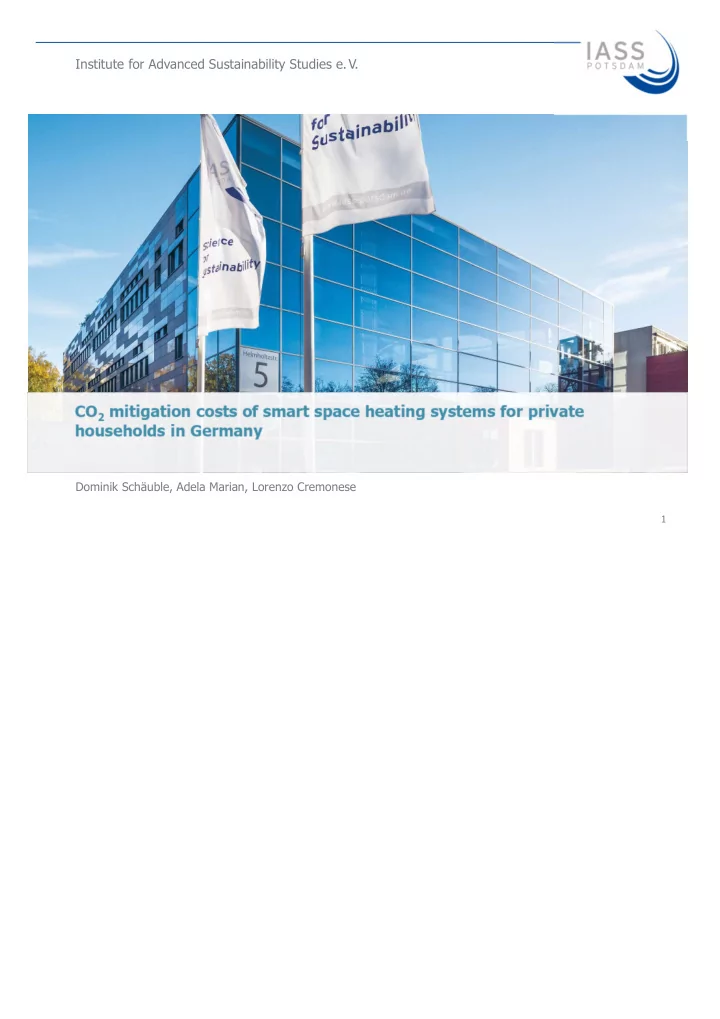
Dominik Schäuble, Adela Marian, Lorenzo Cremonese

slide-2
SLIDE 2

2 Institute for Advanced Sustainability Studies e.V.

Motivation

Space heating in private households contributes significantly to total final energy consumption

Data Source: BMWi, 2018

slide-3
SLIDE 3

3 Institute for Advanced Sustainability Studies e.V.

Motivation

Buildings constructed between 1949 and 1978 are dominating in number Specific energy consumption of these buildings is relatively high Building stock, especially buildings constructed before 1978 need to be adressed

Data source: Destatis, 2016 Data source: dena, 2016

slide-4
SLIDE 4

4 Institute for Advanced Sustainability Studies e.V.

Motivation

Reduction of heat consumption in buildings must be accelerated significantly Rates of high-investment refurbishments are well below what is needed Low-effort, low-investment measures might help…like smart space heating

Heat demand buildings

Target reference year until 2016 2016-2020 2020-2050

GHG emissions Change in % per year Source: Monitoring expert commission, 2018

slide-5
SLIDE 5

5 Institute for Advanced Sustainability Studies e.V.

Scope and objective

Reduction of wasted space heat through smart control of space heating on room level Typical features: Programmable time schedules, Remote control, Automatic reaction to window/door operation, Geo-fencing (reaction to GPS-position), Assimilation of weather forecast Under which conditions is SSH a cost-effective measure for German households to save heating energy and reduce GHG emissions?

slide-6
SLIDE 6

6 Institute for Advanced Sustainability Studies e.V.

Case study estimates of average CO2 mitigation costs and payback ti Investor/user perspective Payback time:

For NPVSSH = 0, t = payback time

Average CO2 mitigation costs: Hardly any empirical data on savings through SSH in Germany or Europe Savings strongly depend on occupant behavior before and after installation Relative savings through SSH ( _SSH) used as independent variable

Methods: Approach and basic equations

slide-7
SLIDE 7

7 Institute for Advanced Sustainability Studies e.V.

General Consumer fuel price: 6.44 Ct/kWh Interest rate: 1% Operating life of SSH system: 10 years Specific emissions

  • 4) tCO2/kWh

1. Case: Average single-family house built between 1949 and 1978 Living area: 127 m² Specific heating energy consumption: 159 kWh/(m²a) System price/ investment cost: 670 € (8 rooms) 2. Case: Average apartment in apartment building built between 1949 and 1978 Living area: 64 m² (apartment), 640 m² (building) Specific heating energy consumption: 134 kWh/(m²a) System price/ investment cost: 340 € (4 rooms) Consumption cost share: 70% Sensitivity studies to investigate variations in parameters and their impact

Methods: Parameterization

slide-8
SLIDE 8

8 Institute for Advanced Sustainability Studies e.V.

Mitigation costs (MC) and relative savings follow a 1/x relation For savings of about 6%, MC become negative in the avg single-family house case Specific heating energy consumption has a considerable impact on MC: -22 €/tCO2 for 10% increase and +27 €/tCO2 for 10% decrease starting from average (at 6%)

Results: Relative savings and Specific energy consumption

slide-9
SLIDE 9

9 Institute for Advanced Sustainability Studies e.V.

For large savings MC are rather insensitive to investment costs and operating life For a 10% decrease in investment costs, MC decrease by -23 €/tCO2 (for 6% savings) For an operating lifetime of only 9 years, MC is 24 €/tCO2 higher than for 10 years (6%)

Results: Investment costs and Operating lifetime

slide-10
SLIDE 10

10 Institute for Advanced Sustainability Studies e.V.

Increasing fuel prices by 10% yields decreases in MC of -22 €/tCO2 (for 6% savings) Using a consumption cost share of 70% instead of 50% yields -57 €/tCO2 lower MC

Results: Fuel price and Consumption Cost Share

MC [€/tCO2] Consu Share 50% share 70% share Savings (%) 2 698 641 4 265 209 6 121 64 10 6

  • 51

15

  • 52
  • 109

20

  • 81
  • 138

30

  • 110
  • 167
slide-11
SLIDE 11

11 Institute for Advanced Sustainability Studies e.V.

For small relative savings (2-10%), mitigation costs of smart space hea strongly with increasing relative savings For small relative savings (2-10%), MC are sensitive towards variability in energy consumption, investment costs and operating lifetime SSH can be cost-effective with savings of at least 6% for an average German single-family house and at least 8% for an average apartment Empirical data on realizable savings with smart space heating is needed urgently; potential support could be connected to monitoring participation Households in inefficient buildings should think about investing in SSH first; potential support should target these households first Increasing the regulatory minimum for consumption cost share would increase incentives for SSH in apartments

Summary and Conclusions

slide-12
SLIDE 12

12

Institute for Advanced Sustainability Studies e. V. Berliner Straße 130 D – 14467 Potsdam Web: www.iass-potsdam.de

Contact

Institute for Advanced Sustainability Studies e.V.

  • Dr. Dominik Schäuble

Senior Research Associate dominik.schaeuble@iass-potsdam.de