D.O. Ligeyo, J. Wanyama, E. Saina, O.M. Odongo and J.A.W. Ochieng - - PowerPoint PPT Presentation

d o ligeyo j wanyama e saina o m odongo and j a w ochieng
SMART_READER_LITE
LIVE PREVIEW

D.O. Ligeyo, J. Wanyama, E. Saina, O.M. Odongo and J.A.W. Ochieng - - PowerPoint PPT Presentation

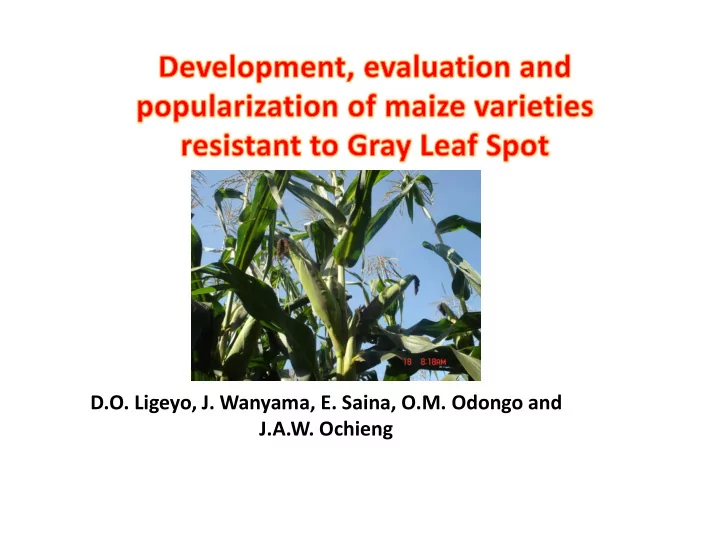
D.O. Ligeyo, J. Wanyama, E. Saina, O.M. Odongo and J.A.W. Ochieng Maize streak virus Gray leaf spot ( Cercospora zeae-maydis ) Introduction GLS result into yield losses of up to 30% Observed in Western Kenya (Kitale) in 1995 First


slide-1
SLIDE 1

D.O. Ligeyo, J. Wanyama, E. Saina, O.M. Odongo and J.A.W. Ochieng
slide-2
SLIDE 2

Maize streak virus Gray leaf spot (Cercospora zeae-maydis)

slide-3
SLIDE 3

Introduction

GLS result into yield losses of up to

30%

Observed in Western Kenya

(Kitale) in 1995

First observed in seed production

farms with incidences of more than 60%

slide-4
SLIDE 4

The project started in 2004 with the following

  • bjectives

 To screen germplasm for resistance to GLS.  To transfer identified/reported resistance to

common inbred lines through crossing and pedigree breeding, back cross breeding and sister line development.

slide-5
SLIDE 5
  • To develop new, improved varieties of maize with

resistance to Grey Leaf Spot (GLS).

  • Maintain and produce breeder’s seed of maize

varieties with high yield potential and stable performance with resistance to Grey Leaf Spot (GLS).

  • To establish baseline for assisting adoption rates of

the developed maize technologies through ex-ante

  • n-farm surveys.

Objectives Cont’d

slide-6
SLIDE 6

Expected outputs

Maize varieties with GLS resistance Adoption of improved maize varieties Breeder seed availed to interested seed merchants

slide-7
SLIDE 7

Outputs

  • 15 inbred lines with resistance to GLS

identified

  • 45 inbred lines with resistance to GLS

developed through pedigree breeding

  • Maize varieties with substantial levels of

resistance developed and released.

slide-8
SLIDE 8

KARI Kitale recently released hybrids with GLS resistance

  • Variety Yield Type Seed co
  • KH600- 15A 7.43 Top Cross hybrid E.A
  • KH600- 16A 7.80 Top Cross hybrid Freshco
  • KH600- 14E 8.19 Top Cross hybrid Freshco
  • KH600-20A 8 .60 Top Cross hybrid Agri Seed
  • KH600- 22A 8.68 Top Cross hybrid Monsant
  • KH600-23A 9.5 Top Cross hybrid ADC
  • KH600-24A 10.5 Top Cross hybrid NASECO
slide-9
SLIDE 9

KH600-20A

slide-10
SLIDE 10

KH600-23A

slide-11
SLIDE 11

KH600-24A

slide-12
SLIDE 12

Outputs Cont’d

  • 6 varieties in NPT, 25 in AYT, 1 Recommended

for release

slide-13
SLIDE 13

Ex-ante survey

  • An ex-ante survey on incidence and severity of

GLS was carried out in 8 districts

  • Based on the key informants responses, most
  • f the farms(over 75%) were infected with GLS

disease across all AEZ’s

  • Most respondents(over 60%) indicated that

GLS disease occurred in almost all the years

slide-14
SLIDE 14

KH600-15A

slide-15
SLIDE 15

ORGANOLEPTIC TASTE APPRECIATION

slide-16
SLIDE 16

Monitoring visit by USAID team at one of the advanced yield trial sites at Naitiri in Bungoma District.

slide-17
SLIDE 17

Output Cont’d

  • Developed varieties popularized
slide-18
SLIDE 18
slide-19
SLIDE 19

Assistant Minister of Agriculture, Hon. Gideon Ndambuki observing KARI maize varieties at Kenya Maize Development Fair at Chepkoilel Campus

slide-20
SLIDE 20
slide-21
SLIDE 21
slide-22
SLIDE 22

Output Cont’d

  • Breeder seed availed to interested seed

merchants (ADC, NASECO, AGRI SEED, E.A SEED, FAIDA, MONSANTO)

slide-23
SLIDE 23

Seed treatment in progress at KARI-Kitale in January 2011.

slide-24
SLIDE 24

Packing of breeder seed of parental materials of KH600-20A at KARI Kitale

slide-25
SLIDE 25

Collaborators

  • CIMMYT, KMDP,ACDI/VOCA, East Africa

Grain Council, Ministry of Agriculture, FIPS, CGA, Seed Companies and Several NGO’s in Agriculture.

slide-26
SLIDE 26

CHALLENGES

 Emergence of new diseases  Seed companies rarely declare the amount of

seed they have sold

 Once an agreement is signed it is the seed

companies who decide the amount of seed to produce

slide-27
SLIDE 27

SO7 Work plan January to March 2013

 Pollination of the materials in the off season

irrigation nursery- February/March

 Seed counting and packaging- March  Ploughing- February  Re-ploughing- early March  Harrowing- Mid- March  Harvesting of the materials in the irrigation

nursery- Late March

slide-28
SLIDE 28

SO7 Work plan January to March 2013 Cont’d

 Submission of 2 varieties for DUS and 3 varieties to

KEPHIS- Mid February

 Cutting pegs- February  Field marking- End of March  Data analysis- January/February  Site selection- Early February  Promotion of developed KARI maize technologies-

February to March

slide-29
SLIDE 29

Proposed BUDGET for February and March 2013

Code Description February March Total 2110202 Casual Labour 107720 104,904 212,624 2210303 Daily subsistence allowance 90,250 84,250 174,500 2211004 Fungicides, Insecticides and Sprays 830 830 1,660 2211023 Supplies for production 73,320 44,900 118,220 2211101 General Office Supplies 12,200 12,200 2211201 Refined Fuels and lubricants for transport 14,000 10,500 24,500 2211203 Refined fuels and lubricants (Ploughing) (lts) 30,500 20,000 50,500 2211311 Contracted Technical Services 504,000 504,000 2220101 Maintenance Expenses-Motor Vehicles 20,400 34,400 54,800 TOTAL BUDGET 841,021 311,984 1,153,005

slide-30
SLIDE 30

Acknowledgement

USAID SO7 for sponsoring this project

and director KARI for financial logistical support.