CyWi Testbed Open-Source Wireless Innovation Lab for 5G and Beyond - - PowerPoint PPT Presentation

cywi testbed
SMART_READER_LITE
LIVE PREVIEW

CyWi Testbed Open-Source Wireless Innovation Lab for 5G and Beyond - - PowerPoint PPT Presentation

CyWi Testbed Open-Source Wireless Innovation Lab for 5G and Beyond Team: SDDEC19-02 Advisor/Client: Dr. Hongwei Zhang http://sddec19-02.sd.ece.iastate.edu/ Project Plan Problem Statement Smart agriculture (e.g. modern machinery control)

slide-1
SLIDE 1

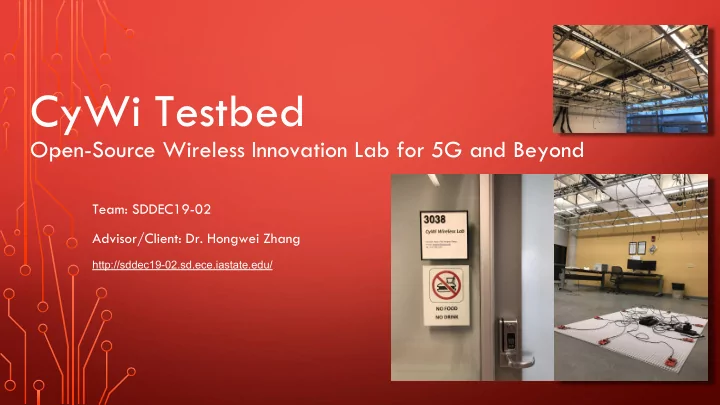
CyWi Testbed

Open-Source Wireless Innovation Lab for 5G and Beyond

Team: SDDEC19-02 Advisor/Client: Dr. Hongwei Zhang

http://sddec19-02.sd.ece.iastate.edu/

slide-2
SLIDE 2

Project Plan

slide-3
SLIDE 3

Problem Statement

  • Smart agriculture (e.g. modern machinery control) demands robust 5G solutions
  • Industry 4.0 requires Cyber-Physical Systems (CPS) and Internet of Things (IoT)
  • Wireless labs and testbeds speed up the pace of innovation

Simulations are not sufficient - radio frequency (RF) research needs physical labs

  • CyWi will enable users to define, execute, and analyze wireless experiments
slide-4
SLIDE 4

Experiment Lifecycle

  • Specification

Users provide requests in spec scripts

  • Resource Allocation

Server unpacks the spec script

Server reserves the requested resources (nodes, frequencies, etc)

  • Node Self-configuration

Nodes receive data for configurations from the database/server

  • Experiment Control

Performance monitoring, logs, traffic output are collected and exported to the user

slide-5
SLIDE 5

Functional Requirements

  • System must register users and assign individual accounts
  • Resource scheduler must efficiently allocate node resources
  • Experiments must be run remotely via web server
  • Users will have the ability to export experiment results
slide-6
SLIDE 6

Non-functional Requirements

  • System status will be tracked and available to users
  • Only registered users can access the system
  • System must be crash resilient
  • Database will be backed up on regular basis
  • Software used will be open-source
slide-7
SLIDE 7

Constraints and Considerations

  • Limited ceiling tiles arranged in

a grid of 11x10 tiles

  • Limited budget for powerful

SDRs and quantity of CPS motes

  • Project scope is large and

multi-year -- documentation is crucial for continued future development

slide-8
SLIDE 8

Market Survey

  • ORBIT - Rutgers University

WiFi, WiMAX, OpenFlow, and USRP2

Over 100 research papers have been published with data obtained from the testbed

  • Powder - University of Utah

4G/5G, MIMO, OpenAirInterface (OAI), OpenStack

  • NetEye - Wayne State University

Wireless sensor networks (WSN)

slide-9
SLIDE 9

Potential Risks & Mitigation

  • Security Considerations

Restricted access to the locked lab room

User approval system for testbed account creation

Server will store minimal user personal information

  • Safety Concerns

Few during installation, electrical wiring (performed by ETG)

Large quantity of cables connecting all components could have been a hazard so the nodes were mounted on the ceiling

slide-10
SLIDE 10

Current Cost Estimate

slide-11
SLIDE 11

Future Cost Estimate

slide-12
SLIDE 12

Project Milestones & Schedule

slide-13
SLIDE 13

Project Milestones & Schedule

slide-14
SLIDE 14

System Design

slide-15
SLIDE 15

Functional Decomposition

slide-16
SLIDE 16

High-Level System Architecture Diagram

  • Users connect via web interface
  • Services include SSH, FTP, MySQL,

Access Control, Resource Scheduler, Node Configuration Manager

Emulab platform will provide many of these functions

  • Node Controllers are accessible and

provide management to SDR nodes, but are transparent to the CPS motes

slide-17
SLIDE 17

Hardware Platforms

  • CPS Motes: Texas Instruments CC26X2R Wireless Development Boards

Bluetooth 5 Low Energy

Zigbee (802.15.4)

Wi-Fi

  • SDR Nodes: Ettus Research USRP B210

Frequency Range: 70MHz – 6GHz

Throughput: 61.44MS/s

USB 3.0 Connectivity

slide-18
SLIDE 18

Hardware Platforms

  • Node Controllers: Intel NUC8i7HVK Mini-PCs

CPU: Intel i7-8559U (2.7GHz up to 4.5GHz)

Memory: 32GB DDR4

Storage: 1xSATA, 1xM.2

GPU: Intel Iris Plus 655

  • Server: Dell Precision 3000

CPU: Intel Xeon Bronze

Memory: 16GB

Storage: 4 TB raid 1

GPU: integrated

slide-19
SLIDE 19

Software Platforms

CPS Motes: Texas Instruments CC26X2R Wireless Development Boards

  • WiFi, Bluetooth, and Zigbee
  • SimpleLink Wireless Development Tools

SDR Nodes: Ettus Research USRP B210

  • Linux Ubuntu 16.04
  • OpenAirInterface 5G Development Tools
  • GNU Radio
slide-20
SLIDE 20

Test Plan

Most of the functional testing will be unit testing

As we finish and test more small pieces, we will integrate and test as a larger system Main Functional Tests

  • Account Registration
  • Resource Reservation/Scheduling
  • User’s Spec Script Execution
  • Experiment Results Exportation
  • Remote Web Server Access
slide-21
SLIDE 21

Test Plan

Most non-functional tests will involve how the system continues to run and back up data

Also includes security and accessibility Non Functional Tests

  • Availability
  • Database Backup
  • System Status and Resiliency
  • Responsive UI
  • Security
  • Accessibility
slide-22
SLIDE 22

Tests Performed (Results)

  • CPS Motes

SimpleLink platform runs without errors

Transmissions at full power achieved 0.08% packet loss

  • SDR Nodes

Currently, we had not yet had success communicating with the SDRs

Bugs by Ubuntu to be resolved

  • Server

Pending hardware arrival

slide-23
SLIDE 23

Conclusion

slide-24
SLIDE 24

Current Project Status In Relation To Roadmap

  • Defined testbed and roadmap plan
  • Node Controllers installed
  • CPS motes and SDR nodes are installed
  • Node Controllers don’t have Linux installed yet
  • Server is ordered and currently in transit (pending ETG)
  • Node Controller Manager is pending server installation
slide-25
SLIDE 25

Individual Team Member Contributions

  • Shay (CPS) - Zigbee network setup and performance testing
  • Tyler (CPS) - Bluetooth network setup and performance testing
  • Chen-Ye (SDR) - OpenAirInterface research and hardware order/setup
  • Jian (SDR) - Powder demonstration and Linux setup
  • Ryan (Server) - Hardware analysis and ordering
  • Pawel (Server) - ORBIT/Powder demonstrations and Emulab installation research
slide-26
SLIDE 26

Plans for Fall 2019

  • Node Controller interaction with SDR nodes and CPS/IoT motes
  • Emulab installation and integration with the rest of the system
  • Basic profile configurations and images for testbed tutorials/walkthroughs
  • Web interface creation and optimization
  • Testing - includes RF signals, configurations, user interface, etc
  • Iterative platform refinements
  • Documentation, Documentation, Documentation!
slide-27
SLIDE 27

Thank you for listening. Any questions?