
Transactions of the Korean Nuclear Society Virtual Spring Meeting July 9-10, 2020
Cyber Security Evaluation for Nuclear I&C Systems Corresponding to V-Model Jiye Jeong , Gyunyoung Heo Department of Nuclear Engineering, Kyung Hee University, 1732 Deogyeong-daero, Giheung-gu, Yongin-si, Gyeonggi-do 17104, Republic of Korea
*Corresponding author: gheo@khu.ac.kr
- 1. Introduction
Transition from conventional analog technology to advanced digital technology is a global trend and the instrumentation and control (I&C) devices of nuclear power plants (NPPs) are changing from analog devices to digital devices due to advances in digital technology and obsolescence of analog equipment. However, the digital technology has some challenges such as proven reliability, common cause failure (CCF), and cyber security for nuclear I&C systems even though the digital system has several channels redundantly. In the early days of digitization of nuclear I&C systems, since the systems generally has used disconnected network from the outside, it would be safe from cyber-attacks. However, in 2010, there was a cyberattack on the Iranian nuclear facility, which named ‘Stuxnet’. In India, the control system of Kudankulam NPP was infected with a malware called ‘DTrack’, and
- ne out of two was shut down last year [1][2]. Moreover,
the increase in cyber-attacks targeting industrial control system (ICS) and the introduction of digital systems in nuclear facilities mean that cyber security is no more
- utside safety issue, which is of utmost importance due
to the characteristic of nuclear facilities handling radiation [2]. Hence, the cyber security of digital I&C systems has been focused nowadays. According to the report from the Carnegie Mellon University Software Engineering Institute, 70% of security vulnerabilities is possible to occur during the design process [3]. Also, the Microsoft Corporation has discovered that the security vulnerability is reduced by more than 50% when the Security Development Lifecycle (SDL) is applied from the software development stage [4]. Therefore, it is worth investigating the applicability of the analyzed control items of cyber security of NPPs on the stage of each software life cycle, so called V-model in this paper.
- 2. Software Life Cycle according to V-Model
The embedded system, a combination of hardware and software has increased the complexity of software in
- rder to embody the safety-related demands, and the
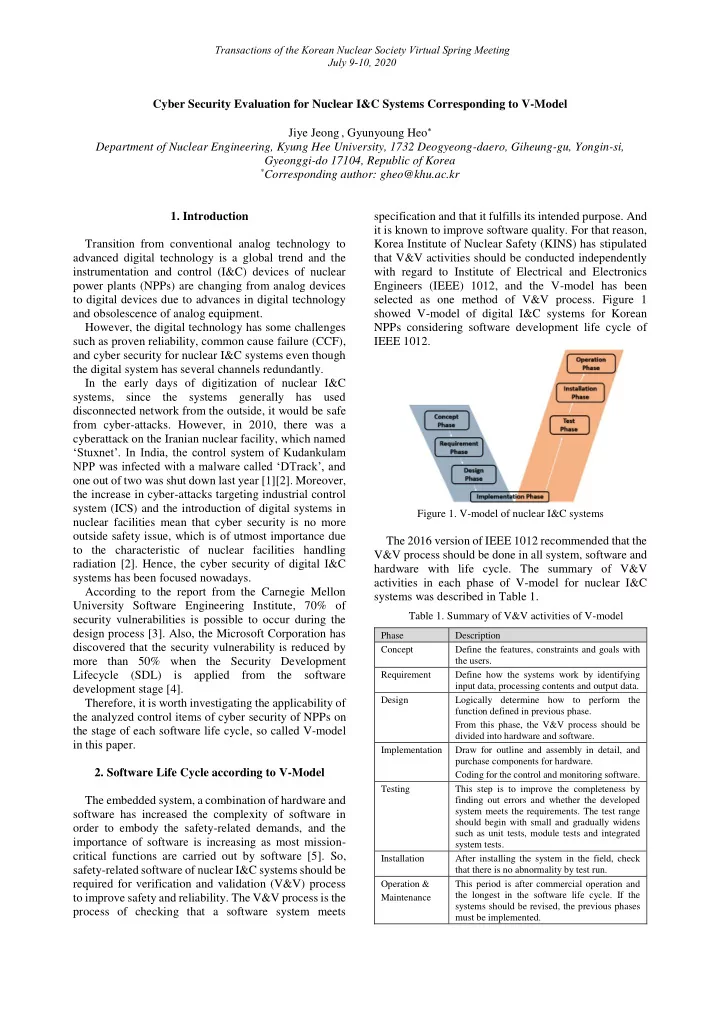
importance of software is increasing as most mission- critical functions are carried out by software [5]. So, safety-related software of nuclear I&C systems should be required for verification and validation (V&V) process to improve safety and reliability. The V&V process is the process of checking that a software system meets specification and that it fulfills its intended purpose. And it is known to improve software quality. For that reason, Korea Institute of Nuclear Safety (KINS) has stipulated that V&V activities should be conducted independently with regard to Institute of Electrical and Electronics Engineers (IEEE) 1012, and the V-model has been selected as one method of V&V process. Figure 1 showed V-model of digital I&C systems for Korean NPPs considering software development life cycle of IEEE 1012.
Figure 1. V-model of nuclear I&C systems
The 2016 version of IEEE 1012 recommended that the V&V process should be done in all system, software and hardware with life cycle. The summary of V&V activities in each phase of V-model for nuclear I&C systems was described in Table 1.
Table 1. Summary of V&V activities of V-model
Phase Description Concept Define the features, constraints and goals with the users. Requirement Define how the systems work by identifying input data, processing contents and output data. Design Logically determine how to perform the function defined in previous phase. From this phase, the V&V process should be divided into hardware and software. Implementation Draw for outline and assembly in detail, and purchase components for hardware. Coding for the control and monitoring software. Testing This step is to improve the completeness by finding out errors and whether the developed system meets the requirements. The test range should begin with small and gradually widens such as unit tests, module tests and integrated system tests. Installation After installing the system in the field, check that there is no abnormality by test run. Operation & Maintenance This period is after commercial operation and the longest in the software life cycle. If the systems should be revised, the previous phases must be implemented.