Cyber-FIT An agent-based modeling approach to simulating cyber team - - PDF document

cyber fit
SMART_READER_LITE
LIVE PREVIEW

Cyber-FIT An agent-based modeling approach to simulating cyber team - - PDF document

<Your Name> Cyber-FIT An agent-based modeling approach to simulating cyber team performance Geoffrey Dobson gdobson@andrew.cmu.edu June 2020 Center for Computational Analysis of Social and Organizational Systems


slide-1
SLIDE 1

<Your Name> 1

Center for Computational Analysis of Social and Organizational Systems http://www.casos.cs.cmu.edu/

Cyber-FIT

An agent-based modeling approach to simulating cyber team performance

Geoffrey Dobson

gdobson@andrew.cmu.edu June 2020

2 Geoffrey Dobson

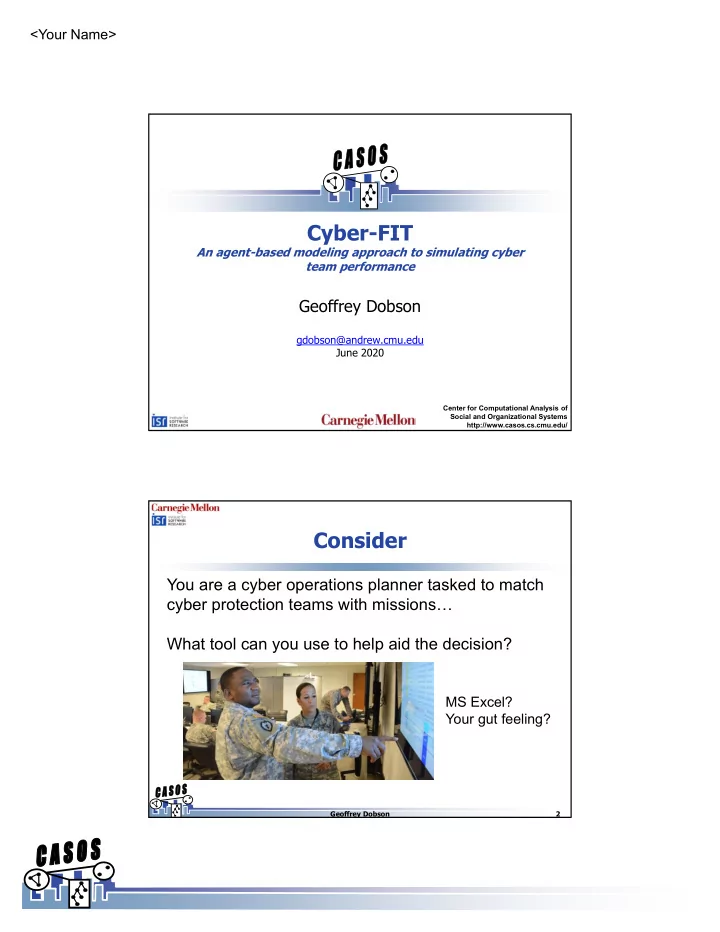
You are a cyber operations planner tasked to match cyber protection teams with missions… What tool can you use to help aid the decision?

Consider

MS Excel? Your gut feeling?

slide-2
SLIDE 2

<Your Name> 2

3 Geoffrey Dobson

Consider

You are war-gaming a projected conflict with the DoD’s most sophisticated simulation tool, OneSAF… How do you simulate varying cyber team makeups in varying projected scenarios?

You can’t

4 Geoffrey Dobson

DoD Cyber Strategy

slide-3
SLIDE 3

<Your Name> 3

5 Geoffrey Dobson

Defense Science Board Report

7 out of 16 could be considered “team performance” measures

6 Geoffrey Dobson

DoD Cyber Training Budgeting

https://www.fifthdomain.com/dod/2018/02/21/army-requests-429-million-for-new-cyber-training-platform/

“several training exercises authorized for 2017 as part of the Combatant Commander Exercise Engagement and Training Transformation (CE2T2) program, funded at more than $150 million”

https://prhome.defense.gov/Portals/52/Documents/RFM/Readiness/docs/Cyber%20Training%2 0in%20DoD%20FY2017%20budget.pdf

slide-4
SLIDE 4

<Your Name> 4

7 Geoffrey Dobson

White House Executive Order

8 Geoffrey Dobson

How to Measure Cyber Teams?

slide-5
SLIDE 5

<Your Name> 5

9 Geoffrey Dobson

Use Agent-Based Modeling?

Wang, Fei-Yue, Kathleen M. Carley, Daniel Zeng, and Wenji Mao. "Social computing: From social informatics to social intelligence." IEEE Intelligent systems 22, no. 2 (2007).

10 Geoffrey Dobson

Use Agent-Based Modeling?

“Each agent individually assesses its situation and makes decisions on the basis of a set of rules”.

Bonabeau, Eric. "Agent-based modeling: Methods and techniques for simulating human systems." Proceedings of the National Academy of Sciences 99, no. suppl 3 (2002): 7280-7287.

An agent is: identifiable, situated, goal-directed, autonomous, flexible

Macal, Charles M., and Michael J. North. "Tutorial on agent-based modeling and simulation." In Simulation conference, 2005 proceedings of the winter, pp. 14-pp. IEEE, 2005.

slide-6
SLIDE 6

<Your Name> 6

11 Geoffrey Dobson

Cyber-FIT Framework

Force Agents:

  • Represent the military personnel
  • Autonomous
  • Heterogeneous
  • Differential behavior
  • React to terrain agents, force

agents Interactions Terrain Agents:

  • Represent the military computers
  • Autonomous
  • Heterogeneous
  • Differential behavior
  • React to environment,

Interactions

12 Geoffrey Dobson

The Measures of Cyber Teams

  • Guiding Research Questions:

– Is this cyber operation effective? – Is the cyber terrain vulnerable? – Have we disrupted the adversary maneuver? – How many cyber forces are necessary?

slide-7
SLIDE 7

<Your Name> 7

13 Geoffrey Dobson

The Measures of Cyber Teams

  • Guiding Research Questions:

– Is this cyber operation effective? Measure: terrain compromise rate – Is the cyber terrain vulnerable? Measure: terrain vulnerability rate – Have we disrupted the adversary maneuver? Measure: adversary phase time – How many cyber forces are needed? Measure: cyber situational awareness

SBP-BRIMS 2017 ICCWS 2018 SBP-BRIMS 2018

14 Geoffrey Dobson

Remainder of Presentation

  • Cyber-FIT versions 1 - 4
  • Demonstration
slide-8
SLIDE 8

<Your Name> 8

15 Geoffrey Dobson

Cyber-FIT Framework v 1

Goal of Version 1: Create a minimally viable model that can be used to run proof of concept virtual experiments

16 Geoffrey Dobson

Cyber-FIT Framework v 1

Forces

  • Defensive Forces defend, Offensive Forces attack
slide-9
SLIDE 9

<Your Name> 9

17 Geoffrey Dobson

Cyber-FIT Framework v 1

Terrain

Networking Servers Clients

Not Vulnerable Vulnerable Compromised Payload Present States

18 Geoffrey Dobson

Cyber-FIT Framework v1

Interactions are directed links from one agent to another

slide-10
SLIDE 10

<Your Name> 10

19 Geoffrey Dobson

Cyber-FIT v1 Definitions

Three environments

Terrain Base Industrial Tactical

20 Geoffrey Dobson

Cyber-FIT v1 Definitions

Terrain Cyber Terrain Type Base Tactical Industrial Networking L M H Servers L H M Clients H M L Vulnerability Growth Rate Across Environments (*Expert Interviews)

slide-11
SLIDE 11

<Your Name> 11

21 Geoffrey Dobson

Cyber-FIT v1 Definitions

Environment type Terrain type

22 Geoffrey Dobson

Cyber-FIT v 1

slide-12
SLIDE 12

<Your Name> 12

23 Geoffrey Dobson

Cyber-FIT v1 Virtual Experiments

What is the expected effect on cyber terrain if the adversary switches from a fifteen day routing protocol attack, to a denial of service attack in a base environment with 6 troops deployed?

24 Geoffrey Dobson

Cyber-FIT v 1 Virtual Experiments

Type 2 (servers) will experience lower compromise rate than Type 1 (networking)

slide-13
SLIDE 13

<Your Name> 13

25 Geoffrey Dobson

Cyber-FIT v1

Goal of Version 1: Create a minimally viable model that can be used to run proof of concept virtual experiments

26 Geoffrey Dobson

Cyber-FIT v2

Goal of Version 2: Incorporate empirical data to add realistic complexity to the model

slide-14
SLIDE 14

<Your Name> 14

27 Geoffrey Dobson

Cyber-FIT v2

Source: https://www.lockheedmartin.com/en-us/capabilities/cyber/cyber-kill-chain.html

Force the attacker agents to traverse the cyber kill chain

28 Geoffrey Dobson

Cyber-FIT v2

Adversary Behavior Modeling

slide-15
SLIDE 15

<Your Name> 15

29 Geoffrey Dobson

Cyber-FIT v2 Virtual Experiments

What is expected time to complete phases three and four during a denial of service attack, with six defensive cyber forces deployed, as the exploitation success rate is increased from two to forty?

How to decrease exploit success rate?

  • Updated Operating Systems and Software
  • Patching
  • Maintenance
  • User Access Control
  • Training

30 Geoffrey Dobson

Cyber-FIT v2 Virtual Experiments

slide-16
SLIDE 16

<Your Name> 16

31 Geoffrey Dobson

Cyber-FIT v2 Virtual Experiments

Takeaway: Exploit Success Rate has larger effect on delivery phase time! Defensive Forces should ensure cyber security tools will alert when Attacker Forces are delivering payload

32 Geoffrey Dobson

Cyber-FIT v2

Goal of Version 2: Incorporate empirical data to add realistic complexity to the model

slide-17
SLIDE 17

<Your Name> 17

33 Geoffrey Dobson

Cyber-FIT v3

Goal of Version 3: Incorporate theoretical model into Cyber-FIT

https://www.c-mric.com/wp-content/uploads/2017/10/rsz_ijcsa_vol2.jpg 34 Geoffrey Dobson

Cyber-FIT v3

“In summary, Cyber SA encompasses people (operator/team), process and technology required to gain awareness of historic, current and impending (future) situations in cyber, the comprehension of such situations, and using those understandings to estimate how current situations may change, and through those predict future situations and the resolution of the current situation, and the enablement of controls to protect the systems from future projected incidents.”

Source: https://www.c-mric.com/wp-content/uploads/2017/10/article1.pdf

slide-18
SLIDE 18

<Your Name> 18

35 Geoffrey Dobson

Cyber-FIT v3

“In summary, Cyber SA encompasses people (operator/team), process and technology required to gain awareness of historic, current and impending (future) situation … “ Compare true state to agent knowledge

36 Geoffrey Dobson

Cyber-FIT v3

slide-19
SLIDE 19

<Your Name> 19

37 Geoffrey Dobson

Cyber-FIT v3 Virtual Experiments

What is the maximum cyber situational awareness during a cyber terrain survey?

Takeaway: Full Cyber SA not possible, so what is the steady state for your team?

38 Geoffrey Dobson

Cyber-FIT v3

Goal of Version 3: Incorporate theoretical model into Cyber-FIT

slide-20
SLIDE 20

<Your Name> 20

39 Geoffrey Dobson

Cyber-FIT Spiral Development

V5 TBD V4 The Performance Measures of Cyber Teams V3 Explored Cyber Situational Awareness Theory V2 Added Empirical Data V1 Foundation NetLogo Repast Realism, Scalability

40 Geoffrey Dobson

The Performance Measures of Cyber Teams

slide-21
SLIDE 21

<Your Name> 21

41 Geoffrey Dobson

The Performance Measures of Cyber Teams

Measure Description Time to react Time to observe and log new vulnerability, indicator of compromise, or exploit Time to restore Time to restore compromised systems Time to survey Time to complete survey phase of the operation Time to secure Time to complete secure phase of the operation Cyber situational awareness Total knowledge of the team, as it relates to terrain status, prioritizations of activities, and awareness of what teammates are working on Operational effectiveness Ratio of successful operations divided by total operations over given time interval Operational variance The aggregate difference in tasks being performed by the team Operational efficiency Ratio of time spent on operations, weighted by severity, and total operations for a given mission Communication variance The aggregate difference in message types being communicated by the team Communication efficiency Ratio of total messages sent and total operations for a given mission Planning efficacy The difference in selected outcome measures as a result of effective cyber mission planning Terrain vulnerability rate Total vulnerabilities of all assigned cyber terrain as a percentage of total possible vulnerabilities Terrain vulnerability change Change in vulnerability since beginning operations Terrain compromises Total number of compromised terrain Terrain compromise change Change in compromised terrain since beginning operations Terrain compromise time Total time terrain is in compromised state Interaction Network Density Proportion of interactional links in the network to total possible links Interaction Network Total- Degree Centralization Total degree centrality of each node in a unimodal network Cyber mission capability rate Ratio of system information request fulfillments and total information system requests by friendly forces conducting kinetic missions Time to breach Time for adversarial cyber forces to access unauthorized cyber terrain Time to deliver Time for adversarial cyber forces to deliver attack or malware payload to system Time to compromise Time for adversarial cyber forces to compromise system Compromise success rate Ratio of adversarial cyber forces’ successful versus unsuccessful compromise attempts

42 Geoffrey Dobson

The Performance Measures of Cyber Teams

Measure Description Question? Time to Restore Average time for cyber team to restore degraded cyber terrain assets Is the terrain degraded? Cyber mission capability rate Ratio of system information request fulfillments and total information system requests by friendly forces conducting kinetic missions Is the cyber mission successful? Interaction Network Total-Degree Centralization Total degree centrality of each node in a unimodal network Who are the informal leaders?

slide-22
SLIDE 22

<Your Name> 22

43 Geoffrey Dobson

Proposed Virtual Experiment

Independent Variables IV Variants Values Defender Agents 5 [10, 20, 30, 40, 50] Defender Agent Skill 1 [1,2,2,3,3,3,4,4,4,5] Attacker Agents 5 [1-5] Attacker Agent Tiers 6 [1-6] Mission Configurations (Friendly Force Agents and Mission Terrain Agents) 3 [{100,150},{500,750},{1,000,1,500}] Base Terrain Agents 1 800 Dependent Variables: Selected from table This experiment will be 5X5X6X3X30 runs = 13,500 replications

44 Geoffrey Dobson

Agent-Based Model Validation Plan

  • 7 Types of agent-based model validations

– Requirements, data, face, process, model output, agent, and theory

– M. J. North and C. M. Macal, Managing business complexity: discovering strategic solutions with agent-based modeling and simulation, Oxford University Press, 2007.
slide-23
SLIDE 23

<Your Name> 23

45 Geoffrey Dobson

Model Validation Plan

  • 1. Requirements Validation

Guiding Question: Is this model solving the right problem?

Discuss with a focus group of military planners and strategists

46 Geoffrey Dobson

Model Validation Plan

  • 2. Data Validation

Guiding Question: Has the data used in the model been validated?

UML Source code on Github

slide-24
SLIDE 24

<Your Name> 24

47 Geoffrey Dobson

Model Validation Plan

  • 3. Face Validation

Guiding Question: Do the model results look right? Interviews with experts

48 Geoffrey Dobson

Model Validation Plan

  • 4. Process Validation

Guiding Question: Do the internal flows of what is being modeled correspond to the real-world processes? Flow diagrams for selected agent actions

slide-25
SLIDE 25

<Your Name> 25

49 Geoffrey Dobson

Model Validation Plan

  • 5. Model Output Validation

Guiding Question: Do the model outputs match the outputs of real-world systems?

=

Interviews with Experts

50 Geoffrey Dobson

Model Validation Plan

  • 6. Agent Validation

Guiding Question: Do agent behaviors and interaction mechanisms correspond to agents in the real world? Markov Chains for selected agent types compared against real world data *

slide-26
SLIDE 26

<Your Name> 26

51 Geoffrey Dobson

Model Validation Plan

  • 7. Theory Validation

Guiding Question: Does the model make a valid use of the theory?

Computational methodology and formulas documented

52 Geoffrey Dobson

Questions