
SLIDE 1
CLINICAL-PATHOLOGICAL CONFERENCE
CUTANEOUS LEUKOCYTOCLASTIC VASCULITIS AND MEMBRANOPROLIFERATIVE GLOMERULONEPHRITIS WITH MONOCLONAL IGM GAMMOPATHY.
Anna Maria Asunis
Divisione di Anatomia Patologica AO Brotzu, Cagliari (CA), IT
CUTANEOUS LEUKOCYTOCLASTIC VASCULITIS AND MEMBRANOPROLIFERATIVE - - PowerPoint PPT Presentation
CLINICAL-PATHOLOGICAL CONFERENCE CUTANEOUS LEUKOCYTOCLASTIC VASCULITIS AND MEMBRANOPROLIFERATIVE GLOMERULONEPHRITIS WITH MONOCLONAL IGM GAMMOPATHY . Anna Maria Asunis Divisione di Anatomia Patologica AO Brotzu, Cagliari (CA), IT Capillary
CLINICAL-PATHOLOGICAL CONFERENCE
Anna Maria Asunis
Divisione di Anatomia Patologica AO Brotzu, Cagliari (CA), IT
Capillary loops: Irregulararly tickened in some tracts, with mesangial proliferation and large fibrinoid deposits (PAS – 20x)
Large fibrinoid deposits subendothelial. Some hyaline thrombi (PAS 40x)
Large fibrinoid deposits with intracapillary
40x)
Irregular subendothelial fibrinoid deposits with numerous polymorphonuclear leukocytes and monocytes (AFOG – 40x)
Mild fibrosis in the mesangium and in some capillary loops
Extensive hyaline casts, fragmented and surrounded by multinucleated cells
Renal specimen including 15 glomeruli. IgM (+++) in capillary thrombi, irrugular and
C3 (++) located as IgM in the tuft. Kappa Chains (++) as IgM in the tuft and in tubular
Lambda Chains (++) in tubular casts. IgG, IgA, C4, C1q, Fbg, and Thioflavine-T antisera
Atypical Membraneproliferative Glomerulonephritis
Glomerular/Vascolar patterns of Plasmacell dyscrasias
Amiloidosi AL
Amiloidosi AH
Light Chain Deposition Disease (LCDD)
Heavy Chain Deposition Disease (HCDD)
Light and Heavy chain deposition Disease (LHCDD)
Crioglobulinemia (tipo 1 e 2)
Monoclonal Immunotactoid Glomerulopathy
Tubular-interstitial involvement
Light chain Cast Nephropathy
Tubular epithelial cell dysfunction
Acute Tubular Necrosis
Thrombus in a glomerular capillary corresponding to a hyaline thrombus by light microscopy. 5500x UrPb
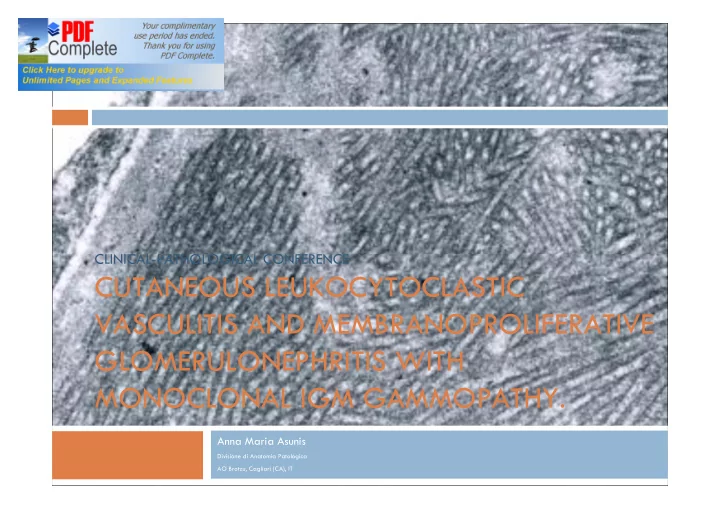
A higher magnification shows deposits composed of slightly curved stacks of microtubular structures with parallel alignment (diameter: 25-30 nm). 87500x UrPb
Organized Glomerular Electron Organized Glomerular Electron-
dense Deposits
Immunofluorescence for Light, Heavy Immunofluorescence for Light, Heavy and AA Protein and AA Protein
LC+ HC+ H&LC+ AA+ Amyloidosis Amyloidosis AL AL Amyloidosis Amyloidosis AH AH Amyloidosis Amyloidosis AHL AHL Amyloidosis Amyloidosis AA AA
Immunofluorescence for Immunofluorescence for Immunoglobulins Immunoglobulins
Collagenofibrotic Glomerulopathy Glomerulopathy
Fibronectin Glomerulopathy Glomerulopathy
Chronic Sclerosis
Diabetes
Fibrillar Glomerulonefritis
Randomly arranged microfibrils (diameter: 12-30 nm; usually around 20 nm) Polyclonal, subclass-restricted IgG in the deposits Mainly primary
Immunotactoids
P Parallel arrays of microtubules (diameter: 10-90 nm; usually above 30 nm) Monoclonal IgG in the deposits Mainly secondary
Cryoglobulinemia
Curved microtubules (diameter: 25-35 nm)
Light/heavy chains deposition disease deposition disease
Dense granules Dense granules
Taken from Atlas of Non tumor Pathology Jennette JC, Silva FG, D’Agati V. (modified)