Update in Vasculitis Advances In Internal Medicine 2015 Rare Rare - - PowerPoint PPT Presentation

update in vasculitis
SMART_READER_LITE
LIVE PREVIEW

Update in Vasculitis Advances In Internal Medicine 2015 Rare Rare - - PowerPoint PPT Presentation

6/25/2015 Black Hole Vasculitis Update in Vasculitis Advances In Internal Medicine 2015 Rare Rare Jonathan Graf, MD Poorly understood mystery of universe Poorly understood mysteries of medicine Professor of


slide-1
SLIDE 1

6/25/2015 1

Update in Vasculitis

Advances In Internal Medicine 2015 Jonathan Graf, MD Professor of Clinical Medicine, UCSF Division of Rheumatology, SFGH

Black Hole Vasculitis

Rare Rare Poorly understood mystery of universe Poorly understood mysteries of medicine Gravity prevents light from escaping Complexity prevents knowledge from escaping If suspected - refer to astrophysicist Suspected cases referred to rheumatologists

General Principles of Vasculitis

  • Not necessarily as rare as one might think
  • 2 general themes:
  • Anatomic consequences of vascular

inflammation

  • Systemic consequences of intense

cytokine release (think sepsis/infection/malignancy) and systemic inflammation

Anatomy of vasculitis

slide-2
SLIDE 2

6/25/2015 2

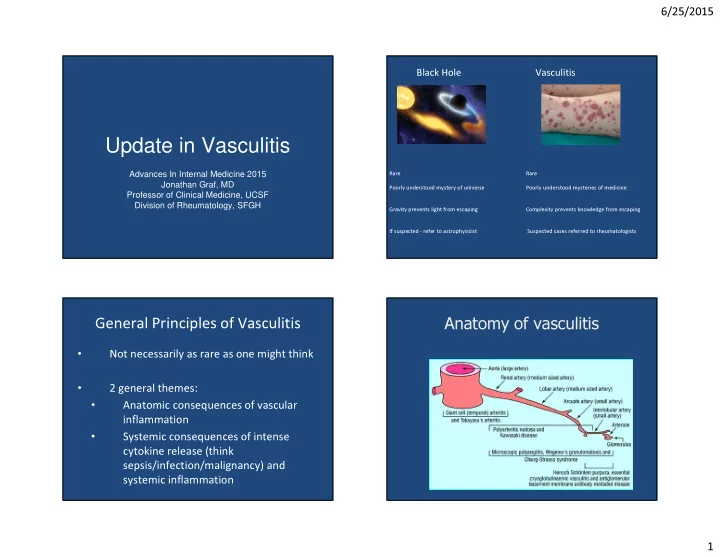
Anatomy of vasculitis Anatomic consequences of vascular inflammation

  • Large vessels

– Limb ischemia, claudication, and stroke

  • Medium vessel

– Organ ischemia (kidney, bowel, nerve infarction, skin ulcers)

  • Small vessel (capillaries)

– Capillaritis –Diffuse alveolar hemorrhage, palpable purpura, glomerulonephritis

How common is vasculitis??

Giant Cell Arteritis: Epidemiology

  • Annual incidence approx 18/100,000 (Minn) 22/100,000 (UK) in

individuals > 50 years of age

  • Higher incidence in northern latitudes
  • Prevalence of GCA 200/100,000 in individuals > 50 years of age

(0.2%)

  • 70% female
  • Rare before age 50.
  • Increases in prevalence with each decade with peak 70-80
slide-3
SLIDE 3

6/25/2015 3

Giant Cell Arteritis Clinical Manifestations

  • Anatomy
  • Large Vessel Vasculitis

(arteries with internal elastic laminae)

  • Most commonly involves

extra-cranial vessels (external corotid) but can involve internal corotid and branches

  • Inflammation in vessel

wall (sometimes but not always with giant cells) leads to intimal and medial proliferation and

  • cclusion of vessel

Giant Cell Arteritis Clinical Manifestations

  • Headache (70-80% at one time or another)

– Commonly dull, aching, often over the temporal area but can be anywhere – Scalp tenderness may be present

  • Visual Changes

– Present in up to a third of patients – Blurred vision, diploplia, amaurosis fugax often presage blindness – Monocular blindness can be abrupt without warning – Can be permanent

Giant Cell Arteritis Clinical Manifestations

  • Jaw Claudication

– Most specific symptom for GCA – Classic presentation is discomfort over masseter muscles with protracted chewing – This is not pain at temporal mandibular joint

  • Constitutional signs are common in this SYSTEMIC disease (lots
  • f pro-inflammatory cytokines)
  • Weight loss, malaise
  • Low grade fever in up to half of patients (Cause of FUO in elderly)
  • 40-50% develop PMR (may precede, follow, or occur

concomitantly)

  • Hallmarks of IL-6 driven disease (inflammation and high CRPs)
slide-4
SLIDE 4

6/25/2015 4

Retinal Ischemia

Giant Cell Arteritis Work-up

  • Establish pre-test probability of GCA using

demographics, history, physical exam

  • Laboratory Evaluation

– ESR and CRP

  • >90% patients have an ESR >50; frequently >100
  • C-reactive protein may be more sensitive and be elevated in

patients with normal ESR

Giant Cell Arteritis: Diagnosis

  • Temporal artery

biopsy

– If elect to pursue biopsy, initiate prednisone 1 mg/kg/day – Request 3-5 CM segment of artery. – Unilateral biopsy is >90% sensitive – 2 weeks of empiric prednisone does not significantly affect the sensitivity.

GCA: Treatment

  • Treat with large, long-term corticosteroids (1 mg/kg) and with

expectation of long-term therapy (and morbidity)

  • No proven steroid-sparing regimen, but baby ASA usually given as

adjuvant therapy to reduce thrombotic complications

  • Majority of patients will experience a durable remission but a

substantial minority (40%) will relapse

  • Relapse can be usually be treated with increases of 10-20% prednisone

dosage and are rarely associated with ischemic complications

  • Persistent elevations in inflammatory markers (ESR/CRP) and more

rapid tapers of corticosteroids associated with higher risk of relapse

slide-5
SLIDE 5

6/25/2015 5

Advances in approach to GCA

  • Improvements in diagnosis (imaging)
  • Better understanding the clinical spectrum of

the disease

  • Advances in therapy coming soon…..

Diagnosing GCA

  • Currently – much rests on empiricism

– Practice is to place patients with suspected GCA based upon history/physical exam on high dose prednisone and arrange for a biopsy – Cutoff can be as low as 10% pre-test clinical suspicion to trigger above algorithm given potential morbidity of disease

  • Biopsy is invasive and difficult to diagnose

– Often segmental (skip lesions can be missed) – Negative biopsy raises problems about continuing long term morbid therapy

GCA Diagnosis: Ultrasound

  • In the right hands, classic

ultrasound findings of GCA include a periluminal “halo sign” of hypoechoic edema in the vessel wall

  • Also can see stenoses and
  • cclusion
  • Operator dependent and not

reliably reproduced

GCA: Large Vessel Involvement

  • Large vessel involvement is more common than
  • nce thought
  • 25% of patients have large vessel arteritis

(often can be symptomatic)

  • When great vessel dz is suspected, MRI/MRA or

CTA are reliable diagnostic tools for visualizing intramural edema (inflammation), thickening, stenoses, aneurisms

  • FDG-PET/CT might be more sensitive: can

detect inflammation in vessel wall in over 50%

  • f GCA pts.
  • Use of FDG-PET/CT to quantify inflammation in

GCA is not standardized and can be nonspecific (atherosclerosis also can look “inflammatory”) – Cases of FUO or in suspected disease with negative TA biopsy

slide-6
SLIDE 6

6/25/2015 6

A 78-y-old woman presented with 6 wk of fever, night sweats, and weight loss. Zohar Keidar et al. J Nucl Med 2008;49:1980-1985

GCA and mortality

  • Traditional wisdom: equivocal if

GCA increases mortality

  • Increasing recognition of long

term complications associated with GCA

  • Aortic aneurisms: higher

rate of rupture and dissection

  • Atherosclerotic CV dz

0-2 yrs 2-10 yrs >10 yrs All cause mortality MRR 1.17 (1.01, 1.36) MRR 0.96 (0.88, 1.05) MRR 1.22 (1.05,1.41) Circulatory System MRR 1.32 ND MMR 1.47 Coronary artery disease MMR 1.39 ND ND Aortic Aneurism MMR 3.69 ND ND

1787 Patients with Histologically confirmed GCA

GCA: Future Therapies

  • Long term corticosteroid exposure

associated with morbidity

  • Search for steroid-sparing agents

generally underwhelming

  • Methotrexate
  • Azathioprine
  • Infliximab and other anti-TNF

therapies

slide-7
SLIDE 7

6/25/2015 7

Tocilizumab (Actemra)

  • Antibody to the IL-6

receptor complex

  • By inhibiting IL-6 signaling,

markedly reduces acute phase inflammatory response

  • Inflammation in GCA is

thought of as a prototypically IL-6 driven disease

7 patients with refractory large vessel vasculitis (including GCA, TA) despite trials of other corticosteroid sparing agents All patients responded after 8-12 weeks of therapy and remained in clinical remission on therapy All patients tapered their prednsone dose from mean 20 mg/day to <6 mg/day One patient died of preoperative MI and on autopsy was found to have

  • ngoing vasculitis despite being “in

clinical remission”

Giant Cell Arteritis: Summary

  • Common form of a systemic vasculitis that increases in

prevalence with age and latitude

  • Diagnosis continues to rest on clinical suspicion and

histopathologic confirmation

  • New imaging techniques may be beneficial in specific cases

(FUO, TA bx neg, or suspected extra-cranial involvement)

  • Treatment continues to rely on long-term susbstntial doses
  • f corticosteroids

– Hope that preliminary data an ongoing large clinical trials will usher in age of biologic (anti-IL6) therapy

Case

  • 36 year old female is admitted to the hospital with hemoptysis,

respiratory distress, and acute kidney injury. She is taking no medications, is married, and has no children.

  • Her exam is significant for hypoxemia, and hypertension and her

workup includes CXR with bilateral pulmonary nodules and infiltrates and an elevated creatinine with hematuria and dysmorphic RBC’s. Her urine tox screen is negative and C-ANCA and Proteinase-3 antibodies are positive. Kidney biopsy reveals a pauci-immune necrotizing glomerulonephritis.

slide-8
SLIDE 8

6/25/2015 8

Chest CT: Multiple Pulmonary Nodules And Ground Glass Opacities Necrotizing Glomerulonephritis

Question

This patient’s diagnosis is most consistent with: A. Wegener’s Granulomatosis B. Microscopic polyangiitis C. Systemic Lupus Erythematosus D. None of the Above

W e g e n e r ’ s G r a n u l

  • m

a t

  • s

i s M i c r

  • s

c

  • p

i c p

  • l

y a n g i i t i s S y s t e m i c L u p u s E r y t h e m . . . N

  • n

e

  • f

t h e A b

  • v

e

84% 7% 5% 5%

Apologies!!! A Renamed Disease!

  • This patient’s diagnosis is most consistent

with: A. Wegener’s Granulomatosis B. Microscopic polyangiitis C. Systemic Lupus Erythematosus D. None of the Above

Granulomatosis with Polyangiitis (GPA)

  • Friedrich Wegener: German

pathologist credited with describing the disease (died in 1990)

  • Wegener’s past ties to nazi party

(1932) and work near Jewish Ghetto

  • f Lodz have become more clearly

understood in recent years

  • 2011: Led to renaming of WG as GPA

by major medical organizations including the ACR

  • This patient does have this disease!!
slide-9
SLIDE 9

6/25/2015 9 ANCA Associated Vasculitis: Quick Facts

  • Wegener’s Granulomatosis: Renamed

Granulomatosis with Polyangiitis 2010 (GPA)

– Clinical

  • Sinus – chronic sxs, necrotizing disease
  • Lungs – nodules, cavities, alveolar hemorrhage
  • Kidneys – pauci-immune glomerulonephritis; normal

complements

– c-ANCA: anti-proteinase-3 abs are highly sensitive

ANCA Associated Vasculitis

  • Microscopic polyangiitis

– Clinical

  • Skin – palpable purpura, ulcers
  • Lungs – Diffuse alveolar hemorrhage
  • Kidneys – glomerulonephritis
  • Neuro – mononeuritis multiplex
  • p-ANCA – anti-myeloperoxidase abs
  • MPA – 75% sensitive
  • Can also be abnormal with Churg-Strauss (EGPA)

Granulomatosis with polyangiitis therapy

  • Until 1970’s nearly universal fatal disease
  • 80% 3 yr mortality improved only slightly with corticosteroids

(mean survival 12.5 months)

  • Introduction of cyclophosphamide turned fatal disease into

treatable disease

  • Oral cyclophosphamide (Cyc) (2mg/kg/day) + corticosteroids

(far more potent regimen that IV)

  • Corticosteroid taper 6-9 months. Cyc continued full dose for at

least 1 year AFTER remission and then tapered

What’s worse: Disease or treatment?

  • Long term effects of Cyc therapy:

– Infections – Sterility – Post treatment malignancies (hematologic, bladder)

  • Clinical trials changed practice habits have evolved

– shorter courses of induction therapy – use of less toxic DMARDs for longer term maintenance

  • f remission

– Use of less toxic DMARDs for treatment of “limited disease” (limited to upper airways)

  • Methotrexate
  • Azathioprine
slide-10
SLIDE 10

6/25/2015 10

Case continued

The patient is initially treated with high dose pulses of IV corticosteroids and begins to improve. However when cytotoxic therapy with oral cyclophosphamide is recommended, she expresses concern over her risks of becoming infertile, and she strongly desires to have a child in the next few years.

Question

Which of the following statements is not correct? A. Risk of premature menopause resulting from cytoxan is dose and age-dependent B. Corticosteroids alone are not sufficient therapy to treat this disease C. Cytotoxic therapy should not be delayed for several months while the patient undergoes egg harvesting and cryopreservation D. Oral Cyclophosphamide is the only therapy approved to treat GPA

Risk of premature meno... Corticosteroids alone are... Cytotoxic therapy should... Oral Cyclophosphamide i...

9% 59% 29% 3%

Rituximab versus Cyclophosphamide for ANCA-Associated Vasculitis

Rituximab, B-cells, and ANCA

  • Antineutrophil cytoplasmic antibodies are possibly

implicated in pathogenesis or propagation/potentiation of ANCA-vasculitis

  • Rituximab is a selective B-cell depleting antibody (anti-CD20)
  • Possibility to remove ANCA by eliminating B-cells that would

replace short-lived ANCA producing plasma cells

  • Other possible mechanisms by which B-cells might be

implicated in ANCA vasculitis

slide-11
SLIDE 11

6/25/2015 11

RAVE Study

Stone et al. NEJM 2010;363:221-32

  • Multicenter, randomized, double dummy , double blinded

placebo controlled non-inferiority trial

  • Oral Cytoxan (gold standard) vs. Rituximab
  • Both regimens given with corticosteroids
  • Included patients with both GPA and MPA (microscopic

polyagiitis) as well as patients with relapsing disease

  • Primary outcome: remission at 6 months free of

glucocorticoid use (won’t get into specifics of how remission defined).

RAVE: 6 month Summary

  • 197 patients enrolled
  • 64% patients in rituximab arm reached endpoint vs. 53% in

cytoxan arm (p<0.001)

– Comparable non-inferiority for GPA and MPA – Comparable non-inferiority for alveolar hemorrage or major renal disease

  • Ritux more effective for relapsing patients to achieve

primary endpoint (67%) vs. cytoxan (42%) (P=0.01)

  • No difference in Adverse Events (surprising)

– Our patient was concerned about fertility, not infections!

  • FDA approval for rituximab to treat both GPA and MPA in

4/2011

RAVE: 18 months outcomes

Encompassing induction and maintenance therapy

  • SINGLE course of rituximab compared to oral

Cyc + maintenance azathioprine up to 18 months

  • Remission Rates

12 mo. 18 mo. Ritux 48%* 39%* Cyc + AZA 39%* 33%*

  • p<0.001 for non-inferiority
  • Superiority for patients with previous relapse

at 12 months but not 18 months (B-cells have reconstituted)

AAV: Maintenance regimens:

Comparing less toxic maintenance regimens

  • MTX and AZA equally

effective with similar adverse event rate

Pagnoux et al. N Engl J Med 2008;359:2790-803.

Hiemstra et al. JAMA. 2010;304(21):2381-2388

AZA SUPERIOR to MMF (Cellcept) in maintaining remission (HR 1.69 p=0.03) with similar adverse event rate
slide-12
SLIDE 12

6/25/2015 12

AAV: Role of Rituximab in maintenance

Guillevin et al. N Engl J Med 2014;371:1771-80.

  • 115 patients (GPA, MPA) in

remission after Cyc + corticosteroids

  • Randomly assigned to

rituximab (0,6,12,18 months) and AZA (2 mg/kg tapered to 1 mg/kg for 22 months)

  • NOT blinded
  • Patients followed to month 28

Rituximab: Maintenance for ANCA Vasculitis

Guillevin et al. N Engl J Med 2014;371:1771-80.

Month 28 relapses(n) Month 28 relapses (%) Hazzard Ratio Rituximab 3/57 5% 1 Azathioprine 17/58 29% 6.61 p=0.002

ANCA Associated Vasculitis Summary

  • Rituximab non-inferior to oral cyclophosphamide in inducing

remission for ANCA associated vasculitis but also doesn’t appear to necessarily offer safety advantage

  • Rituximab likely superior for patients with relapsing disease
  • Methotrexate and azathioprine reasonable alternatives to treat

upper airway “limited disease” in GPA

  • Rituximab appears to be superior therapy for maintaining

remission of AAV > 2 years after remission, although azathioprine is acceptable alternative maintenance regimen

Case

  • 46 year old female admitted to to the hospital with

painful lesions on both of her legs and ears. Lesions

  • n legs began six months earlier and progressed from

small papules to large, necrotic purpura and

  • ulcerations. No other apparent organ involvement other

than skin. Her past medical history is notable only for hypertension and her PE other than her skin is

  • unremarkable. Her family history is unremarkable and

her social history notable for occasional recreational drug and alcohol use. She only takes lisinopril and hydrazine for hypertension and has no medication allergies.

slide-13
SLIDE 13

6/25/2015 13

Skin Rash

Pertinent Laboratory Results

  • WBC was 1.8 and her ANC (800) and ALC (900)

were low.

  • ESR and CRP were elevated (48 and 44)
  • HBV Sag -, HCV +, LFTs normal
  • Serum creatinine, urinalysis, blood cultures,

complements, and cryoglobulins normal

Further Diagnostic Workup

  • ANA positive (1:640 diffuse pattern)
  • Anti-dsDNA was 1:40, but other ANA sub-

serologies were negative

  • pANCA positive > 1:20,480

– Anti-MPO: low positive – Anti-PR3: low positive “Innumerable fibrin thrombi within nearly every superficial dermal vessel and a variable dense neutrophilic infiltrate surrounding some affected vessels”

slide-14
SLIDE 14

6/25/2015 14

Question

In this patient’s case, what is the most likely cause of this patient’s symptoms? A. Systemic lupus erythematosus B. Granulomatosis with polyangiitis C. Microscopic polyangiitis D. Cocaine adulterant

S y s t e m i c l u p u s e r y t h e m a . . . G r a n u l

  • m

a t

  • s

i s w i t h p

  • l

. . . M i c r

  • s

c

  • p

i c p

  • l

y a n g i i t i s C

  • c

a i n e a d u l t e r a n t

7% 49% 41% 2%

Advisory: Cocaine mixed with Levamisole

  • 70 percent of cocaine tested by DEA 7/09

positive for levamisole

  • Immuno-modulating medication to treat

colon cancer, nephrotic syndrome, RA

  • No longer used in humans because of

toxicity that includes neutropenia

  • 20 cases (2 fatal) agranulocytosis in Seattle

and Calgary thought due to levamisole adultered cocaine

  • Most of aforementioned cases had

borderline or frank neutropenia

Increasing adulteration of cocaine with levamisole

Casale J, Corbeil E, and Hays P. DEA Resources, Microgram Journal; 6, Jan-Jun 2008

Novel syndrome associated with levamisole-adulterated cocaine

  • Retiform purpura and extensive

cutaneous necrosis that affects mostly females 40-50

  • Large areas of skin necrosis - not smaller

lesions of palpable purport as would be seen in leukocytoclastic vasculitis

  • “Classically” involves skin but
  • ccasionally can be associated with

vasculitis elsewhere (kidney)

  • Extensive small vessel thrombosis

with/without leukocytoclastic vasculitis

  • Frequent cytopenias (neutropenia)
slide-15
SLIDE 15

6/25/2015 15

Novel syndrome associated with levamisole-adulterated cocaine

  • Associated with multiple autoantibodies

– “Sky high” titers of pANCA with antibodies to multiple components of neutrophil granules – Not just antibodies to MPO

  • Tends to improve with cessation of

levamisole exposure

– Evidence lacking for use of immunosuppressants

Differentiating levamisole toxicity from idiopathic pANCA vascultitis

Coc-Levamisole Patients Classic Microscopic Polyangiitis

Retiform purpura Palpable purpura (cheek/ear) (different distribution) Neutropenia Leukocytosis Small vessel thrombotic Leukocytoclastic vascultiis vasculopathy > vascultis “Sky-high” pANCA+ pANCA+ “within reason” MPO titer lower than pANCA MPO titer correlates with pANCA