Curricular Change Muhlenberg College Presenters Sharon Albert, - - PowerPoint PPT Presentation

curricular change
SMART_READER_LITE
LIVE PREVIEW

Curricular Change Muhlenberg College Presenters Sharon Albert, - - PowerPoint PPT Presentation

Integrating Assessment and Faculty Development to Lead Curricular Change Muhlenberg College Presenters Sharon Albert, Senior Lecturer, Religion Studies, Co-coordinator of Integrative Learning Kathleen Harring, Provost, Professor,


slide-1
SLIDE 1

Curricular Change

Integrating Assessment and Faculty Development to Lead

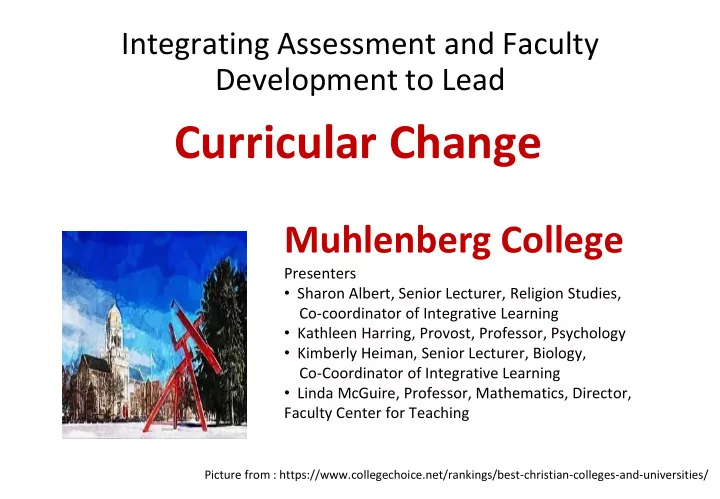
Picture from : https://www.collegechoice.net/rankings/best-christian-colleges-and-universities/

Muhlenberg College

Presenters

  • Sharon Albert, Senior Lecturer, Religion Studies,

Co-coordinator of Integrative Learning

  • Kathleen Harring, Provost, Professor, Psychology
  • Kimberly Heiman, Senior Lecturer, Biology,

Co-Coordinator of Integrative Learning

  • Linda McGuire, Professor, Mathematics, Director,

Faculty Center for Teaching

slide-2
SLIDE 2

General Education Revision: Backstory

  • 2013 adoption of revised curriculum
  • First significant revision since 1989
  • Integrative learning as core element in response

to assessment data

  • Less success at this than our peer institutions

Photo From: Muhlenberg Website

slide-3
SLIDE 3

Curricular Revision: The Dawn of a Living Curriculum

Adopt new General Education Curriculum Pilot new curricular element: Clusters Assess Cluster effectiveness Fully implement Clusters Faculty development workshop

Funding to support new course development

Assessment findings reported to Faculty Faculty development workshop

slide-4
SLIDE 4

Clusters

Signature element of the 2013 curricular revision

  • Two linked courses
  • Taken during Sophomore year
  • Common student cohort
  • Some shared learning goals & assignments
  • Challenges
  • Limited student choice
  • Logistically difficult to implement

Fall 2017 (BIO 129) Fall 2017 (PSY 180)

slide-5
SLIDE 5

Faculty Development for Clusters

  • May workshops
  • Informal “Check-in” conversations during AY
  • Funding to support new course development
  • Assessment findings reported to Faculty

Photo From: Muhlenberg Website

slide-6
SLIDE 6

Cluster Assessment Findings

  • Correlation of “Clusters” and integrative learning not

explicit in the curriculum

  • no common language, definition, or learning goals
  • Evidence of improvement in students’ integrative

learning

  • less visible due to lack of “integrative learning” language
  • Faculty & student reported significant scheduling issues
  • Early implementation course needs met, but deep

concern about long-term sustainability

slide-7
SLIDE 7

Transforming Clusters into the Integrative Learning (IL) Requirement

Faculty vote to change Cluster requirement

2016/2017 APC leads Integrative Learning revision

Faculty adopt criteria for IL experiences Faculty adopt IL definition and learning goals APC retreat APC & CC retreat AAC&U Institute to develop action plan IL coordinator position established Presentation and discussion at every faculty meeting Informal discussions and outreach by IL co-coordinators Focus groups FCT workshops

slide-8
SLIDE 8

Defining Integrative Learning

Approved by Faculty, January 2017

  • Makes connections that

combine disparate perspectives.

  • Applies multiple ways of

knowing to concepts and experiences.

  • Empowers students to

solve problems and address questions in more comprehensive ways.

Picture from: https://www.slideshare.net/Amberagd/integrative-learning

slide-9
SLIDE 9

At Muhlenberg

Integrative Learning is not mastered but constantly develops and is honed. The Integrative Learning curricular requirement provides opportunities for intentionally and collaboratively cultivating this way of thinking.

Photos From Muhlenberg Website

slide-10
SLIDE 10

Faculty Development & Engagement

  • Focus groups
  • Presentation and discussion at every faculty meeting
  • Informal discussions and outreach by IL co-coordinators
  • Faculty Center for Teaching workshops

Photos From Muhlenberg Website

slide-11
SLIDE 11

Implementing Integrative Learning

Our Action Plan for this year includes:

  • Increased visibility & communication of IL
  • Ensuring student understanding of and investment in IL
  • Engaging with all key stakeholders
  • Faculty development
  • Promoting and supporting integrative research and

teaching

Photo From: Muhlenberg Website

slide-12
SLIDE 12

Why It Worked

1) Support, advocacy, leadership coming from the highest level 2) Informal assessment and individual faculty perceptions taken seriously 3) Developed the developers 4) Collecting feedback and educating community about requirement → happening simultaneously

We now have a Living Curriculum responsive to assessment and linked to faculty development.

slide-13
SLIDE 13

For Discussion

  • What is one important curricular challenge on your

campus that has been identified through assessment?

  • What faculty development opportunities can you

create to address this curricular challenge?

  • How can you ensure that all Faculty know their

voices have been heard?

slide-14
SLIDE 14

Reflecting Back

Briefly:

  • What is the one best idea you’ve heard in this

session?

  • What is the most important thing you’ve learned

from the discussion?

slide-15
SLIDE 15

AAC&U 2018: General Education and Assessment: Foundations for Democracy February 15, 2018, 3:45-4:45pm

Integrating Assessment and Faculty Development to Lead Curricular Change

Our Definition of Integrative Learning Integrative learning enables students to make connections that combine disparate disciplinary, methodological, ideological, or epistemological perspectives. Integrative learning entails applying multiple ways of knowing to concepts and experiences. Effective integrated learning empowers students to recognize and solve problems, address existing questions, and ask new ones in more comprehensive ways. Integrative Learning is not mastered but constantly develops and is honed in many ways. At Muhlenberg, the Integrative Learning curricular requirement provides opportunities for intentionally cultivating this way of thinking in collaborative environments and communities. Academic Learning Goals for Integrative Learning Muhlenberg graduates will be able to:

  • 1. Understand relationships among various ways of knowing, and recognize the strengths and limitations of

different approaches for comprehending phenomena.

  • 2. Use diverse perspectives and their vocabularies to intentionally recognize and solve problems, address

existing questions, and ask new questions.

  • 3. Adapt and apply various perspectives developed in other contexts to new situations, while realizing the

strengths and limitations of these different approaches.

  • 4. Communicate the value of an integrative perspective.

Experiences that qualify for the IL designation will be rostered as courses and will be graded. Students will normally fulfill their IL requirement after their first semester and by the end of their Junior year. Criteria for IL designation IL designations will be granted based on alignment of the experience’s content with Muhlenberg’s Academic Program Goals and Learning Outcomes for Integrative Learning and must meet the following criteria: The experience will:

  • 1. Teach how to incorporate and integrate at least two different perspectives (e.g., disciplinary,

methodological, ideological, or epistemological) as a core focus of the experience. The incorporation and integration of these perspectives should be sustained throughout the experience. [Learning goals 1, 2]

  • 2. Include graded projects/assignments sustained throughout the experience that adapt and apply the

integration between at least two different perspectives (e.g., disciplinary, methodological, ideological, or epistemological methods). This might be one ongoing or a series of smaller assignments. [Learning goal 3]

  • 3. Involve critical reflection of students’ learning and understanding of integrative learning skills. [Learning

goal 4]

  • 4. Be sustained over the equivalent of at least one semester.
slide-16
SLIDE 16

AAC&U 2018: General Education and Assessment: Foundations for Democracy February 15, 2018, 3:45-4:45pm

Muhlenberg College

Integrating Assessment and Faculty Development to Lead Curricular Change

Questions for Discussion

What is one important curricular challenge on your campus that has been identified through assessment? What faculty development opportunities can you create to address this curricular challenge? How can you ensure that all Faculty know their voices have been heard?

Presenters: Sharon Albert, Senior Lecturer, Religion Studies, Co-Coordinator of Integrative Learning Kathleen Harring, Provost, Professor, Psychology Kimberly Heiman, Senior Lecturer, Biology, Co-Coordinator of Integrative Learning Linda McGuire, Professor, Mathematics, Director, Faculty Center for Teaching