Current Trends in Liberal Education Paul Hanstedt Professor of - - PDF document

current trends in liberal education
SMART_READER_LITE
LIVE PREVIEW

Current Trends in Liberal Education Paul Hanstedt Professor of - - PDF document

Current Trends in Liberal Education Paul Hanstedt Professor of English Roanoke College @curriculargeek Perhaps the most important thing to remember: A program for reforming general education should be designed around each institutions


slide-1
SLIDE 1

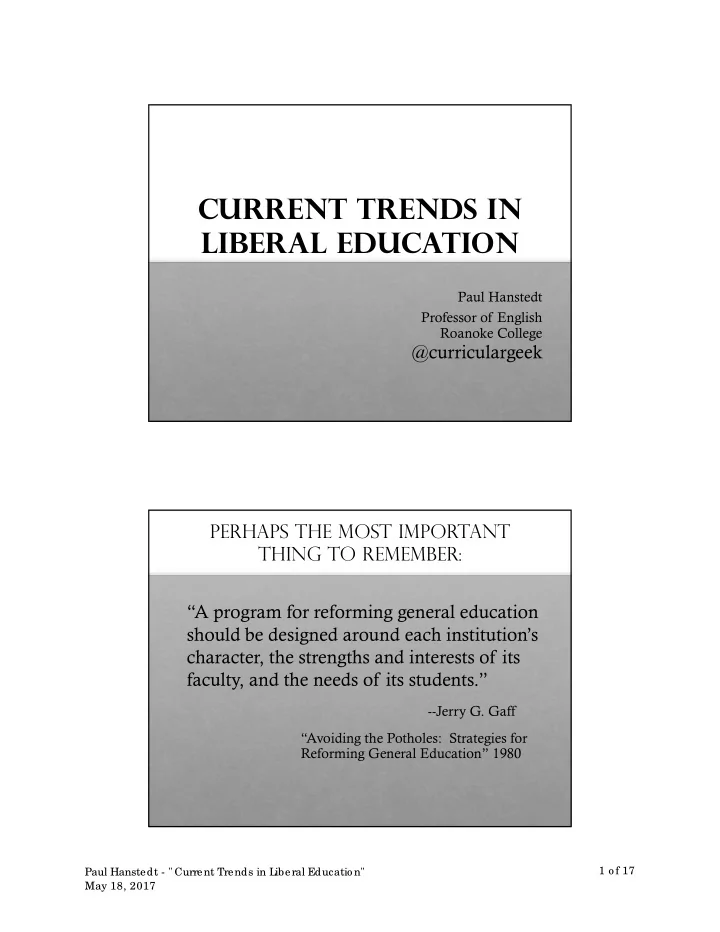
Current Trends in Liberal Education

Paul Hanstedt Professor of English Roanoke College

@curriculargeek Perhaps the most important thing to remember: “A program for reforming general education should be designed around each institution’s character, the strengths and interests of its faculty, and the needs of its students.”

  • -Jerry G. Gaff

“Avoiding the Potholes: Strategies for Reforming General Education” 1980

Paul Hanstedt - " Current Trends in Liberal Education" May 18, 2017 1 of 17

slide-2
SLIDE 2

Breadth Models Integrative Models 2 Social Science 2 Arts and Humanities 2 Math 2 Natural Science 2 Foreign Language 2 PE (Possible additions: Writing 101 and 102) Breadth Models Integrative Models 2 Social Science 2 Arts and Humanities 2 Math 2 Natural Science 2 Foreign Language 2 PE (Possible additions: Writing 101 and 102) Common Core Learning Communities Interdisciplinary Courses Integrative Courses Team-taught Courses Capstone Courses Campus-wide themes ePortfolios Service Learning

Paul Hanstedt - " Current Trends in Liberal Education" May 18, 2017 2 of 17

slide-3
SLIDE 3

Sciences Social Sciences Arts and Humanities

General Education 1.0

Sciences Social Sciences Arts and Humanities

General Education 2.0

Paul Hanstedt - " Current Trends in Liberal Education" May 18, 2017 3 of 17

slide-4
SLIDE 4

Sciences Social Sciences Arts and Humanities

General Education 2.0

Major Courses Community Life Personal Goals Jobs Learning Com- munities Under- graduate Research Service Learning

General Education 3.0

Paul Hanstedt - " Current Trends in Liberal Education" May 18, 2017 4 of 17

slide-5
SLIDE 5

Learning Com- munities Under- graduate Research Service Learning

General Education 3.0

Major Courses Social Sciences Arts and Humanities Sciences 1st-year Exper- iences Global Learning Capstone

General Education 3.0

Major Courses Social Sciences Arts and Humanities Sciences Paul Hanstedt - " Current Trends in Liberal Education" May 18, 2017 5 of 17

slide-6
SLIDE 6

1st-year Exper- iences Global Learning Capstone

General Education 2.0

Major Courses Social Sciences Arts and Humanities

Liberal Education

Sciences

Breadth Models Integrative Models

15% 18% 64%

Paul Hanstedt - " Current Trends in Liberal Education" May 18, 2017 6 of 17

slide-7
SLIDE 7

Reasons for this shift:

  • 1. Making meaning in a complex world
  • 2. The exponential growth of knowledge in
  • ur fields
  • 3. A WICKED world requires WICKED

competencies

  • Work
  • Citizenship

Meaning-Full Education

Paul Hanstedt - " Current Trends in Liberal Education" May 18, 2017 7 of 17

slide-8
SLIDE 8

Growth of Knowledge in Our Fields

English:

  • Traditionally: The Cannon—Chaucer,

Dickens, etc.

  • More Recently: Multiethnic/World

Literatures

  • And also: Critical Theory

Growth of Knowledge in Our Fields

Psychology:

  • Traditionally: Social, Clinical, Developmental,

etc.

  • More Recently: Evolutionary, Neuroscience,

Socio-cultural, Positive

  • And also: Industrial Organizational,

Environmental, Sports . . .

Paul Hanstedt - " Current Trends in Liberal Education" May 18, 2017 8 of 17

slide-9
SLIDE 9

The Changing Dynamics

  • f the Workplace
  • New challenges
  • New technologies
  • New markets/new clientele
  • New regulations

Citizenship

Wicked Problems

  • FBI vs. iPhones
  • Immigration
  • Terrorism vs. civil liberties
  • 2016 Election/Fake News/Current Events

Paul Hanstedt - " Current Trends in Liberal Education" May 18, 2017 9 of 17

slide-10
SLIDE 10

A brief pause . . .

  • Of the four rationales, which do you think is most

important to your students?

  • Complexity of their lives
  • Exponential growth of knowledge in our fields
  • Workplace changes
  • Demands of Citizenship
  • Questions? Thoughts?

So what does integrative liberal education look like?

Paul Hanstedt - " Current Trends in Liberal Education" May 18, 2017 10 of 17

slide-11
SLIDE 11

A “Strands” Model

Nature & Technology A Purposeful Life Globalization

Social Sciences Arts and Humanities Natural Sciences

A “Strands” Model

Nature & Technology A Purposeful Life Globalization

Social Sciences Arts and Humanities Natural Sciences

Paul Hanstedt - " Current Trends in Liberal Education" May 18, 2017 11 of 17

slide-12
SLIDE 12

A “Strands” Model

Nature & Technology A Purposeful Life Globalization

Social Sciences Arts and Humanities Natural Sciences

A “Strands” Model

Nature & Technology A Purposeful Life Globalization

Social Sciences Arts and Humanities Natural Sciences

Paul Hanstedt - " Current Trends in Liberal Education" May 18, 2017 12 of 17

slide-13
SLIDE 13

A “Strands” Model

Nature & Technology A Purposeful Life Globalization

Social Sciences Arts and Humanities Natural Sciences First-Year Seminar(s) Capstone Course

Social Sciences Maths and Sciences Arts and Humanities

A Core-Distribution Model

Paul Hanstedt - " Current Trends in Liberal Education" May 18, 2017 13 of 17

slide-14
SLIDE 14

A Core-Only Model

Term One Term Two The Contemporary Situation The Modern World The Roots of Civilization I The Roots of Civilization II Humanity in the Universe I Humanity in the Universe II Intercultural Studies I Intercultural Studies II Capstone I Capstone II

Wagner College

  • Three learning communities (1st, 4th, and ?

years)

  • Learning communities have experiential

component

  • Distribution requirements overlay learning

communities

Paul Hanstedt - " Current Trends in Liberal Education" May 18, 2017 14 of 17

slide-15
SLIDE 15

Worcester Poly

  • Initial Qualifying Project
  • Come from external sponsors
  • Interdisciplinary in nature
  • Students work in small groups
  • Often international
  • Counts for three courses
  • Major Qualifying Project
  • Small groups
  • Within the major
  • Counts for three courses

A gentle reminder:

  • These models are merely descriptive. Every

institution should begin this conversation by asking: “What kind of graduates do we wish to produce?”

  • Once they’ve answered that question, the

curriculum should be designed to meet those aspirations.

Paul Hanstedt - " Current Trends in Liberal Education" May 18, 2017 15 of 17

slide-16
SLIDE 16

That said . . .

  • Take a moment and jot some notes:
  • What models as a whole do you think might work well at

Western Oregon? Why do you think so?

  • What bits and pieces of various models interest you?

Why?

  • How might some/parts of these models be adapted to fit

the particular mission/student population/needs of WOU?

A Few Key Ideas:

1. GE spread throughout a college curriculum will lead to greater learning and a better chance of integrating the values of the program into life-long learning 2. Very few complex ideas/skills can bet taught in a single shot 3. GE courses should not necessarily be “basic” 4. GE courses provide an opportunity for strong pedagogy 5. Spreading the responsibility for GE amongst a greater number of instructors will lead to a stronger program

Paul Hanstedt - " Current Trends in Liberal Education" May 18, 2017 16 of 17

slide-17
SLIDE 17

Final questions or thoughts?

Thank you for your patience!

hanstedt@roanoke.edu @curriculargeek

Paul Hanstedt - " Current Trends in Liberal Education" May 18, 2017 17 of 17