CURRENT ISSUES IN DIABETES Screening for Diabetes 2013 MANAGEMENT - - PDF document

current issues in diabetes screening for diabetes 2013
SMART_READER_LITE
LIVE PREVIEW

CURRENT ISSUES IN DIABETES Screening for Diabetes 2013 MANAGEMENT - - PDF document

Robert Baron, MD, MS CURRENT ISSUES IN DIABETES MANAGEMENT CURRENT ISSUES IN DIABETES Screening for Diabetes 2013 MANAGEMENT BMI 25 plus other risk factors Robert B. Baron MD MS Inactivity Low HDL or high TG First degree relative


slide-1
SLIDE 1

CURRENT ISSUES IN DIABETES MANAGEMENT 1

Robert Baron, MD, MS

CURRENT ISSUES IN DIABETES MANAGEMENT

Robert B. Baron MD MS Professor and Associate Dean UCSF School of Medicine Declaration of full disclosure: No conflict of interest

ADA Diabetes Care, 2013

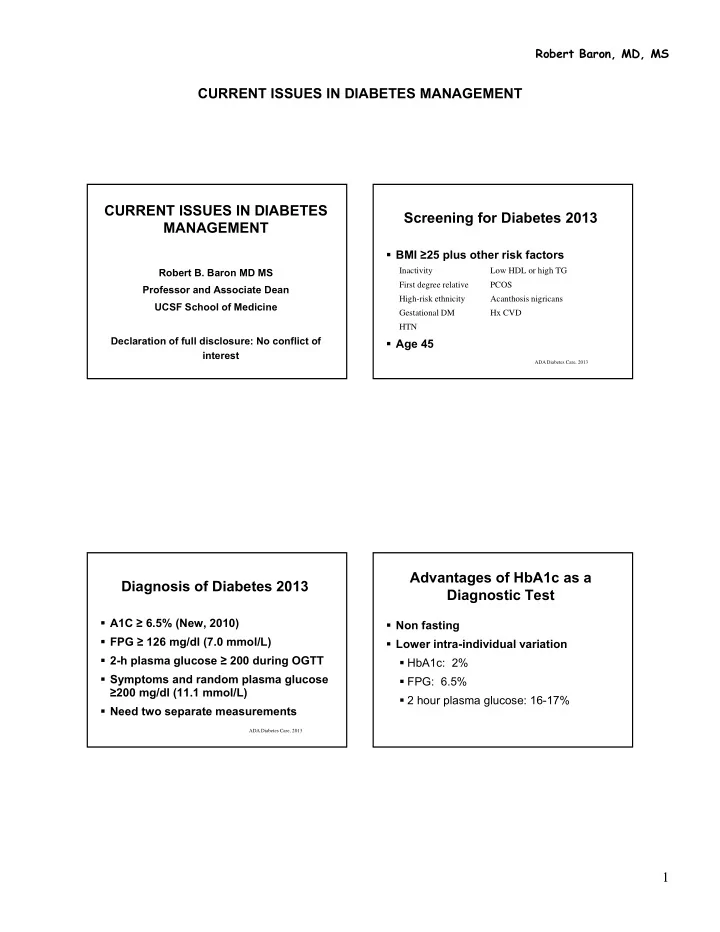
Screening for Diabetes 2013

  • BMI ≥25 plus other risk factors

Inactivity Low HDL or high TG First degree relative PCOS High-risk ethnicity Acanthosis nigricans Gestational DM Hx CVD HTN

  • Age 45

ADA Diabetes Care, 2013

Diagnosis of Diabetes 2013

  • A1C ≥ 6.5% (New, 2010)
  • FPG ≥ 126 mg/dl (7.0 mmol/L)
  • 2-h plasma glucose ≥ 200 during OGTT
  • Symptoms and random plasma glucose

≥200 mg/dl (11.1 mmol/L)

  • Need two separate measurements

Advantages of HbA1c as a Diagnostic Test

  • Non fasting
  • Lower intra-individual variation
  • HbA1c: 2%
  • FPG: 6.5%
  • 2 hour plasma glucose: 16-17%
slide-2
SLIDE 2

CURRENT ISSUES IN DIABETES MANAGEMENT 2

Robert Baron, MD, MS

ADA Diabetes Care, 2013

Diagnosis of Pre-Diabetes 2013

  • A1C 5.7 – 6.4% (New, 2010)
  • FPG 100 - 125 mg/dl (5.6mmol/L - 6.9

mmol/L)

  • 2-h plasma glucose 140 mg/dl – 199 mg/dl

during OGTT (7.8mmol/L – 11.0 mmol/L)

ADA Diabetes Care, 2013

Risk of Pre-Diabetes 2013

  • Increased risk of progression to diabetes
  • 44,203 individuals; 16 studies, 5.6 years
  • A1C 5.5 – 6.0: risk of DM 9 - 25%
  • A1C 6.0 – 6.5: risk of DM 25 – 50%

ADA Diabetes Care, 2013

Treatment of Pre-Diabetes 2013

  • Weight loss 7%; physical activity 150

min/week

  • Metformin (but only metformin) may be

considered, especially for those with BMI >35, age <60, and women with history of gestational DM

ADA Diabetes Care, 2013

2013 Practice Guidelines: ASA

  • ASA: only in those at increased CV risk

(10 year risk >10%. (Typically men over 50, women over 60 with other risk factors) 2009:

  • ASA: over age 40 and for those with other

CHD risk factors

slide-3
SLIDE 3

CURRENT ISSUES IN DIABETES MANAGEMENT 3

Robert Baron, MD, MS

ADA Diabetes Care, 2013

2013 Practice Guidelines: HTN and Lipids and Tobacco

  • BP: Goal less than 130 and less than 80
  • LDL: Goal less than 70 (with CVD); less

than 100 (without CVD)

  • Don’t forget tobacco

ACCORD, NEJM 2010

Intensive BP Control in Type 2 DM: ACCORD

  • RCT of 4733 patients with type 2 DM
  • Compare BP less than 120 mm Hg vs 140

120 140 p

  • BP

119 133

  • CV events plus death

1.87% 2.09% .20

  • Mortality

1.28% 1.19% .55

  • Stroke

0.32% 0.53% .01

  • Adverse events

3.3% 1.3% .001

In type 2 DM: treating to 120 mm Hg did not reduce the rate of composite fatal and non-fatal CV events

Case 1

70 yo woman with type 2 diabetes, hypertension, and coronary heart disease (s/p MI in 2003).

Meds: Metformin, glipizide, aspirin, lisinopril, metoprolol, and simvastatin Exam: BP 130/80, BMI 29 kg/m2 Normal exam

Case 1

Her glycemic goal should be:

  • 1. HbA1c <6.0%
  • 2. HbA1c <6.5%
  • 3. HbA1c <7.0%
  • 4. HbA1c <7.5%
  • 5. HbA1c <8.0%
slide-4
SLIDE 4

CURRENT ISSUES IN DIABETES MANAGEMENT 4

Robert Baron, MD, MS

Glycemic Control Update

  • 3 newer trials

 ADVANCE  ACCORD  VA Diabetes Trial

ACCORD, NEJM, 2008

ACCORD Trial

NIH RCT in DM 2, 10,251 patients, known CVD

  • r risk factors, mean A1c 8.1%

Intensive vs. standard BP (120 v. 140) Lipid control (statins v. statins + fibrates Normalization v. standard BS control (A1c 6 v. 7-7.9) Outcomes: CV events. Also microvascular events, quality of life, others

ACCORD trial

Intensive n=5,128 Standard n=5,123 HR (95% CI) A1c achieved: 6.5% 7.5%

  • 1° outcome:

352 371 0.90 (0.78-1.04) Total mortality 5.0% 3.1% 1.22 (1.01-1.46) CVD mortality 2.6% 1.8% 1.35 (1.04-1.76) Hypoglycemia 10.5% 3.5%

  • Wt. gain>10 kg

27.8% 14.1%

  • ACCORD Trial

Standard Intensive Deaths 203 257 11/1000/y 14/1000/y Number Needed to Harm: 333 February 2008 (after 3.5 years): NIH stops this arm of study

slide-5
SLIDE 5

CURRENT ISSUES IN DIABETES MANAGEMENT 5

Robert Baron, MD, MS

ACCORD, NEJM, 2011

ACCORD Trial 5-Year Outcomes

Additional follow-up of 1.5 years All subjects treated to HbA1c of 7-7.9% during this period Results: Mortality still higher in intensive group (7.6% vs 6.4%; HR 1.19)

Boussageon, BMJ 2011

Outcome of Intensive Glucose Lowering in Type 2 DM

Meta-analysis of 13 RCTs in DM 2; 34,533 pts RR All cause mortality 1.04 (0.91 – 1.19 CV death 1.11 (0.86 – 1.43) Non-fatal MI 0.85 (0.74 – 0.96)* Microalbuminuria 0.90 (0.85 – 0.96)* Severe hypoglycemia 2.33 (21.62 -3.36)*

* P <0.001

Boussageon, BMJ 2011

Outcome of Intensive Glucose Lowering in Type 2 DM

Over five year period: NNT to prevent one MI 117-150 NNT to prevent one microalbuminuria 32- 142 NNT to cause one episode of severe hypoglycemia 15-52

ORIGEN, NEJM, 2012

ORIGEN Trial

RCT, 12,537 subjects; impaired FBS, IGT, or new diabetes, and high CV risk Mean FBS 131 mg/dl Glargine to FBS <95 mg/dl; 6.2 years Results: No difference in CV outcomes

slide-6
SLIDE 6

CURRENT ISSUES IN DIABETES MANAGEMENT 6

Robert Baron, MD, MS

Glycemic Control Summary

  • No consistent evidence that tight glycemic

control reduces risk of CVD in DM 2

  • Possible subgroups with benefit:

shorter diabetes duration, no CVD

  • Strong evidence to support decrease in

microvascular disease outcomes with more intensive glucose control

  • More hypoglycemia and weight gain with more

intensive regimens

ADA Diabetes Care, 2013

2013 Practice Guidelines: Glucose Control

  • Goal A1C ≤7 for most
  • Goal A1C <6.5 for some: short duration, long life

expectancy, and no CVD

  • Goal less stringent (≤8) for history of

hypoglycemia, limited life expectancy, mico or macrovascular complications, comorbid conditions, and those in whom the goal is difficult to attain

Critically I ll patients?

Meta-analysis of 29 RCTs (n=8,432 patients) Mortality Rates Tight Usual RR (95% CI) Overall 21.6% 23.3% 0.93 (0.85-1.03) Very tight, ≤110 mg/dl 23.0% 25.2% 0.90 (0.77-10.4) Moderate, <150 mg/dl 17.3% 18.0% 0.99 (0.83-1.18) Medical ICU 26.9% 29.7% 0.92 (0.82-1.04) Surgical ICU 8.8% 10.8% 0.88 (0.63-1.22) Med-Surg ICU 26.1% 27.0% 0.95 (0.80-1.13)

Glycemic Control Summary

  • No consistent evidence that tight glucose

control improves mortality in hospitalized patients.

slide-7
SLIDE 7

CURRENT ISSUES IN DIABETES MANAGEMENT 7

Robert Baron, MD, MS

ADA Diabetes Care, 2013

2013 Practice Guidelines: Glucose Control in Hospital

  • Critically ill: Goal 140 - 180.
  • IV protocol
  • Non-critically ill: premeal <140 if can be done

safely; random < 180. Less stringent if severe comorbidities

  • Scheduled subcu insulin with basal, nutritional,

and correction components

Case 1

Her glycemic goal should be:

  • 1. HbA1c <6.0%
  • 2. HbA1c <6.5%
  • 3. HbA1c <7.0%
  • 4. HbA1c <7.5%
  • 5. HbA1c <8.0%

In my practice, I have initiated:

  • 1. Exenatide (Byetta™) or Liraglutide (Victoza™)
  • 2. Sitagliptin (Januvia™) or Saxagliptin

(Onglyza™)

  • 3. Both exenatide and sitagliptin
  • 4. Pramlintide (Symlin™)
  • 5. All three of the above
  • 6. None of the above
slide-8
SLIDE 8

CURRENT ISSUES IN DIABETES MANAGEMENT 8

Robert Baron, MD, MS

Case 2: 48 yo woman with DM, BMI 33, on diet and exercise and max dose metformin. HbA1C is now 8.5. Your next best step is:

1.

  • 2. Begin a sulfonylurea
  • 3. Begin pioglitizone
  • 4. Begin NPH insulin or long-acting insulin analogue
  • 5. Begin exenatide (Byetta™), liraglutide

(Victoza™), sitagliptin (Januvia™) or saxagliptin (Onglyza™)

Generic Oral Hypoglycemic Slide

HgA1c Time Change from Drug A to B, C, or D Add Drug A to B, or B to A Add Drug C Add Drug D

Metformin: The Safest Hypoglycaemic Agent in Chronic Kidney Disease?

“There is no evidence from prospective comparative trials or from observational cohort studies that metformin is associated with an increased risk of lactic acidosis, or with increased levels of lactate, compared with other oral hypoglycaemic treatments.”

Risk of fatal and nonfatal lactic acidosis with metformin use in type 2

  • diabetes. Cochrane Database Syst Rev 2010;4: CD002967.

Graham et al, JAMA 2010

Rosiglitazone vs Pioglitazone

Observational study, FDA, 227,571 Medicare patients, over 3 years. Rosi/Pio HR

MI 1.06 Stroke 1.27 CHF 1.25 Death 1.14 Composite 1.18

Number Needed to Harm with Rosiglitazone = 60 per year

slide-9
SLIDE 9

CURRENT ISSUES IN DIABETES MANAGEMENT 9

Robert Baron, MD, MS

Oral Agent “Failure” Why does this occur?

Changing HbA1c goals Compliance, side effects Wrong diagnosis (LADA--latent autoimmune diabetes in adults 10%) Stress, diabetogenic medications Postprandial hyperglycemia Natural progression of the disease

Relative Contributions of Fasting and Postprandial Plasma Glucose to Total Glycemic Excursions as a Function of A1C

Monnier L et al. Diabetes Care. 2003;26:881-885.

20 60 80 2 (7.3–8.4) 3 (8.5–9.2) 4 (9.3–10.2) 5 (>10.2) 1 (<7.3) 40

Contribution (%) A1C (%) Quintiles

Postprandial hyperglycemia Fasting hyperglycemia

Natural History of Type 2 Diabetes

50 100 150 200 250

  • 10
  • 5

5 10 15 20 25 30 Years of Diabetes Glucose (mg/dL) Relative Function (%) Insulin Resistance Insulin Level`

Beta-cell failure

*IFG = impaired fasting glucose

50 100 150 200 250 300 350 Fasting Glucose Post-meal Glucose Obesity IFG* Diabetes Uncontrolled hyperglycemia

Natural History of Type 2 Diabetes

50 100 150 200 250 50 100 150 200 250 300 350

  • 10
  • 5

5 10 15 20 25 30 Years of Diabetes Glucose (mg/dL) Relative Function (%)

Lifestyle

SU Insulin Resistance Insulin Level Fasting Glucose

Beta-cell failure

Post-meal Glucose

Insulin Biguanide

slide-10
SLIDE 10

CURRENT ISSUES IN DIABETES MANAGEMENT 10

Robert Baron, MD, MS Insulin Plus Oral Agents

Introduction of insulin – Bedtime – Intermediate/Long-acting insulins

  • NPH, glargine, levemir
  • 10 units

– Self-monitoring of blood glucose (hypoglycemia education) Insulin plus other oral agent combinations (maintain effect on insulin sensitivity)

When to go to > 1 shot per day

 HgA1c >7

 Glucose in AM at goal but glucose before dinner >140 Options  Add premeal lispro/aspart  Add bid premixed insulin – 70/30, 75/25 Questions  Continue metformin  ? Sulfonylurea, ? Thiazolidinedione (mostly not)

Function of Insulin in Regimens Meal coverage (carbohydrates) Basal insulin Correction of high blood sugar

INCRETINS

Gut factors that promote insulin secretion in response to nutrients Major incretins: GLP-1, CCK, GIP

slide-11
SLIDE 11

CURRENT ISSUES IN DIABETES MANAGEMENT 11

Robert Baron, MD, MS

Oral Glucose Promotes More Insulin Release than IV Glucose - Indicating a Role for Incretins

Incretin Drugs

GLP Agonists – Exenatide – Liraglutide – Exenatide Lar – Semaglutide – Aliglutide – Taspoglutide – Lixsenatide DPP IV Inhibitors – Sitagliptin – Saxagliptin – Vildagliptin – Alogliptin – Linagliptin – Dutogliptin – Metogliptin A1C (%) Effect (change from baseline)

Placebo BID 5 mcg exenatide BID 10 mcg exenatide BID

MET 0.1

  • 0.4
  • 0.8

SFU 0.1

  • 0.5
  • 0.9

MET+SFU 0.2

  • 0.6
  • 0.8

Changes in A1C from baseline vs placebo statistically significant

slide-12
SLIDE 12

CURRENT ISSUES IN DIABETES MANAGEMENT 12

Robert Baron, MD, MS

Weight (change from baseline) & Hypoglycemia

Placebo BID 5 mcg exenatide BID 10 mcg exenatide BID

Weight (kg)

  • 1.4
  • 3.1
  • 4.2

Hypoglycemia (%) MET SFU MET + SFU 5.3 3.3 1.26 4.5 14.4 19.2 5.3 35.7 27.8 Open-label extension study to 90 weeks: persistence in weight loss and A1C

Side Effects

GI – Nausea (44% vs 18% with placebo); incidence lessens over time; 3% dropout rate due to nausea – Vomiting (13% vs 4%) – Diarrhea (13% vs 6%) Headache (9% vs 6%) Hypoglycemia (see previous slide) Improvements in HbA1C With Initial Co-administration of Sitagliptin and Metformin

Placebo Sita 100 mg QD Sita 50 mg BID + Met 500 mg BID Sita 50 mg BID + Met 1000 mg BID Met 1000 mg BID Met 500 mg BID

* Placebo-subtracted LS mean change form baseline at Week 24. Sita=sitagliptin; Met=metformin.

  • 2.5
  • 2.0
  • 1.5
  • 1.0
  • 0.5

HbA1C (%)*

  • 0.8
  • 1.0
  • 1.3
  • 1.6
  • 2.1

Mean Baseline HbA1C = 8.8% N=1091

Aschner P, et al. Oral presentation at the EASD 42nd Annual Meeting; 14-17 September 2006; Copenhagen.

Number of patients (%) Sitagliptin Placebo Monotherapy n = 443 n = 363 Nasopharyngitis 23 (5.2) 12 (3.3) + pioglitazone n = 175 n = 178 Upper resp. infection 11 (6.3) 6 (3.4)

Small increase in WBC – neutrophil count higher by 200 on Sitagliptin No nausea or vomiting No weight loss

Sitagliptin – adverse reactions

slide-13
SLIDE 13

CURRENT ISSUES IN DIABETES MANAGEMENT 13

Robert Baron, MD, MS

Increased Incidence of Pancreatitis and Cancer Among Patients Given Glucagon Like Peptide-1 Based Therapy

  • Sitagliptin or exenatide increased the odds ratio for

pancreatitis 6-fold ( P <2 x 10 -16).

  • Pancreatic cancer was more commonly reported

among patients that took sitagliptin or exenatide, ( P <0.033, P <2x10 -4)

  • All other cancers occurred more frequently among

patients that took sitagliptin, ( P <1x10 -4)

Gastroenterology (2011)

SGLT2 Inhibitors

Sodium-glucose cotransporter 2 Inhibitors

Inhibit glucose reabsorption in renal proximal tubule Potential advantages

Weight loss, low risk of hypoglycemia, reduced BP

Potential disadvantages

Polyuria, electrolyte disorders, UTI, fungal genital infections, ?

Natural History of Type 2 Diabetes

50 100 150 200 250 50 100 150 200 250 300 350

  • 10
  • 5

5 10 15 20 25 30 Years of Diabetes Glucose (mg/dL) Relative Function (%)

Lifestyle

SU Insulin Resistance Insulin Level Fasting Glucose

Beta-cell failure

Post-meal Glucose

Insulin Thiazolidinedione ? - Biguanide Incretins/Others ?

Drug Cost Comparison

Drug and Dose Cost/month

Glucose strips (2 per day) $66 Sulfonylurea Generic $4-14 Brand $50 Rapaglinide 2 mg tid $193 Acarbose 100 mg tid $88 Metformin 1000 bid Generic $4-32 Brand $161 Rosiglitazone 8 mg qd $266 Pioglitazone 45 mg/d $245 Sitagliptin/Saxagliptin $207/190 Exenatide 10 mcg/Liraglutide 1.2mg $271/280 Glargine, 45 U/d $150 24 hour fitness Center $35 YMCA $65

slide-14
SLIDE 14

CURRENT ISSUES IN DIABETES MANAGEMENT 14

Robert Baron, MD, MS

Case 2: 48 yo woman with DM, BMI 33, on diet and exercise and max dose metformin. HbA1C is now 8.5. Your next best step is:

1.

  • 2. Begin a sulfonylurea
  • 3. Begin pioglitizone
  • 4. Begin NPH insulin or long-acting insulin analogue
  • 5. Begin exenatide (Byetta™), liraglutide

(Victoza™), sitagliptin (Januvia™) or saxagliptin (Onglyza™)

Conclusions

  • Tight glycemic control not effective in lowering total

mortality or CV mortality.

  • Many newer diabetes agents available, all with some

side effects and higher costs…few with hard outcome data.

  • Glucose control may be more important early in

diabetes

  • Good BP, lipid control, smoking cessation, and aspirin

use is important throughout the diabetes life course