11/15/2012 ASHP Live Webinar: Building a Medication ASHP Live - - PDF document

11 15 2012
SMART_READER_LITE
LIVE PREVIEW

11/15/2012 ASHP Live Webinar: Building a Medication ASHP Live - - PDF document

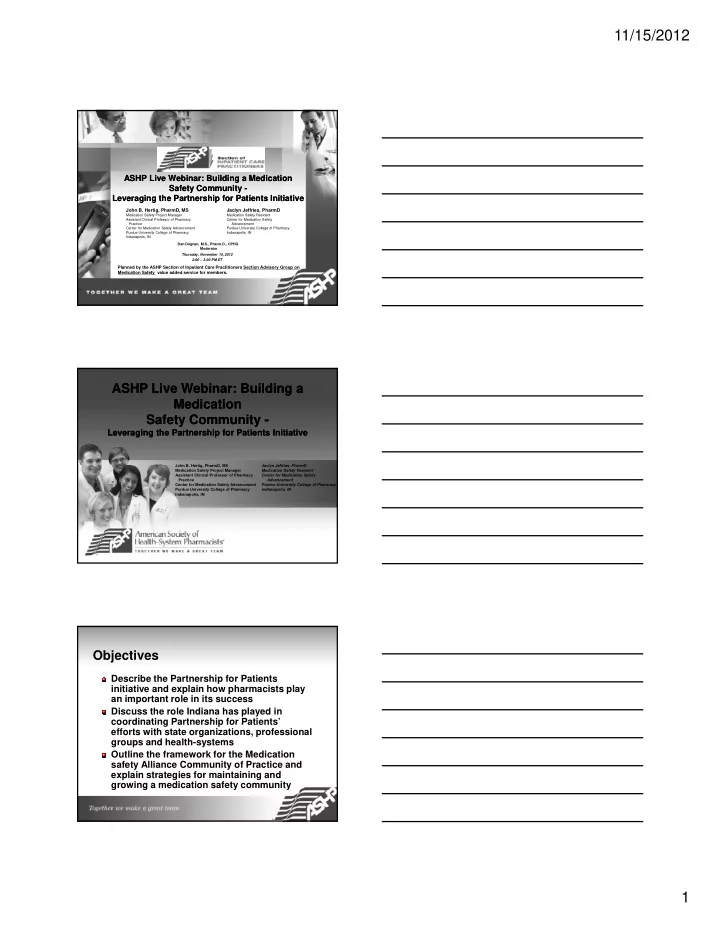
11/15/2012 ASHP Live Webinar: Building a Medication ASHP Live Webinar: Building a Medication Safety Community Safety Community - - Leveraging the Partnership for Patients Initiative Leveraging the Partnership for Patients Initiative John B.


slide-1
SLIDE 1

11/15/2012 1

ASHP Live Webinar: Building a Medication ASHP Live Webinar: Building a Medication Safety Community Safety Community -

  • Leveraging the Partnership for Patients Initiative

Leveraging the Partnership for Patients Initiative

Thursday, November 15, 2012 2:00 – 3:00 PM ET

John B. Hertig, PharmD, MS

Medication Safety Project Manager Assistant Clinical Professor of Pharmacy Practice Center for Medication Safety Advancement Purdue University College of Pharmacy Indianapolis, IN

Planned by the ASHP Section of Inpatient Care Practitioners Section Advisory Group on Medication Safety value added service for members. Jaclyn Jeffries, PharmD

Medication Safety Resident Center for Medication Safety Advancement Purdue University College of Pharmacy Indianapolis, IN Dan Degnan, M.S., Pharm.D., CPHQ Moderator

ASHP Live Webinar: Building ASHP Live Webinar: Building a a Medication Medication Safety Safety Community Community -

  • Leveraging the Partnership for Patients Initiative

Leveraging the Partnership for Patients Initiative

Jaclyn Jeffries PharmD John B Hertig PharmD MS Jaclyn Jeffries, PharmD Medication Safety Resident Center for Medication Safety Advancement Purdue University College of Pharmacy Indianapolis, IN John B. Hertig, PharmD, MS Medication Safety Project Manager Assistant Clinical Professor of Pharmacy Practice Center for Medication Safety Advancement Purdue University College of Pharmacy Indianapolis, IN

Objectives

Describe the Partnership for Patients initiative and explain how pharmacists play an important role in its success Discuss the role Indiana has played in coordinating Partnership for Patients’ coordinating Partnership for Patients efforts with state organizations, professional groups and health-systems Outline the framework for the Medication safety Alliance Community of Practice and explain strategies for maintaining and growing a medication safety community

slide-2
SLIDE 2

11/15/2012 2

Outline

Review Partnership for Patients Initiative Discuss the various engagement networks and Indiana’s role Outline the framework of Indiana’s Outline the framework of Indiana s Medication Safety Alliance Specifically discuss the events and strategies that have been launched Describe future directions for the alliance Questions Getting to know you…

Ask the Audience Polling Question

What type of practice do you represent?

A) Front-line Pharmacist B) Pharmacy Administrator C) Medication Safety Pharmacist/Officer C) Medication Safety Pharmacist/Officer D) Nursing or Physician Safety Leader E) Other

slide-3
SLIDE 3

11/15/2012 3

Polling Question

How much do you know about the Partnership for Patients Initiative?

A) Nothing: this is the first I have been exposed to it B) A littl B) A little C) I feel like I know more than most people D) I am a true expert

Partnership for Patients About Partnership for Patients

Partnership for Patients (PfP) launched by the Department of Health and Human Services (HHS)

 $1 billion in new funding provided by the Affordable Care Act  Public and private partners

Better care and lower cost of health care for all Americans Americans

 Quality  Safety  Affordability

Two core goals of this partnership

 Keep patients from getting injured or sicker in the health care

system

 Help patients heal without complication by improving transitions

from acute-care hospitals to other care settings

slide-4
SLIDE 4

11/15/2012 4

Two Main Goals (end of 2013)

Keep patients from getting injured or sicker

 Decrease preventable hospital-acquired conditions by 40%

compared to 2010

 1.8 million fewer injuries (60,000 lives saved over three

years)

Help patients heal without complication Help patients heal without complication

 Decrease preventable complications by 20% compared to

2010

 1.6 million patients avoid re-hospitalization within 30 days

  • f discharge

Potential to save up to $35 billion across the health care system

 $10 billion in Medicare savings, over the next three years

Hospital Engagement Networks

$218 million was awarded to 26 state, regional, national, or hospital system organizations to be Hospital Engagement Networks (HEN) as part of PfP

 Identify solutions already working  Work to spread them to other hospitals and health care providers

Develop learning collaborative for hospitals and id id f i iti ti d ti iti t provide a wide array of initiatives and activities to improve patient safety

 Intensive training programs  Technical assistance to hospitals  Establish and implement a system to

track and monitor hospital progress

American Hospital association Health Research and Educational Trust (HRET)

How HEN Contracts Fit in the PfP

slide-5
SLIDE 5

11/15/2012 5

National HEN Targeted Harms

1)

Adverse drug events

2)

OB Adverse Events/Birth-related injuries

PfP has identified nine areas of focus Not limited, but these areas of focus are obvious and important places to begin

3)

Central line-associated blood stream infections

4)

Catheter-acquired urinary tract infections

5)

Falls

6)

Surgical infections and complications

7)

Venous thromboembolism

8)

Pressure ulcers

9)

Ventilator-associated pneumonia

10) Readmissions

HRET/AHA HEN

34 states / 1,621 hospitals

IHA as Part of the AHA/HRET HEN

26 Hospital Engagement Networks nationwide Largest is the AHA/HRET HEN 30 state hospital associations, DC and Puerto Rico are participating in the HRET HEN Indiana Hospital Association contingent is 2nd largest among 32 HRET HEN jurisdictions

slide-6
SLIDE 6

11/15/2012 6

Indiana/HRET HEN Summary

119 Indiana hospitals aligned with IHA/HRET Includes:

  • 26 critical access hospitals
  • 8 psychiatric hospitals
  • 5 rehabilitation hospitals
  • 4 long term acute hospitals

Key Focus Areas

National (CMS)

Early Elective Deliveries before 39 weeks (EED) Readmissions

Indiana

EED CAUTI Readmissions Adverse Drug

(Readmissions Race)

Adverse Drug Events Falls Prevention

Building a Network

slide-7
SLIDE 7

11/15/2012 7

Eleven regional safety coalitions Members agree not to compete

  • n patient safety

Layered model of regional coalitions and affinity groups supports transformation, learning and spread Benefits:

  • Innovate at the front lines
  • Align with state and national

efforts, and standardize when beneficial

  • Builds local and hospital-specific

capacity for improvement and innovation

  • Encourages safety leadership at

all levels across multiple professions

Purdue University Involvement

Focus on building lasting capacity for improvement in Indiana

  • Purdue Healthcare Advisors:

 Lean/Six Sigma Belt training  Coaching for Lean/Six Sigma projects  R

d i i i l ti

 Readmission simulation

  • Center for Medication Safety Advancement:

 Medication Safety Course  ADEs and Readmissions  Coaching calls

Medication Safety Alliance (MSA)

Medication Safety Alliance

Purpose Framework Partnerships Pharmacist’s Role

slide-8
SLIDE 8

11/15/2012 8

Alliance Framework

Educating

Medication Safety

Supporting Sharing

Special Thanks

Betsy Lee Director, Indiana Patient Safety Coalition Indiana Hospital Association d a a

  • sp ta

ssoc at o blee@ihaconnect.org (317) 423-7795

Indiana Medication Safety Alliance

Let’s take a closer look at the Medication Safety Alliance (MSA)

 Medication Safety CE  Pre-work webinar and strategies  Pre-work webinar and strategies  Self-assessment on high-risk medications leading to

readmissions

 Conference on Readmissions and ADEs  Coaching calls

Future directions…

slide-9
SLIDE 9

11/15/2012 9

Medication Safety CE Course

Launched on September 17th On-line, on-demand course 7 CE hours for MDs, nurses and pharmacists 10 spots per hospital for inter-professional medication safety team

Readmissions

  • Partnership for Patients
  • Reduce preventable hospital-acquired

conditions by 40% by December 31, 2013

  • Reduce all hospital readmissions by 20% by

D b 31 2013 December 31, 2013

  • PfP focus is on anticoagulants, narcotics,

sedatives, and insulin

U.S. Department of Health & Human Services Partnership for Patients. Health Research & Educational Trust. I mplementation Guide to Reducing Harm from High-Alert Medications. Accessed at http: / / www.hret- hen.org/ images/ downloads/ 508changepacks/ ade_changepackage_508.pdf , August 4, 2012.

Step 1: Identify Problem

Identify high- risk medications Discuss mitigation strategies Provide examples on how to implement

slide-10
SLIDE 10

11/15/2012 10

Data Collection

Formulate research question:

 Readmissions  ADEs

Search strategy:

 PubMed & MEDLINE  MeSH terms

  • “readmissions”
  • “rehospitalizations”
  • “ADEs”

 ADEs  High-risk Medications

ADEs

  • “high-risk meds”
  • “high-alert meds”
  • “transitions”
  • “post-discharge”

 Cross-reference

Data Abstraction

300+ abstracts Inclusion criteria

 Readmitted  ADE  High-risk meds

Article selection Limited results

 9 articles

Analyzed occurrence

 High-risk meds

Exclusion criteria

 Drug/alcohol abuse

Analyzed occurrence

  • f most common
  • ffending classes

Data Discovery and Delivery

Medications Studies W hy im plicated Hematologic Forster, Budnitz, McDonnel, Beckett, Classen, Ruiz, Roughead, Evans

  • Complexity of dosing and monitoring
  • Patient adherence
  • Drug interactions
  • Dietary interactions

Anti-diabetic Budnitz, McDonnel, Beckett, Classen

  • Pharmacology of drugs
  • Complexity of dosing
  • Medication adjustments
  • Narrow therapeutic range

Anti-neoplastic Budnitz, McDonnel, Ruiz , Roughead,

  • Pharmacology of drugs
  • Adverse effects
  • Dose scheduling
  • Drug interactions

Drug interactions

  • Depressed immune system

Analgesics (including narcotics) Forster, Boockvar, Budnitz, Beckett, Evans

  • Dose mix ups
  • Allergic reactions
  • Enhanced CNS effects
  • Ambiguous directions

Cardiovascular Forster, Boockvar, Budnitz, McDonnel, Beckett, Classen, Roughead, Evans

  • Patient adherence
  • Polypharmacy
  • Adverse effects

Anti-infectives Forster, Budnitz, Beckett, Classen, Evans

  • Patient adherence
  • Overuse/misuse
  • Kill normal flora
  • Adverse effects/allergies
  • Drug interactions
slide-11
SLIDE 11

11/15/2012 11

Strategic Thinking

http: / / optimumperformancetechnologies.blogspot.com/ 2009/ 10/ strategic-thinking-strategic-planning.html

Step 2: Strategic Thinking

Identify high- risk medications Discuss mitigation strategies Provide examples on how to implement

Strategic Thinking

Resolution Develop an attainable intervention Focus on avoidable Strategy Focused on transitions

  • f care

Team-based approach readmissions Patient-centered

slide-12
SLIDE 12

11/15/2012 12

Mitigation Strategies

Intervention Impact Medication Reconciliation Discrepancy recognition Decrease ADEs Transition Communication Discrepancy recognition Decrease ADEs Patient Education Side effect awareness Patient Education Side effect awareness Greater medication understanding Decrease ADEs Follow-up Telephone Call Discrepancy recognition Increase patient adherence Decrease ADEs Post-discharge Clinics/ Improved Monitoring Optimize therapy Decrease ADEs

ADE/Readmission Challenges

  • Identify when ADEs occur and talk
  • Make doing the right thing feasible
  • Reporting should not be so time

constraining constraining

  • Biased self-reports
  • Promote cross-monitoring

U.S. Department of Health & Human Services Partnership for Patients. Health Research & Educational Trust. I mplementation Guide to Reduce Avoidable

  • Readmissions. Accessed at http: / / www.hret-

hen.org/ images/ downloads/ 508changepacks/ readmission_changepackage_508 .pdf , September 5, 2012.

“There is no shortage of successful strategies to help patients avoid rehospitalization. What has been lacking is the will to adopt them.”

  • Experts

O’Reilly, KB. Reducing readmissions: How 3 hospitals found success. American Medical Association. Accessed at http: / / www.ama- assn.org/ amednews/ 2011/ 02/ 07/ prsa0207.htm , August 28, 2012.

slide-13
SLIDE 13

11/15/2012 13

Step 3: Taking Action

Identify high- risk medications Discuss mitigation strategies Provide examples on how to implement

Implementation

Make sure patients understand how to care for themselves upon discharge Make sure patients get the follow-up Make sure patients get the follow up medical care they need to manage their conditions

Implementation

Easier said than done…

 Failures due to:

Lack of strategy Encountered barrier Lack of adoption

slide-14
SLIDE 14

11/15/2012 14

Implementation- PDSA

PLAN PLAN Determine problem

Utilize cyclical method to immediately impact and assess change Explore relationship between variables in process and

DO DO Implement change & collect data STUDY STUDY Interpret & assess results ACT ACT Implement change OR restart process

process and

  • utcomes

Small and frequent PDSAs are most effective

Hughes RG, eds. Patient Safety and Quality: An Evidence-Based Handbook for Nurses. Rockville, MD: Agency for Healthcare Research and Quality; 2008.

“The journey of a thousand miles begins with one step.”

  • Lao Tzu

Self-Assessment

Hematologics Anti‐diabetics Antineoplastics Analgesics Cardiovascular Anti‐infectives Warfarin Heparin/LMWH Clopidogrel Insulin Oral hypoglycemics Cyclophosphamide Gemcitabine HCl Capecitabine Fluorouracil “platins” “rubicins” “zumabs” “taxels” Meperidine Indomethacin Ketorolac Aspirin Naproxen Meloxicam Ibuprofen α1 blockers “zosins” Dronedarone Antiarrhythmics Nifedipine Spironolactone Digoxin Nitrofurantoin

slide-15
SLIDE 15

11/15/2012 15

Self-Assessment

Assessment Goals and Strategies Initial Score Mid‐Point Score Final Score Medication reconciliation is performed effectively every time on admission and discharge. Primary care physician (PCP) information is obtained upon admission. Appointments are made with PCPs and/or specialists prior to discharge. A risk‐assessment is performed on patients upon admission. Patients are educated on potential side effects/symptoms from their medications and are counseled on what to do if either present. The teach‐back method is utilized when discussing patient’s medication & self‐care knowledge. The patient and family/caregiver are considered part of the, “team” during hospital stay. Follow‐up telephone calls are performed within 72 hours of hospital discharge Follow‐up telephone calls are performed within 72 hours of hospital discharge. Patients are referred to specialty clinics, when appropriate, prior to discharge. The importance of monitoring particular medications is emphasized during patient stay. Reducing readmissions is a strategic goal of the organization. Strategy implementation is supported with adequate resources. Efforts are made for collaborating with other organizations/facilities within the community to reduce readmissions (i.e. local pharmacies, long term care facilities, home health organizations, Area Agencies on Aging, etc.). Total

IHA Conference

Held November 8th Readmissions and ADEs: Causal Links and Strategies for Action Medication Safety Alliance y Work with organizations to drive improvement

Keeping the Momentum

Subsequent webinars Coaching Calls Exemplars Exemplars Sharing Best Practices Networking Web portal

slide-16
SLIDE 16

11/15/2012 16

Alliance Framework

Educating

Medication Safety

Supporting Sharing

Conclusion

Partnership for Patients Partnership with IHA Medication Safety Alliance Specific strategies and events Keeping the Momentum

Questions?

Contact us:

John B. Hertig, PharmD, MS

Medication Safety Project Manager Assistant Clinical Professor of Pharmacy Practice

Jaclyn Jeffries, PharmD

Medication Safety Resident Purdue University College of Pharmacy Purdue University College of Pharmacy Center for Medication Safety Advancement jhertig@purdue.edu Center for Medication Safety Advancement jajeffri@purdue.edu

slide-17
SLIDE 17

11/15/2012 17

Jaclyn Jeffries PharmD John B Hertig PharmD MS

ASHP Live Webinar: Building ASHP Live Webinar: Building a a Medication Medication Safety Safety Community Community -

  • Leveraging the Partnership for Patients Initiative

Leveraging the Partnership for Patients Initiative

Jaclyn Jeffries, PharmD Medication Safety Resident Center for Medication Safety Advancement Purdue University College of Pharmacy Indianapolis, IN John B. Hertig, PharmD, MS Medication Safety Project Manager Assistant Clinical Professor of Pharmacy Practice Center for Medication Safety Advancement Purdue University College of Pharmacy Indianapolis, IN