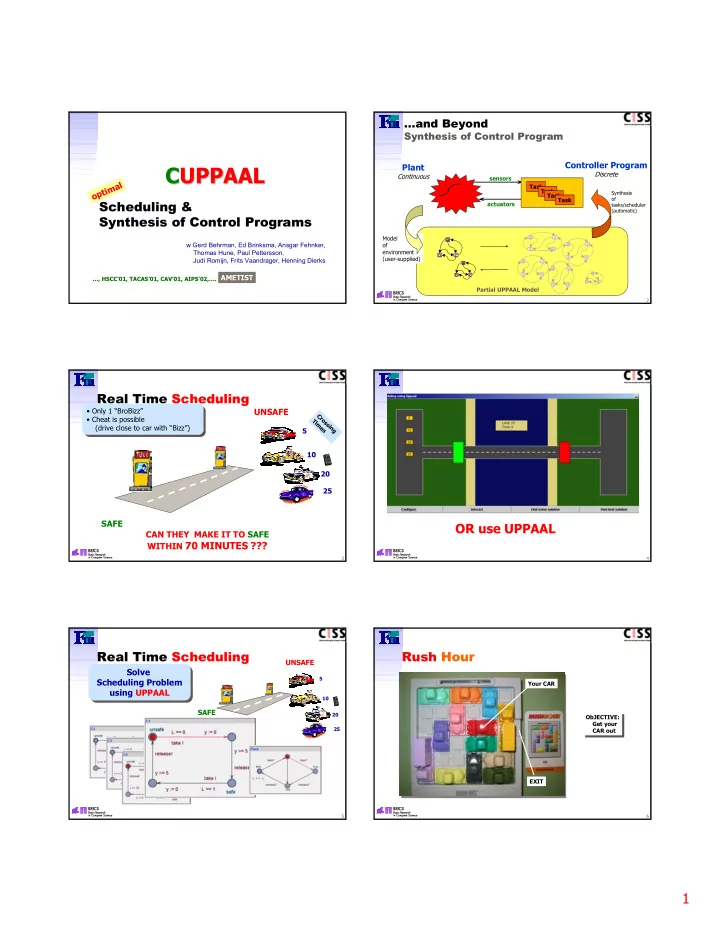
CUPPAAL UPPAAL Plant C Discrete Continuous sensors l a m - - PDF document

cuppaal uppaal
SMART_READER_LITE
LIVE PREVIEW

CUPPAAL UPPAAL Plant C Discrete Continuous sensors l a m - - PDF document

and Beyond Synthesis of Control Program Controller Program CUPPAAL UPPAAL Plant C Discrete Continuous sensors l a m Task i t p Task o Synthesis Task Task of Scheduling & actuators tasks/scheduler (automatic)


slide-1
SLIDE 1

1

Scheduling & Synthesis of Control Programs

  • p

t i m a l

w Gerd Behrman, Ed Brinksma, Ansgar Fehnker, Thomas Hune, Paul Pettersson, Judi Romijn, Frits Vaandrager, Henning Dierks

…, HSCC’01, TACAS’01, CAV’01, AIPS’02,….

C CUPPAAL UPPAAL

AMETIST

2

UC UCb b

…and Beyond

Synthesis of Control Program

Plant

Continuous

Controller Program

Discrete

sensors actuators

a c b 1 2 4 3 a c b 1 2 4 3 1 2 4 3 1 2 4 3 a c b

Partial UPPAAL Model Model

  • f

environment (user-supplied)

Synthesis

  • f

tasks/scheduler (automatic)

Task Task Task Task

3

UC UCb b

Real Time Scheduling

5 10 20 25

UNSAFE SAFE

  • Only 1 “BroBizz”
  • Cheat is possible

(drive close to car with “Bizz”)

  • Only 1 “BroBizz”
  • Cheat is possible

(drive close to car with “Bizz”)

The Car & Bridge Problem CAN THEY MAKE IT TO SAFE WITHIN 70 MINUTES ???

Crossing Times

4

UC UCb b

Real Time Scheduling

5 10 20 25

UNSAFE

Give it a try on next lap-top !

  • Only 1 “BroBizz”
  • Cheat is possible

(drive close to car with “BroBizz”)

  • Only 1 “BroBizz”
  • Cheat is possible

(drive close to car with “BroBizz”)

OR use UPPAAL

5

UC UCb b

Real Time Scheduling

SAFE

5 10 20 25

UNSAFE

Solve Scheduling Problem using UPPAAL Solve Scheduling Problem using UPPAAL

6

UC UCb b

Rush Hour

ObJECTIVE: Get your CAR out ObJECTIVE: Get your CAR out Your CAR EXIT

slide-2
SLIDE 2

2

7

UC UCb b

Steel Production Plant

Machine 1 Machine 2 Machine 3 Machine 4 Machine 5 Buffer Continuos Casting Machine Storage Place Crane B Crane A

  • A. Fehnker

Hune, Larsen, Pettersson Case study of Esprit-LTR project 26270 VHS Physical plant of SIDMAR located in Gent, Belgium. Part between blast furnace and hot rolling mill. Objective: model the plant, obtain schedule and control program for plant.

Lane 1 Lane 2 8

UC UCb b

Steel Production Plant

Machine 1 Machine 2 Machine 3 Machine 4 Machine 5 Buffer Continuos Casting Machine Storage Place Crane B Crane A

Load follows Recipe to become certain quality, e.g: start; T1@10; T2@20; T3@10; T2@10; end within 120. Output: sequence

  • f higher quality

steel.

Lane 1 Lane 2

Input: sequence of steel loads (“pigs”).

9

UC UCb b

Steel Production Plant

Machine 1 Machine 2 Machine 3 Machine 4 Machine 5 Buffer Continuos Casting Machine Storage Place Crane B Crane A

Input: sequence of steel loads (“pigs”).

@10 @20 @10 @10 @40

Load follows Recipe to become certain quality, e.g: start; T1@10; T2@20; T3@10; T2@10; end within 120. Output: sequence

  • f higher quality

steel.

Lane 1 Lane 2 2 2 2 5 6

∑=107

10

UC UCb b

Steel Production Plant

Machine 1 Machine 2 Machine 3 Machine 4 Machine 5 Buffer Continuos Casting Machine Storage Place Crane B Crane A

Input: sequence of steel loads (“pigs”).

@10 @20 @10 @10 @40

Load follows Recipe to

  • btain certain quality,

e.g: start; T1@10; T2@20; T3@10; T2@10; end within 120. Output: sequence

  • f higher quality

steel.

Lane 1 Lane 2 2 2 2

15 16 ∑=127

11

UC UCb b

A single load (part of) A single load (part of) Crane B Crane B

12

UC UCb b

Experiment

  • BFS = breadth-first search, DFS = depth-first search, BSH = bit-state hashing,
  • “-” = requires >2h (on 450MHz Pentium III), >256 MB, or suitable hash-table size was not found.
  • System size: 2n+5 automata and 3n+3 clocks, if n=35: 75 automata and 108 clocks.
  • Schedule generated for n=60 on Sun Ultra with 2x300MHz with 1024MB in 2257s .

A l l G u i d e s S o m e G u i d e s N o G u i d e s n B F S D F S B S H B F S D F S B S H B F S D F S B S H s M B s M B s M B s M B s M B s M B s M B s M B s M B

1 0,1 0,9 0,1 0,9 0,1 0,9 0,1 0,9 0,1 0,9 0,1 0,9 3,2 6,1 0,8 2,2 3.9 3.3 2 18,4 36,4 0,1 1 0,1 1,1

  • 4,4

7,8 7,8 1,2

  • 19,5

36,1

  • 3
  • 3,2

6,5 3,4 1,4

  • 72,4

92,1 901 3,4

  • 4
  • 4

8,2 4,6 1,8

  • 5
  • 5

10,2 5,5 2,2

  • 10
  • 13,3

25,3 16,1 9,3

  • 15
  • 31,6

51,2 48,1 22,2

  • 20
  • 61,8

89,6 332 46,1

  • 25
  • 104

144 87,2 83,3

  • 30
  • 166

216 124,2 136

  • 35

209 250

slide-3
SLIDE 3

3

13

UC UCb b

LEGO Plant Model

LEGO RCX Mindstorms. Local controllers with control programs. IR protocol for remote invocation of programs. Central controller.

m1 m2 m3 m4 m5 crane a crane b casting storage buffer central controller

Synthesis 14

UC UCb b

LEGO Plant Model

Belt/Machine Unit.

15

UC UCb b

Linearly Priced Timed Automata:

Optimal Scheduling

Timed Automata + Costs on transitions and locations. Cost of performing transition: Transition cost. Cost of performing delay d: ( d x Location cost).

(a,x=y=0) (b,x=y=0) (b,x=y=2.5) ε(2.5) (a,x=0,y=2.5) 4 2.5 x 2

  • Cost of Execution Trace: Sum of costs: 4 + 5 + 0 = 9
  • Trace:

b

x<3 y>2, x<2 x<3 {x:=0}

a c cost’=1 cost+=4 cost’=0 cost’=2

16

UC UCb b

Linearly Priced Timed Automata:

Optimal Scheduling

Timed Automata + Costs on transitions and locations. Cost of performing transition: Transition cost. Cost of performing delay d: ( d x Location cost).

(a,x=y=0) (b,x=y=0) (b,x=y=2.5) ε(2.5) (a,x=0,y=2.5) 4 2.5 x 2

  • Cost of Execution Trace: Sum of costs: 4 + 5 + 0 = 9
  • Trace:

b

x<3 y>2, x<2 x<3 {x:=0}

a c cost’=1 cost+=4 cost’=0 cost’=2

P r

  • b

l e m : F i n d t h e m i n i m u m c

  • s

t

  • f

r e a c h i n g l

  • c

a t i

  • n

c P r

  • b

l e m : F i n d t h e m i n i m u m c

  • s

t

  • f

r e a c h i n g l

  • c

a t i

  • n

c

17

UC UCb b EXAMPLE: Optimal rescue plan for important persons

(Presidents and Actors)

UNSAFE SAFE

5 10 20 25

Mines

GORE CLINTON BUSH DIAZ

9 2 3 10 OPTIMAL PLAN HAS ACCUMULATED COST=195 and TOTAL TIME=65!

18

UC UCb b

Experiments

MC Order

447 406

  • 85

time<85

975

1085

BD> B< CB> C< CG>

40 30 20 1 378 252 65 55

CG> G< BG> G< GD>

1 1 1 1

#Pop’d #Expl

TIME COST

SCHEDULE

COST-rates 408 263 65 170

CD> C< CB> C< CG>

10 3 2 1 350 232 60 140

CG> G< BD> C< CG>

4 3 2 1 233 149 65 195

GD> G< CG> G< BG>

10 3 2 9 2638 1762

1538

60

CG> G< BD> C< CG>

Min Time

D25 B20 C10 G5

slide-4
SLIDE 4

4

19

UC UCb b

Jobshop Scheduling

[TACAS’2001]

  • 4. 1 min
  • 3. 1 min
  • 2. 20 min
  • 1. 10 min

Jüri

  • 4. 1 min
  • 3. 1 min
  • 2. 1 min
  • 1. 1 min

Wang

  • 2. 11 min
  • 3. 11 min
  • 1. 13 min
  • 4. 1 min

Jan

  • 1. 10 min
  • 3. 3 min
  • 4. 1 min
  • 2. 5 min

Kim

Comic Stip Local News Economy Sport

Problem: compute the minimal MAKESPAN

NP-hard

Simulated annealing Shiffted bottleneck Branch-and-Bound Gentic Algorithms

20

UC UCb b

Experiments

B-&-B algorithm running for 60 sec. Lawrence Job Shop Problems Lawrence Job Shop Problems m=5 j=10 j=15 j=20 m=10 j=10 j=15

21

UC UCb b

Example: Aircraft Landing

cost t E L T E earliest landing time T target time L latest time e cost rate for being early l cost rate for being late d fixed cost for being late e*(T-t) d+l*(t-T) Planes have to keep separation distance to avoid turbulences caused by preceding planes

Runway

22

UC UCb b

Example: Aircraft Landing

Planes have to keep separation distance to avoid turbulences caused by preceding planes land! x >= 4 x=5 x <= 5 x=5 x <= 5 land! x <= 9 cost+=2 cost’=3 cost’=1 4 earliest landing time 5 target time 9 latest time 3 cost rate for being early 1 cost rate for being late 2 fixed cost for being late

Runway

23

UC UCb b

Aircraft Landing

Source of examples: Baesley et al’2000

Symbolic Semantics

slide-5
SLIDE 5

5

25

UC UCb b

Zones

Operations

x y Z

26

UC UCb b

Priced Zone

x y ∆4

2

  • 1

Z

2 2 + − = x y y x Cost ) , (

27

UC UCb b

Reset

x y ∆4

2

  • 1

Z

y:=0 2

28

UC UCb b

Reset

x y ∆4

2

  • 1

Z

{y}Z y:=0 2

29

UC UCb b

Reset

x y ∆4

2

  • 1

Z

{y}Z 6 y:=0 2

30

UC UCb b

Reset

x y ∆4

2

  • 1

Z

{y}Z 6

  • 1

1

4 A split of {y}Z y:=0 2

slide-6
SLIDE 6

6

31

UC UCb b

Facets

The solution

32

UC UCb b

33

UC UCb b

Delay

x y ∆4

3

  • 1

Z

34

UC UCb b

Delay

x y ∆4

3

  • 1

Z

↑ Z

35

UC UCb b

Delay

x y ∆4

3

  • 1

Z

↑ Z

3 2

3

36

UC UCb b

Delay

x y ∆4

3

  • 1

Z

3 4

  • 1

A split of

↑ Z

↑ Z 3

slide-7
SLIDE 7

7

37

UC UCb b

Facets

The solution

38

UC UCb b

39

UC UCb b

Branch & Bound Algorithm

40

UC UCb b

Branch & Bound Algorithm

41

UC UCb b

Branch & Bound Algorithm

42

UC UCb b

Branch & Bound Algorithm

R’ is bigger & cheaper than R R’ is bigger & cheaper than R

R R ≤ '

is a well-quasi

  • rdering which

guarantees termination! is a well-quasi

  • rdering which

guarantees termination!

slide-8
SLIDE 8

8

43

UC UCb b

Branch & Bound Algorithm

44

UC UCb b

Related Work

Alur, Courcourbetis, Henzinger (1993) Accumulated delays in Realtime Systems Alur, Torre, Pappas (HSCC’01) Optimal Paths in Weighted Timed Automata Behrmann, Fehnker, et all (HSCC’01) Minimum-Cost Reachability for Priced Timed Automata

45

UC UCb b

Related Work (cont)

  • Asarin & Maler (1999)

Time optimal control using backwards fixed point computation

  • Niebert, Tripakis & Yovine (2000)

Minimum-time reachability using forward reachability

  • Behrmann, Fehnker et all (TACAS’2001)

Minimum-time reachability using Branch-and-Bound

  • Abdeddaim, Maler (CAV’01)

Job-Shop Scheduling using Timed Automata

  • General Trend (AAAI’01):

Integrating Scheduling/Planning and Model Checking

Ed Brinksma Kim G Larsen Patricia Bouyer

Emmanuel Fleury

Optimal Infinite Scheduling

work in progress

47

UC UCb b

The Plate Juggling Problem

thanks to Oded

Problem: avoid having the plates falling down

48

UC UCb b

The Plate Juggling Problem

thanks to Oded

Problem: avoid having the plates falling down

slide-9
SLIDE 9

9

49

UC UCb b

The Plate Juggling Problem

using Timed Automata

A Plate The Joggler

50

UC UCb b

Infinite Scheduling

E฀ ¬(Plate1.Bang or Plate2.Bang or …)

¬(Plate1.Bang or Plate2.Bang or …)

51

UC UCb b

Optimal Infinite Scheduling

with respect to what ??

52

UC UCb b

Optimal Infinite Scheduling

with respect to what ?? 6 4 7 2 Linearly Priced Timed Automata = Timed Automata with Costs (rates and impulses)

1 5 53

UC UCb b

Optimal Infinite Scheduling

¬(Plate1.Bang or Plate2.Bang or …)

c1 c2 c3 cn t1 t2 t3 tn

σ

Value of path σ: val(σ) = limn→∞ cn/tn Optimal Schedule σ*: val(σ*) = infσ val(σ)

Accumulated cost Accumulated time

54

UC UCb b

Optimal Infinite Scheduling

with respect to what ?? 6/3 4/5 7/1 2/4 Linearly Multi-Priced Timed Automata = Timed Automata with Costs (rates and impulses) and Rewards (rates and impulses)

1 5/1 1

slide-10
SLIDE 10

10

55

UC UCb b

Optimal Infinite Scheduling

¬(Plate1.Bang or Plate2.Bang or …)

c1 c2 c3 cn r1 r2 r3 rn

σ

Value of path σ: val(σ) = limn→∞ cn/rn Optimal Schedule σ*: val(σ*) = infσ val(σ)

56

UC UCb b

Optimal Infinite Scheduling

¬(Plate1.Bang or Plate2.Bang or …)

c1 c2 c3 cn r1 r2 r3 rn

σ

Value of path σ: val(σ) = limn→∞ cn/rn Optimal Schedule σ*: val(σ*) = infσ val(σ)

CLAIM: If EITHER Cost or Reward is Uniformly Priced then σ* is computable CLAIM: If EITHER Cost or Reward is Uniformly Priced then σ* is computable

57

UC UCb b

Appr Optimal Schedules

using UPPAAL

whack1 whack2

2 1 Simplified Juggling Problem

σ optimal ??

cost: impulse reward: time Infinite Schedule: σ = (ε(2);whack1;epsilon(1); whack2;ε(3);whack2;whack1)* x y

1 2 3 4 1 2 3

2 3 1 2 2 1 1 val(σ)= (2+1+1+2)/(2+1+3) = 1

58

UC UCb b

Appr Optimal Schedules

int[0,N] cost; clock time;

59

UC UCb b

Appr Optimal Schedules

int[0,N] cost; clock time;

E[] (not (Plate1.Bang or Plate2.Bang) and (cost>=N-1 imply time >= M)) = E[] φ(N,M)

60

UC UCb b

Appr Optimal Schedules

int[0,N] cost; clock time;

E[] (not (Plate1.Bang or Plate2.Bang) and (cost>=N-1 imply time >= M)) = E[] φ(N,M)

σ ² ² [] φ(N,M) imply val(σ)· N/M

slide-11
SLIDE 11

11

61

UC UCb b

Appr Optimal Schedules

int[0,N] cost; clock time;

E[] (not (Plate1.Bang or Plate2.Bang) and (cost>=N-1 imply time >= M)) = E[] φ(N,M)

NO (10,13) YES (10,12) NO (7,9) YES (7,8) NO (3,4) YES (3,3)

∃σ. σ²[] φ(N,M) (N,M)

62

UC UCb b

Appr Optimal Schedules

int[0,N] cost; clock time;

NO (10,13) YES (10,12) NO (7,9) YES (7,8) NO (3,4) YES (3,3)

∃σ. σ²[] φ(N,M) (N,M)

x y

1 2 3 4 1 2 3

σ10,12

To be Continued ….