Cumulativity is needed: a reply to winter (2000) Sigrid Beck and Uli - - PDF document

cumulativity is needed a reply to winter 2000 sigrid beck
SMART_READER_LITE
LIVE PREVIEW

Cumulativity is needed: a reply to winter (2000) Sigrid Beck and Uli - - PDF document

Cumulativity is needed: a reply to winter (2000) Sigrid Beck and Uli Sauerland Elizabeth Bogal-Allbritten Suzi Lima The problem Winter (2000): cumulative readings involve a hidden anaphoric dependency or a lexical mechanism (which is essential


slide-1
SLIDE 1

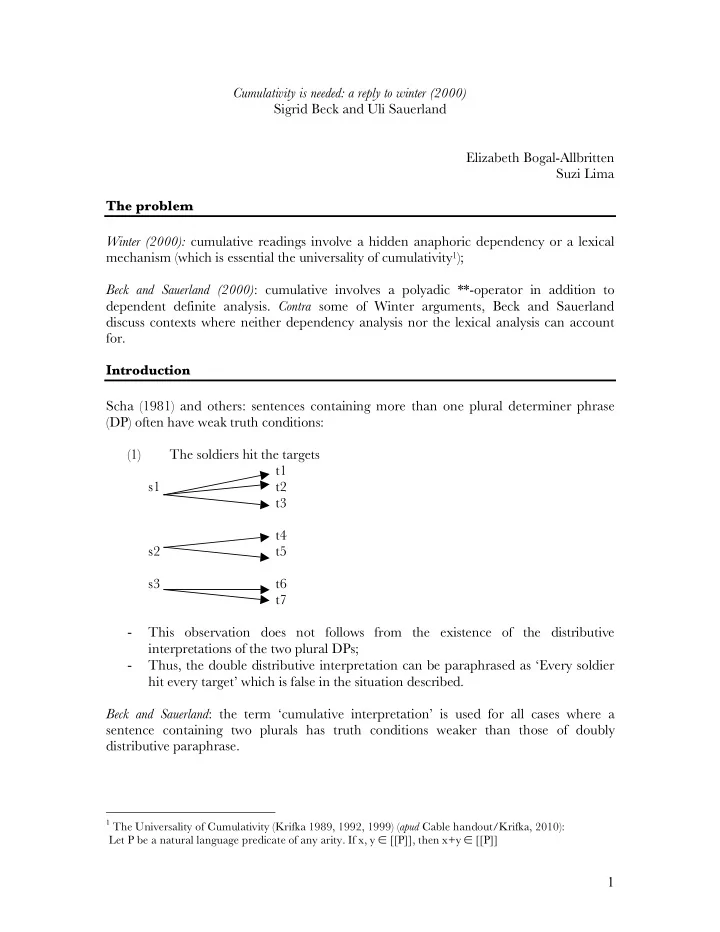
1 Cumulativity is needed: a reply to winter (2000) Sigrid Beck and Uli Sauerland Elizabeth Bogal-Allbritten Suzi Lima The problem Winter (2000): cumulative readings involve a hidden anaphoric dependency or a lexical mechanism (which is essential the universality of cumulativity1); Beck and Sauerland (2000): cumulative involves a polyadic **-operator in addition to dependent definite analysis. Contra some of Winter arguments, Beck and Sauerland discuss contexts where neither dependency analysis nor the lexical analysis can account for. Introduction Scha (1981) and others: sentences containing more than one plural determiner phrase (DP) often have weak truth conditions: (1) The soldiers hit the targets t1 s1 t2 t3 t4 s2 t5 s3 t6 t7

  • This observation does not follows from the existence of the distributive

interpretations of the two plural DPs;

  • Thus, the double distributive interpretation can be paraphrased as ‘Every soldier

hit every target’ which is false in the situation described. Beck and Sauerland: the term ‘cumulative interpretation’ is used for all cases where a sentence containing two plurals has truth conditions weaker than those of doubly distributive paraphrase.

1 The Universality of Cumulativity (Krifka 1989, 1992, 1999) (apud Cable handout/Krifka, 2010):

Let P be a natural language predicate of any arity. If x, y ∈ [[P]], then x+y ∈ [[P]]

slide-2
SLIDE 2

2 Lexical analysis Scha 1981: this proposal makes use of a meaning postulate (restricted to lexical predicates) instead of the **-operator to assign a cumulative interpretation; **-operator analysis **- operator (Krifka 1986, Beck and Sauerland 2000): apply to any two-place predicate (that can be formed in the syntax) and triggers a cumulative interpretation (note: **-

  • perator is essentially equivalent to the generalized *-operator discussed in class)

Definition of the **-operator: [[**R]] (X) (Y) = 1 if and only if ∀x ∈ X ∃y ∈ Y R(x) (y) and ∀y ∈ Y ∃x ∈ X R(x) (y) A relation (R) between two individuals is true iff for all x in X there is a y in Y such that R holds

  • f x,y and for all y in Y there is an x in X such that R holds of x, y

Dependency analysis Dependency analysis: one of the plurals contains an implicity variable bound by the other

  • ne:

(1) The soldiers hit the targets Representation of (1): (5) The soldiers λx. x hits the target (of x) If the subject in (5) is interpreted as a distributive universal and some relation R of targets to soldiers is contextual salient, we arrive at the interpretation in (6): (6) ∀x [x is one of the soldiers  hit [the R(x) targets]]] R(x)(y) = 1 iff y is a target assigned to x The interpretation of (6) can be paraphrased in (7): (7) Each soldier hit the target(s) assigned to him Motivation for dependency analysis: dependent definites are required independently of the issue of relational plurals (8a can be understood as in 8b): (8a) Every soldier hit the targets (8b) Every soldier hit the targets assigned to him

slide-3
SLIDE 3

3 Main question Question: which of three possible accounts for (1) is actually required?

  • The dependency analysis is independently attested, but it is not sufficient to

account for all examples of cumulativity: (9) These three soldiers hit those seven targets (10) Each of these three soldiers hit the seven targets assigned to him

  • The dependency analysis assigns to (9) an interpretation that can paraphrased in

(10). However, (10) is false or results in a presupposition failure because no soldier is assigned seven targets (as (10), generated by dependency analysis, would suggest). Note that **-analysis and the lexical analysis could explain (9);

  • Winter (2000): lexical analysis and the dependency account explain all cases of

weak readings with two plural noun phrases;

  • Beck and Sauerland (2000): dependency analysis and lexical analysis are not

enough; **-analysis is required.

  • 2. Interpretation of the dependent plural

(1) The soldiers hit the targets s1 t1 s2 t2 s3 t3 Can (1) be explained under the dependency analysis (The soldiers λx. x hit the target (of x)? (i) if the plural marking is interpreted: (1) is not true in this situation because no soldier hit a plurality of targets associated with him; (ii) in fact, only a sentence without plural marking (“The soldier hit the target”) is appropriated to a situation where every soldier is associated with only one target;

  • Based on this kind of fact Winter (2000) argues that “dependent plurality”

is not interpreted, i.e., plural marking on any DP may be purely morphological if the plural DP contains a pronominal bound another plural DP

slide-4
SLIDE 4

4 Side note (ia) The soldiers hit the target (ib) The soldiers hit the targets

  • For (ia), singular: weak interpretation depends on a context; dependency analysis

is available;

  • For (ib), plural: cumulative interpretation is available in an empty context. They

argue in favor of **-operator in this case or lexical analysis (dependency analysis does not apply). (iia) The boys put a coin into the machine (iib) The boys put a coin into the machines. For (iia), singular: weak interpretation (cumulative) is possible, but depends on a context; dependency analysis is available For (iib), plural: cumulative interpretation is available in an empty context. They argue in favor of **-operator in this case (neither lexical analysis nor dependency analysis apply). Dependent plurality and pronouns Winter: plural marking on any DP may be purely morphological if the plural DP contains a pronominal bound by another plural DP: (13) The boys (each) think they will win (note: they is always assigned a singular individual. Nevertheless, the pronoun itself must be morphologically plural. Back and Sauerland: agreement; the plural feature of they is not interpreted) Beck and Sauerland contra Winter: there are cases of DP containing a bound pronominal where plural marking must be interpreted: Situation: every woman has exactly one husband (15) a. The women will leave after the/their husbands arrived (interpretation: all the husbands have to arrive before the first woman leaves) (15) b. The women will leave after the/their husband arrived (interpretation: the first woman leaves when her own husband arrives)

  • If plural (husbands) is interpreted: the difference in interpretation between (15a) and

(15b) is predicted, because the/their husbands cannot refer to the husband of just

  • nly one woman and therefore refers to the group of all husbands.
  • If plural (husbands) is not interpreted: no difference in interpretation is expected in

(15).

slide-5
SLIDE 5

5 Conclusions (Beck and Sauerland): (i) dependent plurality is restricted to pronominals; plural marking on a bound pronominal need not to be interpreted as a plurality; Counter-example: ‘Monocycles have wheels’ (iii) Plural marking on non-pronominal DPs must be interpreted. If plural marking

  • n non-pronominals must be interpreted, there are examples of cumulative

readings that are explained by neither dependency analysis nor lexical

  • analysis. Such as in:

(17) The women gave a kiss to the/their husbands

  • The dependency analysis does not predict that (17) can be true in a situation

where each woman has exactly one husband and gave a kiss to her one husband;

  • A lexical analysis is also insufficient, since the cumulated predicate is: ‘λy. λx

x give a kiss to y’;

  • The **-analysis can predict that (17) can be true in the situation under

consideration (each woman has exactly one husband and gave a kiss to her

  • ne husband) due to syntactic processes that can create the predicate ‘λy. λx x

give a kiss to y’: (18) [the women] [the husbands] ** [λy. λx x gave a kiss to y]

  • 3. More cases on **-cumulativity
  • Other cases where dependency analysis cannot derive cumulativity:

First counter-evidence to dependent and lexical analysis: cardinal definites 19a Many politicians have taken a bribe from the five companies (Cumulative reading: there is no politician who took a bribe from every one of the five companies, as long as there are many politicians who took a bribe from one of the five companies) 19b These five teachers gave a bad mark to those 20 protesting students (Cumulative reading: each of the 20 students got a bad mark from only one of the five teachers) 19c The two women wanted to marry the two men (Cumulative reading: each woman decided to marry one of the two men) Dependent definites analysis does not work because of the presence of the numeral in the lower plural. For example consider the analysis in (20) for (19c): 20 ∀x [x is one of the two women  x wanted to marry [the R(x) two men]]] where R(x)(y) = 1 iff x dates y For all x, if x is a woman then x wanted to marry the two men who dated her

slide-6
SLIDE 6

6

  • The analysis in (20) is false in a situation where, for each woman, there is only one

man she decided to marry, but true in a situation where, for each woman, there are two men she decided to marry;

  • (21) can be interpreted as in (20):

21 Each of the two women wanted to marry the TWO men that she dated

  • Lexical analysis also does not work because the cumulative readings in (19) are not

lexical; Second counter-evidence to dependent and lexical analysis: cardinal indefinites (22a) Three boys gave a present to five girls (22b) The two gardeners sold 2000 roses to a woman, and only 500 to a man (22c) Jim and Frank want to marry two dentists

  • For the numeral indefinite example in (22a), a dependency analysis would only

yield the interpretation in (24) for (22a): (24) Three boys each gave a present to five girls related to them Third counter-evidence to dependent and lexical analysis: conjunctions (23a) Three boys gave a present to Ann, Jill, Sue, Nina and Zoe (23b) The two gardeners sold of a rose to Sue, Mary, and Peter (23c) Jim and Frank want to marry Sue and Amy (respectively)

  • For conjunctions, the dependent analysis is ruled out because a coordination of

proper names cannot contain an implicit variable.

  • An analysis based on dependent definites is impossible for indefinites, conjunction

and for cardinal definites. References Krifka, M.: 1986, Nominalreferenz und Zeitkonstitution. Zur Semantik von Massentermen, Pluraltermen und Aspektklassen, Ph.D. dissertation, Universität München. (Published by Wilhelm Finck, Munich, 1989.) Scha, R.: 1981, ‘Distributive, Collective and Cumulative Quantification’, in J. Groenendijk, T. Janssen, and M. Stokhof (eds.), Formal Methods in the Study of Language, Part 2, Mathematical Centre Tracts 136, University of Amsterdam, pp. 483–512. Reprinted in J. Groenendijk, M. Stokhof, and T. Janssen (eds.), 1984, Truth, Interpretation and Information, pp. 131–58. Foris, Dordrecht. Winter, Y.: 2000, ‘Distributivity and Dependency’, Natural Language Semantics 8, 27–69.

slide-7
SLIDE 7

Presentation on Beck and Sauerland (2000) Part Two Elizabeth Bogal-Allbritten LING 720 Part One: Cardinal definites, cardinal indefinites, and conjunctions all can be analyzed with **

  • Apparent absence of cumulative reading due to other factors

0: Winter:

  • Cardinal definites: cumulativity restricted to lexical predicates
  • Cardinal indefinites: cumulativity analyzed with cumulative quantification, a la Scha

(1981)

  • Conjunctions of proper names: cumulativity due to coordination-specific mechanism

I: Cardinal Definites Winter demonstrated that cumulativity not restricted to lexical predicates. But do we need dependent definites? (1) The two women wanted to marry the two men. Winter’s argument: (2)

  • a. Non-lexical predicate: λxλy. x is separated from y by a wall.
  • b. The fathers are separated from the children by a wall.
  • c. The two fathers are separated from the four children by a wall.

FIGURE A: Ann and Ruth are Bill’s children; Mary and Sue are John’s children. Each father is separated from his children by a wall but it is not true that each of the two fathers is separated from each of the four children by a wall (the doubly distributive, and very accessible, meaning for (2c)). Bill Ann John Ruth Mary Sue

  • Only the dependency and **-analysis are available
  • Dependency analysis: cumulativity possible in (2b) (where dependency is

permitted) but blocked in (2c) by numerals

  • **-analysis: cumulativity possible in both
slide-8
SLIDE 8

Perhaps there is more at work ‘blocking’ cumulativity in (2c)

  • A cumulative reading is easier if two analyses (dependency and **) can both generate

it. How do you find this point? Convincing?

  • Pragmatic factors may affect availability of cumulative reading:
  • The stronger doubly distributive reading always competes with cumulative

reading

  • Semantic and pragmatic factors (“no woman would marry two men!”)
  • verrule the stronger reading but it surfaces in the absence of such factors

Factors that overcome pragmatic bias towards the doubly distributive reading:

  • Placing the two numeral expressions into focus and the cumulated relation in the

background (3)

  • a. In the picture over there, the three women are separated from the four dogs by a wall.
  • b. In this picture, the two men are separated from the four children by a wall.
  • Having matching cardinalities for the two groups

(4) The two semanticists gave the two consultants a flower.

  • Removing the man-child relation in (2c) also improves the accessibility of the

cumulative reading II: Cardinal Indefinites (5) 600 Dutch companies use 5000 American computers. We can capture the cumulative interpretation of (5) with **: (6) ∃X (X is a plurality of 600 Dutch companies) ∃Y (Y is a plurality of 6000 American computers) [X **use Y] Winter: The above analysis does not work for exactly sentences because ∃X and ∃Y can select subsets with specified cardinalities. The **-analysis can’t account for non-upward entailing numerals!

  • We would predict (7) to be true in a context with 700 Dutch companies using 10,000

American computers (7) Exactly 600 Dutch companies use exactly 6000 American computers.

slide-9
SLIDE 9

Hackl’s (2000, 2001) analysis of non-upward monotonic quantificational determiners like exactly 600 allows us to maintain an account with **

  • exactly 600 decomposes into [[exactly 600] many], [exactly 600] takes clausal scope;

same with exactly 6000 (8) 600 is the maximal number n such that [6000 is the maximal number m such that [∃X (X is a plurality is n-many Dutch companies) ∃Y (Y is a plurality of m-many American computers) [X **use Y] Upshot: **-analysis accounts for indefinite numerals after all, if we assume Hackl’s independently motivated account. III: Conjunctions of Proper Names Winter: (9a) permits a cumulative reading while (9b) does not, but dependent definites can’t account for it: (9)

  • a. John and Bill gave Mary and Jane a flower.
  • b. John and Bill gave Mary, Sue, Ann, and Jane a flower.

Cumulative reading especially easy if respectively used

  • Winter: conjunctions are folded out in space by respectively

(10) John and Bill gave a flower to Mary and Sue, respectively. Contrast in (9a,b) not as strong as in (2a,b) – a cumulative interpretation is possible, as predicted by the **-analysis (and other factors are responsible for biasing against this reading)

  • Difficulty of cumulative interpretation arises from biasing factors already discussed
  • Putting the plural NPs in focus favors a cumulative construal
  • Using plurals with matching cardinality favors cumulativity

Does the **-analysis really capture all of the data?

  • Footnote 7: “Winter suggests that the data involving respectively should receive a

different analysis from cumulativity phenomena, an analysis that has to cover examples like (i) as well. Our strategy is different: we try to push a **-analysis as far as possible in the hope that it might generalize to (i) as well” (i) John loves and hates Mary and Sue respectively.

slide-10
SLIDE 10

Part Two: The **-Analysis and QR Locality Binary predicates to which ** applies can be complex syntactic constituents created by QR

  • Prediction: Availability of cumulative interpretation due to ** restricted to syntactic

environments that permit formation of a binary predicate, through QR where necessary

  • Where QR is blocked, the dependency analysis may be able to apply and still make

available the cumulative construal In (11b), the cumulated predicate arises through QR (11)

  • a. The two women want to marry the two men.
  • b. (the two women) (the two men) **λyλx[x want to marry y]

Binary predicate created by having movement target a position between (a) the predicate created by the first instance of movement and (b) the moved phrase. (12)

  • a. First instance of QR: [the two women] λx [x want to marry the two men]
  • b. Second instance of QR: [the two women] [the two men] λy λx [x want to marry y]
  • c. **-insertion: [the two women] [the two men] **λyλx [x want to marry y]

QR easier out of infinitival clauses than finite clauses Cardinal definites: (13)

  • a. The two lawyers have pronounced the two proposals to be against the law.
  • b. #The two lawyers have pronounced that the two proposals are against the law.

QR of the two proposals can’t occur in (13b) so binary predicate [**λyλx.x has pronounced that y is against the law] can’t be produced Cardinal indefinites: (14)

  • a. Max and Peter want to marry two dentists.
  • b. # Max and Peter said that Bill married two dentists.

Conjunctions of proper names: (15)

  • a. Max and Peter want to marry Sue and Amy, respectively.
  • b. *Max and Peter said that Bill married Ann and Amy, respectively.
slide-11
SLIDE 11

Relative clauses are islands for QR Cardinal definites: (16)

  • a. Sue and Amy saw a premiere of the two new operas this week.
  • b. #Sue and Amy talked to a man who likes the two new operas.
  • c. **λyλx.x talked to a man who likes y

Cardinal indefinites: (17)

  • a. Sue and Amy saw a premiere of two new operas this week.
  • b. #Sue and Amy talked to a man who likes two European countries.

Conjunctions of proper names: (18)

  • a. Sue and Amy saw a premiere of ‘Cats’ and ‘Oklahoma’, respectively.
  • b. *Sue and Amy talked to a man who likes Northampton and Danbury, respectively.

QR blocked out of specific NPs Cardinal definites: (19)

  • a. Sue and Amy discussed a review of these two books in class.
  • b. #Sue and Amy discussed Jill’s review of these two books in class.

Cardinal indefinites: (20)

  • a. Sue and Amy discussed a review of two new books.
  • b. #Sue and Amy discussed Jill’s review of two new books.

Conjunctions of proper names: (21)

  • a. Sue and Amy discussed a review of ‘Move Alpha’ and ‘Fried Green Tomatoes,’

respectively.

  • b. ??Sue and Amy discussed Jill’s review of ‘Move Alpha’ and ‘Fried Green Tomatoes,’

respectively. Second object in a double-object construction can’t QR to take scope

  • ver first object

Basic example: (22)

  • a. I gave a boy every cookie.
  • b. a boy >> every cookie
  • c. *every cookie >> a boy
slide-12
SLIDE 12

Bruening (2000): Both quantifiers in (22a) can QR but there is a shortest attract constraint that blocks the second object from moving to a position higher than the first Cardinal definites: Cumulation by ** can take scope over the indefinite second object a cookie: (23)

  • a. The two girls gave the two boys a cookie.
  • b. **λyλx.x gave y a cookie

Cumulation by ** cannot take scope over the indefinite first object (this would require the two cookies to take scope over a boy)

  • A cumulative reading where a single boy was given a total of two cookies (by two

girls) is possible. (24)

  • a. (#)The two girls gave a boy the two cookies.
  • b. **λzλx.x gave a boy z

(25)

  • a. * [[two girls] [two cookies] **[λyλx[x gave a boy y]]]
  • b. [a boy] λz [[two girls] [two cookies] **[λyλx[x gave z y]]]

Bruening’s analysis predicts that both objects of a double-object construction can scope over the subject as long as the first object ends up in a higher position: (26)

  • a. Today, a gardener sold 1000 customers 1200 flowers.
  • b. [1000 customers] [1200 flowers] **λyλx[a gardener sold x y]

Cardinal indefinites: (27)

  • a. Two girls gave two boys a cookie.

**λyλx[x gave y a cookie]

  • b. #Two girls gave a boy two books.

**λzλx[x gave a boy z] Conjunctions with proper names: (28)

  • a. Two girls gave Sue and Amy a cookie.

**λyλx[x gave y a cookie]

  • b. #Sue and Amy gave a boy ‘Peter Pan’ and ‘Move Alpha,’ respectively.

**λzλx[x gave a boy z] Part Three: Four Conclusions I: Our findings support the **-operator

  • ** applies to any relation-denoting constituent that the syntax can create.
  • Syntactic constraints affect the availability of cumulative readings as we’d expect.
slide-13
SLIDE 13

II: Cumulative readings with cardinal definites, cardinal indefinites, and conjunctions should all be analyzed in the same way

  • All types of plural NPs subject to parallel syntactic constraints.
  • Only a **-analysis can capture this parallelism neatly.
  • Note: the **-analysis can also be cashed out in terms of the *-operator and + (operating
  • ver tuples)

III: Our data speak against an analysis solely in terms of dependent definites

  • A dependent definite analysis wouldn’t predict locality conditions to affect availability
  • f cumulative readings.

…But we can’t give up the dependency analysis completely, for definites: (29) The companies will go bankrupt if the computers are not powerful enough. Winter notes that the cumulative reading crosses an island boundary

  • We will analyze (29) using dependent definites

If the **-analysis is right for cardinal definites / indefinites and conjunctions, we predict that the cumulative reading will not go through if an island boundary must be crossed.

  • This is borne out:

(30) 600 companies will go bankrupt if 5000 computers are not powerful enough. IV: The lexical analysis is not really necessary

  • Like the dependency analysis, the lexical analysis can’t account for syntactic

constraints

  • The lexical analysis isn’t needed to account for cases for which ** won’t suffice (e.g.,

(29))

  • If we have **, we can create cumulative readings for lexical predicates.
  • There is no need to keep an independent lexical mechanism.