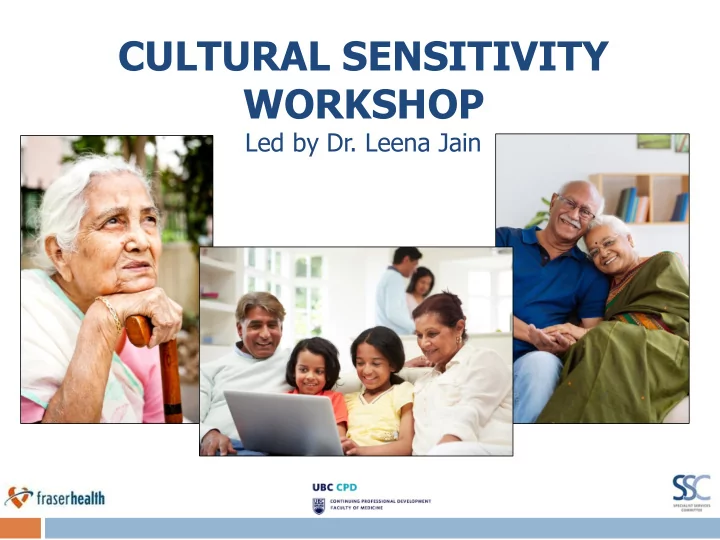
CULTURAL SENSITIVITY WORKSHOP Led by Dr. Leena Jain - - PowerPoint PPT Presentation

cultural sensitivity workshop
SMART_READER_LITE
LIVE PREVIEW

CULTURAL SENSITIVITY WORKSHOP Led by Dr. Leena Jain - - PowerPoint PPT Presentation

CULTURAL SENSITIVITY WORKSHOP Led by Dr. Leena Jain Acknowledgement Funding for this initiative was provided by the Specialist Services Committee (SSC), one of four joint collaborative committees representing a partnership of Doctors of BC


slide-1
SLIDE 1

CULTURAL SENSITIVITY WORKSHOP

Led by Dr. Leena Jain

slide-2
SLIDE 2

Acknowledgement

Funding for this initiative was provided by the Specialist Services Committee (SSC), one of four joint collaborative committees representing a partnership of Doctors of BC and the BC Ministry of Health.

slide-3
SLIDE 3

SOUTH ASIAN POPULATION

  • South Asians are a group of people whose

ethnic roots originate from the Indian subcontinent.

  • Within the Fraser Health region, South Asians

are the largest ethnic group, representing 15% of the total population and growing at a much faster rate than the total Fraser Health population.

  • The South Asian residents in the Fraser

Health region are very diverse with several religions, languages, cultural practices and traditions.

slide-4
SLIDE 4

LANGUAGE

  • Among the South Asian population here, roughly 1 in 5 do

not speak English.

  • Based on our needs assessment survey, other than English

the most commonly spoken language is:

  • Punjabi (68%), followed by
  • Hindi and
  • Urdu
  • Language and educational barriers are major health and

clinical challenges in South Asians greatly impacting ability to be aware of dementia knowledge and their uptake and continued use of health care services for dementia.

slide-5
SLIDE 5
  • In a survey conducted among a South Asian group, they

reported major barriers to early diagnosis being:

(1) a lack of knowledge or awareness of dementia,

(2) belief that not remembering things is a normal part of aging after 60 years of age, and (3) a language barrier.

BARRIERS TO EARLY DIAGNOSIS OF SOUTH ASIAN COMMUNITY

slide-6
SLIDE 6

CULTURAL SENSITIVITY

  • Knowledge of the South Asian culture, including lifestyle,

religions, languages, personal preferences, and values, will help provide culturally acceptable services and support. In an attempt to better understand that, we will discuss the following topics:

  • Family Hierarchy and Social Dynamics
  • Culturally Adept Caregiving
  • Other health risks and their effect on dementia
  • Reliance on Faith
slide-7
SLIDE 7

FAMILY HIERARCHY AND SOCIAL DYNAMICS

  • The men are usually the heads of the families and take important

decisions, therefore with dementia diagnosis, that status is often lost and is replaced with feeling ignored and frustrated.

  • Men of this generation work outside of home and are in charge of

finances and transport whereas women take care of the household chores including cooking, cleaning, laundry and bringing up the

  • grandchildren. It's rare to see them sharing day to day chores.
  • Elderly parents live with their sons
  • preferentially. The daughters leave

home once married to live with their husbands and his family. It is common practice to live in joint families.

slide-8
SLIDE 8

FAMILY HIERARCHY AND SOCIAL DYNAMICS

  • Most elderly are dependent on their children for

commuting and also communicating which makes them vulnerable for social isolation.

  • South Asian seniors rely on their children for handling their

finances so do not really understand the relevance of Power of Attorney.

  • Social control and socialization are essential functions of

the family system. Stigma surrounding dementia can be a huge barrier for the patient or family out of fear that society will think they are ‘crazy’ or ‘a lost cause’.

slide-9
SLIDE 9
  • Most often spouses are primary caregivers, since the adult children

are busy with full-time jobs and taking care of their school-age children.

  • The caregiving can be burdensome for

caregivers juggling multiple roles (taking care of the spouse and also being involved in the care of their own children and grandchildren).

  • Dependence on their children for commuting and communicating

further challenges this role and their ability to access resources.

  • Requires integrating the South Asian caregiver with the health care

providers so they are more likely to take up services available to them.

CULTURALLY ADEPT CAREGIVING

slide-10
SLIDE 10
  • The South Asian community is far more likely to view caring as their

duty, and are less likely to move their family member into care outside the family;

  • this traditional view of caring can prevent caregivers from engaging and

sharing the care responsibilities with a variety of service providers.

  • South Asian caregivers have reported service providers do not have

appropriate or sufficient cultural competence to meet the service needs

  • f them and their families.

CULTURALLY ADEPT CAREGIVING

  • Resource: UK Alzheimer’s Society has

developed an Information Programme for South Asian Families (IPSAF), a YouTube video on dementia for caregivers, translated in South Asian languages, highlighting specific cultural South Asian issues.

slide-11
SLIDE 11

OTHER HEALTH RISKS AND THEIR EFFECTS ON DEMENTIA

  • There is a higher prevalence of diabetes,

high blood pressure, high cholesterol and coronary artery disease in the South Asian community, all risk factors that increase chances of developing dementia.

  • The South Asian diet and primarily limited

exercise (mostly for the women) are also factors for high obesity levels in the community increasing their risk of dementia.

  • Heavy alcohol consumption is common in

South Asian men but is sometimes hidden

  • r not mentioned to doctors.
slide-12
SLIDE 12

RELIANCE ON FAITH

  • South Asian community are very

connected to their faith in god, following religious practices, and attending places of worship regularly.

  • They believe that God must have

put them in this state for a reason and this gives them the strength to endure.

slide-13
SLIDE 13
  • Approach interpreter services or use a member of your staff to convey

information if they do not understand English very well.

  • Conduct a MoCA in the language they are comfortable in.
  • Always keep family members in the loop while making decisions such

as starting medications, as sometimes the older adults do not have the health literacy to understand what they are saying yes to.

  • Encourage South Asian persons with dementia and caregivers to enroll

into support groups or meet other persons living with dementia for connection and support.

HOW TO SUPPORT SOUTH ASIAN DEMENTIA PATIENTS AND FAMILIES IN A CULTURALLY- SENSITIVE MANNER

slide-14
SLIDE 14
  • Do not make assumptions, ask them what language they would like

information in. Give them translated material on dementia if needed and provide English versions for their children or grandchildren who may want to learn more.

  • Suggest using some of the services listed in the ‘7 Numbers for Early

Dementia’ for home support, adult day programs or transportation.

  • Discuss their diet with them as well as their caregiver who might be

responsible for the cooking and caretaking.

  • Be open about how alcohol drinking might impact their condition.

Alcoholism is a huge issue in the South Asian community, but many do not ask for help out of shame or addiction. Suggest tips, resources or services on how to reduce consumption or quit.

HOW TO SUPPORT SOUTH ASIAN DEMENTIA PATIENTS AND FAMILIES IN A CULTURALLY- SENSITIVE MANNER

slide-15
SLIDE 15

Punjabi MoCA now available for world- wide use on www.mocatest.org

slide-16
SLIDE 16

South Asian Dementia Help Line

Support and Education Coordinator

Baljeet Judge

Phone: 604-449-5003

Monday to Friday, 9 a.m. to 4 p.m.

Toll-free: 1-833-674-5003

slide-17
SLIDE 17

RESOURCES

Resources developed in English, Punjabi and Hindi:

  • 7 Numbers for Early Dementia
  • HandyDART Simplified Instructions
  • Keep your Brain Healthy Brochure
slide-18
SLIDE 18

RESOURCES

  • More Punjabi-translated brochures

available at the Alzheimer Society

  • f BC’s website:
  • Dispelling the Myths
  • Getting a Diagnosis
  • 10 Warning Signs
slide-19
SLIDE 19

RESOURCES

  • Interpretation services in community:
  • MOSAIC Interpretation and Translation (in more than 80

languages)

  • Options Translation and Interpretation Services
  • HealthLink BC (Nurseline) 8-1-1
  • Translation services available in 130 languages
  • In Fraser Health services e.g. acute care and Fraser Health

community clinics:

  • http://fhpulse/clinical_resources/diversity_translation_services/Pag

es/InterpreterServices.aspx

  • Provincial Language Service (in over 150 languages)
slide-20
SLIDE 20
  • For more information, please contact:
  • Dr. Leena Jain

leena.jain@fraserhealth.ca

  • Jeevan Sangha

jeevan.sangha@fraserhealth.ca