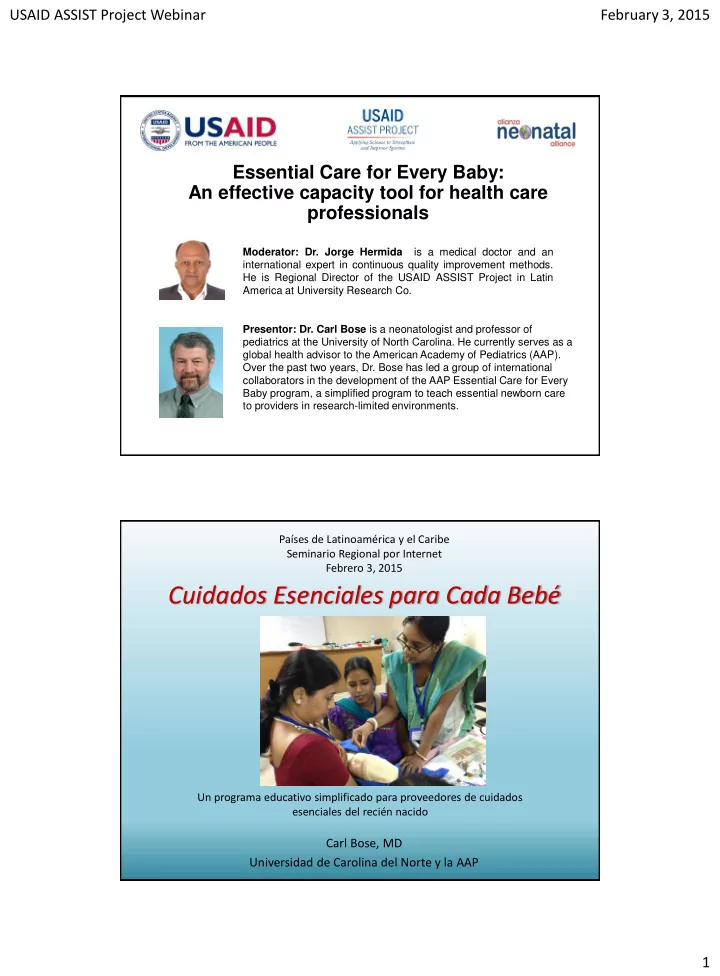
SLIDE 1 USAID ASSIST Project Webinar February 3, 2015 1
Presentor: Dr. Carl Bose is a neonatologist and professor of pediatrics at the University of North Carolina. He currently serves as a global health advisor to the American Academy of Pediatrics (AAP). Over the past two years, Dr. Bose has led a group of international collaborators in the development of the AAP Essential Care for Every Baby program, a simplified program to teach essential newborn care to providers in research-limited environments.
Essential Care for Every Baby: An effective capacity tool for health care professionals
Moderator: Dr. Jorge Hermida is a medical doctor and an international expert in continuous quality improvement methods. He is Regional Director of the USAID ASSIST Project in Latin America at University Research Co.
Cuidados Esenciales para Cada Bebé
Carl Bose, MD Universidad de Carolina del Norte y la AAP
Países de Latinoamérica y el Caribe Seminario Regional por Internet Febrero 3, 2015 Un programa educativo simplificado para proveedores de cuidados esenciales del recién nacido
SLIDE 2 USAID ASSIST Project Webinar February 3, 2015 2
Salud neonatal a nivel mundial
- 3.8 millones de muertes neonatales (3.2 millones de
mortinatos)
- ~ 3 veces las muertes provocadas por el VIH/SIDA y
la malaria combinados
- > 400 muertes neonatales cada hora
¡La mayoría de estas muertes son prevenibles!
¿Dónde ocurren la mayoría de muertes neonatales?
Oestergaard et al. PLoS Med 2011
SLIDE 3 USAID ASSIST Project Webinar February 3, 2015 3 Desigualdades intra-país relativas a la supervivencia infantil
Fuente: Estado de la Niñez de Latinoamérica y el Caribe, UNICEF 2008
SLIDE 4 USAID ASSIST Project Webinar February 3, 2015 4
¿Qué ocasiona la muerte neonatal? ¿Qué puede hacerse al respecto?
Improved resuscitation
- KMC
- Alternate feeding techniques
- Thermoregulation
- Cord care
- Improved hygiene
- Exclusive breastfeeding
SLIDE 5 USAID ASSIST Project Webinar February 3, 2015 5
¿Qué se está haciendo?
- Prácticas de cuidados esenciales neonatales (CEN)
recomendadas por la OMS y varias autoridades de salud
Requisitos para introducir cambios en la atención de salud:
- Educación para garantizar los conocimientos y
habilidades de los proveedores
- Plan de implementación para trasladar los
conocimientos y habilidades a la práctica
¿Qué se está haciendo?
- Prácticas de cuidados esenciales neonatales (CEN)
recomendadas por la OMS y varias autoridades de salud
Requisitos para introducir cambios en la práctica:
- Educación para garantizar los conocimientos y
habilidades de los proveedores
- Plan de implementación que traslade los
conocimientos y habilidades a la práctica
SLIDE 6 USAID ASSIST Project Webinar February 3, 2015 6
Cuidados Esenciales para Cada Bebé, un programa de Ayudando a los Bebés a Sobrevivir
- Paquete de programas educativos para mejorar
la sobrevivencia neonatal
- Currículo basado en la evidencia
- Enfoque educativo compartido – aprendizaje
cooperativo, basado en destrezas, simulación de tecnología sencilla y alta fidelidad
- Se sugiere práctica continua y mejoramiento
de la calidad Los programas Ayudando a los Bebés a Sobrevivir
Improved resuscitation
- Cord care
- Improved hygiene
- Exclusive breastfeeding
SLIDE 7 USAID ASSIST Project Webinar February 3, 2015 7
Improved resuscitation
- Cord care
- Improved hygiene
- Exclusive breastfeeding
Los programas Ayudando a los Bebés a Sobrevivir
Cuidados Esenciales para Cada Bebé
materiales
SLIDE 8
USAID ASSIST Project Webinar February 3, 2015 8
Cuidados Esenciales para Cada Bebé
Plan de Acción
Cuidados Esenciales para Cada Bebé
Rotafolio del Facilitador
SLIDE 9
USAID ASSIST Project Webinar February 3, 2015 9
Cuidados Esenciales para Cada Bebé
Rotafolio del Facilitador
Cuidados Esenciales para Cada Bebé
Guía para Proveedores – Ejercicios Prácticos
SLIDE 10
USAID ASSIST Project Webinar February 3, 2015 10
Cuidados Esenciales para Cada Bebé
Guía para Proveedores – Ejercicios para desarrollar habilidades comunicativas
Cuidados Esenciales para Cada Bebé
Guía para Proveedores – Revisión y Mejoramiento de la Calidad
SLIDE 11
USAID ASSIST Project Webinar February 3, 2015 11
Cuidados Esenciales para Cada Bebé
Guía para Padres
Cuidados Esenciales para Cada Bebé
Guía para Padres
SLIDE 12
USAID ASSIST Project Webinar February 3, 2015 12
Cuidados Esenciales para Cada Bebé
Modelo de pechos – lactancia, extracción, cuidados piel a piel
Cuidados Esenciales para Cada Bebé Pruebas de campo en Kenia Eldoret - 2013 Pruebas de campo en India Nueva Delhi, Calcuta, Hyderabad 2013
SLIDE 13 USAID ASSIST Project Webinar February 3, 2015 13 Pruebas de campo adicionales en Uganda e introducción a 10 países de Africa en Addis Abeba, 2014
Academia Americana de Pediatría Recursos a nivel mundial
- Plataforma en internet para acceder a CECB y otros programas
- Formatos adecuados para descargar/imprimir*
- No hay tarifa de uso
- Los usuarios manifiestan su acuerdo con “las condiciones de
uso”:
- Usado únicamente para educación sin fines de lucro
- No puede ser vendido
- Modificación en función del plan de adaptación local aprobado
- Versión en español disponible ≈ inicios del 2015
- Url: http://www.aap.org/en-us/advocacy-and-policy/aap-health-
initiatives/global/Pages/eceb.aspx *Las versiones impresas están disponibles a través de la Librería de la AAP o
Laerdal Global Health
SLIDE 14 USAID ASSIST Project Webinar February 3, 2015 14
Improved resuscitation
- Cord care
- Improved hygiene
- Exclusive breastfeeding
Los programas Ayudando a los Bebés a Sobrevivir
Peso 1.6 kg Tamaño y proporciones realistas para un bebé pré-termino Respalda la capacitación en:
- Posición y acoplamiento adecuado
- Colocación correcta del tubo naso-gástrico
- Alimentación con cuchara, taza y tubo naso-gástrico
- Cuidados continuos piel a piel
Cuidados Esenciales para bebés pequeños
Simulador de un bebé pretérmino
SLIDE 15 USAID ASSIST Project Webinar February 3, 2015 15
Cuidados Esenciales para bebés pequeños
Cronograma de desarrollo/producción
Notes
Enero/Febrero 2014 Desarrollo de contenidos del Rotafolio Esquema de contenidos desarrollado Marzo Revisión Delphi Revisión de contenidos sin imágenes Mayo Revisión OMS ¿Está confirmada esta fecha? Junio Proceso editorial presencial Elk Grove Village Junio Modificación de materiales Cambios necesarios debido a las revisiones Julio/Agosto Finalización de imágenes, contenidos Uso de materiales modificados con imágenes Septiembre Prueba de campo y revisiones Cambios necesarios debido a la prueba Octubre-Enero, 2015 Corrección de estilo y revisiones finales Preparación de imágenes finales y ajustes de formato Abril, 2015 Lanzamiento en Asia del Sur Material impreso y archivos pdf imprimibles disponibles
¿Qué se está haciendo?
- Prácticas de cuidados esenciales neonatales (CEN)
recomendadas por la OMS y varias autoridades de salud
Requisitos para introducir cambios en la práctica:
- Educación para garantizar los conocimientos y
habilidades de los proveedores
- Plan de implementación que traslade los
conocimientos y habilidades a la práctica
SLIDE 16 USAID ASSIST Project Webinar February 3, 2015 16
Figura 1. Tiempo para que cada región alcance la misma probabildad de sobrevivencia neonatal en el 2012 que tienen los recién nacidos en países de ingresos elevados, Lawn et
Hay trabajo por hacer
~ 2043
Ayudando a los Bebés a Sobrevivir
SLIDE 17 USAID ASSIST Project Webinar February 3, 2015 17
Essential Care for Every Baby
Carl Bose, MD University of North Carolina and the AAP
Latin American and Caribbean Countries Regional Webinar February 3, 2015 A simplified educational program for providers of essential newborn care
Global Neonatal Health
- 3.8 neonatal deaths (3.2 million stillbirths)
- ~ 3x deaths due to HIV/AIDs and malaria combined
- > 400 neonatal deaths each hour
Most of these deaths are preventable!
SLIDE 18 USAID ASSIST Project Webinar February 3, 2015 18
Where do most neonatal deaths occur?
Oestergaard et al. PLoS Med 2011
SLIDE 19 USAID ASSIST Project Webinar February 3, 2015 19
Intra-country Disparities in Child Survival
From: State of Latin American and Caribbean Children, UNICEF 2008
What causes neonatal death?
SLIDE 20 USAID ASSIST Project Webinar February 3, 2015 20
What can be done?
Improved resuscitation
- KMC
- Alternate feeding techniques
- Thermoregulation
- Cord care
- Improved hygiene
- Exclusive breastfeeding
What is being done?
- Essential newborn care (ENC) practices
recommended by the WHO and many health authorities
Requirements for change in practice:
- Education to insure knowledge and skill of
providers
- Implementation plan to translate knowledge and
skill into practice
SLIDE 21 USAID ASSIST Project Webinar February 3, 2015 21
What is being done?
- Essential newborn care (ENC) practices
recommended by the WHO and many health authorities
Requirements for change in practice:
- Education to insure knowledge and skill of
providers
- Implementation plan to translate knowledge and
skill into practice
Essential Care for Every Baby, a Helping Babies Survive program
- Package of educational programs to improve
neonatal survival
- Evidence-based curricula
- Shared educational approach – skills-based,
cooperative learning, low-tech, high-fidelity simulation
- Suggested ongoing practice and quality
improvement
SLIDE 22 USAID ASSIST Project Webinar February 3, 2015 22
The Helping Babies Survive Programs
Improved resuscitation
- Cord care
- Improved hygiene
- Exclusive breastfeeding
Improved resuscitation
- Cord care
- Improved hygiene
- Exclusive breastfeeding
The Helping Babies Survive Programs
SLIDE 23
USAID ASSIST Project Webinar February 3, 2015 23
Essential Care for Every Baby
materials
Essential Care for Every Baby
Action Plan
SLIDE 24
USAID ASSIST Project Webinar February 3, 2015 24
Essential Care for Every Baby
Facilitator Flip Chart
Essential Care for Every Baby
Facilitator Flip Chart
SLIDE 25
USAID ASSIST Project Webinar February 3, 2015 25
Essential Care for Every Baby
Provider Guide – Practice Exercises
Essential Care for Every Baby
Provider Guide – Exercises with Communication Skills
SLIDE 26
USAID ASSIST Project Webinar February 3, 2015 26
Essential Care for Every Baby
Provider Guide – Review and Quality Improvement
Essential Care for Every Baby
Parent Guide
SLIDE 27
USAID ASSIST Project Webinar February 3, 2015 27
Essential Care for Every Baby
Parent Guide
Essential Care for Every Baby
Breast Model – breastfeeding, expression, skin-to-skin care
SLIDE 28
USAID ASSIST Project Webinar February 3, 2015 28 Essential Care for Every Baby Kenya field testing Eldoret - 2013 India field testing New Delhi, Kolkata, Hyderabad 2013 Additional field testing in Uganda and introduction to 10 countries in Africa in Addis Ababa, 2014
SLIDE 29 USAID ASSIST Project Webinar February 3, 2015 29
American Academy of Pediatrics Global Resources
- Web-based platform for access to ECEB and other programs
- Formats suitable for downloading/printing*
- No fee
- Users agree to “terms of use”:
- Used for non-profit education only
- May not be sold
- Modification by approved localization plan
- Spanish version available ≈ early 2015
- Url: http://www.aap.org/en-us/advocacy-and-policy/aap-
health-initiatives/global/Pages/eceb.aspx *Printed versions available through AAP Bookstore or Laerdal Global Health
Improved resuscitation
- Cord care
- Improved hygiene
- Exclusive breastfeeding
The Helping Babies Survive Programs
SLIDE 30 USAID ASSIST Project Webinar February 3, 2015 30
Weight 1.6 kg Realistic size and proportions for preterm baby Supports training in
- proper breastfeeding positioning and attachment
- correct nasogastric tube placement
- spoon, cup and nasogastric tube feeding
- continuous skin-to-skin care
Essential Care for Small Babies
Preterm simulator
Essential Care for Small Babies
Development/production timeline
Notes
January/February 2014 Flipchart content development Content outline developed March Delphi review Review on content without images May WHO review Has this date been confirmed? June Editorial face-to-face Elk Grove Village June Modification of materials Necessary edits due to reviews July/August Finalization of images, content Using modified materials with images September Field testing and revisions Necessary edits due to testing October-January, 2015 Copyediting and final revisions Preparation of final images and formatting April, 2015 Launch in South Asia Printed material and printable pdfs available
SLIDE 31 USAID ASSIST Project Webinar February 3, 2015 31
What is being done?
- Essential newborn care (ENC) practices
recommended by the WHO and many health authorities
Requirements for change in practice:
- Education to insure knowledge and skill of
providers
- Implementation plan to translate knowledge and
skill into practice
Figure 1 Time for each region to reach the same chance of neonatal survival as in 2012 for newborn babies in high-income countries, Lawn et al. Lancet, 2014
There is work to be done
~ 2043
SLIDE 32 USAID ASSIST Project Webinar February 3, 2015 32
Helping Babies Survive
Essential Care for Every Baby
Carl Bose, MD University of North Carolina and the AAP
Latin American and Caribbean Countries Regional Webinar February 3, 2015 A simplified educational program for providers of essential newborn care
SLIDE 33 USAID ASSIST Project Webinar February 3, 2015 33
Global Neonatal Health
- 3.8 neonatal deaths (3.2 million stillbirths)
- ~ 3x deaths due to HIV/AIDs and malaria combined
- > 400 neonatal deaths each hour
Most of these deaths are preventable!
Where do most neonatal deaths occur?
Oestergaard et al. PLoS Med 2011
SLIDE 34 USAID ASSIST Project Webinar February 3, 2015 34
Intra-country Disparities in Child Survival
From: State of Latin American and Caribbean Children, UNICEF 2008
SLIDE 35 USAID ASSIST Project Webinar February 3, 2015 35
What causes neonatal death? What can be done?
Improved resuscitation
- KMC
- Alternate feeding techniques
- Thermoregulation
- Cord care
- Improved hygiene
- Exclusive breastfeeding
SLIDE 36 USAID ASSIST Project Webinar February 3, 2015 36
What is being done?
- Essential newborn care (ENC) practices
recommended by the WHO and many health authorities
Requirements for change in practice:
- Education to insure knowledge and skill of
providers
- Implementation plan to translate knowledge and
skill into practice
What is being done?
- Essential newborn care (ENC) practices
recommended by the WHO and many health authorities
Requirements for change in practice:
- Education to insure knowledge and skill of
providers
- Implementation plan to translate knowledge and
skill into practice
SLIDE 37 USAID ASSIST Project Webinar February 3, 2015 37
Essential Care for Every Baby, a Helping Babies Survive program
- Package of educational programs to improve
neonatal survival
- Evidence-based curricula
- Shared educational approach – skills-based,
cooperative learning, low-tech, high-fidelity simulation
- Suggested ongoing practice and quality
improvement
The Helping Babies Survive Programs
Improved resuscitation
- Cord care
- Improved hygiene
- Exclusive breastfeeding
SLIDE 38 USAID ASSIST Project Webinar February 3, 2015 38
Improved resuscitation
- Cord care
- Improved hygiene
- Exclusive breastfeeding
The Helping Babies Survive Programs
Essential Care for Every Baby
materials
SLIDE 39
USAID ASSIST Project Webinar February 3, 2015 39
Essential Care for Every Baby
Action Plan
Essential Care for Every Baby
Facilitator Flip Chart
SLIDE 40
USAID ASSIST Project Webinar February 3, 2015 40
Essential Care for Every Baby
Facilitator Flip Chart
Essential Care for Every Baby
Provider Guide – Practice Exercises
SLIDE 41
USAID ASSIST Project Webinar February 3, 2015 41
Essential Care for Every Baby
Provider Guide – Exercises with Communication Skills
Essential Care for Every Baby
Provider Guide – Review and Quality Improvement
SLIDE 42
USAID ASSIST Project Webinar February 3, 2015 42
Essential Care for Every Baby
Parent Guide
Essential Care for Every Baby
Parent Guide
SLIDE 43
USAID ASSIST Project Webinar February 3, 2015 43
Essential Care for Every Baby
Breast Model – breastfeeding, expression, skin-to-skin care
Essential Care for Every Baby Kenya field testing Eldoret - 2013 India field testing New Delhi, Kolkata, Hyderabad 2013
SLIDE 44 USAID ASSIST Project Webinar February 3, 2015 44 Additional field testing in Uganda and introduction to 10 countries in Africa in Addis Ababa, 2014
American Academy of Pediatrics Global Resources
- Web-based platform for access to ECEB and other programs
- Formats suitable for downloading/printing*
- No fee
- Users agree to “terms of use”:
- Used for non-profit education only
- May not be sold
- Modification by approved localization plan
- Spanish version available ≈ early 2015
- Url: http://www.aap.org/en-us/advocacy-and-policy/aap-
health-initiatives/global/Pages/eceb.aspx *Printed versions available through AAP Bookstore or Laerdal Global Health
SLIDE 45 USAID ASSIST Project Webinar February 3, 2015 45
Improved resuscitation
- Cord care
- Improved hygiene
- Exclusive breastfeeding
The Helping Babies Survive Programs
Weight 1.6 kg Realistic size and proportions for preterm baby Supports training in
- proper breastfeeding positioning and attachment
- correct nasogastric tube placement
- spoon, cup and nasogastric tube feeding
- continuous skin-to-skin care
Essential Care for Small Babies
Preterm simulator
SLIDE 46 USAID ASSIST Project Webinar February 3, 2015 46
Essential Care for Small Babies
Development/production timeline
Notes
January/February 2014 Flipchart content development Content outline developed March Delphi review Review on content without images May WHO review Has this date been confirmed? June Editorial face-to-face Elk Grove Village June Modification of materials Necessary edits due to reviews July/August Finalization of images, content Using modified materials with images September Field testing and revisions Necessary edits due to testing October-January, 2015 Copyediting and final revisions Preparation of final images and formatting April, 2015 Launch in South Asia Printed material and printable pdfs available
What is being done?
- Essential newborn care (ENC) practices
recommended by the WHO and many health authorities
Requirements for change in practice:
- Education to insure knowledge and skill of
providers
- Implementation plan to translate knowledge and
skill into practice
SLIDE 47 USAID ASSIST Project Webinar February 3, 2015 47
Figure 1 Time for each region to reach the same chance of neonatal survival as in 2012 for newborn babies in high-income countries, Lawn et al. Lancet, 2014
There is work to be done
~ 2043
Helping Babies Survive
SLIDE 48 USAID ASSIST Project Webinar February 3, 2015 48
Thank you for your participation!
- For more information or to register for future webinars or the
USAID ASSIST project updates please contact Elizabeth Silva at esilva@wi-her.org
- Visit the USAID ASSIST Knowledge Portal at
www.usaidassist.org
- Vist the USAID ASSIST’s Salud Materno Infantil Website at
www.maternoinfantil.org