CSE 332: Data Structures Homework 1, Wednesday, beginning of - - PDF document

cse 332 data structures
SMART_READER_LITE
LIVE PREVIEW

CSE 332: Data Structures Homework 1, Wednesday, beginning of - - PDF document

Announcements Due next week Project 1A, Monday, 11:59 PM CSE 332: Data Structures Homework 1, Wednesday, beginning of class Project 1B, Thursday, 11:59 PM Asymptotic Analysis II Richard Anderson, Steve Seitz Winter


slide-1
SLIDE 1

1

CSE 332: Data Structures Asymptotic Analysis II

Richard Anderson, Steve Seitz Winter 2014

2

Announcements

  • Due next week

– Project 1A, Monday, 11:59 PM – Homework 1, Wednesday, beginning of class – Project 1B, Thursday, 11:59 PM

3

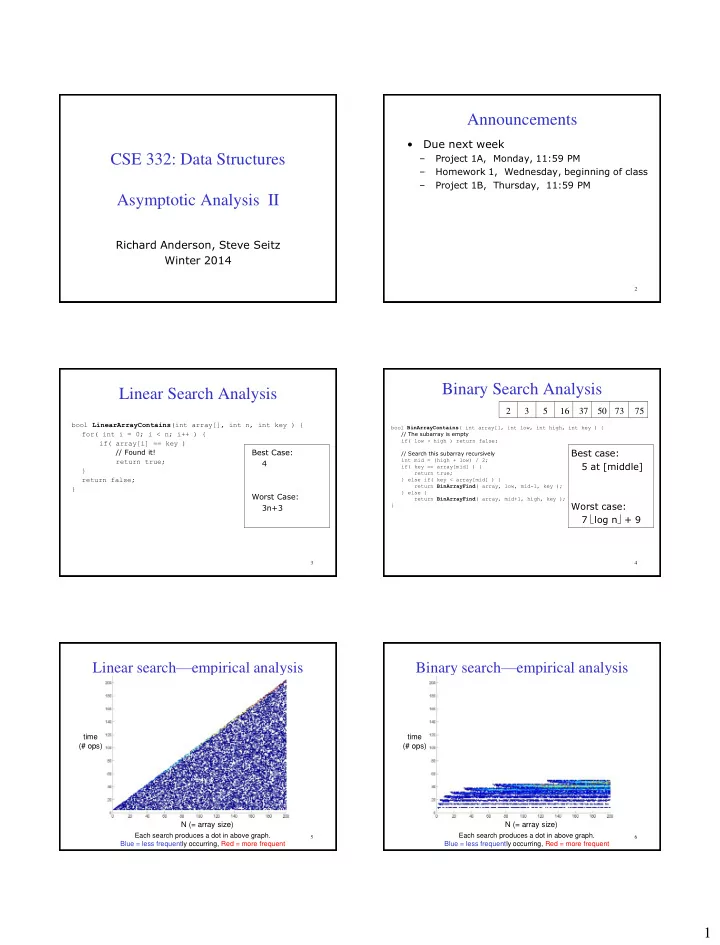
Linear Search Analysis

bool LinearArrayContains(int array[], int n, int key ) { for( int i = 0; i < n; i++ ) { if( array[i] == key ) // Found it! return true; } return false; }

Best Case: 4 Worst Case: 3n+3

4

Binary Search Analysis

bool BinArrayContains( int array[], int low, int high, int key ) { // The subarray is empty if( low > high ) return false; // Search this subarray recursively int mid = (high + low) / 2; if( key == array[mid] ) { return true; } else if( key < array[mid] ) { return BinArrayFind( array, low, mid-1, key ); } else { return BinArrayFind( array, mid+1, high, key ); }

Best case: 5 at [middle] Worst case: 7 log n + 9 2 3 5 16 37 50 73 75

5

Linear search—empirical analysis

N (= array size) time (# ops)

Each search produces a dot in above graph. Blue = less frequently occurring, Red = more frequent

6

Binary search—empirical analysis

N (= array size) time (# ops)

Each search produces a dot in above graph. Blue = less frequently occurring, Red = more frequent

slide-2
SLIDE 2

2

7

Empirical comparison

N (= array size) time (# ops) N (= array size)

Linear search Binary search

Gives additional information

8

Fast Computer vs. Slow Computer

9

Fast Computer vs. Smart Programmer (small data)

10

Fast Computer vs. Smart Programmer (big data)

11

Asymptotic Analysis

  • Consider only the order of the running time

– A valuable tool when the input gets “large” – Ignores the effects of different machines or different implementations of same algorithm

12

Asymptotic Analysis

  • To find the asymptotic runtime, throw

away the constants and low-order terms

– Linear search is – Binary search is

Remember: the “fastest” algorithm has the slowest growing function for its runtime

) ( 3 3 ) ( n O n n T LS

worst

  

 

) (log 9 log 7 ) (

2

n O n n T BS

worst

  

slide-3
SLIDE 3

3

13

Asymptotic Analysis

Eliminate low order terms

– 4n + 5  – 0.5 n log n + 2n + 7  – n3 + 3 2n + 8n 

Eliminate coefficients

– 4n  – 0.5 n log n  – 3 2n =>

14

Properties of Logs

Basic:

  • AlogAB = B
  • logAA =

Independent of base:

  • log(AB) =
  • log(A/B) =
  • log(AB) =
  • log((AB)C) =

Changing base  multiply by constant

– For example: log2x = 3.22 log10x – More generally – Means we can ignore the base for asymptotic analysis (since we’re ignoring constant multipliers)

15

Properties of Logs

n A n

B B A

log log 1 log         

16

Another example

  • Eliminate

low-order terms

  • Eliminate

constant coefficients

16n3log8(10n2) + 100n2

17

Comparing functions

  • f(n) is an upper bound for h(n)

if h(n) ≤ f(n) for all n This is too strict – we mostly care about large n Still too strict if we want to ignore scale factors

18

Definition of Order Notation

  • h(n) є O(f(n)) Big-O “Order”

if there exist positive constants c and n0 such that h(n) ≤ c f(n) for all n ≥ n0 O(f(n)) defines a class (set) of functions

slide-4
SLIDE 4

4

19

Order Notation: Intuition

Although not yet apparent, as n gets “sufficiently large”, a(n) will be “greater than or equal to” b(n)

a(n) = n3 + 2n2 b(n) = 100n2 + 1000

20

Order Notation: Example

100n2 + 1000  (n3 + 2n2) for all n  100 So 100n2 + 1000  O(n3 + 2n2)

21

Example

h(n)  O( f(n) ) iff there exist positive constants c and n0 such that: h(n)  c f(n) for all n  n0 Example: 100n2 + 1000  1 (n3 + 2n2) for all n  100 So 100n2 + 1000  O(n3 + 2n2 )

22

Constants are not unique

h(n)  O( f(n) ) iff there exist positive constants c and n0 such that: h(n)  c f(n) for all n  n0 Example: 100n2 + 1000  1 (n3 + 2n2) for all n  100 100n2 + 1000  1/2 (n3 + 2n2) for all n  198

23

Another Example: Binary Search

h(n)  O( f(n) ) iff there exist positive constants c and n0 such that: h(n)  c f(n) for all n  n0 Is 7log2n + 9  O (log2n)?

24

Order Notation: Worst Case Binary Search

slide-5
SLIDE 5

5

25

Some Notes on Notation

Sometimes you’ll see (e.g., in Weiss) h(n) = O( f(n) )

  • r

h(n) is O( f(n) ) These are equivalent to h(n)  O( f(n) )

26

Big-O: Common Names

– constant: O(1) – logarithmic: O(log n) (logkn, log n2  O(log n)) – linear: O(n) – log-linear: O(n log n) – quadratic: O(n2) – cubic: O(n3) – polynomial: O(nk) (k is a constant) – exponential: O(cn) (c is a constant > 1)

27

Asymptotic Lower Bounds

  • ( g(n) ) is the set of all functions

asymptotically greater than or equal to g(n)

  • h(n)  ( g(n) ) iff

There exist c>0 and n0>0 such that h(n)  c g(n) for all n  n0

28

Asymptotic Tight Bound

  • ( f(n) ) is the set of all functions

asymptotically equal to f (n)

  • h(n)  ( f(n) ) iff

h(n)  O( f(n) ) and h(n)  (f(n) )

  • This is equivalent to:

lim ( )/ ( )

n

h n f n c



 

29

Full Set of Asymptotic Bounds

  • O( f(n) ) is the set of all functions

asymptotically less than or equal to f(n) – o(f(n) ) is the set of all functions asymptotically strictly less than f(n)

  • ( g(n) ) is the set of all functions

asymptotically greater than or equal to g(n) – ( g(n) ) is the set of all functions asymptotically strictly greater than g(n)

  • ( f(n) ) is the set of all functions

asymptotically equal to f (n)

30

  • h(n)  O( f(n) ) iff

There exist c>0 and n0>0 such that h(n)  c f(n) for all n  n0

  • h(n)  o(f(n)) iff

There exists an n0>0 such that h(n) < c f(n) for all c>0 and n  n0 – This is equivalent to:

  • h(n)  ( g(n) ) iff

There exist c>0 and n0>0 such that h(n)  c g(n) for all n  n0

  • h(n)  ( g(n) ) iff

There exists an n0>0 such that h(n) > c g(n) for all c>0 and n  n0 – This is equivalent to:

  • h(n)  ( f(n) ) iff

h(n)  O( f(n) ) and h(n)  (f(n) )

– This is equivalent to:

Formal Definitions

lim ( )/ ( )

n

h n f n



 lim ( )/ ( )

n

h n g n



  lim ( )/ ( )

n

h n f n c



 

slide-6
SLIDE 6

6

31

Big-Omega et al. Intuitively

Asymptotic Notation Mathematics Relation O     =

  • <

 >

32

Complexity cases (revisited)

Problem size N

– Worst-case complexity: max # steps algorithm takes on “most challenging” input

  • f size N

– Best-case complexity: min # steps algorithm takes on “easiest” input of size N – Average-case complexity: avg # steps algorithm takes on random inputs of size N – Amortized complexity: max total # steps algorithm takes on M “most challenging” consecutive inputs of size N, divided by M (i.e., divide the max total by M).

33

Bounds vs. Cases

Two orthogonal axes:

– Bound Flavor

  • Upper bound (O, o)
  • Lower bound (, )
  • Asymptotically tight ()

– Analysis Case

  • Worst Case (Adversary), Tworst(n)
  • Average Case, Tavg(n)
  • Best Case, Tbest(n)
  • Amortized, Tamort(n)

One can estimate the bounds for any given case.

34

Bounds vs. Cases

35

Pros and Cons

  • f Asymptotic Analysis

36

Big-Oh Caveats

  • Asymptotic complexity (Big-Oh) considers only large n

– You can “abuse” it to be misled about trade-offs – Example: n1/10 vs. log n

  • Asymptotically n1/10 grows more quickly
  • But the “cross-over” point is around 5 * 1017
  • So n1/10 better for almost any real problem
  • Comparing O() for small n values can be misleading

– Quicksort: O(nlogn) – Insertion Sort: O(n2) – Yet in reality Insertion Sort is faster for small n – We’ll learn about these sorts later