CSCI 5832 Natural Language Processing Lecture 1 Jim Martin - - PDF document

csci 5832 natural language processing
SMART_READER_LITE
LIVE PREVIEW

CSCI 5832 Natural Language Processing Lecture 1 Jim Martin - - PDF document

CSCI 5832 Natural Language Processing Lecture 1 Jim Martin 1/18/08 1 Today 1/15 An exercise Overview of the field of NLP Administrivia Course topics Commercial relevance 2 1/18/08 Whats this story about? 2 speech 1


slide-1
SLIDE 1

1

1/18/08 1

CSCI 5832 Natural Language Processing

Lecture 1 Jim Martin

1/18/08 2

Today 1/15

  • An exercise
  • Overview of the field of NLP
  • Administrivia
  • Course topics
  • Commercial relevance

1/18/08 3

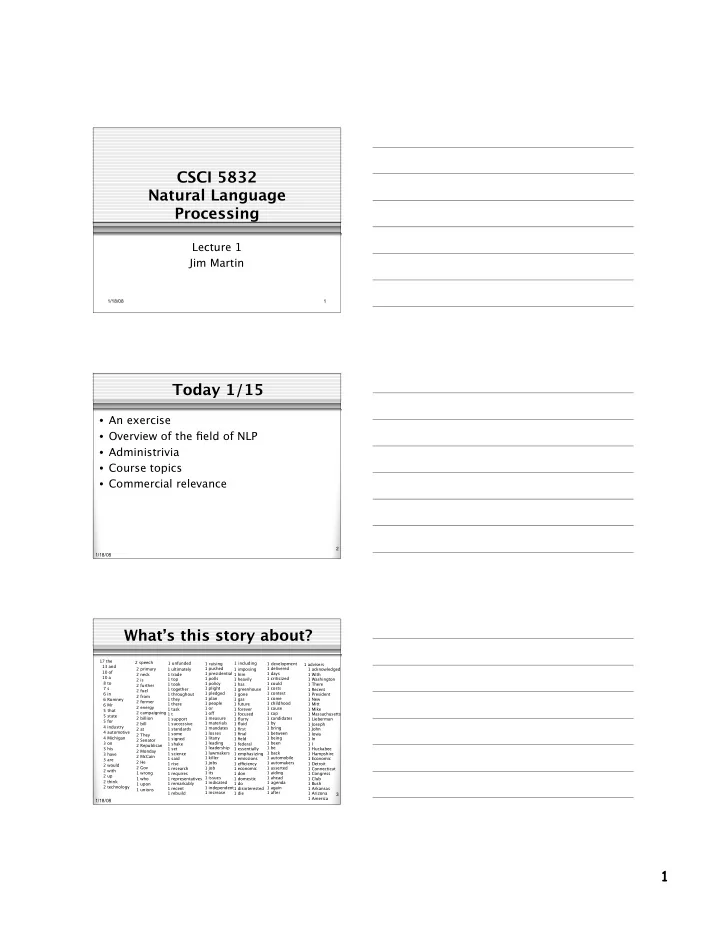
What’s this story about?

17 the 13 and 10 of 10 a 8 to 7 s 6 in 6 Romney 6 Mr 5 that 5 state 5 for 4 industry 4 automotive 4 Michigan 3 on 3 his 3 have 3 are 2 would 2 with 2 up 2 think 2 technology

2 speech

2 primary 2 neck 2 is 2 further 2 fuel 2 from 2 former 2 energy 2 campaigning 2 billion 2 bill 2 at 2 They 2 Senator 2 Republican 2 Monday 2 McCain 2 He 2 Gov 1 wrong 1 who 1 upon 1 unions

1 unfunded

1 ultimately 1 trade 1 top 1 took 1 together 1 throughout 1 they 1 there 1 task 1 t 1 support 1 successive 1 standards 1 some 1 signed 1 shake 1 set 1 science 1 said 1 rise 1 research 1 requires 1 representatives 1 remarkably 1 recent 1 rebuild 1 raising 1 pushed 1 presidential 1 polls 1 policy 1 plight 1 pledged 1 plan 1 people 1 or 1 ofg 1 measure 1 materials 1 mandates 1 losses 1 litany 1 leading 1 leadership 1 lawmakers 1 killer 1 jobs 1 job 1 its 1 issues 1 indicated 1 independent 1 increase

1 including

1 imposing 1 him 1 heavily 1 has 1 greenhouse 1 gone 1 gas 1 future 1 forever 1 focused 1 flurry 1 fluid 1 first 1 final 1 field 1 federal 1 essentially 1 emphasizing 1 emissions 1 effjciency 1 economic 1 don 1 domestic 1 do 1 disinterested 1 die 1 development 1 delivered 1 days 1 criticized 1 could 1 costs 1 contest 1 come 1 childhood 1 cause 1 cap 1 candidates 1 by 1 bring 1 between 1 being 1 been 1 be 1 back 1 automobile 1 automakers 1 asserted 1 aiding 1 ahead 1 agenda 1 again 1 after 1 advisers 1 acknowledged 1 With 1 Washington 1 There 1 Recent 1 President 1 New 1 Mitt 1 Mike 1 Massachusetts 1 Lieberman 1 Joseph 1 John 1 Iowa 1 In 1 I 1 Huckabee 1 Hampshire 1 Economic 1 Detroit 1 Connecticut 1 Congress 1 Club 1 Bush 1 Arkansas 1 Arizona 1 America

slide-2
SLIDE 2

2

1/18/08 4

The story

Romney Battles McCain for Michigan Lead By MICHAEL LUO DETROIT — With economic issues at the top of the agenda, the leading Republican presidential candidates set off Monday on a final flurry of campaigning in Michigan ahead of the state’s primary that could again shake up a remarkably fluid Republican field. Recent polls have indicated the contest is neck-and-neck between former Gov. Mitt Romney of Massachusetts and Senator John McCain of Arizona, with former Gov. Mike Huckabee of Arkansas further back.

  • Mr. Romney’s advisers have acknowledged that the state’s primary is essentially do-or-die for him after successive losses

in Iowa and New Hampshire. He has been campaigning heavily throughout the state, emphasizing his childhood in Michigan and delivered a policy speech on Monday focused on aiding the automotive industry. In his speech at the Detroit Economic Club, Mr. Romney took Washington lawmakers to task for being a “disinterested” in Michigan’s plight and imposing upon the state’s automakers a litany of “unfunded mandates,” including a recent measure signed by President Bush that requires the raising of fuel efficiency standards. He criticized Mr. McCain and Senator Joseph I. Lieberman, independent of Connecticut, for a bill that they have pushed to cap and trade greenhouse gas emissions. Mr. Romney asserted that the bill would cause energy costs to rise and would ultimately be a “job killer.”

  • Mr. Romney further pledged to bring together in his first 100 days representatives from the automotive industry, unions,

Congress and the state of Michigan to come up with a plan to “rebuild America’s automotive leadership” and to increase to $20 billion, from $4 billion, the federal support for research and development in energy, fuel technology, materials science and automotive technology. 1/18/08 5

Vector Representations

  • The first slide was a basic vector

representation for the meaning of a text

 Also known as a “bag of words” representation

  • Discourse segments, sentence

boundaries, syntax, word order are all ignored.

  • Roughly, all that matters is the set of

words that occur and how often they

  • ccur

1/18/08 6

Vector Representations

  • These representations are the basis for

many interesting and useful systems

  • BUT there has to be something better.
  • Much of NLP is directed at finding

representations that do a better job at capturing the meaning and intent behind texts.

slide-3
SLIDE 3

3

1/18/08 7

Natural Language Processing

  • What is it?

 We’re going to study what goes into getting computers to perform useful and interesting tasks involving human languages.  We will be secondarily concerned with the insights that such computational work gives us into human processing of language.

1/18/08 8

Why Should You Care?

Two trends

  • 1. An enormous amount of knowledge is now

available in machine readable form as natural language text

  • 2. Conversational agents are becoming an

important form of human-computer communication

1/18/08 9

Major Topics

  • 1. Words
  • 2. Syntax
  • 3. Meaning
  • 4. Discourse
  • 5. Applications exploiting each
slide-4
SLIDE 4

4

1/18/08 10

Applications

  • First, what makes an application a

language processing application (as

  • pposed to any other piece of

software)?

 An application that requires the use of knowledge about human languages

  • Example: Is Unix wc (word count) an

example of a language processing application?

1/18/08 11

Applications

  • Word count?

 When it counts words: Yes

  • To count words you need to know what a word
  • is. That’s knowledge of language.

 When it counts lines and bytes: No

  • Lines and bytes are computer artifacts, not

linguistic entities

1/18/08 12

What’s missing

slide-5
SLIDE 5

5

1/18/08 13

Big Applications

  • Question answering
  • Conversational agents
  • Summarization
  • Machine translation

1/18/08 14

Big Applications

  • These kinds of applications require a

tremendous amount of knowledge of language.

  • Consider the following interaction with

HAL the computer from 2001: A Space Odyssey

1/18/08 15

HAL from 2001

  • Dave: Open the pod bay doors, Hal.
  • HAL: I’m sorry Dave, I’m afraid I

can’t do that.

slide-6
SLIDE 6

6

1/18/08 16

What’s needed?

  • Speech recognition and synthesis
  • Knowledge of the English words

involved What they mean

  • How groups of words clump

What the clumps mean

1/18/08 17

What’s needed?

  • Dialog

 It is polite to respond, even if you’re planning to kill someone.  It is polite to pretend to want to be cooperative (I’m afraid, I can’t…)

1/18/08 18

Real Example

What is the Fed’s current position on interest rates?

  • What or who is the “Fed”?
  • What does it mean for it to to have a

position?

  • How does “current” modify that?
slide-7
SLIDE 7

7

1/18/08 19

Caveat

NLP has an AI aspect to it.

 We’re often dealing with ill-defined problems  We don’t often come up with perfect solutions/algorithms  We can’t let either of those facts get in our way

1/18/08 20

Administrative Stufg

  • Waitlist/SAVE

 Course is open

  • Web page

 www.cs.colorado.edu/~martin/csci5832.html

  • Reasonable preparation
  • Requirements

1/18/08 21

CAETE

  • This venue tends to encourage students

to act like they are viewing the taping of a TV show.

  • You’re not, you’re part of the show.
  • You must participate.
slide-8
SLIDE 8

8

1/18/08 22

Web Page

The course web page can be found at.

www.cs.colorado.edu/~martin/csci5832.html.

It will have the syllabus, lecture notes, assignments, announcements, etc. You should check it periodically for new stufg.

1/18/08 23

Mailing List

  • There is a automatically generated

mailing list.

  • Mail goes to your offjcial CU email

address.

 I can’t alter it so don’t ask me to send your mail to gmail/yahoo/work or whatever  You can set up a forward yourself  But you can only send to the list from your CU account

1/18/08 24

Preparation

  • Basic algorithm

and data structure analysis

  • Ability to program
  • Some exposure to

logic

  • Exposure to basic

concepts in probability

  • Familiarity with

linguistics, psychology, and philosophy

  • Ability to write well in

English

slide-9
SLIDE 9

9

1/18/08 25

Requirements

  • Readings:

 Speech and Language Processing by Jurafsky and Martin, Prentice-Hall 2008

  • Draft version of the 2nd Ed.

 Various conference and journal papers

  • Around 4 or 5 assignments
  • 3 quizzes
  • Final comprehensive exam on Monday

May 5 from 1:30 to 4:00.

1/18/08 26

Programming

  • All the programming will be done in

Python.

 It’s free and works on Windows, Macs, and Linux  It’s easy to install  Easy to learn

1/18/08 27

Programming

  • Go to www.python.org to get started.
  • The default installation comes with an

editor called IDLE. It’s a serviceable development environment.

  • Python mode in emacs is pretty good.

It’s what I use but I’m a dinosaur.

  • If you like eclipse, there is a python

plug-in for it.

slide-10
SLIDE 10

10

1/18/08 28

Grading

  • Assignments – 30%
  • Quizzes – 30%
  • Final Exam – 30%
  • Participation – 10%

1/18/08 29

Course Material

  • We’ll be intermingling discussions of:

 Linguistic topics

  • E.g. Morphology, syntax, discourse structure

 Formal systems

  • E.g. Regular languages, context-free grammars

 Applications

  • E.g. Machine translation, information extraction

1/18/08 30

Linguistics Topics

  • Word-level processing
  • Syntactic processing
  • Lexical and compositional

semantics

  • Discourse processing

My biases…

 I’m not terribly into phonology or speech  I care about meaning in general, and word meanings in particular

slide-11
SLIDE 11

11

1/18/08 31

Topics: Techniques

  • Finite-state methods
  • Context-free methods
  • Augmented grammars

 Unification  Lambda calculus

  • First order logic
  • Probability

models

  • Supervised

machine learning methods

1/18/08 32

Topics: Applications

  • Small

 Spelling correction  Hyphenation

  • Medium

 Word-sense disambiguation  Named entity recognition  Information retrieval

  • Large

 Question answering  Conversational agents  Machine translation

  • Stand-alone
  • Enabling applications
  • Funding/Business plans

1/18/08 33

Next Time

  • Read Chapter 1
  • Download, install and learn Python.

The first assignment will be given out next time.