CSCI 5832 Natural Language Processing Lecture 3 Jim Martin - - PDF document

csci 5832 natural language processing
SMART_READER_LITE
LIVE PREVIEW

CSCI 5832 Natural Language Processing Lecture 3 Jim Martin - - PDF document

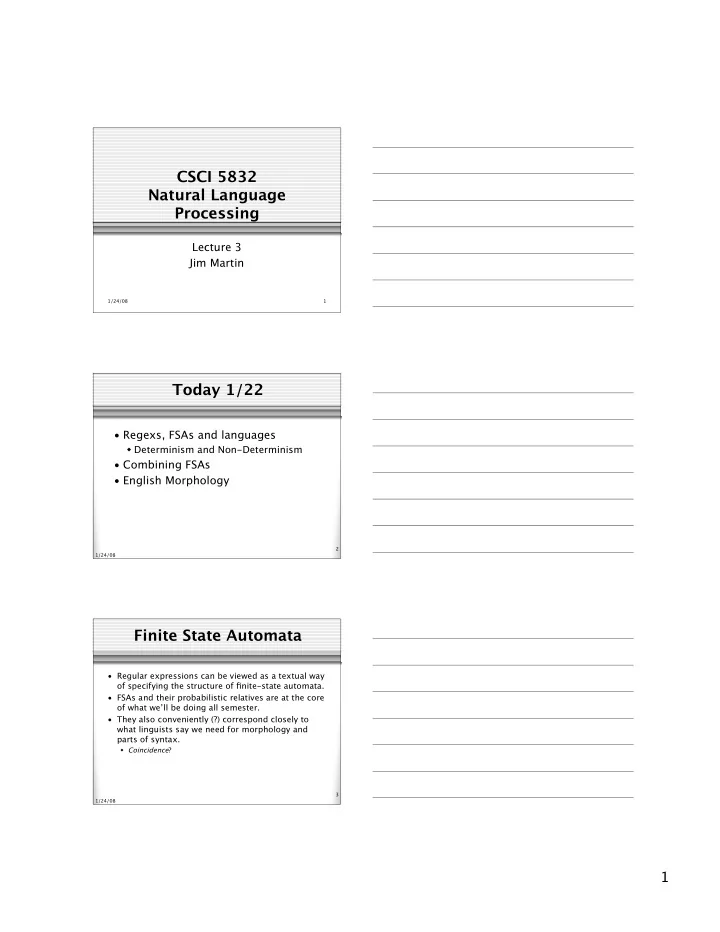
CSCI 5832 Natural Language Processing Lecture 3 Jim Martin 1/24/08 1 Today 1/22 Regexs, FSAs and languages Determinism and Non-Determinism Combining FSAs English Morphology 2 1/24/08 Finite State Automata Regular


slide-1
SLIDE 1

1

1/24/08 1

CSCI 5832 Natural Language Processing

Lecture 3 Jim Martin

1/24/08 2

Today 1/22

  • Regexs, FSAs and languages

 Determinism and Non-Determinism

  • Combining FSAs
  • English Morphology

1/24/08 3

Finite State Automata

  • Regular expressions can be viewed as a textual way
  • f specifying the structure of finite-state automata.
  • FSAs and their probabilistic relatives are at the core
  • f what we’ll be doing all semester.
  • They also conveniently (?) correspond closely to

what linguists say we need for morphology and parts of syntax.

 Coincidence?

slide-2
SLIDE 2

2

1/24/08 4

FSAs as Graphs

  • Let’s start with the sheep language from

the text

 /baa+!/

1/24/08 5

Sheep FSA

  • We can say the following things about

this machine

 It has 5 states  b, a, and ! are in its alphabet  q0 is the start state  q4 is an accept state  It has 5 transitions

1/24/08 6

More Formally

  • You can specify an FSA by

enumerating the following things.

 The set of states: Q  A finite alphabet: Σ  A start state  A set of accept/final states  A transition function that maps QxΣ to Q

slide-3
SLIDE 3

3

1/24/08 7

Generative Formalisms

  • Formal Languages are sets of strings

composed of symbols from a finite set of symbols.

  • Finite-state automata define formal

languages (without having to enumerate all the strings in the language)

  • The term Generative is based on the view

that you can run the machine as a generator to get strings from the language.

1/24/08 8

Generative Formalisms

  • FSAs can be viewed from two

perspectives:

 Acceptors that can tell you if a string is in the language  Generators to produce all and only the strings in the language

1/24/08 9

Three Views

  • Three equivalent formal ways to look

at what we’re up to (not including tables)

Regular Expressions Regular Grammars Finite State Automata

slide-4
SLIDE 4

4

1/24/08 10

But note

  • There are other machines that

correspond to this same language

  • More on this one later

1/24/08 11

About Alphabets

  • Don’t take that word to narrowly; it

just means we need a finite set of symbols in the input.

  • These symbols can and will stand for

bigger objects that can have internal structure.

1/24/08 12

Dollars and Cents

slide-5
SLIDE 5

5

1/24/08 13

QxΣ → Q

  • The guts of FSAs

can ultimately be represented as tables ∅ ∅ ∅ ∅ 4 ∅ 4 ∅ ∅ 3 ∅ ∅ 2,3 ∅ 2 ∅ ∅ 2 ∅ 1 ∅ ∅ ∅ 1 e ! a b State

1/24/08 14

Recognition

  • Recognition is the process of determining if a

string should be accepted by a machine

  • Or… it’s the process of determining if a string is in

the language defined by the machine

  • Or… it’s the process of determining if a regular

expression matches a string

  • Those all amount to the same thing in the end

1/24/08 15

Recognition

  • Traditionally, (Turing’s idea) this

recognition process is depicted with a tape.

slide-6
SLIDE 6

6

1/24/08 16

Recognition

  • Simply a process of starting in the

start state

  • Examining the current input
  • Consulting the table
  • Going to a new state and updating the

tape pointer.

  • Until you run out of tape.

1/24/08 17

D-Recognize

1/24/08 18

Key Points

  • Deterministic means that at each point in

processing there is always one unique thing to do (there are no choices to be made).

  • D-recognize is a simple table-driven

interpreter

  • The algorithm is universal for all

unambiguous regular languages.

 To change the machine, you just change the table.

slide-7
SLIDE 7

7

1/24/08 19

Key Points

  • Crudely therefore… matching strings with

regular expressions (ala Perl, grep, etc.) is a matter of

 translating the regular expression into a machine (a table) and  passing the table to an interpreter

1/24/08 20

Recognition as Search

  • You can view this algorithm as a trivial kind
  • f state-space search.
  • States are pairings of tape positions and

state numbers.

  • Operators are compiled into the table
  • Goal state is a pairing with the end of tape

position and a final accept state

  • Its trivial because?

1/24/08 21

Non-Determinism

slide-8
SLIDE 8

8

1/24/08 22

Non-Determinism

  • Yet another technique

 Epsilon transitions  Key point: these transitions do not examine or advance the tape during recognition

1/24/08 23

Equivalence

  • Non-deterministic machines can be

converted to deterministic ones with a fairly simple construction

  • That means that they have the same

power; non-deterministic machines are not more powerful than deterministic ones in terms of the languages they can and can not accept

1/24/08 24

ND Recognition

  • Two basic approaches (used in all

major implementations of Regular Expressions)

  • 1. Either take a ND machine and convert it

to a D machine and then do recognition with that.

  • 2. Or explicitly manage the process of

recognition as a state-space search (leaving the machine as is).

slide-9
SLIDE 9

9

1/24/08 25

Implementations

1/24/08 26

Non-Deterministic Recognition: Search

  • In a ND FSA there exists at least one path

through the machine for a string that is in the language defined by the machine.

  • But not all paths directed through the

machine for an accept string lead to an accept state.

  • No paths through the machine lead to an

accept state for a string not in the language.

1/24/08 27

Non-Deterministic Recognition

  • So success in a non-deterministic

recognition occurs when a path is found through the machine that ends in an accept state.

  • Failure occurs when all of the possible

paths lead to failure.

slide-10
SLIDE 10

10

1/24/08 28

Example

b a a a ! \

q0 q1 q2 q2 q3 q4

1/24/08 29

Example

1/24/08 30

Example

slide-11
SLIDE 11

11

1/24/08 31

Example

1/24/08 32

Example

1/24/08 33

Example

slide-12
SLIDE 12

12

1/24/08 34

Example

1/24/08 35

Example

1/24/08 36

Example

slide-13
SLIDE 13

13

1/24/08 37

Key Points

  • States in the search space are pairings
  • f tape positions and states in the

machine.

  • By keeping track of as yet unexplored

states, a recognizer can systematically explore all the paths through the machine given an input.

1/24/08 38

ND-Recognize

1/24/08 39

Infinite Search

  • If you’re not careful such searches can

go into an infinite loop.

  • How?
slide-14
SLIDE 14

14

1/24/08 40

Why Bother?

  • Non-determinism doesn’t get us more

formal power and it causes headaches so why bother?

 More natural (understandable) solutions

1/24/08 41

Compositional Machines

  • Formal languages are just sets of strings
  • Therefore, we can talk about various set
  • perations (intersection, union,

concatenation)

  • This turns out to be a useful exercise

1/24/08 42

Union

slide-15
SLIDE 15

15

1/24/08 43

Concatenation

1/24/08 44

Negation

  • Construct a machine M2 to accept all

strings not accepted by machine M1 and reject all the strings accepted by M1

 Invert all the accept and not accept states in M1

  • Does that work for non-deterministic

machines?

1/24/08 45

Intersection

  • Accept a string that is in both of two

specified languages

  • An indirect construction…

 A^B = ~(~A or ~B)

slide-16
SLIDE 16

16

1/24/08 46

Motivation

  • Consider the expression

Let’s have a meeting on Thursday, Jan 26th

 Writing an FSA to recognize English date expressions is not terribly hard.  Except for the part about rejecting invalid dates.  Write two FSAs: one for the form of the dates, and one for the calendar arithmetic part  Intersect the two machines

1/24/08 47

Next Time

  • Finish Chapter 3