CSC2542 Other slides are modifications of slides developed by Malte - - PDF document

csc2542
SMART_READER_LITE
LIVE PREVIEW

CSC2542 Other slides are modifications of slides developed by Malte - - PDF document

Acknowledgements Some the slides used in this course are modifications of Dana Naus lecture slides for the textbook Automated Planning, licensed under the Creative Commons Attribution-NonCommercial-ShareAlike License:


slide-1
SLIDE 1

1

CSC2542 Representations for (Classical) Planning

Sheila McIlraith Department of Computer Science University of Toronto Fall 2010

2

Acknowledgements

Some the slides used in this course are modifications of Dana Nau’s lecture slides for the textbook Automated Planning, licensed under the Creative Commons Attribution-NonCommercial-ShareAlike License: http://creativecommons.org/licenses/by-nc-sa/2.0/ Other slides are modifications of slides developed by Malte Helmert, Bernhard Nebel, and Jussi Rintanen. I have also used some material prepared by P@trick Haslum and Rao Kambhampati. I would like to gratefully acknowledge the contributions of these researchers, and thank them for generously permitting me to use aspects of their presentation material.

3

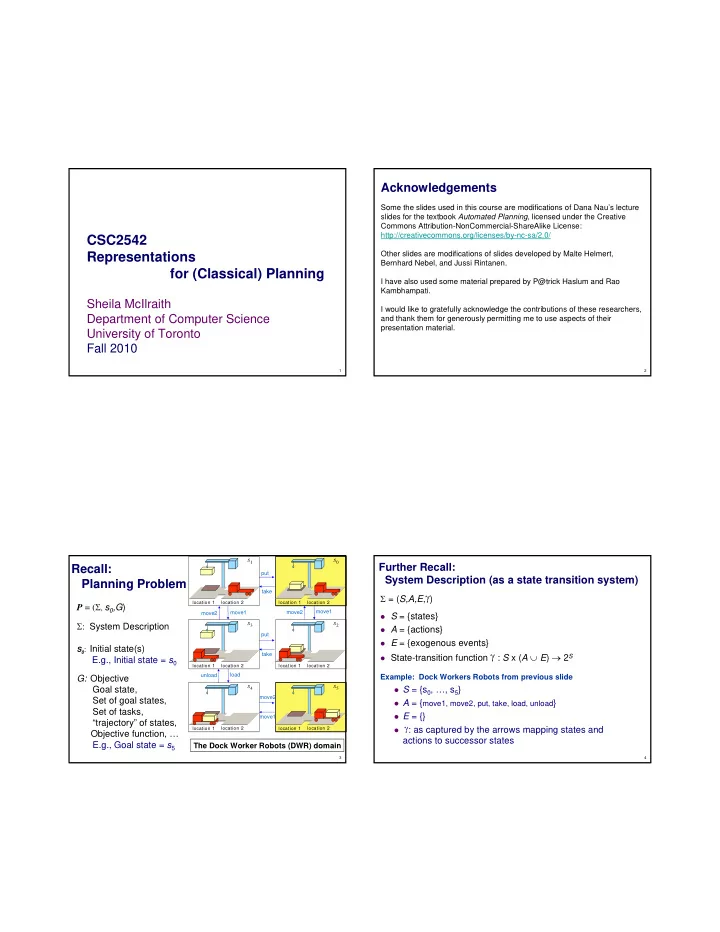
Recall: Planning Problem

take put move1 put take move1 move1 move2 load unload move2 move2

location 1 location 2

s0

location 1 location 2

s1 s4

location 1 location 2

s5

location 1 location 2 location 1 location 2

s3

location 1 location 2

s2

P = (Σ, s0,G) Σ: System Description

S0: Initial state(s)

E.g., Initial state = s0 G: Objective Goal state, Set of goal states, Set of tasks, “trajectory” of states, Objective function, … E.g., Goal state = s5

The Dock Worker Robots (DWR) domain

4

Σ = (S,A,E,γ)

S = {states} A = {actions} E = {exogenous events} State-transition function γ : S x (A ∪ E) → 2S

Example: Dock Workers Robots from previous slide

S = {s0, …, s5} A = {move1, move2, put, take, load, unload} E = {} γ: as captured by the arrows mapping states and

actions to successor states

Further Recall: System Description (as a state transition system)

slide-2
SLIDE 2

5

Representational Challenge

  • How do we represent our planning problem is a way

that supports exploration of the principles and practice

  • f automated planning?

Approach:

  • There isn’t one answer.
  • The textbook proposes representations that are suitable

for generating classical plans.

6

Broad Perspective on Plan Representation

The right representation for the right objective. Distinguish representation schemes for:

1.

studying the principles of planning and related tasks.

2.

specifying planning domains

3.

direct use within (classical) planners

7

Summary: Broad Perspective

  • 1. Studying the formal principles of planning and other related task

(First-order) logical languages

(e.g., situation calculus, A languages, event calculus, fluent calculus, PDL) Properties:

well-defined semantics, representational issues must be addressed in the

language (not in the algorithm that interprets and manipulates them)

excellent for study and proving properties. Not ideal for 3 below.

  • 2. Specifying planning domains

PDDL-n (PDDL2.1, PDDL2.2, PDDL3, ….)

Properties:

(reasonably) well-defined semantics designed for input to planners – translate to an internal representation for

specific planners. Translators exist for most state-of-the-art planners

  • 3. Direct use within (classical) planners

Classical representation (e.g., STRIPS) Set-theoretic representation (basis for rep’ns used w/ SAT solvers) State-variable representation (e.g., SAS, SAS+)

Variants of these exist for particular planners (e.g., SAT solvers, model checkers, etc.)

8

This Lecture:

  • 1. Studying the formal principles of planning and other related task

(First-order) logical languages

(e.g., situation calculus, A languages, event calculus, fluent calculus, PDL) Properties:

well-defined semantics, representational issues must be addressed in the

language (not in the algorithm that interprets and manipulates them)

excellent for study and proving properties. Not ideal for 3 below.

  • 2. Specifying planning domains

PDDL-n (PDDL2.1, PDDL2.2, PDDL3, ….)

Properties:

(reasonably) well-defined semantics designed for input to planners – translate to an internal representation for

specific planners. Translators exist for most state-of-the-art planners

  • 3. Direct use within (classical) planners (what’s in the text)

Classical representation (e.g., STRIPS) Set-theoretic representation (basis for rep’ns used w/ SAT solvers) State-variable representation (e.g., SAS, SAS+)

Variants of these exist for particular planners (e.g., SAT solvers, model checkers, etc.)

WILL COVER LATER

slide-3
SLIDE 3

9

Outline

  • Representation schemes for classical planning

1.

Classical representation

2.

Set-theoretic representation

3.

State-variable representation

  • Examples: DWR and the Blocks World
  • Comparisons

10 location 1 location 2 location 1 location 2

s1 s3 s4

take put

location 1 location 2 location 1 location 2

s0 s2 s5

move1 put take move1 move1 move2 load unload

Quick Review of Classical Planning

move2 move2

8 restrictive assumptions req’d: A0: Finite A1: Fully observable A2: Deterministic A3: Static A4: Attainment goals A5: Sequential plans A6: Implicit time A7: Offline planning

location 1 location 2 location 1 location 2 11

Representation: Motivation for Approach

Default view:

represent state explicitly represent actions as a transition system (e.g., as an incidence matrix)

Problem:

explicit graph corresponding to transition system is huge direct manipulation of transition system is cumbersome

Solution: Provide compact representation of transition system & induced graph

  • 1. Explicate the structure of the “states”

e.g., states specified in terms of state variables

  • 2. Represent actions not as transition system/incidence matrices but as

functions (e.g., operators) specified in terms of the state variables

An action is applicable to a state when some state variables

have certain values. When applicable, it will change the values of certain (other) state variables

  • 3. To plan,

Just give the initial state Use the operators to generate the other states as needed

12

Why is this more compact?

Why is this more compact than an explicit transition system?

  • In an explicit transition system, actions are represented as state-to-

state transitions. Each action will be represented by an incidence matrix of size |S|x|S|

  • In the proposed model, actions are represented only in terms of state

variables whose values they care about, and whose value they affect. (It exploits the structure of the problem!)

  • Consider a state space of 1024 states. It can be represented by

log21024=10 state variables. If an action needs variable v1 to be true and makes v7 to be false, it can be represented by just 2 bits (instead

  • f a 1024x1024 matrix)

Of course, if the action has a complicated mapping from states to

states, in the worst case the action rep will be just as large

The assumption being made here is that the actions will have

effects on a small number of state variables.

slide-4
SLIDE 4

13

  • 1. Classical Representation

Start with a function-free first-order language Finitely many predicate symbols and constant symbols,

but no function symbols

Example: the DWR domain Locations: l1, l2, … Containers: c1, c2, … Piles: p1, p2, … Robot carts: r1, r2, … Cranes: k1, k2, …

14

Quick review of terminology

  • Atom: predicate symbol and args

Use these to represent both fixed and dynamic (“fluent”) relations

adjacent(l,l’) attached(p,l) belong(k,l)

  • ccupied(l)

at(r,l) loaded(r,c) unloaded(r) holding(k,c) empty(k) in(c,p)

  • n(c,c’)

top(c,p) top(pallet,p)

  • Ground expression: contains no variable symbols -

e.g., in(c1,p3)

  • Unground expression: at least one variable symbol -

e.g., in(c1,x)

  • Substitution: θ = {x1 ← v1, x2 ← v2, …, xn ← vn}

Each xi is a variable symbol; each vi is a term

  • Instance of e: result of applying a substitution θ to e

Replace variables of e simultaneously, not sequentially

15

States

  • State: a set s of ground atoms

The atoms represent the things that are true in one of Σ’s states Only finitely many ground atoms, so only finitely many possible states

16

Operators

Operator: a triple o=(name(o), precond(o), effects(o)) name(o) is a syntactic expression of the form n(x1,…,xk) n: operator symbol - must be unique for each operator x1,…,xk: variable symbols (parameters) must include every variable symbol in o precond(o): preconditions literals that must be true in order to use the operator effects(o): effects literals the operator will make true

slide-5
SLIDE 5

17

Actions

Action: ground instance (via

substitution) of an operator

18

Notation

Let a be an operator or action. Then precond+(a) = {atoms that appear positively in a’s preconditions} precond–(a) = {atoms that appear negatively in a’s preconditions} effects+(a) = {atoms that appear positively in a’s effects} effects–(a) = {atoms that appear negatively in a’s effects} effects+(take(k,l,c,d,p) = {holding(k,c), top(d,p)} effects–(take(k,l,c,d,p) = {empty(k), in(c,p), top(c,p), on(c,d)}

E.g.,

19

Aside: Some things to note

The state only explicitly represents what is true. The

semantics of this representation is that any fluent not included in the state is false – just like a database. (Recall that one of the assumptions of classical planning is complete initial (and subsequent) state. The problem would be a lot harder w/o this assumption!!)

Terminology: an action is a ground operator. In the

Knowledge Representation (KR) literature the concept of an “operator” is not used. Actions may be ground or unground.

Classical planners generally operate over ground

actions.

20

Applicability

An action a is applicable to a state s if s satisfies precond(a), i.e., if precond+(a) ⊆ s and precond–(a) ∩ s = ∅ Here are an action and a state that it’s applicable to:

slide-6
SLIDE 6

21

Result of Performing an Action

If a is applicable to s, the result of performing it is

γ(s,a) = (s – effects–(a)) ∪ effects+(a)

Delete negative effects, and add positive ones Set of things that are true. (if not in set then false)

22

Planning domain:

language & operators

Operators corresponds to a

set of state-transition systems

Operators for the DWR Domain

23

Planning Problems

Given a planning domain (language L, operators O)

Encoding of a planning problem: a triple P=(O,s0,g) O is the collection of operators s0 is a state (the initial state) g is a set of literals (the goal formula) The actual planning problem: P = (Σ,s0, g) s0 and g are as above Σ = (S,A,γ) is a state-transition system S = {all sets of ground atoms in L} A = {all ground instances of operators in O} γ = state-transition function determined by the operators

24

Plans and Solutions

Plan: any sequence of actions σ = 〈a1, a2, …, an〉 such that

each ai is a ground instance of an operator in O

The plan is a solution for P=(O,s0,g) if it is executable and

achieves g

i.e., if there are states s0, s1, …, sn such that γ (s0,a1) = s1 γ (s1,a2) = s2 … γ (sn–1,an) = sn sn satisfies g

slide-7
SLIDE 7

25

Example

Let P1 = (O, s1, g1), where O is the set of operators given earlier

g1={loaded(r1,c3),

at(r1,loc2)}

26

Example

GOAL STATE: g1={loaded(r1,c3),at(r1,loc2)} INITIAL STATE:

27

Here are three solutions for P1:

  • 〈take(crane1,loc1,c3,c1,p1), move(r1,loc2,loc1), move(r1,loc1,loc2),

move(r1,loc2,loc1), load(crane1,loc1,c3,r1), move(r1,loc1,loc2)〉

  • 〈take(crane1,loc1,c3,c1,p1), move(r1,loc2,loc1),

load(crane1,loc1,c3,r1), move(r1,loc1,loc2)〉

  • 〈move(r1,loc2,loc1), take(crane1,loc1,c3,c1,p1),

load(crane1,loc1,c3,r1), move(r1,loc1,loc2)〉

Each produces:

Example (cont.)

28

Example (cont.)

First is redundant: can remove actions and still have a solution

1.

〈take(crane1,loc1,c3,c1,p1), move(r1,loc2,loc1), move(r1,loc1,loc2), move(r1,loc2,loc1), load(crane1,loc1,c3,r1), move(r1,loc1,loc2)〉

2.

〈take(crane1,loc1,c3,c1,p1), move(r1,loc2,loc1), load(crane1,loc1,c3,r1), move(r1,loc1,loc2)〉

3.

〈move(r1,loc2,loc1), take(crane1,loc1,c3,c1,p1), load(crane1,loc1,c3,r1), move(r1,loc1,loc2)〉

2nd and 3rd are irredundant and shortest

slide-8
SLIDE 8

29

  • 2. Set-Theoretic Representation

Like classical rep’n, but restricted to propositional logic.

States: Instead of a collection of ground atoms …

{on(c1,pallet), on(c1,r1), on(c1,c2), …, at(r1,l1), at(r1,l2), …}

… use a collection of propositions (boolean variables):

{on-c1-pallet, on-c1-r1, on-c1-c2, …, at-r1-l1, at-r1-l2, …}

30

Instead of operators like this one,

take-crane1-loc1-c3-c1-p1

precond: belong-crane1-loc1, attached-p1-loc1,empty-crane1, top-c3-p1, on-c3-c1 delete:

empty-crane1, in-c3-p1, top-c3-p1, on-c3-p1

add:

holding-crane1-c3, top-c1-p1

Take all of the operator instances, E.g.: And rewrite ground atoms as propositions, E.g.:

31

Comparison

A set-theoretic representation is equivalent to a classical representation in which all of the atoms are ground Problem: Exponential blowup

If a classical operator contains n atoms and each atom has arity k,

then it corresponds to cnk actions where c = |{constant symbols}|

32

Non-fluents (properties that don’t change) are ground relations:

e.g., adjacent(loc1,loc2)

Fluents are functions:

i.e., for properties that can change, assign values to state variables

Classical and state-variable rep’ns take similar amounts of space

each can be translated into the other in low-order polynomial time

  • 3. State-Variable Representation

{top(p1)=c3, cpos(c3)=c1, cpos(c1)=pallet, holding(crane1)=nil, rloc(r1)=loc2, loaded(r1)=nil, …}

slide-9
SLIDE 9

33

Captures further information about the state. E.g., that

state variables can only take on one of the values in the

  • domain. This helps reduce the search space.

Basis for the SAS and SAS+ formalisms (used most

recently in the FastDownward Planner (FD)

Basis for encodings further plan properties such as

domain transition graphs (DTGs) and causal graphs (CG)

State-Variable Representation (cont.)

34

Example: The Blocks World (Review on your own)

35

Example: The Blocks World

Infinitely wide table, finite number of children’s blocks Ignore where a block is located on the table A block can sit on the table or on another block Want to move blocks from one configuration to another e.g.,

initial state goal

Classical, set-theoretic, and state-variable formulations for

the case of FIVE BLOCKS follow.

c a b c a b e d

36

  • 1. Example Classical Representation

Constant symbols: The blocks: a, b, c, d, e Predicates:

  • ntable(x) - block x is on the table
  • n(x,y)
  • block x is on block y

clear(x)

  • block x has nothing on it

holding(x) - the robot hand is holding block x handempty- the robot hand isn’t holding anything

c a b e d

slide-10
SLIDE 10

37

unstack(x,y) Precond: on(x,y), clear(x), handempty Effects: ~on(x,y), ~clear(x), ~handempty, holding(x), clear(y) stack(x,y) Precond: holding(x), clear(y) Effects: ~holding(x), ~clear(y),

  • n(x,y), clear(x), handempty

pickup(x) Precond: ontable(x), clear(x), handempty Effects: ~ontable(x), ~clear(x), ~handempty, holding(x) putdown(x) Precond: holding(x) Effects: ~holding(x), ontable(x), clear(x), handempty

Classical Operators

c a b c a b c a b c a b c a b

38

For five blocks, 36 propositions, 50 actions E.g.,

  • ntable-a
  • block a is on the table
  • n-c-a
  • block c is on block a

clear-c

  • block c has nothing on it

holding-d

  • the robot hand is holding block d

handempty

  • the robot hand isn’t holding anything

… (31 more)

c a b d e

  • 2. Example Set-Theoretic Representation

39

Set-Theoretic Actions

E.g.,

unstack-c-a Pre:

  • n-c,a, clear-c, handempty

Del:

  • n-c,a, clear-c, handempty

Add: holding-c, clear-a stack-c-a Pre: holding-c, clear-a Del: holding-c, clear-a Add:

  • n-c-a, clear-c, handempty

pickup-c Pre:

  • ntable-c, clear-c, handempty

Del:

  • ntable-c, clear-c, handempty

Add: holding-c putdown-c Pre: holding-c Del: holding-c Add:

  • ntable-c, clear-c, handempty

c a b c a b c a b c a b c a b

. . . (46 more)

40

Constant symbols:

a, b, c, d, e

  • f type block

0, 1, table, nil

  • f type other

State variables:

pos(x) = y if block x is on block y pos(x) = table if block x is on the table pos(x) = nil if block x is being held clear(x) = 1 if block x has nothing on it clear(x) = 0 if block x is being held or has a block on it holding = x if the robot hand is holding block x holding = nil if the robot hand is holding nothing

c a b e d

  • 3. Example State-Variable Representation
slide-11
SLIDE 11

41

State-Variable Operators

unstack(x : block, y : block) Precond: pos(x)=y, clear(y)=0, clear(x)=1, holding=nil Effects: pos(x)=nil, clear(x)=0, holding=x, clear(y)=1 stack(x : block, y : block) Precond: holding=x, clear(x)=0, clear(y)=1 Effects: holding=nil, clear(y)=0, pos(x)=y, clear(x)=1 pickup(x : block) Precond: pos(x)=table, clear(x)=1, holding=nil Effects: pos(x)=nil, clear(x)=0, holding=x putdown(x : block) Precond: holding=x Effects: holding=nil, pos(x)=table, clear(x)=1 c a b c a b c a b c a b c a b

42

Representational Equivalence

Any problem that can be represented in one representation

can also be represented in the other two

Can convert in linear time and space, except when

converting to set-theoretic (where we get an exponential blowup)

Classical representation State-variable representation Set-theoretic representation

trivial P(x1,…,xn) becomes fP(x1,…,xn)=1 write all of the ground instances f(x1,…,xn)=y becomes Pf(x1,…,xn,y)

43

Comparison

Classical representation Most popular for classical planning, basis of PDDL Set-theoretic representation Can take much more space than classical representation Useful in algorithms that manipulate ground atoms directly e.g., planning graphs, SAT Useful for certain kinds of theoretical studies State-variable representation (e.g., SAS, SAS+) Equivalent to classical representation in expressive power Arguably less natural to conceive Useful in non-classical planning problems as a way to

handle numbers, functions, time

44

Extending Expressivity: ADL

Previous representations were so-called “STRIPS” rep’ns.

These have useful properties for automatically generating classical plans, but are not always sufficient to express the behaviour of more complex domains.

  • ADL is a richer, and thus more compact, representation

language that allows for

Disjunction and Quantification in preconditions and goals Effects that are Quantified, and/or Conditional (effect is

conditioned on state)

PDDL supports STRIPS and ADL, but not all planners

support ADL, and not all planners even support a so-called Classical Representation

In the KR community ADL or greater is common.

slide-12
SLIDE 12

45

Pros/Cons: Compiling to Canonical Action Rep’n

Possible to compile down ADL actions into STRIPS actions

Quantification -> conjunctions/disjunctions over finite universes Actions with conditional effects -> multiple (exponentially more)

actions without conditional effects

Actions with disjunctive effects -> multiple actions, each of which

take one of the disjuncts as their preconditions

Domain axioms (ramifications) -> the individual effects of the

actions; so all actions satisfy STRIPS assumption Compilation is not always a win-win.

By compiling down to canonical form, we can concentrate on

highly efficient planning for canonical actions

However, often compilation leads to an exponential blowup

and makes it harder to exploit the structure of the domain

By leaving actions in non-canonical form, we can often do more

compact encoding of the domains as well as more efficient search

However, we will have to continually extend planning

algorithms to handle these representations