CSC2542 Bernhard Nebel, and Jussi Rintanen. Introduction to - - PDF document

csc2542
SMART_READER_LITE
LIVE PREVIEW

CSC2542 Bernhard Nebel, and Jussi Rintanen. Introduction to - - PDF document

Acknowledgements Some of the slides used in this course are modifications of Dana Naus lecture slides for the textbook Automated Planning, licensed under the Creative Commons Attribution-NonCommercial-ShareAlike License:


slide-1
SLIDE 1

1

CSC2542 Introduction to Planning

Sheila McIlraith Department of Computer Science University of Toronto Fall 2010

2

Acknowledgements

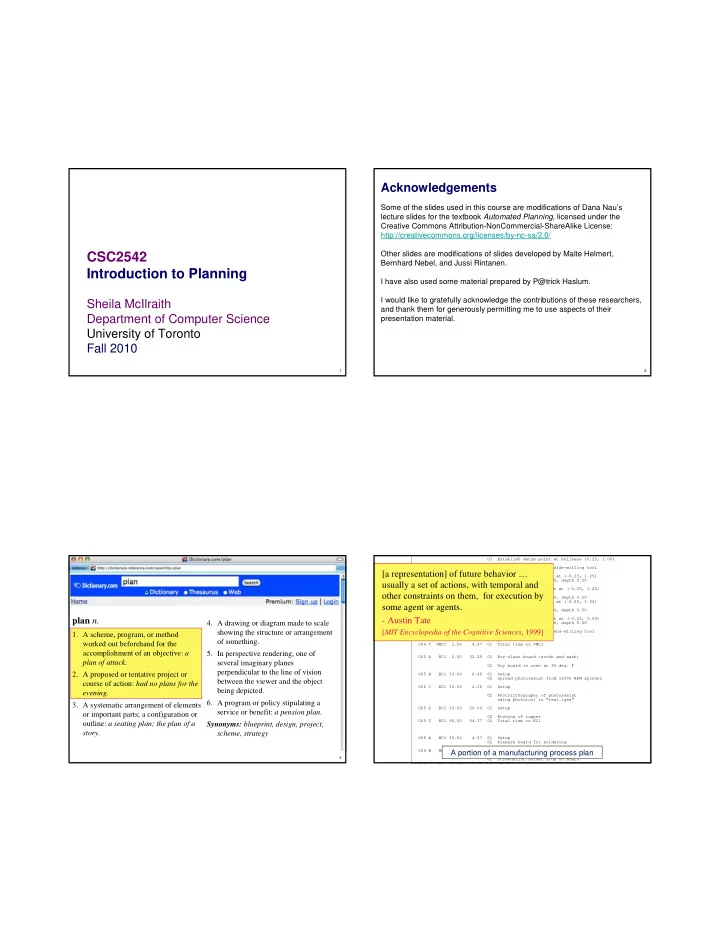
Some of the slides used in this course are modifications of Dana Nau’s lecture slides for the textbook Automated Planning, licensed under the Creative Commons Attribution-NonCommercial-ShareAlike License: http://creativecommons.org/licenses/by-nc-sa/2.0/ Other slides are modifications of slides developed by Malte Helmert, Bernhard Nebel, and Jussi Rintanen. I have also used some material prepared by P@trick Haslum. I would like to gratefully acknowledge the contributions of these researchers, and thank them for generously permitting me to use aspects of their presentation material.

3

  • 4. A drawing or diagram made to scale

showing the structure or arrangement

  • f something.
  • 5. In perspective rendering, one of

several imaginary planes perpendicular to the line of vision between the viewer and the object being depicted.

  • 6. A program or policy stipulating a

service or benefit: a pension plan. Synonyms: blueprint, design, project, scheme, strategy

plan n.

  • 1. A scheme, program, or method

worked out beforehand for the accomplishment of an objective: a plan of attack.

  • 2. A proposed or tentative project or

course of action: had no plans for the evening.

  • 3. A systematic arrangement of elements
  • r important parts; a configuration or
  • utline: a seating plan; the plan of a

story.

4 02 Clamp board 03 Establish datum point at bullseye (0.25, 1.00) 004 B VMC1 0.10 0.34 01 Install 0.15-diameter side-milling tool 02 Rough side-mill pocket at (-0.25, 1.25) length 0.40, width 0.30, depth 0.50 03 Finish side-mill pocket at (-0.25, 1.25) length 0.40, width 0.30, depth 0.50 04 Rough side-mill pocket at (-0.25, 3.00) length 0.40, width 0.30, depth 0.50 05 Finish side-mill pocket at (-0.25, 3.00) length 0.40, width 0.30, depth 0.50 004 C VMC1 0.10 1.54 01 Install 0.08-diameter end-milling tool [...] 004 T VMC1 2.50 4.87 01 Total time on VMC1 005 A EC1 0.00 32.29 01 Pre-clean board (scrub and wash) 02 Dry board in oven at 85 deg. F 005 B EC1 30.00 0.48 01 Setup 02 Spread photoresist from 18000 RPM spinner 005 C EC1 30.00 2.00 01 Setup 02 Photolithography of photoresist using phototool in "real.iges" 005 D EC1 30.00 20.00 01 Setup 02 Etching of copper 005 T EC1 90.00 54.77 01 Total time on EC1 006 A MC1 30.00 4.57 01 Setup 02 Prepare board for soldering 006 B MC1 30.00 0.29 01 Setup 02 Screenprint solder stop on board 006 C MC1 30 00 7 50 01 Setup

[a representation] of future behavior … usually a set of actions, with temporal and

  • ther constraints on them, for execution by

some agent or agents.

  • Austin Tate

[MIT Encyclopedia of the Cognitive Sciences, 1999] A portion of a manufacturing process plan

slide-2
SLIDE 2

5

Modes of Planning

  • Mixed Initiative Planning
  • Automated Plan Generation

6

Example Planning Applications

7

Autonomous planning, scheduling, control NASA: JPL and Ames Remote Agent Experiment (RAX) Deep Space 1 Mars Exploration Rover (MER)

Autonomous Agents for Space Exploration

8

Other Autonomous Systems

Not necessarily embodied!

slide-3
SLIDE 3

9

Other Autonomous Systems:

9

Not necessarily embodied!

10

Sheet-metal bending machines - Amada Corporation Software to plan the sequence of bends

[Gupta and Bourne, J. Manufacturing Sci. and Engr., 1999]

Manufacturing Automation

11

E.g., Bridge Baron - Great Game Products

1997 world champion of computer bridge

[Smith, Nau, and Throop, AI Magazine, 1998]

2004: 2nd place

(North— ♠Q)

… …

PlayCard(P3; S, R3) PlayCard(P2; S, R2) PlayCard(P4; S, R4) FinesseFour(P4; S) PlayCard(P1; S, R1) StandardFinesseTwo(P2; S) LeadLow(P1; S) PlayCard(P4; S, R4’) StandardFinesseThree(P3; S) EasyFinesse(P2; S) BustedFinesse(P2; S) FinesseTwo(P2; S) StandardFinesse(P2; S) Finesse(P1; S) Us:East declarer, West dummy Opponents:defenders, South & North Contract:East – 3NT On lead:West at trick 3 East:♠KJ74 West: ♠A2 Out: ♠QT98653 (North— 3) East— ♠J West— ♠2 North— ♠3 South— ♠5 South— ♠Q

Games

12

Other Applications

Scheduling with Action Choices & Resource Requirements Problems in supply chain management HSTS (Hubble Space Telescope scheduler) Workflow management Air Traffic Control Route aircraft between runways and terminals. Crafts

must be kept safely separated. Safe distance depends

  • n craft and mode of transport. Minimize taxi and wait

time.

Character Animation Generate step-by-step character behaviour from high-

level spec

Plan-based Interfaces E.g. NLP to database interfaces Plan recognition

slide-4
SLIDE 4

13

Other Applications (cont.)

Web Service Composition Compose web services, and monitor their execution Many of the web standards have a lot of connections to

action representation languages

BPEL; BPEL-4WS allow workflow specifications DAML-S allows process specifications Business Process Composition /Workflow Management Including Grid Services/Scientific Workflow Management Genome Rearrangement The relationship between different organisms can be

measured by the number of “evolution events” (rearrangements) that separate their genomes

Find shortest (or most likely) sequence of rearrangements

between a pair of genomes

14

Outline

Conceptual model for planning Classes of planning problems Classes of planners and example instances Beyond planning Planning research – the big picture Some of what I hope you’ll get from the course

15

Conceptual Model

State transition system Σ = (S,A,E, γ) S = {states} A = {actions} E = {exogenous events} γ = state-transition function

System Σ

  • 1. Environment

16

Σ = (S,A,E,γ)

S = {states} A = {actions} E = {exogenous events} State-transition function

γ : S x (A ∪ E) → 2S

S = {s0, …, s5} A = {move1, move2,

put, take, load, unload}

E = {}

γ: see the arrows

State Transition System

take put move1 put take move1 move1 move2 load unload move2 move2

location 1 location 2

s0

location 1 location 2

s1 s4

location 1 location 2

s5

location 1 location 2 location 1 location 2

s3

location 1 location 2

s2

Dock Worker Robots (DWR):

slide-5
SLIDE 5

17

Observation function h: S → O

location 1 location 2

s3

Given observation

  • in O, produces

action a in A

Controller

Conceptual Model

  • 2. Controller

18

Omit unless planning is online Planning problem Planning problem Planning problem

Planner

Conceptual Model

  • 3. Planner’s Input

19

Planning Problem

take put move1 put take move1 move1 move2 load unload move2 move2

location 1 location 2

s0

location 1 location 2

s1 s4

location 1 location 2

s5

location 1 location 2 location 1 location 2

s3

location 1 location 2

s2

P = (Σ, s0,G) Σ: System Description

S0: Initial state(s)

E.g., Initial state = s0 G: Objective Goal state, Set of goal states, Set of tasks, “trajectory” of states, Objective function, … E.g., Goal state = s5

The Dock Worker Robots (DWR) domain

20

Instructions to the controller

Planner

Conceptual Model

  • 4. Planner’s Output
slide-6
SLIDE 6

21

Plans

take put move1 put take move1 move1 move2 load unload move2 move2

location 1 location 2

s0

location 1 location 2

s1 s4

location 1 location 2

s5

location 1 location 2 location 1 location 2

s3

location 1 location 2

s2

Classical plan:

a sequence of actions E.g., 〈take, move1, load, move2〉

Policy:

partial function from S into A E.g., {(s0, take), (s1, move1), (s3, load), (s4, move2)}

take move1 load move2

The Dock Worker Robots (DWR) domain

22

Outline

Conceptual model for planning Classes of planning problems Classes of planners and example instances Beyond planning Planning research – the big picture Some of what I hope you’ll get from the course

23

Different Classes Planning Problems

Varying components of the planning problem specification yields different classes of problems. E.g., dynamics: deterministic, nondeterministic, probabilistic

  • bservability: full, partial, none

horizon: finite, infinite

  • bjective requirement: satisfying, optimizing

24

Different Classes Planning Problems

dynamics: deterministic, nondeterministic, probabilistic

  • bservability: full, partial, none

horizon: finite, infinite

  • bjective requirement: satisfying, optimizing

classical planning conditional planning with full observability conditional planning with partial observability conformant planning markov decision processes (MDP) partial observable MDP (POMDP) preference-based/over-subscription planning

slide-7
SLIDE 7

25

Different Classes Planning Problems

dynamics: deterministic, nondeterministic, probabilistic

  • bservability: full, partial, none

horizon: finite, infinite

  • bjective requirement: satisfying, optimizing

classical planning conditional planning with full observability conditional planning with partial observability conformant planning markov decision processes (MDP) partial observable MDP (POMDP) preference-based/over-subscription planning

26

Different Classes Planning Problems

dynamics: deterministic, nondeterministic, probabilistic

  • bservability: full, partial, none

horizon: finite, infinite

  • bjective requirement: satisfying, optimizing

classical planning conditional planning with full observability conditional planning with partial observability conformant planning markov decision processes (MDP) partial observable MDP (POMDP) preference-based/over-subscription planning

27

Different Classes Planning Problems

dynamics: deterministic, nondeterministic, probabilistic

  • bservability: full, partial, none

horizon: finite, infinite

  • bjective requirement: satisfying, optimizing

classical planning conditional planning with full observability conditional planning with partial observability conformant planning markov decision processes (MDP) partial observable MDP (POMDP) preference-based/over-subscription planning

28

Different Classes Planning Problems

dynamics: deterministic, nondeterministic, probabilistic

  • bservability: full, partial, none

horizon: finite, infinite

  • bjective requirement: satisfying, optimizing

classical planning conditional planning with full observability conditional planning with partial observability conformant planning markov decision processes (MDP) partial observable MDP (POMDP) preference-based/over-subscription planning

slide-8
SLIDE 8

29

Different Classes Planning Problems

dynamics: deterministic, nondeterministic, probabilistic

  • bservability: full, partial, none

horizon: finite, infinite

  • bjective requirement: satisfying, optimizing

classical planning conditional planning with full observability conditional planning with partial observability conformant planning markov decision processes (MDP) partial observable MDP (POMDP) preference-based/over-subscription planning

30

Different Classes Planning Problems

dynamics: deterministic, nondeterministic, probabilistic

  • bservability: full, partial, none

horizon: finite, infinite

  • bjective requirement: satisfying, optimizing

classical planning conditional planning with full observability conditional planning with partial observability conformant planning markov decision processes (MDP) partial observable MDP (POMDP) preference-based/over-subscription planning

31

Other Dimensions

dynamics: deterministic, nondeterministic, probabilistic : explicit time, implicit time : instantaneous, durative : continuous, discrete, hybrid perception: perfect, noisy horizon: finite, infinite

  • bjective requirement: satisfying, optimizing
  • bjective form: final-state goal, temporally-extended goal, control knowledge,

hierarchical task network (HTN), script/program (Golog) plan form: sequential plan, partial order plan, controller, generalized plan, program… …

classical planning conditional planning with full observability conditional planning with partial observability conformant planning markov decision processes (MDP) partial observable MDP (POMDP) preference-based/over-subscription planning

32

Why is Planning Difficult?

  • solutions to classical planning problems are paths from an

initial state to a goal state in the transition graph

Efficiently solvable by Dijkstra’s algorithm in

O(|V| log |V| + |E|) time

Why don’t we solve all planning problems this way?

  • state space may be huge: 109, 1012, 1015, …states
  • constructing the transition graph is infeasible!
  • planning algorithms try to avoid constructing whole graph
  • planning algorithms often are – but not guaranteed to be

more effiencient that obvious solution methods constructing the transition graph and using e.g., Dijkstra’s algorithm

slide-9
SLIDE 9

33

Outline

Conceptual model for planning Classes of planning problems Classes of planners and example instances Beyond planning Planning research – the big picture Some of what I hope you’ll get from the course

34

Three Main Classes of Planners

  • 1. Domain-specific
  • 2. Domain-independent
  • 3. Domain-customizable

* Ghallab, Nau, and Traverso’s use “configurable” (which I don’t like) Also called “Domain-specific” or “Knowledge-Based”

35

QuickTime™ and a TIFF (Uncompressed) decompressor are needed to see this picture.

  • 1. Domain-Specific Planners
  • Made or tuned for specific domain
  • Won’t work well (if at all) in any other domain
  • Many successful real-world planning systems

work this way

36

  • 2. Domain-Independent Planners

In principle, a domain-independent planner works in

any planning domain

Uses no domain-specific knowledge except the

definitions of the basic actions

slide-10
SLIDE 10

37

In practice, Not feasible to develop domain-independent planners

that work in every possible domain

Make simplifying assumptions to restrict the set of

domains

Classical planning Historical focus of most automated-planning research

  • 2. Domain-Independent Planners

Very active area of research. Many excellent planning systems.

38

  • A0: Finite system:

finitely many states, actions, events

  • A1: Fully observable:

the controller always knows the system’s current state

  • A2: Deterministic:

each action has only one outcome

  • A3: Static (no exogenous events):

changes only occur as the result of the controller’s actions

  • A4: Attainment goals:

a set of goal states Sg

  • A5: Sequential plans:

a plan is a linearly ordered sequence of actions (a1, a2, … an)

  • A6: Implicit time:

Actions are instantaneous (have no duration)

  • A7: Off-line planning:

planner doesn’t know the execution status

Restrictive Assumptions

39

Classical planning requires all eight restrictive assumptions Offline generation of action sequences for a

deterministic, static, finite system, with complete knowledge, attainment goals, and implicit time

Reduces to the following problem: Given (Σ, s0, G) Find a sequence of actions (a1, a2, … an) that produces

a sequence of state transitions (s1, s2, …, sn) such that Gis in sn.

This is just path-searching in a graph Nodes = states Edges = actions Is this trivial?

Classical Planning

40

Classical Planning (cont.)

It’s hard because problems are huge!

Generalize the earlier example: 5 locations, 3 robot carts, 100 containers, 3 piles Then there are 10277 states Number of particles in the universe is only about 1087 The example is more than 10190 times as larger! Automated planning research has been heavily dominated

by domain-independent classical planning

Dozens of different algorithms We’ll cover the state-of-the-art in this area

slide-11
SLIDE 11

41

c a b a b c putdown(x) pickup(a) stack(a,b) stack(b,c) pickup(b)

Goal:

  • n(a,b) & on(b,c)

Start unstack(x,a)

clear(a) handempty clear(b), handempty holding(a) clear(b)

  • n(a,b)
  • n(b,c)

holding(a) clear(x), with x = a

Approach: Plan-Space Planning

Decompose sets of goals into

the individual goals

Plan for them separately Bookkeeping info to detect

and resolve interactions For classical planning, not used much any more IxTeT and the Mars rovers use temporal-planning extensions of it

42

Approach: Planning Graphs

Relaxed problem

[Blum & Furst, 1995]

Apply all applicable actions at once Next “level” contains all the effects of all of those

actions

43

For n = 1, 2, … Make planning graph of n

levels (polynomial time)

State-space search

within the planning graph

Such a plan graph is used in

many SAT and heuristic search planners

E.g., Graphplan

Level 1 Level 2

pickup(b) unstack(c,a) pickup(a) stack(b,c) pickup(b) unstack(c,a) putdown(b) stack(b,a) stack(c,b) putdown(c) stack(c,a)

  • • •

no-op no-op

Level 0

c a b All actions applicable to s0 All effects

  • f those

actions All actions applicable to subsets

  • f Level 1

All effects

  • f those

actions Literals in s0 c a b c b a b c a

44

Approach: Heuristic Search

Can we do an A*-style heuristic search? Historically, it was difficult to find a good h function Planning graphs make it feasible Can extract h from the planning graph Problem: A* quickly runs out of memory So do a greedy search Greedy search can get trapped in local minima Greedy search plus local search at local minima HSP [Bonet & Geffner], FastForward (FF) [Hoffmann],

Fast Downward [Helmert], LAMA [Richter], etc.

slide-12
SLIDE 12

45

Approach: Translation to General Problem Solver

Translate the planning problem or the planning graph

into another kind of problem for which there are efficient solvers

Find a solution to that problem Extract the plan from the solution SAT solvers SATplan and Blackbox [Kautz & Selman] Answer Set Programming (ASP) solvers [Son et al.], [Lifschitz et al.], etc. Integer programming solvers such as Cplex [Vossen et al.]

46

  • 3. Domain-customizable

Domain-independent planners are quite slow compared with

domain-specific planners

Blocks world in linear time [Slaney and Thiébaux, A.I., 2001] Can get analogous results in many other domains But don’t want to write a new planner for every domain! Domain-customizable planners Domain-independent planning engine Input (the “objective”) includes info about how to solve

problems in the domain.

Hierarchical Task Network (HTN) planning Planning with control formulas Planning with a plan script or agent program

47

Problem reduction Tasks (activities) rather than goals Methods to decompose tasks into subtasks Enforce constraints, backtrack if necessary Real-world applications Noah, Nonlin, O-Plan, SIPE, SIPE-2,SHOP, SHOP2

Approach: HTN Planning

48

travel(UMD, Toulouse) get-ticket(IAD, TLS) travel(UMD, IAD) fly(BWI, Toulouse) travel(TLS, LAAS) get-taxi ride(TLS,Toulouse) pay-driver go-to-Orbitz find-flights(IAD,TLS) buy-ticket(IAD,TLS) get-taxi ride(UMD, IAD) pay-driver Task: Method: taxi-travel(x,y) get-taxi ride(x,y) pay-driver get-ticket(BWI, TLS) go-to-Orbitz find-flights(BWI,TLS) BACKTRACK travel(x,y) Method: air-travel(x,y) travel(a(y),y) get-ticket(a(x),a(y)) travel(x,a(x)) fly(a(x),a(y))

slide-13
SLIDE 13

49

Approach: Planning with Control Formulas

  • At each state si we have a control formula fi in linear temporal logic

“never pick up x from table unless x needs to be on another block”

  • For each successor of s, derive a control formula using logical

progression

  • Prune any successor state in which the progressed formula is false

TLPlan [Bacchus & Kabanza] TALplanner [Kvarnstrom & Doherty]

s0, f0 s1, f1 s2, f2 a1 = pickup(b) a2 = pickup(c) c a b a b c goal

. . . s1 doesn’t satisfy f1

50

rent-car S0 bookAirTicket

... ... ...

bookTaxi bookCruise

... ...

bookCar bookHotel

procedural constructs:

  • sequence
  • if-then-else
  • nondeterministic choice
  • while-do, etc.

bookTaxi

E.g., bookAirTicket(x); if far then bookCar(x) else bookTaxi(y)

Approach: Planning w/ Program or Plan Script

E.g., Golog [Levesque et al.] Nondeterministic programs that act as procedural control knowledge, placing constraints on the valid action sequence/plans

51

Three Main Classes of Planners

  • 1. Domain-specific
  • 2. Domain-independent

E.g., Planning graph-based, SAT-based, heuristic search

  • 3. Domain-customizable

E.g., HTN, domain control formula, agent programs/scripts

52

Comparisons (in general)

Domain-specific planner Write an entire computer program - lots of work Lots of domain-specific performance improvements Domain-independent planner Just give it the basic actions - not much effort Can be less efficient (but not always)!

Domain-specific Configurable Domain-independent up-front human effort performance

slide-14
SLIDE 14

53

Outline

Conceptual model for planning Classes of planning problems Classes of planners and example instances Beyond planning Planning research – the big picture Some of what I hope you’ll get from the course

54

Broad Application of Planning Techniques

Planning algorithms are applicable to a broad range of applications that can roughly be viewed as reachability

  • problems. E.g.,

Software verification Diagnosis of dynamical systems Story understanding Situation assessment/Plan recognition Gene rearrangement

55

Outline

Conceptual model for planning Classes of planning problems Classes of planners and example instances Beyond planning Planning research Some of what I hope you’ll get from the course

56

Planning Research – The big picture

Two research communities that make fundamental contributions to research in planning: 1) Knowledge Representation and Reasoning Community

  • mathematical foundations of planning
  • knowledge representation, formal properties, etc.

2) Automated Planning and Scheduling Community

  • Driven largely by the objective of developing fast and

effective planning algorithms We will look at research from both communities.

slide-15
SLIDE 15

57

Selected Historical perspective:

Planning Algorithms – Recent Advances

STRIPS(’68) …. SATPlan(’92) UCPOP(’92) HTN(’92) GraphPlan(’95) Golog Agent Programs(‘97) Blackbox (SAT + Plan Graph)(’99) HSP Heuristic Search(’98) Domain-control Formula(‘98) Model Checking(’00) Better & better heuristics

Domain-independent Domain-customizable

58

Planning Research – The big picture

The Landscape:

CONFERENCES ICAPS* (Int. Conf on AI Planning and Scheduling) *merging of AIPS and ECP AAMAS (Int. Conf. on Autonomous Agents and Multiagent Systems) KR IJCAI, AAAI, ECAI JOURNALS JAIR, AIJ BIENNIAL COMPETITION and BENCHMARKING DOMAINS IPC-n (International Planning Competition) PDDL (Planning Domain Definition Language) standard input language for most benchmark problem sets

59

Planning Research – The big picture

Recent Advances Very “active” field -- lots of papers in top conferences

Tremendous strides in deterministic plan synthesis Biennial Intl. Planning Competitions Current interest is in exploiting the insights from

deterministic planning techniques to other planning scenarios Some topics of recent focus:

Better heuristics Richer domain customization (including preferences) From discrete to timed hybrid and/or continuous systems Planning and learning

60

Outline

Conceptual model for planning Classes of planning problems Classes of planners and example instances Beyond planning Planning research – the big picture Some of what I hope you’ll get from the course

slide-16
SLIDE 16

61

What will you get from this course?

big picture of different kinds of planning problems logical foundations of planning algorithms for solving different problem classes, with an

emphasis on the classical (“simplest”) setting:

  • algorithms based on heuristic search
  • algorithms based on SAT
  • algorithms that exploit rich objectives (domain control

knowledge, temporally extended goals, preferences)

many of these techniques are applicable to problems

  • utside AI as well

hands-on experience with a classical planner (optional)

62

For Next Week (Sept 23)

Skim/review Chapters 1, 2, and 4, 5 in the reference textbook. (The URL is posted on our course web page.)

63

Important Announcement

Please add your name to the list that is circulating We may change classrooms (though perhaps not

imminently). Watch the web announcements.

From time to time we will need to have a tutorial (especially

for the assignment). There will be a doodle poll regarding scheduling of the tutorial. I’ll schedule the tutorial hour at a time when all registered students can attend.