CSC209 Fall 2001 Office hours: - - PowerPoint PPT Presentation

csc209 fall 2001
SMART_READER_LITE
LIVE PREVIEW

CSC209 Fall 2001 Office hours: - - PowerPoint PPT Presentation

CSC209 Fall 2001 Office hours:


slide-1
SLIDE 1

CSC209 Fall 2001 Karen Reid 1

  • Karen Reid

Email : reid150@cs.utoronto.ca Office: BA 4240 Phone: 416-978-7797 Web Page: www.cs.utoronto.ca/~csc150h

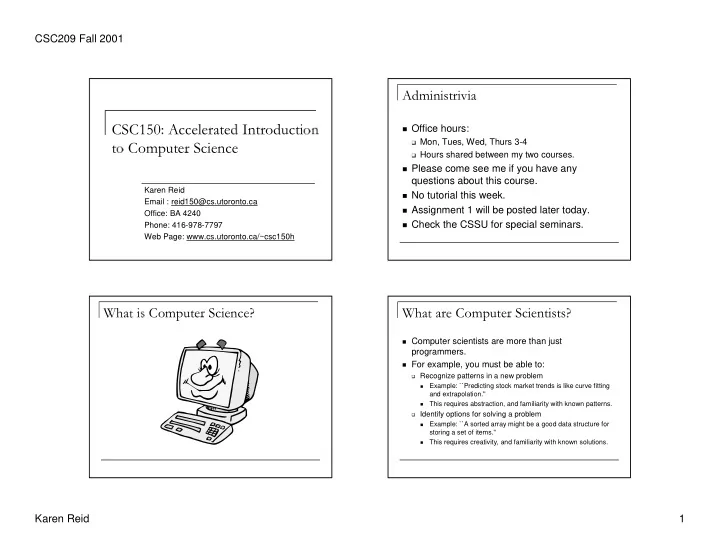
Office hours:

Mon, Tues, Wed, Thurs 3-4

Hours shared between my two courses.

Please come see me if you have any questions about this course.

No tutorial this week.

Assignment 1 will be posted later today.

Check the CSSU for special seminars.

Computer scientists are more than just programmers.

For example, you must be able to:

Recognize patterns in a new problem

Example: ``Predicting stock market trends is like curve fitting and extrapolation.''

This requires abstraction, and familiarity with known patterns.

Identify options for solving a problem

Example: ``A sorted array might be a good data structure for storing a set of items.'‘

This requires creativity, and familiarity with known solutions.

slide-2
SLIDE 2

CSC209 Fall 2001 Karen Reid 2

Weigh options

Example: ``Keeping the array sorted allows faster search, but not keeping it sorted allows faster insertion.''

This requires the ability to analyze potential solutions for correctness and efficiency.

Make an appropriate choice for a given situation

Example: ``Because I expect to do more searching than insertion, a sorted array is better.''

Notice that none of this is about programming.

CSC108 – need no programming background.

teaches objects, classes and methods (functions/procedures)

teaches conditionals, loops (week 7), arrays (~week 9)

teaches searching and sorting

teaches basic inheritance

CSC148 – should have passed CSC108.

should know object oriented programming in Java

loops, conditionals, procedures/functions, parameters, arrays,

searching and sorting.

CSC150 – need good programming skills in a language other than Java.

should know loops, conditionals, procedures/functions, parameters, arrays, searching and sorting in a language like Pascal, Turing, or C.

covers all of the CSC148 material.

covers object oriented programming

classes, objects, methods, inheritance

No Java knowledge is necessary.

Write a program (in your favourite programming language) that reads an array

  • f 20 integers from the keyboard, passes that

array to a procedure or function that sorts its parameter, and then prints the sorted array.

This should take you less than an hour and a half with only occasional uses of a textbook for help.

slide-3
SLIDE 3

CSC209 Fall 2001 Karen Reid 3

  • Weeks 1-3 – Introduction to Java and object
  • riented programming.
  • Weeks 4-13 – CSC148 material

Abstract data types – queues, stacks, interfaces

Java memory model, more on OO model.

Linked Data structures

Design by Contract

Exceptions

Trees

Recursion

Proof methods

Time Analysis

CSC150 – 5 assignments, 4 labs

CSC148 – 4 assignments, 8 labs

CSC150 and CSC148 will share assignment 3 and 4, and the final.

You are probably most familiar with programming, but that is only a small part of the full life cycle of software, which includes:

Specification: stating precisely what the program must do.

Design: deciding how the program will do it --- data structures, algorithms, and software “architecture”.

Implementation (programming): obvious.

Testing: checking that the program meets the specifications.

Release: distribution and installation of the software.

Maintenance: fixing errors, handling new requirements, accommodating resource changes, etc.

(There are many models of how these stages relate and in what

  • rder they should happen.)

There is a tendency to think that programming is the central activity, and that most errors are introduced at that stage.

In fact, errors happen at all stages. The sooner they are found, the cheaper they are to fix

Stage when error is caught and c cost to fix it

design 1.0 units

just before testing 6.5

during testing 15

after release 60--100

slide-4
SLIDE 4

CSC209 Fall 2001 Karen Reid 4

Moral: Pay close attention to design and

  • testing. “The sooner you start coding, the

longer it will take to finish.”

And most of the effort spent on a program is in its maintenance.

Moral: Design, document, and test your code so that it will be easy to maintain.

Pressman, Software Engineering: A Practitioner's Approach, 1992, p. 559.

This course is an introduction to the science of

  • computing. We'll work on the skills you need to be a

computer scientist, able to contribute to all parts of the software lifecycle. This will include:

Specification:

Writing precise specifications.

Design:

Looking at a problem abstractly.

Knowing standard abstractions that have proven useful in computer science, and how to use them.

Some new data structures that offer alternative ways to implement an abstract idea.

Analyzing the efficiency of an algorithm.

Using proofs to establish facts about data structures and algorithms.

Implementation:

Knowing the properties of a good program.

Designing a program to have these properties.

Writing code that uses a new programming technique: recursion

Testing:

Choosing a systematic and thorough set of test cases.

Documenting testing so that it will be convincing.

Working in the PC labs

See course info sheet for information about your account

Change your password ASAP to preserve security

  • f your account.

Never tell anyone your password

You may need to use the PC labs occasionally, so it is worth getting familiar with them early on.

http://www.cdfpc.utoronto.ca

slide-5
SLIDE 5

CSC209 Fall 2001 Karen Reid 5

You may use your own computer to do most of the assignment work for this course.

Java software:

Code Warrior

JDK – at least version 1.3

  • Dr. Java (needs JDK)

Starter code we give you will assume Code Warrior

  • r generic JDK.

We can’t help you with your software on your home machine, and you won’t get an extension because

  • f such problems.

Plagiarism is a kind of fraud, and is taken

  • seriously. Letting someone else use your

work is also an academic offense.

The work you submit must be your own – both the words and the ideas.

You may discuss the assignment with other students to understand what the questions are asking, BUT

You must not take away written notes from such discussions.

You must not look at anyone else’s solution or show anyone your solution.

You must write your solution alone.

Be prepared to prove that the work is your

  • wn:

keep backups, notes, and printouts.

Don’t leave printouts or notes lying around.

If you are having trouble with an assignment, come see me or the TA! Don’t cheat yourself.

Sometimes it is okay to use material from lecture notes or a text book. Be sure to say where you got it from.

slide-6
SLIDE 6

CSC209 Fall 2001 Karen Reid 6

On the other hand you should get to know other CSC150 (and CSC148) students and work together to:

understand course lecture and tutorial material

understand assignment handouts

work through example programs, proof, and analyses.

solve exercises from notes

solve old exam questions

work on the online homework.

study for exams