SLIDE 1 CS70: Lecture 33.
WLLN, Confidence Intervals (CI): Chebyshev vs. CLT
- 1. Review: Inequalities: Markov, Chebyshev
- 2. Law of Large Numbers
- 3. Review: CLT
- 4. Confidence Intervals: Chebyshev vs. CLT
Inequalities: An Overview
n pn
µ Pr[|X − µ| > ]
n pn
pn
Distribution
n pn
Pr[X > a] a Markov µ
Fraction of H’s
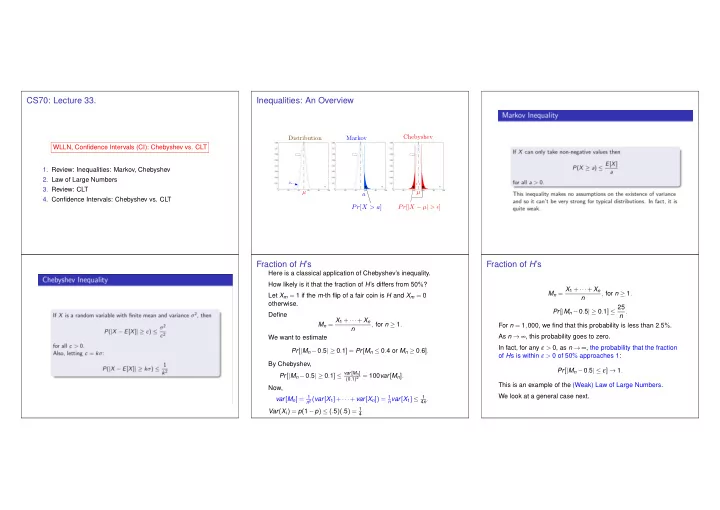
Here is a classical application of Chebyshev’s inequality. How likely is it that the fraction of H’s differs from 50%? Let Xm = 1 if the m-th flip of a fair coin is H and Xm = 0
Define Mn = X1 +···+Xn n , for n ≥ 1. We want to estimate Pr[|Mn −0.5| ≥ 0.1] = Pr[Mn ≤ 0.4 or Mn ≥ 0.6]. By Chebyshev, Pr[|Mn −0.5| ≥ 0.1] ≤ var[Mn]
(0.1)2 = 100var[Mn].
Now, var[Mn] = 1
n2 (var[X1]+···+var[Xn]) = 1 nvar[X1] ≤ 1 4n.
Var(Xi) = p(1−p) ≤ (.5)(.5) = 1
4
Fraction of H’s
Mn = X1 +···+Xn n , for n ≥ 1. Pr[|Mn −0.5| ≥ 0.1] ≤ 25 n . For n = 1,000, we find that this probability is less than 2.5%. As n → ∞, this probability goes to zero. In fact, for any ε > 0, as n → ∞, the probability that the fraction
- f Hs is within ε > 0 of 50% approaches 1:
Pr[|Mn −0.5| ≤ ε] → 1. This is an example of the (Weak) Law of Large Numbers. We look at a general case next.
SLIDE 2
Weak Law of Large Numbers
Theorem Weak Law of Large Numbers Let X1,X2,... be pairwise independent with the same distribution and mean µ. Then, for all ε > 0, Pr[|X1 +···+Xn n − µ| ≥ ε] → 0, as n → ∞. Proof: Let Mn = X1+···+Xn
n
. Then Pr[|Mn − µ| ≥ ε] ≤ var[Mn] ε2 = var[X1 +···+Xn] n2ε2 = nvar[X1] n2ε2 = var[X1] nε2 → 0, as n → ∞.
Recap: Normal (Gaussian) Distribution.
For any µ and σ, a normal (aka Gaussian) random variable Y, which we write as Y = N (µ,σ2), has pdf fY(y) = 1 √ 2πσ2 e−(y−µ)2/2σ2. Standard normal has µ = 0 and σ = 1. Note: Pr[|Y − µ| > 1.65σ] = 10%;Pr[|Y − µ| > 2σ] = 5%.
Recap: Central Limit Theorem
Central Limit Theorem Let X1,X2,... be i.i.d. with E[X1] = µ and var(X1) = σ2. Define Sn := An − µ σ/√n = X1 +···+Xn −nµ σ√n . Then, Sn → N (0,1),as n → ∞. That is, Pr[Sn ≤ α] → 1 √ 2π
α
−∞ e−x2/2dx.
E(Sn) = 1 σ/√n(E(An)− µ) = 0 Var(Sn) = 1 σ2/nVar(An) = 1.
Confidence Interval (CI) for Mean: CLT
Let X1,X2,... be i.i.d. with mean µ and variance σ2. Let An = X1 +···+Xn n . The CLT states that An − µ σ/√n = X1 +···+Xn −nµ σ√n → N (0,1) as n → ∞. Thus, for n ≫ 1, one has Pr[−2 ≤ (An − µ σ/√n ) ≤ 2] ≈ 95%. Equivalently, Pr[µ ∈ [An −2 σ √n,An +2 σ √n]] ≈ 95%. That is, [An −2 σ √n,An +2 σ √n] is a 95%−CI for µ.
SLIDE 3 CI for Mean: CLT vs. Chebyshev
Let X1,X2,... be i.i.d. with mean µ and variance σ2. Let An = X1 +···+Xn n . The CLT states that X1 +···+Xn −nµ σ√n → N (0,1) as n → ∞. Also, [An −2 σ √n,An +2 σ √n] is a 95%−CI for µ. What would Chebyshev’s bound give us? [An −4.5 σ √n,An +4.5 σ √n] is a 95%−CI for µ.(Why?) Thus, the CLT provides a smaller confidence interval.
Coins and CLT.
Let X1,X2,... be i.i.d. B(p). Thus, X1 +···+Xn = B(n,p). Here, µ = p and σ =
X1 +···+Xn −np
→ N (0,1).
Coins and CLT.
Let X1,X2,... be i.i.d. B(p). Thus, X1 +···+Xn = B(n,p). Here, µ = p and σ =
X1 +···+Xn −np
→ N (0,1) and [An −2 σ √n,An +2 σ √n] is a 95%−CI for µ with An = (X1 +···+Xn)/n. Hence, [An −2 σ √n,An +2 σ √n] is a 95%−CI for p. Since σ ≤ 0.5, [An −20.5 √n,An +20.5 √n] is a 95%−CI for p. Thus, [An − 1 √n,An + 1 √n] is a 95%−CI for p.
Summary
Inequalities and Confidence Interals
- 1. Inequalities: Markov and Chebyshev Tail Bounds
- 2. Weak Law of Large Numbers
- 3. Confidence Intervals: Chebyshev Bounds vs. CLT Approx.
- 4. CLT: Xn i.i.d. =
⇒ An−µ
σ/√n → N (0,1)
√n,An +2 σ √n] = 95%-CI for µ.