CS440/ECE448 Lecture 12: Stochastic Games, Stochastic Search, and - - PowerPoint PPT Presentation

cs440 ece448 lecture 12 stochastic games stochastic
SMART_READER_LITE
LIVE PREVIEW

CS440/ECE448 Lecture 12: Stochastic Games, Stochastic Search, and - - PowerPoint PPT Presentation

CS440/ECE448 Lecture 12: Stochastic Games, Stochastic Search, and Learned Evaluation Functions Slides by Svetlana Lazebnik, 9/2016 Modified by Mark Hasegawa-Johnson, 2/2019 Reminder: Exam 1 (Midterm) Thu, Feb 28 in class Review in

slide-1
SLIDE 1

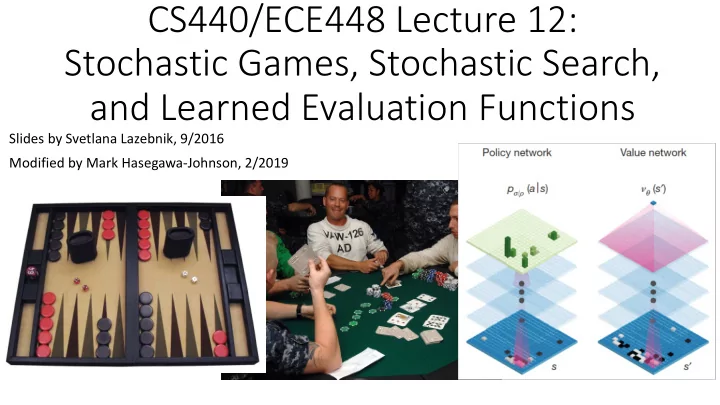
CS440/ECE448 Lecture 12: Stochastic Games, Stochastic Search, and Learned Evaluation Functions

Slides by Svetlana Lazebnik, 9/2016 Modified by Mark Hasegawa-Johnson, 2/2019

slide-2
SLIDE 2

Reminder: Exam 1 (“Midterm”) Thu, Feb 28 in class

  • Review in next lecture
  • Closed-book exam

(no calculators, no cheat sheets)

  • Mostly short questions
slide-3
SLIDE 3

Types of game environments

Deterministic Stochastic Perfect information (fully observable) Imperfect information (partially observable) Chess, checkers, go Backgammon, monopoly Battleship Scrabble, poker, bridge

slide-4
SLIDE 4

Content of today’s lecture

  • Stochastic games: the Expectiminimax algorithm
  • Imperfect information
  • Minimax formulation
  • Expectiminimax formulation
  • Stochastic search, even for deterministic games
  • Learned evaluation functions
  • Case study: Alpha-Go
slide-5
SLIDE 5

Stochastic games

How can we incorporate dice throwing into the game tree?

slide-6
SLIDE 6

Stochastic games

slide-7
SLIDE 7

Minimax vs. Expectiminimax

  • Minimax:
  • Maximize (over all possible moves I can make) the
  • Minimum (over all possible moves Min can make) of the
  • Reward

!"#$%('()%) = max

/0 /1234

min

789:4 /1234 ;%<"=)

  • Expectiminimax:
  • Maximize (over all possible moves I can make) the
  • Minimum (over all possible moves Min can make) of the
  • Expected reward

!"#$%('()%) = max

/0 /1234

min

789:4 /1234 > ;%<"=)

> ;%<"=) = ?

1@AB1/34

C=(D"DE#EFG ($FH(I% ×;%<"=)(($FH(I%)

slide-8
SLIDE 8

Stochastic games

Expectiminimax: Compute value of terminal, MAX and MIN nodes like minimax, but for CHANCE nodes, sum values of successor states weighted by the probability of each successor

  • Value(node) =

§ Utility(node) if node is terminal § maxaction Value(Succ(node, action)) if type = MAX § minaction Value(Succ(node, action)) if type = MIN § sumaction P(Succ(node, action)) * Value(Succ(node, action)) if type = CHANCE

slide-9
SLIDE 9

Expectiminimax example

  • RANDOM: Max flips a coin. It’s heads or tails.
  • MAX: Max either stops, or continues.
  • Stop on heads: Game ends, Max wins (value = $2).
  • Stop on tails: Game ends, Max loses (value = -$2).
  • Continue: Game continues.
  • RANDOM: Min flips a coin.
  • HH: value = $2
  • TT: value = -$2
  • HT or TH: value = 0
  • MIN: Min decides whether to keep the current
  • utcome (value as above), or pay a penalty

(value=$1).

T H H H T T 2

  • 2

2 1 1 0 1 -2 1 1

  • 2

½

  • 1

2

  • 1

½

slide-10
SLIDE 10

Expectiminimax summary

  • All of the same methods are useful:
  • Alpha-Beta pruning
  • Evaluation function
  • Quiescence search, Singular move
  • Computational complexity is pretty bad
  • Branching factor of the random choice can be high
  • Twice as many “levels” in the tree
slide-11
SLIDE 11

Games of Imperfect Information

slide-12
SLIDE 12

Imperfect information example

  • Min chooses a coin:
  • Penny (1 cent): Lincoln
  • Nickel (5 cent): Jefferson
  • I say the name of a U.S. President.
  • If I guessed right, she gives me the coin.
  • If I guessed wrong, I have to give her a

coin to match the one she has.

1

  • 5

5

  • 1
slide-13
SLIDE 13

Imperfect information example

  • The problem: I don’t know which

state I’m in. I only know it’s one of these two

1

  • 5

5

  • 1
slide-14
SLIDE 14

Method #1: Treat “unknown” as “random”

  • Expectiminimax: treat the unknown

information as random.

  • Choose the policy that maximizes

my expected reward.

  • “Lincoln”:

! " ×1 + ! " × −5 = −2

  • “Jefferson”:

! " ×(−1) + ! " ×5 = 2

  • Expectiminimax policy: say

“Jefferson”.

  • BUT WHAT IF and are not

equally likely? 1

  • 5

5

  • 1
slide-15
SLIDE 15

Method #2: Treat “unknown” as “unknown”

  • Suppose Min can choose whichever coin

she wants. She knows that I will pick Jefferson – then she will pick the penny!

  • Another reasoning: I want to know what

is my worst-case outcome (e.g., to decide if I should even play this game…)

  • The solution: choose the policy that

maximizes my minimum reward.

  • “Lincoln”: minimum reward is -5.
  • “Jefferson”: minimum reward is -1.
  • Miniminimax policy: say “Jefferson”.

1

  • 5

5

  • 1
slide-16
SLIDE 16

How to deal with imperfect information

  • If you think you know the probabilities of different settings, and if

you want to maximize your average winnings (for example, you can afford to play the game many times): expectiminimax

  • If you have no idea of the probabilities of different settings; or, if you

can only afford to play once, and you can’t afford to lose: miniminimax

  • If the unknown information has been selected intentionally by your
  • pponent: use game theory
slide-17
SLIDE 17

Mi Minimi minima max with imperfect information

  • Minimax:
  • Maximize (over all possible moves I can make) the
  • Minimum
  • (over all possible states of the information I don’t know,
  • … over all possible moves Min can make) the
  • Reward.

!"#$%('()%) = max

/0123 45673

min

/:;23 45673

min

4:33:;< :;=5

>%?"@)

slide-18
SLIDE 18

Stochastic games of imperfect information

Source States are grouped into information sets for each player

slide-19
SLIDE 19

Stochastic search

slide-20
SLIDE 20

Stochastic search for stochastic games

  • The problem with expectiminimax: huge branching factor (many possible outcomes)

! "#$%&' = )

*+,-*./0

1&23%345467 28692:# ×"#$%&'(28692:#)

  • An approximate solution: Monte Carlo search

! "#$%&' ≈ 1 @ )

ABC D

"#$%&'(4E6ℎ &%@'2: G%:#)

  • Asymptotically optimal: as @ → ∞, the approximation gets better.
  • Controlled computational complexity: choose n to match the amount of

computation you can afford.

slide-21
SLIDE 21

Monte Carlo Tree Search

  • What about deterministic games with deep trees, large branching

factor, and no good heuristics – like Go?

  • Instead of depth-limited search with an evaluation function,

use randomized simulations

  • Starting at the current state (root of search tree), iterate:
  • Select a leaf node for expansion

using a tree policy (trading off exploration and exploitation)

  • Run a simulation using

a default policy (e.g., random moves) until a terminal state is reached

  • Back-propagate the outcome

to update the value estimates

  • f internal tree nodes
  • C. Browne et al., A survey of Monte Carlo Tree Search Methods, 2012
slide-22
SLIDE 22

Monte Carlo Tree Search

Current state = root of tree Node weights: wins/total playouts for current player Leaf nodes = nodes where no simulation (”playout”) has been performed yet

  • 1. Selection: Start from root (current state), select successive nodes until a leaf node L is reached
  • 2. Expansion: Unless L is decisive win/loose/draw, create children for L, and choose one child C to expand
  • 3. Simulation: keep choosing moves from C until game is finished
  • 4. Backpropagation: update outcome of game up the tree.
slide-23
SLIDE 23

Exploration vs Exploitation (briefly)

  • Exploration: how much can we afford to explore the space to gather

more information?

  • Exploitation: how can we maximize expected payoff (given the

information we have)

slide-24
SLIDE 24

Learned evaluation functions

slide-25
SLIDE 25

Stochastic search off-line

Training phase:

  • Spend a few weeks allowing your computer to play

billions of random games from every possible starting state

  • Value of the starting state = average value of the ending states

achieved during those billion random games Testing phase:

  • During the alpha-beta search, search until you reach a state whose

value you have stored in your value lookup table

  • Oops…. Why doesn’t this work?
slide-26
SLIDE 26

Evaluation as a pattern recognition problem

Training phase:

  • Spend a few weeks allowing your computer to play billions of random games from

billions of possible starting states.

  • Value of the starting state = average value of the ending states achieved during those

billion random games Generalization:

  • Featurize (e.g., x1=number of patterns, x2 = number of patterns, etc.)
  • Linear regression: find a1, a2, etc. so that Value(state) ≈ a1*x1+a2*x2+…

Testing phase:

  • During the alpha-beta search, search as deep as you can, then estimate the value of each

state at your horizon using Value(state) ≈ a1*x1+a2*x2+…

slide-27
SLIDE 27

Pros and Cons

  • Learned evaluation function
  • Pro: off-line search permits lots of compute time, therefore lots of training

data

  • Con: there’s no way you can evaluate every starting state that might be

achieved during actual game play. Some starting states will be missed, so generalized evaluation function is necessary

  • On-line stochastic search
  • Con: limited compute time
  • Pro: it’s possible to estimate the value of the state you’ve reached during

actual game play

slide-28
SLIDE 28

Case study: AlphaGo

  • “Gentlemen

should not waste their time

  • n trivial games
  • - they should

play go.”

  • -- Confucius,
  • The Analects
  • ca. 500 B. C. E.

Anton Ninno Roy Laird, Ph.D. antonninno@yahoo.com roylaird@gmail.com special thanks to Kiseido Publications

slide-29
SLIDE 29

AlphaGo

  • Deep convolutional

neural networks

  • Treat the Go board as an

image

  • Powerful function

approximation machinery

  • Can be trained to predict

distribution over possible moves (policy) or expected value of position

  • D. Silver et al., Mastering the Game of Go with Deep Neural Networks and Tree Search, Nature 529,

January 2016

slide-30
SLIDE 30

AlphaGo

  • SL policy network
  • Idea: perform supervised learning (SL) to predict human moves
  • Given state s, predict probability distribution over moves a, P(a|s)
  • Trained on 30M positions, 57% accuracy on predicting human moves
  • Also train a smaller, faster rollout policy network (24% accurate)
  • RL policy network
  • Idea: fine-tune policy network using reinforcement learning (RL)
  • Initialize RL network to SL network
  • Play two snapshots of the network against each other, update parameters

to maximize expected final outcome

  • RL network wins against SL network 80% of the time, wins against open-

source Pachi Go program 85% of the time

  • D. Silver et al., Mastering the Game of Go with Deep Neural Networks and Tree Search, Nature 529,

January 2016

slide-31
SLIDE 31

AlphaGo

  • SL policy network
  • RL policy network
  • Value network
  • Idea: train network for position evaluation
  • Given state s, estimate v(s), expected outcome of play starting with

position s and following the learned policy for both players

  • Train network by minimizing mean squared error between actual and

predicted outcome

  • Trained on 30M positions sampled from different self-play games
  • D. Silver et al., Mastering the Game of Go with Deep Neural Networks and Tree Search, Nature 529,

January 2016

slide-32
SLIDE 32

AlphaGo

  • D. Silver et al., Mastering the Game of Go with Deep Neural Networks and Tree Search, Nature 529,

January 2016

slide-33
SLIDE 33

AlphaGo

  • Monte Carlo Tree Search
  • Each edge in the search tree maintains prior probabilities P(s,a),

counts N(s,a), action values Q(s,a)

  • P(s,a) comes from SL policy network
  • Tree traversal policy selects actions that maximize Q value plus

exploration bonus (proportional to P but inversely proportional to N)

  • An expanded leaf node gets a value estimate that is a

combination of value network estimate and outcome of simulated game using rollout network

  • At the end of each simulation, Q values are updated to the

average of values of all simulations passing through that edge

  • D. Silver et al., Mastering the Game of Go with Deep Neural Networks and Tree Search, Nature 529,

January 2016

slide-34
SLIDE 34

AlphaGo

  • Monte Carlo Tree Search
  • D. Silver et al., Mastering the Game of Go with Deep Neural Networks and Tree Search, Nature 529,

January 2016

slide-35
SLIDE 35

AlphaGo

  • D. Silver et al., Mastering the Game of Go with Deep Neural Networks and Tree Search, Nature 529,

January 2016

slide-36
SLIDE 36

Alpha-Go video

slide-37
SLIDE 37

Game AI: Origins

  • Minimax algorithm: Ernst Zermelo, 1912
  • Chess playing with evaluation function, quiescence

search, selective search: Claude Shannon, 1949 (paper)

  • Alpha-beta search: John McCarthy, 1956
  • Checkers program that learns its own evaluation

function by playing against itself: Arthur Samuel, 1956 (Rodney Brooks blog post)

slide-38
SLIDE 38

Game AI: State of the art

  • Computers are better than humans:
  • Checkers: solved in 2007
  • Chess:
  • State-of-the-art search-based systems now better than humans
  • Deep learning machine teaches itself chess in 72 hours, plays at

International Master Level (arXiv, September 2015)

  • Computers are competitive with top human players:
  • Backgammon: TD-Gammon system (1992) used reinforcement

learning to learn a good evaluation function

  • Bridge: top systems use Monte Carlo simulation and alpha-

beta search

  • Go: computers were not considered competitive until AlphaGo

in 2016

slide-39
SLIDE 39

Game AI: State of the art

  • Computers are not competitive with top human players:
  • Poker
  • Heads-up limit hold’em poker is solved (2015)
  • Simplest variant played competitively by humans
  • Smaller number of states than checkers, but partial observability makes it difficult
  • Essentially weakly solved = cannot be beaten with statistical significance

in a lifetime of playing

  • CMU’s Libratus system beats four of the best human players at no-limit

Texas Hold’em poker (2017)

slide-40
SLIDE 40

http://xkcd.com/1002/ See also: http://xkcd.com/1263/

slide-41
SLIDE 41

Calvinball:

  • Play it online
  • Watch an instructional video