CS4102 Algorithms Fall 2018 Warm up Given access to unlimited - - PowerPoint PPT Presentation

β–Ά
cs4102 algorithms
SMART_READER_LITE
LIVE PREVIEW

CS4102 Algorithms Fall 2018 Warm up Given access to unlimited - - PowerPoint PPT Presentation

CS4102 Algorithms Fall 2018 Warm up Given access to unlimited quantities of pennies, nickels dimes, and quarters, (worth value 1, 5, 10, 25 respectively), provide an algorithm which gives change for a given value using the fewest number of


slide-1
SLIDE 1

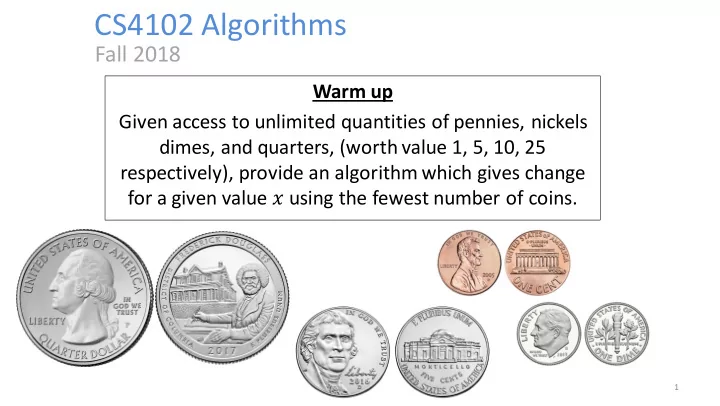
Warm up Given access to unlimited quantities of pennies, nickels dimes, and quarters, (worth value 1, 5, 10, 25 respectively), provide an algorithm which gives change for a given value 𝑦 using the fewest number of coins.

CS4102 Algorithms

Fall 2018

1

slide-2
SLIDE 2

Change Making

43 cents

2

slide-3
SLIDE 3

Change Making Algorithm

  • Given: target value 𝑦, list of coins 𝐷 = [𝑑1, … , π‘‘π‘œ]

(in this case 𝐷 = [1,5,10,25])

  • Repeatedly select the largest coin less than the remaining

target value:

3

while(𝑦 > 0) let 𝑑 = max(𝑑𝑗 ∈ {𝑑1 , … , π‘‘π‘œ} | 𝑑𝑗 ≀ 𝑦) print 𝑑 𝑦 = 𝑦 βˆ’ 𝑑

slide-4
SLIDE 4

Why does this always work?

  • If 𝑦 < 5, then pennies only

– 5 pennies can be exchanged for a nickel

  • If 5 ≀ 𝑦 < 10 we must have a nickel

– 2 nickels can be exchanged for a dime

  • If 10 ≀ 𝑦 < 25 we must have at least 1 dime

– 3 dimes can be exchanged for a quarter and a nickel

  • If 𝑦 β‰₯ 25 we must have at least 1 quarter

4

Only case Greedy uses pennies! Only case Greedy uses nickels! Only case Greedy uses dimes! Only case Greedy uses quarters!

slide-5
SLIDE 5

5

Warm up 2 Given access to unlimited quantities of pennies, nickels dimes, kims, and quarters, (worth value 1, 5, 10, 11, 25 respectively), give 90 cents change using the fewest number of coins.

slide-6
SLIDE 6

Greedy solution

90 cents

6

slide-7
SLIDE 7

Greedy solution

90 cents

7

slide-8
SLIDE 8

Today’s Keywords

  • Greedy Algorithms
  • Choice Function
  • Change Making
  • Interval Scheduling
  • Exchange Argument

8

slide-9
SLIDE 9

CLRS Readings

  • Chapter 16

9

slide-10
SLIDE 10

Homework

  • Hw6 Due Friday November 9, 11pm

– Dynamic Programming and Greedy – Written assignment

10

slide-11
SLIDE 11

Greedy vs DP

  • Dynamic Programming:

– Require Optimal Substructure – Several choices for which small subproblem

  • Greedy:

– Require Optimal Substructure – Must only consider one choice for small subproblem

11

slide-12
SLIDE 12

Greedy Algorithms

  • Require Optimal Substructure

– Solution to larger problem contains the solution to a smaller one – Only one subproblem to consider!

  • Idea:
  • 1. Identify a greedy choice property
  • How to make a choice guaranteed to be included in some optimal solution
  • 2. Repeatedly apply the choice property until no subproblems remain

12

slide-13
SLIDE 13

Change Making Choice Property

  • Largest coin less than or equal to target value must be part of

some optimal solution (for standard U.S. coins)

13

slide-14
SLIDE 14

Interval Scheduling

  • Input: List of events with their start and end

times (sorted by end time)

  • Output: largest set of non-conflicting events (start

time of each event is after the end time of all preceding events)

14

[2, 3.25] CS4102 [1, 4] Corn Maze Run [3, 4] CHS Prom [3.5, 4.75] DMB concert [4, 5.25] Bingo [4.5, 6] SCUBA lessons [5, 6.5] Roller Derby [7, 8] Pumpkin Carving

slide-15
SLIDE 15

Interval Scheduling DP

15

𝑑1 𝑑2 𝑑3 𝑓2 π‘“π‘œ

𝐢𝑓𝑑𝑒(𝑒) = max # events that can be scheduled before time 𝑒 𝐢𝑓𝑑𝑒 en = max 𝐢𝑓𝑑𝑒 sn + 1

π‘“π‘œβˆ’1 π‘‘π‘œ

𝐢𝑓𝑑𝑒 enβˆ’1 Include event π‘œ Exclude event π‘œ

slide-16
SLIDE 16

Greedy Interval Scheduling

  • Step 1: Identify a greedy choice property

– Options:

  • Shortest interval
  • Fewest conflicts
  • Earliest start
  • Earliest end

16

Prove using Exchange Argument

slide-17
SLIDE 17

Interval Scheduling Algorithm

17

Find event ending earliest, add to solution, Remove it and all conflicting events, Repeat until all events removed, return solution

slide-18
SLIDE 18

Interval Scheduling Algorithm

Find event ending earliest, add to solution, Remove it and all conflicting events, Repeat until all events removed, return solution

18

slide-19
SLIDE 19

Interval Scheduling Algorithm

19

Find event ending earliest, add to solution, Remove it and all conflicting events, Repeat until all events removed, return solution

slide-20
SLIDE 20

Interval Scheduling Algorithm

20

Find event ending earliest, add to solution, Remove it and all conflicting events, Repeat until all events removed, return solution

slide-21
SLIDE 21

Interval Scheduling Run Time

21

Equivalent way StartTime = 0 For each interval (in order of finish time): if end of interval < Start Time: do nothing else: add interval to solution StartTime = end of interval

𝑃(π‘œ) 𝑃(1) 𝑃(1)

Find event ending earliest, add to solution, Remove it and all conflicting events, Repeat until all events removed, return solution

slide-22
SLIDE 22

Exchange argument

  • Shows correctness of a greedy algorithm
  • Idea:

– Show exchanging an item from an arbitrary optimal solution with your greedy choice makes the new solution no worse – How to show my sandwich is at least as good as yours:

  • Show: β€œI can remove any item from your sandwich, and it would be no worse

by replacing it with the same item from my sandwich”

22

slide-23
SLIDE 23

Exchange Argument for Earliest End Time

  • Claim: earliest ending interval is always part of some
  • ptimal solution
  • Let π‘ƒπ‘„π‘ˆπ‘—,π‘˜ be an optimal solution for time range [𝑗, π‘˜]
  • Let π‘βˆ— be the first interval in [𝑗, π‘˜] to finish overall
  • If π‘βˆ— ∈ π‘ƒπ‘„π‘ˆπ‘—,π‘˜ then claim holds
  • Else if π‘βˆ— βˆ‰ π‘ƒπ‘„π‘ˆπ‘—,π‘˜, let 𝑏 be the first interval to end in

π‘ƒπ‘„π‘ˆπ‘—,π‘˜

– By definition π‘βˆ— ends before 𝑏, and therefore does not conflict with any other events in π‘ƒπ‘„π‘ˆ

𝑗,π‘˜

– Therefore π‘ƒπ‘„π‘ˆ

𝑗,π‘˜ βˆ’ {𝑏} + {π‘βˆ—} is also an optimal solution

– Thus claim holds

23

slide-24
SLIDE 24

Next Time: Caching Problem

  • Why is using too much memory a bad thing?

24

slide-25
SLIDE 25

Von Neumann Bottleneck

  • Named for John von Neumann
  • Inventor of modern computer architecture
  • Other notable influences include:

– Mathematics – Physics – Economics – Computer Science

25

slide-26
SLIDE 26

Von Neumann Bottleneck

  • Reading from memory is VERY slow
  • Big memory = slow memory
  • Solution: hierarchical memory
  • Takeaway for Algorithms: Memory is time,

more memory is a lot more time

26

CPU, registers Cache Disc If not look here Hopefully your data in here Hope it’s not here Access time: 1 cycle Access time: 10 cycles Access time: 1,000,000 cycles

slide-27
SLIDE 27

Exchange Argument for (U.S. coin) Change Making

  • Claim: largest coin is always part of some optimal solution
  • Consider that we had an optimal solution for target value 𝑦, call

this π‘ƒπ‘„π‘ˆ

𝑦

  • Let π‘‘βˆ— be the largest coin in π‘ƒπ‘„π‘ˆ

𝑦

  • If π‘‘βˆ— ∈ π‘ƒπ‘„π‘ˆ

𝑦 then claim holds

  • Else if π‘‘βˆ— βˆ‰ π‘ƒπ‘„π‘ˆ

𝑦, let 𝑑 be the largest coin in π‘ƒπ‘„π‘ˆ 𝑦

– Using slide 4, we could exchange 𝑑 for a combination of coins including π‘‘βˆ— to have a solution that is no worse

27