SLIDE 1
CS302 Topic: Simulation and Priority Queues
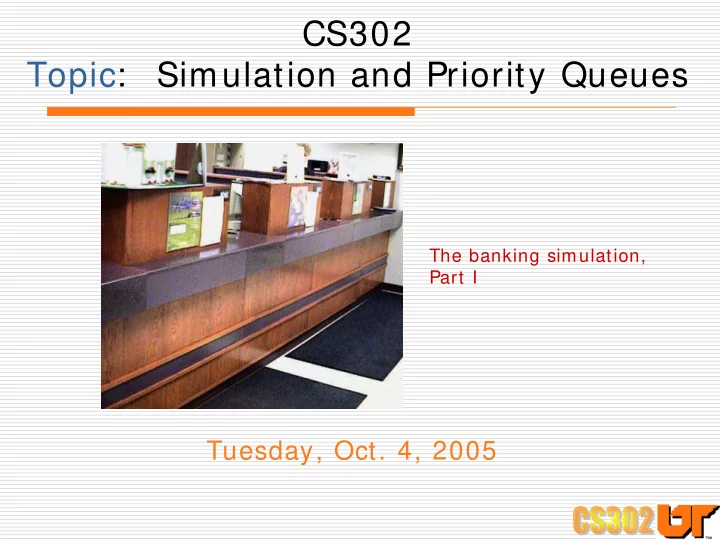
The banking simulation, Part I
Tuesday, Oct. 4, 2005
SLIDE 2 Announcements
- Lab 4 (Stock Reports); due this Friday, Oct. 7
- Don’t procrastinate!!
I like work: it fascinates me. I like work: it fascinates me. I can sit and look at it for hours. I can sit and look at it for hours.
- - J.K. Jerome (Three Men in a Boat, 1889)
J.K. Jerome (Three Men in a Boat, 1889)
- Midterm :
- 2 weeks from today (Tues., Oct. 18)
- Includes material covered in class and on labs
- Open book, open notes
- No electronic devices
SLIDE 3 Recall: What are properties of Priority Queue / Heap?
What are properties of heap?
- Structure property:
- Complete binary tree. In other words, tree is completely filled, with
possible exception of last level, which is filled from left to right
- Heap-Order property (for a min heap):
- For every internal node v other than the root,
- key(v) ≥ key(parent(v))
Heap
SLIDE 4 Recall: What are Priority Queue / Heap Runtimes?
Time complexities:
- insert:
- O(log n), worst case
- O(1), on average
- Can be shown that, on average, don’t have to percolate
new element all the way up
- On average, percolation terminates early
- On average, 2.607 comparisons are required to perform
an insert
- deleteMin:
- O(log n)
- buildHeap:
- O(n)
Heap
SLIDE 5 Recall: What are possible implementations of Priority Queues?
5 2 3 1 4
2 3 4 5 1
W hich did w e favor? W hy? Heaps Better runtime characteristics
SLIDE 6 A C+ + Implementation of Priority Queues
NOTE: Here, we are giving an example of implementing priority queues using red-black trees In Lab 6: You’ll implement Priority Queues using Heaps – THIS IS THE PREFERRED WAY NOTE: Different implementations of Priority Queues can have different interfaces
- We’ll describe one possible interface today
- In Lab 6:
Your interface might be slightly different!
SLIDE 7 A Public Interface for a Priority Queue
class pQueue { public: pQueue(); ~pQueue(); void insert(int key, Jval val); int minKey(); Jval minVal(); void deleteMin(); int size(); bool empty(); };
What operations should we provide?
- Required (for any priority queue):
- Insert()
- DeleteMin()
- Optional (depends on interface design):
- minKey()
- minVal()
- size()
- empty()
SLIDE 8 Example Program using pQueues
#include <iostream> #include "pQueue.h" #include "Fields.h" #include <string> using namespace std; main() { pQueue p; Fields f; string *s; int key; while (f.get_line() >= 0) { // we need to use a pointer to a string because a Jval cannot store // a string (it can store a char * but it cannot store a string) s = new string(f.get_current_line()); sscanf(s->c_str(), "%d", &key); p.insert(key, new_jval_v(s)); } while (!p.Empty()) { s = (string *) p.minVal().v; cout << *s; p.deleteMin(); } }
What does this program do? Sorts each line of standard input based on its first field (which we assume is integer)
sortem.cpp
SLIDE 9
Priority Queue interface using red-black trees
Hold elements of priority queue in red-black tree Maintain size of queue What should the data variables be for this priority queue interface?
class pQueue { public: ... protected rbTree <int> tree; int queueSize; };
SLIDE 10 Priority Queue interface using red-black trees (con’t.)
- What should constructor do?
pQueue::pQueue() { queuesize = 0; }
- Since tree is statically allocated, it is automatically
created and destroyed. So, no need for memory allocation in constructor.
- What should destructor do?
pQueue::~pQueue() { }
SLIDE 11
Priority Queue interface using red-black trees (con’t.)
How do we implement insert()?
void pQueue::insert(int key, Jval val) { tree.insert(key, val); queueSize++; }
SLIDE 12
Priority Queue interface using red-black trees (con’t.)
How do we implement minKey()?
int pQueue::minKey() { if (queueSize == 0) { fprintf(stderr, "pQueue::Minkey() called on an empty pQueue\n"); exit(1); } tree.first(); return tree.getKey(); }
SLIDE 13
Priority Queue interface using red-black trees (con’t.)
How do we implement minVal()?
Jval pQueue::minVal() { if (queueSize == 0) { fprintf(stderr, "pQueue::Minval() called on an empty pQueue\n"); exit(1); } tree.first(); return tree.getVal(); }
SLIDE 14
Priority Queue interface using red-black trees (con’t.)
How do we implement deleteMin()?
void pQueue::deleteMin() { if (queueSize == 0) { fprintf(stderr, "pQueue::deleteMin() called on an empty pQueue\n"); exit(1); } tree.first(); tree.deleteNode(); queueSize--; }
SLIDE 15
Priority Queue interface using red-black trees (con’t.)
How do we implement size()?
int pQueue::size() { return queueSize; }
How do we implement empty()?
bool pQueue::empty() { return (queueSize == 0); }
SLIDE 16 Recall: Applications of Priority Queues?
- Example Applications:
- Unix/ Linux job scheduling
- Processes given a priority
- Time allocated to process is based on priority of job
- Priority of jobs in printer queue
- Sorting
- Standby passengers at airport
- Auctions
- Stock market
- Event-driven simulations
- VLSI design (channel routing, pin layout)
- Artificial intelligence search algorithms
SLIDE 17 Discrete Event Simulations
Here, we’re interested in procesess and systems that change at discrete instants What are examples of discrete events?
- Pushing an elevator button
- Starting of a motor
- Stopping of a motor
- Arrival of a customer
- Departure of a customer
- Turning on a light
These events are discrete events, because there is an instant of time at which each occurs
SLIDE 18 Are these discrete events?
- Train departing station
- Yes
- Train moving from point A to point B
- No
- Train arriving at point B
- Yes
- Note:
- We can model an event of a train moving from point
A to point B as two separate events (i.e., the departure and the arrival)
- If we associate a time value with each discrete event,
then we can model the duration of activities
SLIDE 19 Discrete Event Simulators aren’t good for continuous time
For example, not good for simulating motion of planetary bodies Better approach?
SLIDE 20 Note on Queuing Theory
- Queuing Theory: a branch of mathematics that deals with
computing (probabilistically) delays in lines at servicing points
- Answer depends on:
- How frequently users arrive
- How long it takes to process a user once their turn arrives
- Both of above typically represented as probability
distribution functions
- Finding solutions:
- Simple cases:
Can compute answer analytically
- More complex cases (e.g., with k operators): Solve using
discrete event simulation
SLIDE 21 The Banking Simulation
We have a bank:
- Customers arrive and wait in a line until one of k
tellers is available
- Customer arrival governed by probability distribution
- Service time governed by a probability distribution
We want to know:
- How long (on average) does a customer have to
wait?
- How long (on average) is the line?
- What is the optimal number of tellers?
Enough so that customers don’t have to wait too long Not so many that we waste our money paying tellers
SLIDE 22 The Simulation Process
- Simulation consists of processing events.
- Here, events are:
- Customer arriving
- Customer departing
- Use probability distributions to generate:
- Input stream consisting of ordered pairs of arrival time and
service time, sorted by arrival time
- Then, we run the simulation for a while and collect data on:
- How the number of tellers impacts how long people wait
- How long tellers are idle
- From data, we can determine optimal number of tellers
SLIDE 23
Example of simulation process
Our system: 2 tellers, 4 customers. Simulator generates these events:
New Person: 0 enters the bank at 1.5. Transaction time: 5.7 New Person: 1 enters the bank at 2.8. Transaction time: 1.9 New Person: 2 enters the bank at 3.3. Transaction time: 8.7 New Person: 3 enters the bank at 9.2. Transaction time: 2.7
based on “customer arrival” probability distribution based on “service time” probability distribution
SLIDE 24 Simulation process, con’t.
- Time 1.5: Person 0 enters bank
- Both tellers are free teller 1 starts working on person 0’s transaction.
(Transaction takes 5.7 minutes, so it’s done at 1.5+ 5.7 = 7.2)
- Time 2.8: Person 1 enters bank
- Teller 2 is free teller 2 starts working on person 1’s transaction.
(Transaction takes 1.9 minutes, so it’s done at 2.8+ 1.9 = 4.7)
- Time 3.3: Person 2 enters bank
- Both tellers are busy, so person 2 waits.
- Time 4.7: Teller 2 is free
- Teller 2 starts working on person 2’s transaction. (Transaction takes
8.7 minutes, so it will be done at 4.7+ 8.7 = 13.4)
- Time 7.2: Teller 1 is free.
- Time 9.2: Person 3 enters bank.
- Teller 1 is free, teller 1 starts working on person 3’s transaction
(Transaction takes 2.7 minutes, so it will be done at 9.2+ 2.7 = 11.9)
- Time 11.9: Teller 1 is free
- Time 13.4: Teller 2 is free. No more people generated by simulation, so
we’re done.
New Person: 0 enters the bank at 1.5. Transaction time: 5.7 New Person: 1 enters the bank at 2.8. Transaction time: 1.9 New Person: 2 enters the bank at 3.3. Transaction time: 8.7 New Person: 3 enters the bank at 9.2. Transaction time: 2.7
SLIDE 25 Analyzing data: Waiting time?
- Time 1.5: Person 0 enters bank
- Both tellers are free teller 1 starts working on person 0’s transaction.
(Transaction takes 5.7 minutes, so it’s done at 1.5+ 5.7 = 7.2)
- Time 2.8: Person 1 enters bank
- Teller 2 is free teller 2 starts working on person 1’s transaction.
(Transaction takes 1.9 minutes, so it’s done at 2.8+ 1.9 = 4.7)
- Time 3.3: Person 2 enters bank
- Both tellers are busy, so person 2 waits.
- Time 4.7: Teller 2 is free
- Teller 2 starts working on person 2’s transaction. (Transaction takes
8.7 minutes, so it will be done at 4.7+ 8.7 = 13.4)
- Time 7.2: Teller 1 is free.
- Time 9.2: Person 3 enters bank.
- Teller 1 is free, teller 1 starts working on person 3’s transaction
(Transaction takes 2.7 minutes, so it will be done at 9.2+ 2.7 = 11.9)
- Time 11.9: Teller 1 is free
- Time 13.4: Teller 2 is free. No more people generated by simulation, so
we’re done.
Person 0: Person 2: 1.4 Person 1: Person 3:
Average = 0.35
SLIDE 26 Analyzing data: Teller idle time? (Let’s say that bank “closes” at 12.0)
- Time 1.5: Person 0 enters bank
- Both tellers are free teller 1 starts working on person 0’s transaction.
(Transaction takes 5.7 minutes, so it’s done at 1.5+ 5.7 = 7.2)
- Time 2.8: Person 1 enters bank
- Teller 2 is free teller 2 starts working on person 1’s transaction.
(Transaction takes 1.9 minutes, so it’s done at 2.8+ 1.9 = 4.7)
- Time 3.3: Person 2 enters bank
- Both tellers are busy, so person 2 waits.
- Time 4.7: Teller 2 is free
- Teller 2 starts working on person 2’s transaction. (Transaction takes
8.7 minutes, so it will be done at 4.7+ 8.7 = 13.4)
- Time 7.2: Teller 1 is free.
- Time 9.2: Person 3 enters bank.
- Teller 1 is free, teller 1 starts working on person 3’s transaction
(Transaction takes 2.7 minutes, so it will be done at 9.2+ 2.7 = 11.9)
- Time 11.9: Teller 1 is free
- Time 13.4: Teller 2 is free. No more people generated by simulation, so
we’re done.
Teller 1: 1.5 + 2 + 0.1 = 3.6 2.8 + 0 = 2.8 Teller 2:
Average = 3.2
SLIDE 27 Suppose we change # tellers to 3. How does this affect waiting time?
Person 2 would get helped immediately
- Time 1.5: Person 0 enters bank
- Both tellers are free teller 1 starts working on person 0’s transaction.
(Transaction takes 5.7 minutes, so it’s done at 1.5+ 5.7 = 7.2)
- Time 2.8: Person 1 enters bank
- Teller 2 is free teller 2 starts working on person 1’s transaction.
(Transaction takes 1.9 minutes, so it’s done at 2.8+ 1.9 = 4.7)
- Time 3.3: Person 2 enters bank
- Both tellers are busy, so person 2 waits.
- Time 4.7: Teller 2 is free
- Teller 2 starts working on person 2’s transaction. (Transaction takes
8.7 minutes, so it will be done at 4.7+ 8.7 = 13.4)
- Time 7.2: Teller 1 is free.
- Time 9.2: Person 3 enters bank.
- Teller 1 is free, teller 1 starts working on person 3’s transaction
(Transaction takes 2.7 minutes, so it will be done at 9.2+ 2.7 = 11.9)
- Time 11.9: Teller 1 is free
- Time 13.4: Teller 2 is free. No more people generated by simulation, so
we’re done.
Average waiting time drops to 0
SLIDE 28 Suppose we change # tellers to 3. How does this affect idle time?
- Time 1.5: Person 0 enters bank
- Both tellers are free teller 1 starts working on person 0’s transaction.
(Transaction takes 5.7 minutes, so it’s done at 1.5+ 5.7 = 7.2)
- Time 2.8: Person 1 enters bank
- Teller 2 is free teller 2 starts working on person 1’s transaction.
(Transaction takes 1.9 minutes, so it’s done at 2.8+ 1.9 = 4.7)
- Time 3.3: Person 2 enters bank
- Both tellers are busy, so person 2 waits.
- Time 4.7: Teller 2 is free
- Teller 2 starts working on person 2’s transaction. (Transaction takes
8.7 minutes, so it will be done at 4.7+ 8.7 = 13.4)
- Time 7.2: Teller 1 is free.
- Time 9.2: Person 3 enters bank.
- Teller 1 is free, teller 1 starts working on person 3’s transaction
(Transaction takes 2.7 minutes, so it will be done at 9.2+ 2.7 = 11.9)
- Time 11.9: Teller 1 is free
- Time 13.4: Teller 2 is free. No more people generated by simulation, so
we’re done.
Goes up to 5.83 (from 3.2)
SLIDE 29 Here’s the general process for discrete event simulation loop
“State”: all variables that describe a system
- Initialize (State)
- Time ← 0
- Initialize (futureEventSet)
- While (futureEventSet not empty) do:
- Event ← next event in futureEventSet (i.e., deleteMin)
- Time ← Time (Event)
- State ← function of old state and event
- Update(futureEventSet)
Generic Simulation Program: Generic Simulation Program:
SLIDE 30 Event Generation
Tricky part of simulation:
- Choosing how to generate random events
Example: Say we want transaction times to average 10 minutes.
- Here are 2 sequences that average 10:
- 8 12 10 11 9 7 13
- 0 0 0 0 0 0 0 0 0 100
- But, these have very different characteristics
we need to define the distribution we’re interested in
SLIDE 31
Distributions: Uniform
Distribution: Defines characterization of random numbers in more specific ways than just an average value Uniform distribution:
Mean m For our purposes, we’ll have random numbers 0 ≤ r ≤ 2m, with every value between 0 and 2m equally likely
SLIDE 32 Uniform distributions in C+ + (pseudo-random number generators)
srand48(i): takes integer i and uses it as a seed to the random number generator (just do this once) drand48(): returns a double uniformly distributed in range [ 0,1)
- drand is a random number generator that
follows a uniform distribution with a mean of 0.5
What do you do if you want a mean of m? Multiply the result of drand48 by 2m.
SLIDE 33 Note on how pseudo-random number generators work
drand48() generates a sequence of 48-bit integers Xi according to following: srand48(seedval) sets the high order 32-bits of Xi to the argument seedval Note: these numbers aren’t really random.
- Sequence repeats
- Numbers are predictable
1
( )mod , for 0x5DEECE66D 0xB
n n
X aX c m n a c
+ =
+ ≥ = =
SLIDE 34
Example of generating random numbers from uniform distribution
/* generate 20 random numbers using a uniform distribution with a mean of “mean” */ srand48(737); // provide an initial "seed" to random generator for (i = 0; i < 20; i++) { d = drand48()*mean*2; printf("%d \t %lf \n", i, d); }
SLIDE 35
Uniform Distribution in Banking Example
Service time: represented by uniform distribution
SLIDE 36
Distributions: Exponential
In our banking simulation: arrival time is represented by histogram distribution
SLIDE 37
That’s all, folks.
Questions?
SLIDE 38 Recall: How do we map “tree” structure to heap array?
2 5 9 7 2 6 12 11 6 1 2 3 4 5 6 7 8 9
2 5 6 9 7 2 6 12 11 1 2 3 4 5 6 7 8 9 10