CS 61A Lecture 12 Monday, September 29 2 The Closure Property of - - PDF document

cs 61a lecture 12
SMART_READER_LITE
LIVE PREVIEW

CS 61A Lecture 12 Monday, September 29 2 The Closure Property of - - PDF document

Announcements Homework 3 due Wednesday 10/1 @ 11:59pm Homework Party on Monday 9/29, time and place TBD Optional Hog Contest due Wednesday 10/1 @ 11:59pm Project 2 due Thursday 10/9 @ 11:59pm CS 61A Lecture 12 Monday, September 29


slide-1
SLIDE 1

CS 61A Lecture 12

Monday, September 29

Announcements

  • Homework 3 due Wednesday 10/1 @ 11:59pm
Homework Party on Monday 9/29, time and place TBD
  • Optional Hog Contest due Wednesday 10/1 @ 11:59pm
  • Project 2 due Thursday 10/9 @ 11:59pm
2

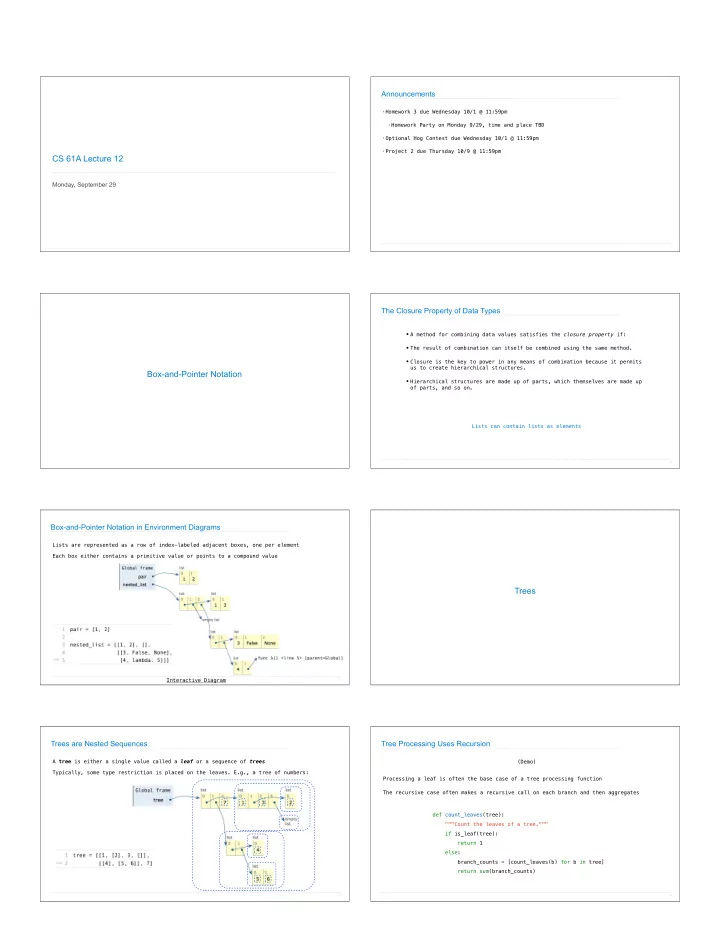
Box-and-Pointer Notation

The Closure Property of Data Types

  • A method for combining data values satisfies the closure property if:
  • The result of combination can itself be combined using the same method.
  • Closure is the key to power in any means of combination because it permits

us to create hierarchical structures.

  • Hierarchical structures are made up of parts, which themselves are made up
  • f parts, and so on.

Lists can contain lists as elements

4

Box-and-Pointer Notation in Environment Diagrams

Lists are represented as a row of index-labeled adjacent boxes, one per element Each box either contains a primitive value or points to a compound value

5

Interactive Diagram

Trees

Trees are Nested Sequences

A tree is either a single value called a leaf or a sequence of trees Typically, some type restriction is placed on the leaves. E.g., a tree of numbers:

7

Tree Processing Uses Recursion

Processing a leaf is often the base case of a tree processing function The recursive case often makes a recursive call on each branch and then aggregates

8

(Demo) def count_leaves(tree): """Count the leaves of a tree.""" if is_leaf(tree): return 1 else: branch_counts = [count_leaves(b) for b in tree] return sum(branch_counts)

slide-2
SLIDE 2

Discussion Question

Complete the definition of flatten, which takes a tree and returns a list of its leaves Hint: If you sum a sequence of lists, you get 1 list containing the elements of those lists

9

sum([flatten(b) for b in tree], []) def flatten(tree): """Return a list containing the leaves of tree.

  • >>> tree = [[1, [2], 3, []], [[4], [5, 6]], 7]

>>> flatten(tree) [1, 2, 3, 4, 5, 6, 7] """ if is_leaf(tree): return [tree] else: return ___________________________________

  • def is_leaf(tree):

return type(tree) != list >>> sum([[1], [2, 3], [4]], []) [1, 2, 3, 4] >>> sum([[1]], []) [1] >>> sum([[[1]], [2]], []) [[1], 2]

Sequence Operations

Membership & Slicing

>>> digits = [1, 8, 2, 8] >>> 2 in digits True >>> 1828 not in digits True >>> digits[0:2] [1, 8] >>> digits[1:] [8, 2, 8] Python sequences have operators for membership and slicing Membership. Slicing.

11

Slicing creates a new object

Binary Trees

Trees may also have restrictions on their structure A binary tree is either a leaf or a sequence containing at most two binary trees The process of transforming a tree into a binary tree is called binarization

12

def right_binarize(tree): """Construct a right-branching binary tree.

  • >>> right_binarize([1, 2, 3, 4, 5, 6, 7])

[1, [2, [3, [4, [5, [6, 7]]]]]] """ if is_leaf(tree): return tree if len(tree) > 2: tree = [tree[0], tree[1:]] return [right_binarize(b) for b in tree] (Demo) All but the first branch are grouped into a new branch

Strings

Strings are an Abstraction

Representing data: '200' '1.2e-5' 'False' '(1, 2)' Representing language: """And, as imagination bodies forth The forms of things to unknown, and the poet's pen Turns them to shapes, and gives to airy nothing A local habitation and a name. """ Representing programs: 'curry = lambda f: lambda x: lambda y: f(x, y)' (Demo)

14

String Literals Have Three Forms

>>> 'I am string!' 'I am string!'

  • >>> "I've got an apostrophe"

"I've got an apostrophe"

  • >>> '您好'

'您好' >>> """The Zen of Python claims, Readability counts. Read more: import this.""" 'The Zen of Python\nclaims, Readability counts.\nRead more: import this.' "Line feed" character represents a new line A backslash "escapes" the following character Single-quoted and double-quoted strings are equivalent

15

Strings are Sequences

>>> city = 'Berkeley' >>> len(city) 8 >>> city[3] 'k' Careful: An element of a string is itself a string, but with only one element!

16

However, the "in" and "not in" operators match substrings >>> 'here' in "Where's Waldo?" True >>> 234 in [1, 2, 3, 4, 5] False >>> [2, 3, 4] in [1, 2, 3, 4, 5] False When working with strings, we usually care about whole words more than letters Length and element selection are similar to all sequences

slide-3
SLIDE 3

Dictionaries

{'Dem': 0}

Limitations on Dictionaries

Dictionaries are unordered collections of key-value pairs Dictionary keys do have two restrictions:

  • A key of a dictionary cannot be a list or a dictionary (or any mutable type)
  • Two keys cannot be equal; There can be at most one value for a given key

This first restriction is tied to Python's underlying implementation of dictionaries The second restriction is part of the dictionary abstraction If you want to associate multiple values with a key, store them all in a sequence value

18