CS 4803 Crypto as a science (modern cryptography) has short but - - PowerPoint PPT Presentation

cs 4803
SMART_READER_LITE
LIVE PREVIEW

CS 4803 Crypto as a science (modern cryptography) has short but - - PowerPoint PPT Presentation

Cryptography is very old and very new Crypto is an ancient discipline Recall Julius Caesar, Enigma,... CS 4803 Crypto as a science (modern cryptography) has short but Computer and Network Security exciting history Most of it


slide-1
SLIDE 1

CS 4803 Computer and Network Security

Alexandra (Sasha) Boldyreva

  • Cryptography. Introduction.

1

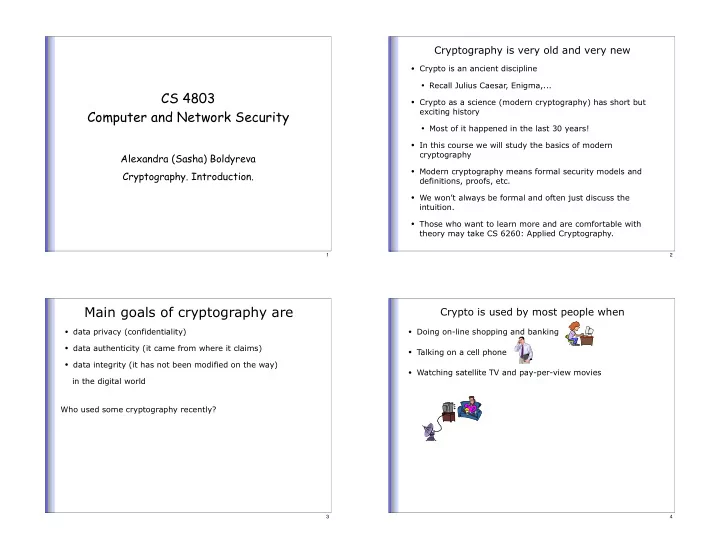
Cryptography is very old and very new

  • Crypto is an ancient discipline
  • Recall Julius Caesar, Enigma,...
  • Crypto as a science (modern cryptography) has short but

exciting history

  • Most of it happened in the last 30 years!
  • In this course we will study the basics of modern

cryptography

  • Modern cryptography means formal security models and

definitions, proofs, etc.

  • We won’t always be formal and often just discuss the

intuition.

  • Those who want to learn more and are comfortable with

theory may take CS 6260: Applied Cryptography.

2

Main goals of cryptography are

  • data privacy (confidentiality)
  • data authenticity (it came from where it claims)
  • data integrity (it has not been modified on the way)

in the digital world Who used some cryptography recently?

3

Crypto is used by most people when

  • Doing on-line shopping and banking
  • Talking on a cell phone
  • Watching satellite TV and pay-per-view movies

4

slide-2
SLIDE 2

Players and settings

S R A

  • 1. Symmetric-key setting

K K

5

Players and settings

S R A

  • 2. Asymmetric (public)-key setting

skr pkr

... ... R pkr ... ...

pkr

6

Goals and primitives

setting goal symmetric-key asymmetric-key data privacy symmetric (secret-key) encryption asymmetric (public- key) encryption data authenticity/ integrity message authentication code (MAC) digital signature scheme

7

Symmetric vs public-key crypto

  • Symmetric schemes are easier to construct and implement

(less math is required)

  • Symmetric schemes are faster (by 3-4 orders of magnitude)
  • But how do parties agree on the shared key at the first place?

8

slide-3
SLIDE 3

How good is a scheme?

  • “Trial-and-error” approach:
  • 1. Try to find an attack
  • 2. If an attack found then the scheme is insecure, fix the scheme,

repeat step 1.

  • 3. If no attack found then ....?
  • “Provable security” approach:
  • show that if an attack found (a scheme is insecure), then one can

break some trusted assumption (e.g. factoring)

  • requires a definition of what “secure” means

9

Symmetric encryption schemes

  • A scheme SE is specified by 3 algorithms K,E,D.

R S A

K

  • K

C M

  • K

C M SE=K,E,D or SE=KeySp,E,D

It is required that for every M∈MsgSp and every K∈KeySp,

D(K, E(K, M))=M

MsgSp-message space KeySp-key space

10

  • OneTimePad=(K,E,D), MsgSp={0,1}n:
  • : return a random n-bit string K (KeySp={0,1}n)
  • (K,M): CM⊕K, return C
  • (K,C): MC⊕K, return M
  • Example: M=011111111011101

K=110010011010100 C=101101100001001

  • As the name suggests, the scheme is to be used only once: a

new key must be used to encrypt a new message.

One Time Pad

11

Perfect (Shannon) security

  • Def (informal). An encryption scheme SE=(K,E,D) is

perfectly secure if everything what can be learned about the message from a ciphertext can be learned without the ciphertext.

  • Th.1 OneTimePad is a Shannon-secure encryption scheme.
  • Th.2 [Shannon’s theorem, optimality of OneTimePad]

If a scheme is perfectly secure, then the key space cannot be smaller than the message space (if KeySp={0,1}k and MsgSp={0,1}m, then km and a key must be as long as the message we want to encrypt).

12

slide-4
SLIDE 4
  • So we cannot do better than OneTimePad. But it is impractical

(very fast, but we need a very long key). Is it the end? Yes, of the information-theoretic (unconditionally secure) crypto. No, if we relax the security requirement and assume that adversaries are computationally bounded. We will also assume that

  • Bad guys have limited computational power
  • There are some “hard” problems
  • Secret keys are secret
  • But we will NOT assume that algorithms are secret. All

algorithms are public (Kerckhoff’s principle). “Security by

  • bscurity” is a bad idea!
  • We move to the area of computational-complexity crypto, that
  • pens a lot of possibilities.

13