Chapter 2: Classical Encryption Techniques Dr. Loai Tawalbeh - - PDF document

chapter 2 classical encryption techniques
SMART_READER_LITE
LIVE PREVIEW

Chapter 2: Classical Encryption Techniques Dr. Loai Tawalbeh - - PDF document

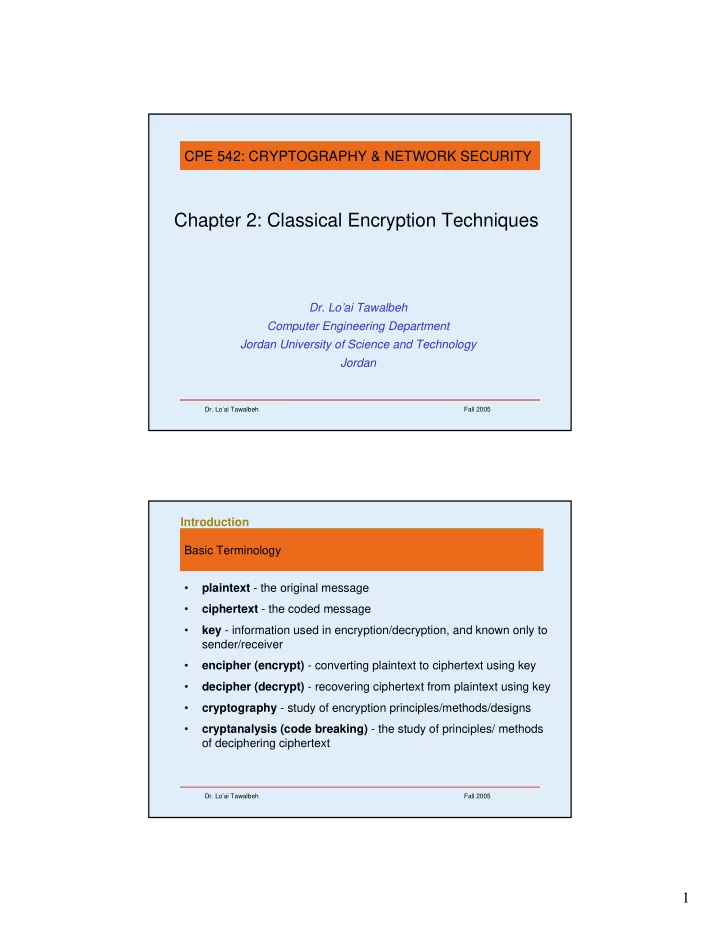
CPE 542: CRYPTOGRAPHY & NETWORK SECURITY Chapter 2: Classical Encryption Techniques Dr. Loai Tawalbeh Computer Engineering Department Jordan University of Science and Technology Jordan Dr. Loai Tawalbeh Fall 2005 Introduction


slide-1
SLIDE 1

1

  • Dr. Lo’ai Tawalbeh

Fall 2005

Chapter 2: Classical Encryption Techniques

  • Dr. Lo’ai Tawalbeh

Computer Engineering Department Jordan University of Science and Technology Jordan

CPE 542: CRYPTOGRAPHY & NETWORK SECURITY

  • Dr. Lo’ai Tawalbeh

Fall 2005

Basic Terminology

  • plaintext - the original message
  • ciphertext - the coded message
  • key - information used in encryption/decryption, and known only to

sender/receiver

  • encipher (encrypt) - converting plaintext to ciphertext using key
  • decipher (decrypt) - recovering ciphertext from plaintext using key
  • cryptography - study of encryption principles/methods/designs
  • cryptanalysis (code breaking) - the study of principles/ methods
  • f deciphering ciphertext

Introduction

slide-2
SLIDE 2

2

  • Dr. Lo’ai Tawalbeh

Fall 2005

Cryptographic Systems are categorized according to: 1. The operation used in transferring plaintext to ciphertext:

  • Substitution: each element in the plaintext is mapped into another element
  • Transposition: the elements in the plaintext are re-arranged.
  • 2. The number of keys used:
  • Symmetric (private- key) : both the sender and receiver use the same key
  • Asymmetric (public-key) : sender and receiver use different key
  • 3. The way the plaintext is processed :
  • Block cipher : inputs are processed one block at a time, producing a

corresponding output block.

  • Stream cipher: inputs are processed continuously, producing one element at a

time (bit,

Cryptographic Systems

  • Dr. Lo’ai Tawalbeh

Fall 2005

Symmetric Encryption Model Cryptographic Systems

slide-3
SLIDE 3

3

  • Dr. Lo’ai Tawalbeh

Fall 2005

Requirements

  • two requirements for secure use of symmetric

encryption:

  • 1. a strong encryption algorithm
  • 2. a secret key known only to sender / receiver
  • Y = Ek(X), where X: the plaintext, Y: the ciphertext
  • X = Dk(Y)
  • assume encryption algorithm is known
  • implies a secure channel to distribute key

Cryptographic Systems

  • Dr. Lo’ai Tawalbeh

Fall 2005

Attacks:

  • 1. Cryptanalytic Attacks: depends on the nature of the

encryption algorithm used.

  • Uses information such as plaintext/ciphertext pairs to deduce

the key

  • 2. Brute-force Attack: try all the possible keys – depends
  • n the key length.

Cryptographic Systems

slide-4
SLIDE 4

4

  • Dr. Lo’ai Tawalbeh

Fall 2005

Security Definitions

  • unconditional security
  • no matter how much computer power is available, the cipher

cannot be broken since the ciphertext provides insufficient information to uniquely determine the corresponding plaintext

  • computational security
  • given limited computing resources (e.g., time needed for

calculations is greater than age of universe), the cipher cannot be broken Cryptographic Systems

  • Dr. Lo’ai Tawalbeh

Fall 2005

Shift Cipher: Letters of the alphabet are assigned a number as below

Z 25 Y 24 X 23 W 22 V 21 U 20 T 19 S 18 R 17 Q 16 P 15 O 14 N 13 M 12 L 11 K 10 J 9 I 8 H 7 G 6 F 5 E 4 D 3 C 2 B 1 A

Algorithm: Let P = C = K= Ζ26 and x ∈ P, y ∈ C, k ∈ K Encryption: Ek(x) = x + k mod 26. Decryption: Dk(x) = x - k mod 26.

Shift Cipher

Classical Ciphers-Substitution Ciphers

slide-5
SLIDE 5

5

  • Dr. Lo’ai Tawalbeh

Fall 2005

Remark: When k = 3 the shift cipher is given a special name - Caesar Cipher. Example: Let the key k = 17 Plaintext: X = A T T A C K = (0, 19, 19, 0, 2, 10). Ciphertext : Y = (0+17 mod 26, 19+17 mod 26, …) Y = (17, 10, 10, 17, 19, 1) = R K K R T B Attacks on Shift Cipher

  • 1. Exhaustive Search: Try all possible keys.

|K|=26.

  • 2. Letter frequency analysis (Same plaintext maps to same

ciphertext)

Shift Ciphers- cont.

  • Dr. Lo’ai Tawalbeh

Fall 2005

Monoalphabetic Cipher

Substitution Ciphers

  • Jumble the letters arbitrarily
  • each plaintext letter maps to a different random

ciphertext letter.

  • key is 26 letters long
  • There are 26! = 4x 1026 Possible keys.
  • Plain: abcdefghijklmnopqrstuvwxyz
  • Cipher: DKVQFIBJWPESCXHTMYAUOLRGZN
  • Plaintext: ifwewishtoreplaceletters
  • Ciphertext: WIRFRWAJUHYFTSDVFSFUUFYA
slide-6
SLIDE 6

6

  • Dr. Lo’ai Tawalbeh

Fall 2005

Attacks: Frequency Analysis

  • Letter frequency analysis (Same plaintext maps to same

ciphertext): language redundancy :

  • letters are not equally commonly used
  • in English e is by far the most common letter, then

T,R,N,I,O,A, S

  • ther letters are fairly rare : cf. Z,J,K,Q,X

Substitution Ciphers

  • Dr. Lo’ai Tawalbeh

Fall 2005

English Letter Frequencies

slide-7
SLIDE 7

7

  • Dr. Lo’ai Tawalbeh

Fall 2005

Use in Cryptanalysis

  • key concept - monoalphabetic substitution

ciphers do not change relative letter frequencies

  • calculate letter frequencies for ciphertext
  • compare counts/plots against known values
  • for monoalphabetic must identify each letter
  • tables of common double/triple letters help
  • See the example in page 33
  • Dr. Lo’ai Tawalbeh

Fall 2005

Example Cryptanalysis

  • given ciphertext:

UZQSOVUOHXMOPVGPOZPEVSGZWSZOPFPESXUDBMETSXAIZ VUEPHZHMDZSHZOWSFPAPPDTSVPQUZWYMXUZUHSX EPYEPOPDZSZUFPOMBZWPFUPZHMDJUDTMOHMQ

  • count relative letter frequencies (see text)
  • guess P & Z are e and t
  • guess ZW is th and hence ZWP is the
  • proceeding with trial and error finally get:

it was disclosed yesterday that several informal but direct contacts have been made with political representatives of the vietcong in moscow

slide-8
SLIDE 8

8

  • Dr. Lo’ai Tawalbeh

Fall 2005

Playfair Key

  • not even the large number of keys in a monoalphabetic cipher

provides security

  • ne approach to improve security was to encrypt multiple letters
  • a 5X5 matrix of letters based on a keyword
  • fill in letters of keyword (sans duplicates)
  • fill rest of matrix with other letters
  • eg. using the keyword MONARCHY

MONAR CHYBD EFGIK LPQST UVWXZ

  • Dr. Lo’ai Tawalbeh

Fall 2005

Encrypting and Decrypting

  • plaintext encrypted two letters at a time:

1. if a pair is a repeated letter, insert a filler like 'X',

  • eg. "balloon"

encrypts as "ba lx lo on" 2. if both letters fall in the same row, replace each with letter to right (wrapping back to start from end), eg. “ar" encrypts as "RM" 3. if both letters fall in the same column, replace each with the letter below it (again wrapping to top from bottom), eg. “mu" encrypts to "CM" 4.

  • therwise each letter is replaced by the one in its row in the column
  • f the other letter of the pair, eg. “hs" encrypts to "BP", and “ea" to

"IM" or "JM" (as desired)

slide-9
SLIDE 9

9

  • Dr. Lo’ai Tawalbeh

Fall 2005

Security of the Playfair Cipher

  • security much improved over monoalphabetic
  • since have 26 x 26 = 676 digrams
  • would need a 676 entry frequency table to analyse (verses 26 for a

monoalphabetic)

  • and correspondingly more ciphertext
  • was widely used for many years (eg. US & British military in WW1)
  • it can be broken, given a few hundred letters
  • since still has much of plaintext structure
  • Dr. Lo’ai Tawalbeh

Fall 2005

The key is an n × n matrix whose entries are integers in Ζ26.

Hill Cipher

Example: Let n=3 and the key matrix be M, C=PM

⎟ ⎟ ⎟ ⎠ ⎞ ⎜ ⎜ ⎜ ⎝ ⎛ = 8 9 11 6 5 4 3 2 1 M

and the plaintext be ABC = (0, 1, 2) then the encryption

  • peration is a vector-matrix multiplication

t) (ciphertex AXW 26 mod ) 22 , 23 , ( 8 9 11 6 5 4 3 2 1 ) 2 , 1 , ( ⇒ ≡ ⎟ ⎟ ⎟ ⎠ ⎞ ⎜ ⎜ ⎜ ⎝ ⎛ ×

In order to decrypt we need the inverse of key matrix M, which is

⎟ ⎟ ⎟ ⎠ ⎞ ⎜ ⎜ ⎜ ⎝ ⎛ = 1 13 15 24 17 6 1 5 22 N

slide-10
SLIDE 10

10

  • Dr. Lo’ai Tawalbeh

Fall 2005

Polyalphabetic Ciphers

  • another approach to improving security is to use multiple cipher

alphabets

  • called polyalphabetic substitution ciphers
  • makes cryptanalysis harder with more alphabets to guess and

flatter frequency distribution

  • use a key to select which alphabet is used for each letter of the

message

  • use each alphabet in turn
  • repeat from start after end of key is reached
  • Dr. Lo’ai Tawalbeh

Fall 2005

Vigenère Cipher

  • simplest polyalphabetic substitution cipher is the

Vigenère Cipher

  • effectively multiple caesar ciphers
  • key is multiple letters long K = k1 k2 ... kd
  • ith letter specifies ith alphabet to use
  • use each alphabet in turn
  • repeat from start after d letters in message
  • decryption simply works in reverse
slide-11
SLIDE 11

11

  • Dr. Lo’ai Tawalbeh

Fall 2005

Example

  • write the plaintext out
  • write the keyword repeated above it
  • use each key letter as a caesar cipher key
  • encrypt the corresponding plaintext letter
  • eg using keyword deceptive

key: deceptivedeceptivedeceptive

  • - row

plaintext: wearediscoveredsaveyourself

  • - column

ciphertext:ZICVTWQNGRZGVTWAVZHCQYGLMGJ

  • Dr. Lo’ai Tawalbeh

Fall 2005

Security of Vigenère Ciphers

  • have multiple ciphertext letters for each plaintext letter
  • hence letter frequencies are obscured
  • but not totally lost
  • start with letter frequencies
  • see if look monoalphabetic or not
  • if not, then need to determine number of alphabets,

since then can attach each

slide-12
SLIDE 12

12

  • Dr. Lo’ai Tawalbeh

Fall 2005

Kasiski Method

  • method developed by Babbage / Kasiski
  • repetitions in ciphertext give clues to period
  • so find same plaintext an exact period apart
  • which results in the same ciphertext
  • f course, could also be random
  • eg repeated “VTW” in previous example
  • suggests size of 3 or 9
  • then attack each monoalphabetic cipher individually using same

techniques as before

  • Dr. Lo’ai Tawalbeh

Fall 2005

Autokey Cipher

  • ideally want a key as long as the message
  • Vigenère proposed the autokey cipher
  • with keyword is prefixed to message as key
  • knowing keyword can recover the first few letters
  • use these in turn on the rest of the message
  • but still have frequency characteristics to attack
  • eg. given key deceptive

key: deceptivewearediscoveredsav plaintext: wearediscoveredsaveyourself ciphertext:ZICVTWQNGKZEIIGASXSTSLVVWLA

slide-13
SLIDE 13

13

  • Dr. Lo’ai Tawalbeh

Fall 2005

One-Time Pad

  • if a truly random key as long as the message is used,

the cipher will be secure

  • called a One-Time pad
  • is unbreakable since ciphertext bears no statistical

relationship to the plaintext

  • since for any plaintext & any ciphertext there exists a

key mapping one to other

  • can only use the key once though
  • have problem of safe distribution of key
  • Dr. Lo’ai Tawalbeh

Fall 2005

Transposition Ciphers

  • now consider classical transposition or permutation

ciphers

  • these hide the message by rearranging the letter order
  • without altering the actual letters used
  • can recognise these since have the same frequency

distribution as the original text

slide-14
SLIDE 14

14

  • Dr. Lo’ai Tawalbeh

Fall 2005

Rail Fence cipher

  • write message letters out diagonally over a number of

rows

  • then read off cipher row by row
  • eg. write message out as:

m e m a t r h t g p r y e t e f e t e o a a t

  • giving ciphertext

MEMATRHTGPRYETEFETEOAAT

  • Dr. Lo’ai Tawalbeh

Fall 2005

Row Transposition Ciphers

  • a more complex scheme
  • write letters of message out in rows over a specified

number of columns

  • then reorder the columns according to some key before

reading off the rows

Key: 4 3 1 2 5 6 7 Plaintext: a t t a c k p

  • s t p o n e

d u n t i l t w o a m x y z Ciphertext: TTNAAPTMTSUOAODWCOIXKNLYPETZ

slide-15
SLIDE 15

15

  • Dr. Lo’ai Tawalbeh

Fall 2005

Product Ciphers

  • ciphers using substitutions or transpositions are not secure

because of language characteristics

  • hence consider using several ciphers in succession to make

harder, but:

  • two substitutions make a more complex substitution
  • two transpositions make more complex transposition
  • but a substitution followed by a transposition makes a new much

harder cipher

  • this is bridge from classical to modern ciphers
  • Dr. Lo’ai Tawalbeh

Fall 2005

Rotor Machines

  • before modern ciphers, rotor machines were most common

product cipher

  • were widely used in WW2
  • German Enigma, Allied Hagelin, Japanese Purple
  • implemented a very complex, varying substitution cipher
  • used a series of cylinders, each giving one substitution, which

rotated and changed after each letter was encrypted

  • with 3 cylinders have 263=17576 alphabets
slide-16
SLIDE 16

16

  • Dr. Lo’ai Tawalbeh

Fall 2005

Steganography

  • an alternative to encryption
  • hides existence of message
  • using only a subset of letters/words in a longer message

marked in some way

  • using invisible ink
  • hiding in LSB in graphic image or sound file
  • has drawbacks
  • high overhead to hide relatively few info bits
  • Dr. Lo’ai Tawalbeh

Fall 2005

Summary

  • have considered:
  • classical cipher techniques and terminology
  • monoalphabetic substitution ciphers
  • cryptanalysis using letter frequencies
  • Playfair ciphers
  • polyalphabetic ciphers
  • transposition ciphers
  • product ciphers and rotor machines
  • stenography