CS 1655 / Spring 2010 Secure Data Management and Web Applications - - PDF document

cs 1655 spring 2010 secure data management and web
SMART_READER_LITE
LIVE PREVIEW

CS 1655 / Spring 2010 Secure Data Management and Web Applications - - PDF document

CS 1655 / Spring 2010 Secure Data Management and Web Applications 01 Data Mining and Knowledge Discovery Alexandros Labrinidis University of Pittsburgh CS 1655 / Spring 2010 1 Trends leading to Data Flood More data is generated:


slide-1
SLIDE 1

1

CS 1655 / Spring 2010 1

CS 1655 / Spring 2010 Secure Data Management and Web Applications

Alexandros Labrinidis University of Pittsburgh

01 – Data Mining and Knowledge Discovery

CS 1655 / Spring 2010 2

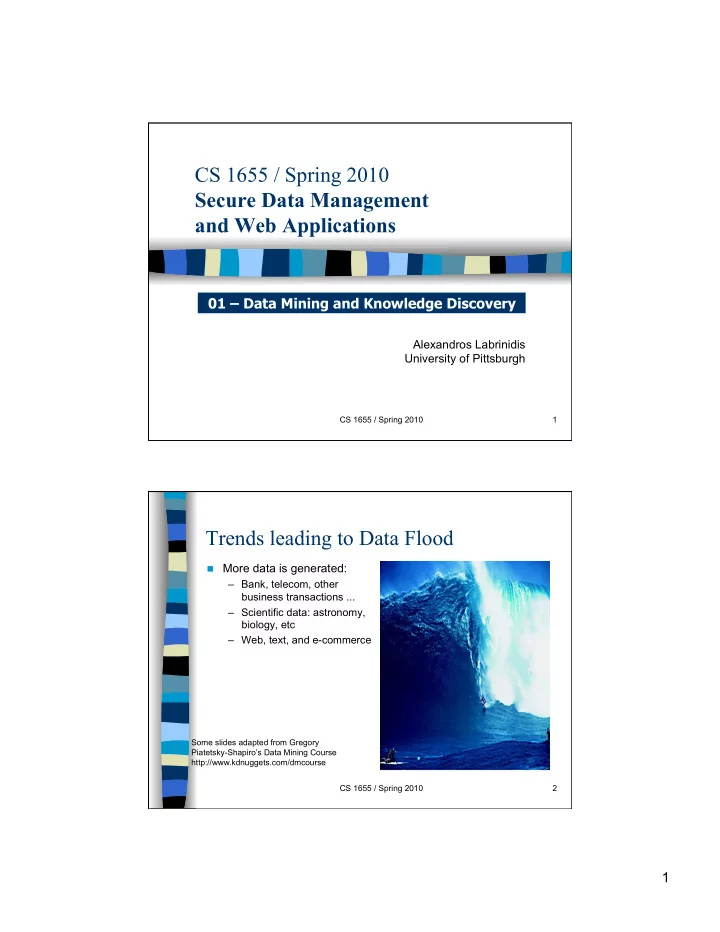
Trends leading to Data Flood

 More data is generated:

– Bank, telecom, other business transactions ... – Scientific data: astronomy, biology, etc – Web, text, and e-commerce

Some slides adapted from Gregory Piatetsky-Shapiro’s Data Mining Course http://www.kdnuggets.com/dmcourse

slide-2
SLIDE 2

2

CS 1655 / Spring 2010 3

Big Data Examples

 Europe's Very Long Baseline Interferometry (VLBI)

has 16 telescopes, each of which produces 1 Gigabit/second of astronomical data over a 25-day

  • bservation session

– storage and analysis a big problem – Other: lsst.org, Large Hardon Collider  AT&T handles billions of calls per day – so much data, it cannot be all stored -- analysis has to be done “on the fly”, on streaming data

CS 1655 / Spring 2010 4

Largest databases in 2003

 Commercial databases: – Winter Corp. 2003 Survey: France Telecom has largest decision-support DB, ~30TB; AT&T ~ 26 TB  Web – Alexa internet archive: 7 years of data, 500 TB – Google searches 4+ Billion pages, many hundreds TB (Jan 2005: 8 Billion) – IBM WebFountain, 160 TB (2003) – Internet Archive (www.archive.org),~ 300 TB

slide-3
SLIDE 3

3

CS 1655 / Spring 2010 5

How much data exists?

 UC Berkeley 2003 estimate:

5 exabytes of new data was created in 2002

– exabyte = 1 million terabytes = 1,000,000,000,000,000,000 bytes E….P….T….G.…M….K – digitized Library of Congress (17 million books) is only 136 Terabytes (5 exabytes = 37,000 x LOCs)

– http://www.sims.berkeley.edu/research/projects/how-much-info-2003 CS 1655 / Spring 2010 6

Data Growth Rate

 Twice as much information was created in 2002 as in

1999 (~30% growth rate)

 Other growth rate estimates even higher  Very little data will ever be looked at by a human  Knowledge Discovery is NEEDED to make sense and

use of data.

slide-4
SLIDE 4

4

CS 1655 / Spring 2010 7

Lesson Outline

 Introduction: Data Flood  Data Mining Application Examples  Data Mining & Knowledge Discovery  Data Mining Tasks

CS 1655 / Spring 2010 8

Data Mining Application areas

 Science

– astronomy, bioinformatics, drug discovery, …

 Business

– advertising, CRM (Customer Relationship management), investments, manufacturing, sports/entertainment, telecom, e-Commerce, targeted marketing, health care, …

 Web:

– search engines, bots, …

 Government

– law enforcement, profiling tax cheaters, anti-terror(?)

slide-5
SLIDE 5

5

CS 1655 / Spring 2010 9

DM for Customer Modeling

 Customer Tasks: – attrition prediction – targeted marketing:

  • cross-sell, customer acquisition

– credit-risk – fraud detection  Industries – banking, telecom, retail sales, …

CS 1655 / Spring 2010 10

Customer Attrition: Case Study

Situation: Attrition rate at for mobile phone customers is around 25-30% a year! Task: Given customer information for the past N months, predict who is likely to attrite next month. Also, estimate customer value and what is the cost- effective offer to be made to this customer.

slide-6
SLIDE 6

6

CS 1655 / Spring 2010 11

Customer Attrition Results

 Verizon Wireless built a customer data warehouse  Identified potential attriters  Developed multiple, regional models  Targeted customers with high propensity to accept the

  • ffer

 Reduced attrition rate from over 2%/month to under

1.5%/month (huge impact, with >30 M subscribers)

(Reported in 2003)

CS 1655 / Spring 2010 12

Assessing Credit Risk

 Situation: Person applies for a loan  Task: Should a bank approve the loan?  Note: People who have the best credit don’t need the

loans, and people with worst credit are not likely to

  • repay. Bank’s best customers are in the middle

 This is a big deal - think of how many “you’ve been

approved” spam you are getting :-)

slide-7
SLIDE 7

7

CS 1655 / Spring 2010 13

Credit Risk - Results

 Banks develop credit models using variety of

machine learning methods.

 Mortgage and credit card proliferation are the results

  • f being able to successfully predict if a person is

likely to default on a loan

 Widely deployed in many countries

CS 1655 / Spring 2010 14

Successful e-commerce

 A person buys a book at Amazon.com  Task: Recommend other books (products) this

person is likely to buy

 Amazon does clustering based on books bought: – customers who bought “Advances in Knowledge Discovery and Data Mining”, also bought “Data Mining: Practical Machine Learning Tools and Techniques with Java Implementations”  Recommendation program is quite successful

slide-8
SLIDE 8

8

CS 1655 / Spring 2010 15

Genomic Microarrays

Given microarray data for a number of samples (patients), can we

 Accurately diagnose the disease?  Predict outcome for given treatment?  Recommend best treatment?

CS 1655 / Spring 2010 16

Example: ALL/AML data

 38 training cases, 34 test, ~ 7,000 genes  2 Classes: Acute Lymphoblastic Leukemia (ALL) vs

Acute Myeloid Leukemia (AML)

 Use train data to build diagnostic model

ALL AML

Results on test data: 33/34 correct, 1 error may be mislabeled

slide-9
SLIDE 9

9

CS 1655 / Spring 2010 17

Security and Fraud Detection

 Credit Card Fraud Detection  Detection of Money laundering – FAIS (US Treasury)  Securities Fraud – NASDAQ KDD system  Phone fraud – AT&T, Bell Atlantic, British Telecom/MCI  Bio-terrorism detection at Salt Lake Olympics 2002

CS 1655 / Spring 2010 19

Lesson Outline

 Introduction: Data Flood  Data Mining Application Examples  Data Mining & Knowledge Discovery  Data Mining Tasks

slide-10
SLIDE 10

10

CS 1655 / Spring 2010 20

Knowledge Discovery Definition

Knowledge Discovery in Data is the non-trivial process of identifying

– valid – novel – potentially useful – and ultimately understandable patterns in data. from Advances in Knowledge Discovery and Data Mining, Fayyad, Piatetsky-Shapiro, Smyth, and Uthurusamy, (Chapter 1), AAAI/MIT Press 1996

CS 1655 / Spring 2010 21

Related Fields Statistics

Machine Learning

Databases Visualization

Data Mining and Knowledge Discovery

slide-11
SLIDE 11

11

CS 1655 / Spring 2010 22

Statistics, ML and DM

Statistics:

– more theory-based – more focused on testing hypotheses

Machine learning

– more heuristic – focused on improving performance of a learning agent – also looks at real-time learning and robotics – areas not part of data mining

Data Mining and Knowledge Discovery

– integrates theory and heuristics – focus on the entire process of knowledge discovery, including data cleaning, learning, and integration and visualization of results

Distinctions are fuzzy

witten&eibe

CS 1655 / Spring 2010 23

Historical Note: Many Names of Data Mining

 Data Fishing, Data Dredging: 1960- – used by Statistician (as bad name)  Data Mining :1990 -- – used DB, business – in 2003 – bad image because of TIA  Knowledge Discovery in Databases (1989-) – used by AI, Machine Learning Community

 also Data Archaeology, Information Harvesting, Information

Discovery, Knowledge Extraction, ...

Currently: Data Mining and Knowledge Discovery are used interchangeably

slide-12
SLIDE 12

12

CS 1655 / Spring 2010 24

Lesson Outline

 Introduction: Data Flood  Data Mining Application Examples  Data Mining & Knowledge Discovery  Data Mining Tasks

CS 1655 / Spring 2010 25

Major Data Mining Tasks

 Classification: predicting an item class  Clustering: finding clusters in data  Associations: e.g. A & B & C occur frequently

 Visualization: to facilitate human discovery

 Summarization: describing a group

 Deviation Detection: finding changes  Estimation: predicting a continuous value  Link Analysis: finding relationships  …

slide-13
SLIDE 13

13

CS 1655 / Spring 2010 26

DM Tasks: Classification

Learn a method for predicting the instance class from pre-labeled (classified) instances Many approaches: Statistics, Decision Trees, Neural Networks, ...

CS 1655 / Spring 2010 27

Data Mining Tasks: Clustering

Find “natural” grouping of instances given un-labeled data

slide-14
SLIDE 14

14

CS 1655 / Spring 2010 28

Summary:

 Technology trends lead to data flood – data mining is needed to make sense of data  Data Mining has many applications, successful and

not

 Knowledge Discovery Process  Data Mining Tasks – classification, clustering, …

CS 1655 / Spring 2010 29

More on Data Mining and Knowledge Discovery KDnuggets.com

 News, Publications  Software, Solutions  Courses, Meetings, Education  Publications, Websites, Datasets  Companies, Jobs  …