
SLIDE 1
1
Cryptography and Network Security Chapter 3
Fifth Edition by William Stallings Lecture slides by Lawrie Brown
Chapter 3 – Block Ciphers and the Data Encryption Standard
All the afternoon Mungo had been working on Stern's code, principally with the aid of the latest messages which he had copied down at the Nevin Square drop. Stern was very confident. He must be well aware Stern was very confident. He must be well aware London Central knew about that drop. It was obvious that they didn't care how often Mungo read their messages, so confident were they in the impenetrability of the code. —Talking to Strange Men, Ruth Rendell
Modern Block Ciphers
- now look at modern block ciphers
- one of the most widely used types of
cryptographic algorithms
- id
/ h i i i
- provide secrecy /authentication services
- focus on DES (Data Encryption Standard)
- to illustrate block cipher design principles
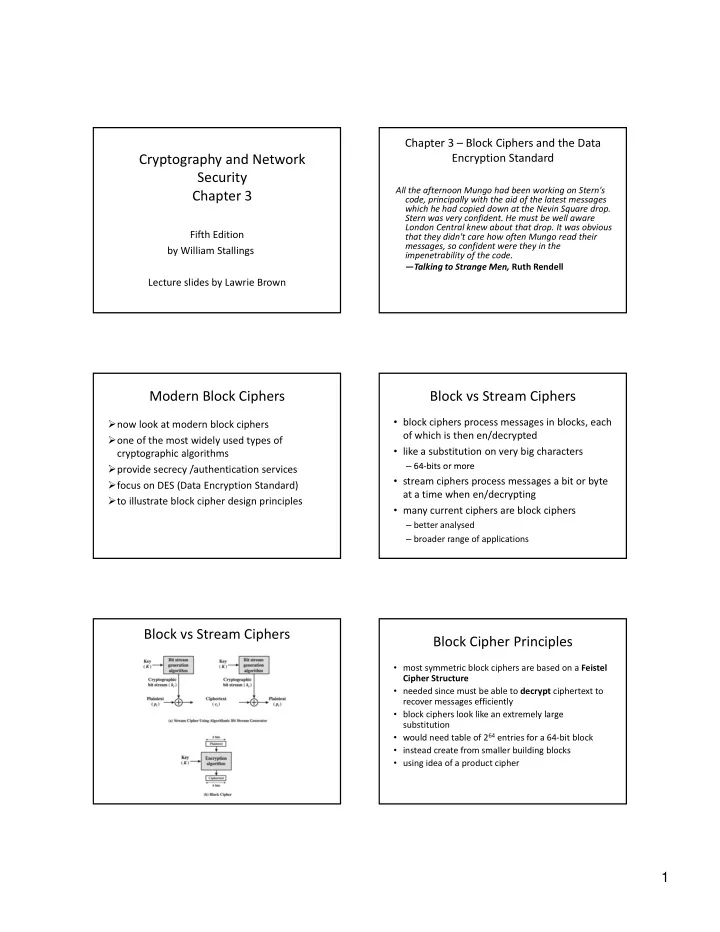
Block vs Stream Ciphers
- block ciphers process messages in blocks, each
- f which is then en/decrypted
- like a substitution on very big characters
64 bits or more – 64‐bits or more
- stream ciphers process messages a bit or byte
at a time when en/decrypting
- many current ciphers are block ciphers
– better analysed – broader range of applications
Block vs Stream Ciphers Block Cipher Principles
- most symmetric block ciphers are based on a Feistel
Cipher Structure
- needed since must be able to decrypt ciphertext to
recover messages efficiently bl k i h l k lik l l
- block ciphers look like an extremely large
substitution
- would need table of 264 entries for a 64‐bit block
- instead create from smaller building blocks
- using idea of a product cipher