
SLIDE 1
1
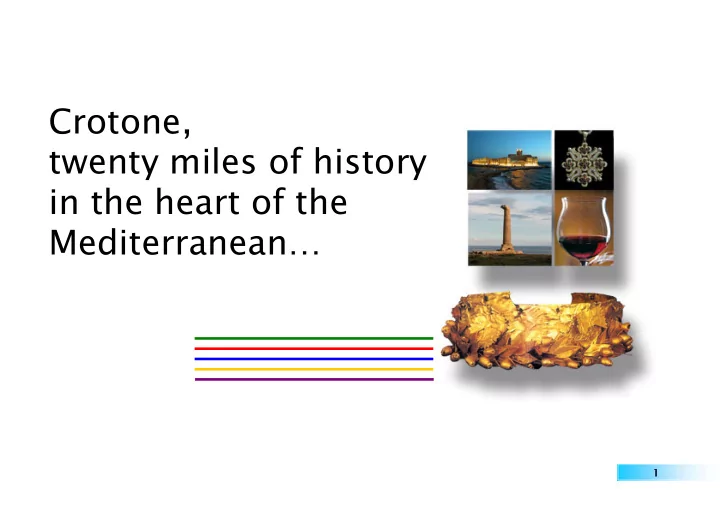
Crotone, twenty miles of history in the heart of the Mediterranean - - PowerPoint PPT Presentation
Crotone, twenty miles of history in the heart of the Mediterranean 1 The Port of Crotone - Location History, culture, fine food and wines make of Crotone and its neighbouring area a worthwhile stop. Its visitors will discover the ruins of
1
2
History, culture, fine food and wines make of Crotone and its neighbouring area a worthwhile stop. Its visitors will discover the ruins of the ancient Greek-Roman settlement and worship place, the Aragonian fortifications and the medieval city centre, testifying 2700 years of history. . Crotone is located on the east coast of Calabria, in Southern Italy, just along the route from the Adriatic to the Tyrrhenian Sea. Moreover, the port of Crotone is situated in front of Greece, with the nearest Greek island being 125 marine miles away. Latitude 39° 05’ N Longitude 17° 08’ E The port of Crotone is approximately 230 marine miles far from Bari 476 marine miles far from Santorini 162 marine miles far from Corfu 253 marine miles far from Palermo 321 marine miles far from Naples 546 marine miles far from Venice 228 km far from Reggio Calabria 250 km far from Taranto There are two airports close to Crotone
The port is divided into two (adjacent but not communicating) docks known as the “North Dock” and the “South Dock”. The former is used for commercial traffic, opens towards the northwest, and is 200 metres (65.50 ft) wide with a sounding depth of approximately 9 metres (29.50 ft). The latter is designated as a tourist and fishing port, with an opening towards the south-southwest, 50 metres (164 ft) in width, with 2.5-metres sounding depths.
3
The story of Crotone takes its roots in the VIII century B.C., when it was founded with the name of Kroton by Greek settlers who found a mild climate and a fertile land, as well as a strategic position on the Ionian Sea, that still makes the city a crucial point in the Mediterranean. Crotone and its hinterland offer still intact and extremely varied natural landscapes, going from the mountains of the Sila National Park to the unspoilt sea of "Capo Rizzuto" Marine Protected Area with its rare wildlife. It is during the Magna Graecia period (VII-I BC), that Crotone inherited the unique privilege
taking
the role
guardian of the history of this civilization. Even today, wherever
excavates, it is possible to uncover remains from the Greek age which saw Crotone at the height of its splendour in the 5th century BC. During the course
the centuries Crotone has been home to several Mediterranean people, such as the Oenotrians, the Greeks, the Romans, the Byzantines, the Bruttii as well as of Franco-German origin, such as the Normans, the Suebi, the Angioins and the Bourbons. These populations, founders of western and Mediterranean civilization, have left visible traces of their greatest and culture. The stratification of the territory makes it possible to trace, at different depths, testimony to the different historic phases which have passed Crotone. The plan which privileged this area was not simply of a strategic character for the military defence of the coasts, but also for the environmental and cultural profile which characterize this territory.
4
Situated at the feet of the Charles V Castle and the old town, the port embraces part of the residential and commercial centre, which is easily and quickly reachable on
by car, including Sant’Anna Airport, located just 16 km away.
Area North Dock – 88 hectares; South Dock – 6.5 hectares Average depth 9 m Piers Length (m) Sounding Depth (m) Molo Giunti (Port) 170 8.5 Molo Foraneo (Port) 300 6 Spezzato Shore (Pier) 88 8 Banchina di Riva (Pier) 430 8.5 Molo di Sottoflutto (Port) 400 10 Molo di Sottoflutto (Port) – Pier 14 209 10 Molo di Sottoflutto (Port) – Pier 15 264 10 Total length of the piers (m) 2650 m Width of the piers (m) from 40 m to 250 m Number of docking sites Approximately 12 for ships measuring up to 100 metres. Opening hours 24/7 Maximum stopover Unlimited Maximum ship dimensions Length (m) 300 Width (m) 45 Load draught (m) 10 Turning basin (m) 400 Anchorage Availability
Passenger transportation craft
Navigation required
Tugboats available
Climate Prevailing winds NE/SW Sea flow/limit m Average: 0.3. Maximum range: 0.8 (January / February)
5
Services Refueling
Waste removal
Bunker provisions
Water
Supplies
Storage containers
Parking 3,300 m2 Captains 1 Tugboat operators 2 Mooring personnel 3 Boatmen 1 Maritime health authority
Veterinarian
Ecological services
Piers for cruise traffic North Dock Length Sounding depth Distance to main square C A: Banchina di Riva 430 m 8.5 m 800 m B: Molo di Sottoflutto 400 m 10 m 1,800 m North Dock details Port entrance width: 200 m Sounding depth: 8,8 m Normally the anchorage sea currents head in a NORTH-SOUTH (180°) direction. The current from north to south reaches a maximum speed of 0.4/0.5 knots, whereas from south to north the currents are NN. Within the port, the current is influenced by tide or wind and can reach speeds of 0.5 knots at the port entrance, and 0.3 inside the port.
6
Average data °C max °C min Precipitation mm Sunshine hours/day Prevailing Winds-knots January 13 6 90 4 NNE-8.5 February 13 6 55 5 NNE-8.5 March 15 7 75 6 SSW-8 April 18 9 39 7 SSW-8.5 May 23 12 25 8 SSW-8.5 June 27 16 8 9 SSW-8.5 July 31 20 11 10 NNE-8.5 August 30 20 18 9 S-8.5 September 27 17 48 8 NNE-8.5 October 22 14 103 6 NNE-8.5 November 17 10 106 5 NNE 8.5 December 14 7 104 4 NNE 8
22 23 27 3 1 3 0 2 7 14 13 13 15 18 17 6 6 7 9 12 16 2 0 20 17 14 10 7
Jan Feb Mar Apr May Jun Jul Aug Sep Oct Nov Dec
° C max ° C min
90 55 75 39 25 8 11 18 48 103 106 104 Jan Feb M ar Apr M ay Jun Jul Aug Sep Oct Nov Dec
Precipitation m m
7
Archaeological Sites
A number of traces bear witness to the Magna Græcia period, possibly the most fruitful that Crotone has ever known, during which the mathematician Pythagoras of Samo chose the city as the site for his school.
Art
Crotone, with its old town and the Castle of Charles V; Santa Severina, named among the most beautiful Italian villages; San Giovanni in Fiore, famous for its abbey and its founder Gioacchino da Fiore; and finally Le Castella, an ancient fishing village well known for its fortress that sits on a small islet anchored to the shore by a strip of land.
Sea protected Area
The coastline stretching between Capo Colonna and Le Castella is truly spectacular, so rich in history and nature, with sea colours going from sky blue to emerald green, that in 1991 was declared a protected marine reserve. With an area of about 15,000 hectares, it is the largest in Italy.
Wineries
One of the best-known local products is wine, especially the “D.O.C.” Cirò one, known as “wine of the gods”, as it was offered to the Olympic champions as a prize.
Mountains
The Calabrian mountains can be identified with the vast plateau at the centre
characterized by the larician pine, a soaring, tall tree that recalls the gentle wilderness of the Alps.
8
Archaeological Sites Historic Sites Sea protected Area Wineries Mountains
9
Total inhabitants: approx. 60,000 It can be visited in 3 hours Croton was long one of the most flourishing cities of Magna Graecia. According to the historian Herodotus, the physicians of Crotone were considered the foremost among the
Piazza Pythagoras is the most important square of Crotone and a meeting point for
through Via Vittorio Veneto we arrive in Piazza Duomo where the magnificent cathedral dating from the IX century is located. CATHEDRAL: it has a neo-classical façade; the interior has a nave with two aisles and Baroque decorations. Noteworthy are a baptismal font (XII century) and the Madonna di Capo Colonna painting, the icon of the “Black Madonna” which, according to the tradition, was brought from the East in the first years of the Christian era.
Clares convent. The church is charcaterised by a beautiful Neapolitan majolica floor and a precious wooden crucifix from the XVIII century. CHARLES V CASTLE: the castle stands in a imposing position in the highest point of the town, thus able to keep guard over the sea and the surrounding countryside. Today, it represents an enlarged reconstruction of the old, Medieval castle with the various modifications carried
THE NATIONAL ARCHAEOLOGICAL MUSEUM: it is situated near the medieval castle and holds all the most significant finds coming from the archaeological areas of Crotone, especially Capo Colonna. Of great interest is the section dedicated to the so-called “treasure of Hera Lacinia”, with votive objects of extremely high artistic value, found in the sanctuary bearing the same name. Historic Sites
10
The crotonese craft is particuary known for its skilled goldsmiths, who create magnificent jewels, often inspired by the Greek and Byzantine style.
The short distance between the pier and downtown allowing anyone for a pleasant walk. The suggested path, starting directly from the port (A), is about 3 km (1.80 Mi) and takes approximately 3 hours. A PIER FOR CRUISE TRAFFIC B CHARLES V CASTLE C NATIONAL ARCHAEOLOGICAL MUSEUM D
E CATHEDRAL F PIAZZA PYTHAGORAS G CITY BEACH
11
Crotone’s coastline offers a great variety of places to enjoy the Ionian Sea. The costal area is, in fact, characterised by alternating large and small headlands and bays, wide sandy beaches and sea cliffs.
12
Delicious homemade ice cream in one
“Cavateddri alla Crotonese”, homemade pasta, served with a rich pork-based ragout sauce. A walk through the colours and the perfumes of the city market near Piazza Pythagoras. “Sardella with onion”, a typical and tasty appetiser made
bread. Italian cuisine classes or wine and food tastings can be arranged in any location (in a historic site, a winery as well as in a restaurant).
13
Downtown in Crotone, taking a walk from piazza Pitagora and following Via Vittorio Veneto you can meet some of the best shops
Goldsmith’s art is the flagship of the local handicrafts, often inspired by its Greek and the Byzantine roots. Some of the master goldsmith are very famous, and their masterpieces are renowed for their artistic value and appreciated by critics in the jewellery field. Lots of VIP clients, around the world, appreciate and own these creations.
14
Distance: 30 km from Crotone Total time by bus: 60 mins Total inhabitants: approx. 2,300 It can be visited in 3 hours Known as the “Stone Ship” because it clings imposingly to a tufa rock buttress overlooking the Neto river valley, the medieval “borgo” (village) of Santa Severina is listed among “The most beautiful villages in Italy” and renowned for the wonderful Carafa fortress. The castle is composed by a 15th-century square keep with four angular towers and the same number of jutting bastions. It is surrounded by a moat and encircling walls, with a section that offers examples of different types of crenellation (Byzantine, Norman and Suevian) The elegant salons are ornated with stuccoes and paintings by Francesco Giordano. Even the archaeological museum housed within it chronicles the historical evolutions of the castle and the town. From the 9th to the 11th century the town lived its period of greatest splendour: the Baptistery, which is accessed via a little door in the Cathedral, is the oldest Byzantine monument in Calabria: built between the 8th and the 9th century on a circular base with a Greek cross, it was
The Church of Saint Filomena, an interesting example of Byzantine-Norman architecture, is an 11th century construction with a small dome decorated with little columns (a typical pattern in Armenian buildings). What was once the Church of the Pozzoleo has been restored, and today holds the crypt of Saint Filomena. It once held a beautiful holy-water font made of Parian marble, now in the interesting Diocesan Museum, situated alongside of the cathedral. The Carrafa castle can be the magnificent location for cocktails and tasting of local products, as well as for any kind of events such concerts and stage shows. Historic Sites
15
Distance: 28 km from Crotone Total time by bus: 50 mins Total inhabitants: approx. 1,000 It can be visited in 2 hours Upon entering the ancient fishing village located about 20 km from Crotone, you will immediately see
castle, the view becomes even more spectacular, as the castle sits on a small islet anchored to the shore by a tiny strip of land. The fortress is on an irregular layout and was likely built by the Aragonese around an existing Angevin fortification, even though its initial construction has been dated back to 204 B.C. The island-fortress of Le Castella is particularly enchanting at night, because of the way lights play
Historic Sites
16
Distance: 53 km from Crotone Total time by bus: 1 h 40 mins Total inhabitants: approx. 18,000 It can be visited in 3 hours
centre of the Sila Plateau, with active handicraft, commercial and tourism initiatives. The town has illustrious origin, being the site where Gioacchino Da Fiore in 1189 established his monastery, around which the village gradually developed. The monastery and the cloister in addition to the abbey, founded in 1185, have been almost completely restored. In the crypt there are the remains of the Abbot, the remains of the cells, and fine 17th century wooden choir stalls. Three sculptured stone portals from the 17th century are incorporated into the main church which contains a fine baptismal font of the same period. There is a Museum in the left nave of the Abbey covering an area of over 1,ooo m2 with numerous sections displaying an interesting series of local utensil and an impressive photographic collection of S. Giovanni in Fiore and the Sila. Historic Sites
17
Distance: 13 km from Crotone Total time by bus: 30 mins It can be visited in 2 hours Symbol of the city’s millenary history, the Doric column erected on the Capocolonna promontory (at about 13 km from the centre of Crotone) carries an echo of the splendour of the Magna Græcia period. It is the only remaining column of the temple dedicated to the goddess Hera. Dating back to the 6th century B.C., it was one of the most important religious locations in Magna Græcia, upon which today stands Capocolonna Archaeological Park. The Park is made of roughly 30,000 square meters of terrain allocated for excavations which brought to light the foundations of different buildings and domestic locations, along with 20 hectares of Mediterranean woods in which are present pleasant natural trails that lead from the museum to the column. In the Park is situated the magnificent museum built into the earth, to limit its environmental impact. Divided into three sections (“The Earth,” “The Sacred,” and “The Sea”), the Capocolonna Archaeological Museum gathers together artefacts found underwater, votive objects and parts of the temple. Archaeological Sites
18
Distance: 28 km from Crotone Total time by bus: 50 mins It can be visited in 3 hours The colour of the sea changes from sky blue to emerald green and the coast, rich in history and nature, is so spectacular that in 1991 was declared a marine protected area. The marine reserve of “Capo Rizzuto” stretches along the coast for 42 km, covering an area of about 15,000 hectares, which make it the largest in Italy. Eight promontories mark the reserve’s boundaries. The first of which is Capo Colonna, moving further along, you reach the Punta Le Castella, the last bulwark of the reserve, with its Aragonian castle, situated on an island, birthplace to Ugurk-Ali, who later became commander of the imperial fleet of Constantinople. On board of a glass-bottomed boat it is possible to admire the spectacular seabed. A unique experience, rocked by the waves while watching the immense meadows of “Posidonia Oceanica” seagrass, inhabited by multicoloured fish. Aquarium and CEAM (environmental education centre): Located in Capo Rizzuto vilage, the Aquarium houses 22 tanks with a total capacity of about 20.000 litres; inside you can admire the flora and fauna of the protected area, it is in itself a miniature reserve in which the marine habitat has been faithfully recreated, completely respecting the organisms present. There is also a laboratory dedicated to the Aquarium’s younger guests, with the aim of learning about marine biology and ecology. The Aquarium is also rescue centre for loggerhead ses turtles. Sea protected Area
19
Distance: 38 km from Crotone Total time by bus: 1 h 20 mins It can be visited in 3 hours Getting to know Crotone does not just mean admiring its cultural and natural heritage but also discovering the delicious flavours and scents of its local cuisine. One of its best-known products is its wine, especially the “D.O.C.” from Cirò and Melissa, and the “I.G.T” Val di Neto wines. The grape-growing tradition has ancient roots: back in the time of Magna Græcia, Cirò, the “wine of the gods”, was proffered to Olympic champions after the games. The Cirò’s wine-makers usually hold wine tastings in their wineries, as well as guided tours in their vineyards. Such events give the chance to learn more about
important ingredients of the local cuisine. First of all the olive oil, whose tradition is also fairly ancient; nowadays the “D.O.P. Alto Crotonese” extra-virgin olive oil is quite highly considered. The delicious local cold cuts (sausages, soppressata and capocollo) are spiced with hot chilli peppers, added to better preserve the meat and enhance its flavour. From the black pork of Calabria comes a variety of delicacies for sophisticated palates.The various sheep pastures provide the ingredients for the Crotonese pecorino cheese and salted ricotta, perfect for grating on top of the locally produced “covatelli” pasta with meat sauce. The wheat bread is excellent too, especially the one produced in the Cutro bakeries, and goes well with local pâtés and sauces such as ““sardella”, made with whitebait (sardines), chilli pepper and wild herbs. Wineries
20
Distance from Crotone: Camigliatello (B) 77 km, Trepidò (C) 40 km Total time by bus: Camigliatello 2 h 30 min, Trepidò 2 hrs It can be visited in 4 hours The port of Crotone is one of the few places that, thanks to the short distance, offers the chance to reach the mountains so easily and comfortably. The Calabrian Mountains can be identified with the vast plateau at the centre of the region, with peaks that hit the 2000-meter mark. The Silan landscape is characterized by the larician pine, a soaring, tall tree that recalls the gentle wilderness of the Alps. Camigliatello and Trepidò are the main Silan towns quickly reachable from Crotone, positioned near the enchanting mountain lakes, all waiting to be discovered. During the winter, there are a number
Fallistro Wood represents a natural monument, really unique in his kind. Here you can find a grouped presence of about 50 enormous specimens of larch-trees and mountain maples with a 40 metre height, with a two metre diameter and an age of about 400 years. This is the last surviving example of a primitive forest named "The Sila's Giants". Mountains