Cross-lingual similarity calculation for plagiarism detection and - - PDF document

cross lingual similarity calculation for plagiarism
SMART_READER_LITE
LIVE PREVIEW

Cross-lingual similarity calculation for plagiarism detection and - - PDF document

Cross-lingual similarity calculation for plagiarism detection and more Tools and resources Ralf Steinberger European Commission Joint Research Centre (JRC) http://langtech.jrc.ec.europa.eu/ PAN-CLEF, Rome, Italy, 19 September 2012


slide-1
SLIDE 1

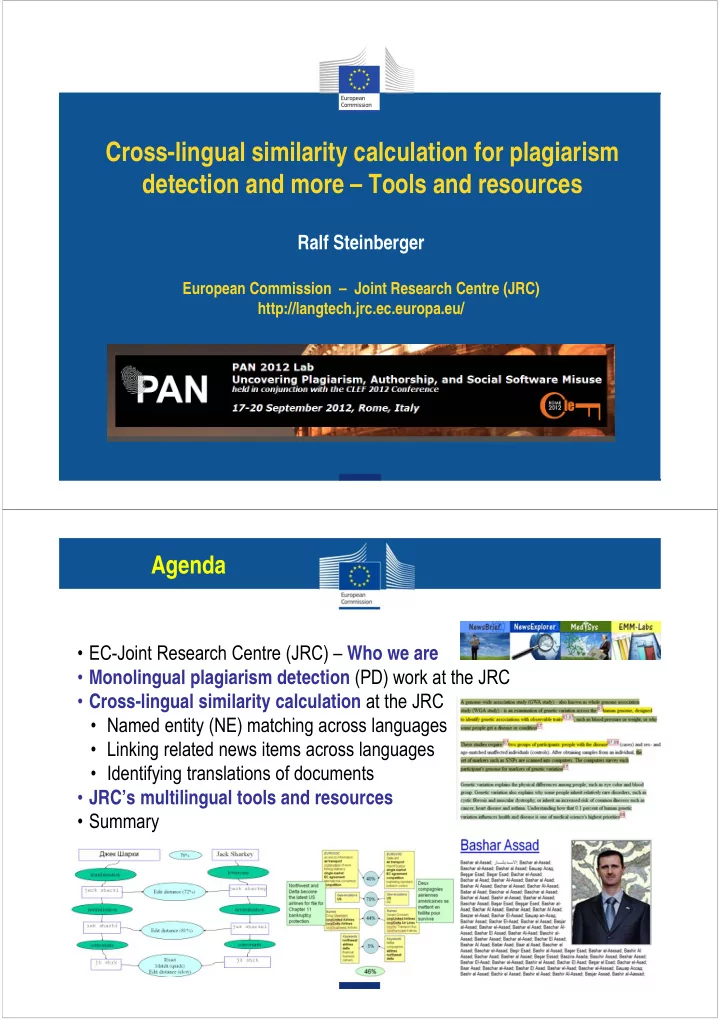
Cross-lingual similarity calculation for plagiarism detection and more – Tools and resources

Ralf Steinberger

European Commission – Joint Research Centre (JRC) http://langtech.jrc.ec.europa.eu/

PAN-CLEF, Rome, Italy, 19 September 2012

Agenda

  • EC-Joint Research Centre (JRC) – Who we are
  • Monolingual plagiarism detection (PD) work at the JRC
  • Cross-lingual similarity calculation at the JRC
  • Named entity (NE) matching across languages
  • Linking related news items across languages
  • Identifying translations of documents
  • JRC’s multilingual tools and resources
  • Summary
slide-2
SLIDE 2

JRC - Who we are

  • European Commission

(scientific-technical arm of public administration)

  • Non-commercial
  • Multi-disciplinary / multilingual
  • Main product: Europe Media Monitor (EMM)
  • ~ 150,000 online news articles / day in ~ 50 languages
  • ~ 3600 Sources (world-wide, with focus on Europe)
  • In-depth analysis in 20 languages (NewsExplorer)
  • 24/7, updated every 10 minutes
  • Freely accessible via http://emm.newsbrief.eu/overview.html
  • Articles are fed into the various EMM applications:

Europe Media Monitor EMM – A few facts

slide-3
SLIDE 3

Agenda

  • EC-Joint Research Centre (JRC) – Who we are
  • Monolingual plagiarism detection (PD) work at the JRC
  • Cross-lingual similarity calculation at the JRC
  • Named entity (NE) matching across languages
  • Linking related news items across languages
  • Identifying translations of documents
  • JRC’s multilingual tools and resources
  • Summary

Monolingual PD work

  • N-gram overlap between pairs of documents
  • Karp-Rabin algorithm, using word 5-grams
  • to weed out duplicates in the IAEA document database (ca. 350K documents)
  • to find news article near-duplicates in EMM (applied to all news clusters)

at the JRC (1)

slide-4
SLIDE 4

Detection of verbatim plagiarism in research deliverables of EC-funded projects.

  • Method: Search for longest (in chars) word 6-grams of each document in EC database and
  • n the web (avoiding strings from document template)
  • If target documents pass similarity threshold:
  • Full-text comparison of matching documents to detect significant matches
  • Visualise document overlap and manually check.
  • Contact: Charles Macmillan

Monolingual PD work

at the JRC (2)

Agenda

  • EC-Joint Research Centre (JRC) – Who we are
  • Monolingual plagiarism detection (PD) work at the JRC
  • Cross-lingual similarity calculation at the JRC
  • Named entity (NE) matching across languages
  • Linking related news items across languages
  • Identifying translations of documents
  • JRC’s multilingual tools and resources
  • Summary
slide-5
SLIDE 5

Cross-lingual similarity

Entity names

Cross-lingual similarity

Entity names (2)

slide-6
SLIDE 6

asesinato del exprimer ministro Rafic al-Hariri, que la oposición atribuyó

es

l'assassinat de l'ex-dirigeant Rafic Hariri et le départ du chef de la diplom

fr

na de moord op oud-premier Rafiq al-Hariri gingen gisteren bijna een

nl

libanesischen Regierungschef Rafik Hariri vor einem Monat wichtige B

de

danjega libanonskega premiera Rafika Haririja. Libanonska opozicija si

sl

möödumisele ekspeaminister Rafik al-Hariri surma põhjustanud pommipl

et

death of former Prime Minister Rafik Hariri, blamed by many opposition

en

لايتغاقباسلا ءارزولا سيئر يريرحلا قيفر اقباس ثدح امو ةيدوھي دايأب

ar

Бывший премьер-министр Ливана Рафик Харири, который

ru

Multilingual NER Merging name variants

20% + 80% Condition:

  • For all newly found name forms, detect whether

they are a variant of an existing NE:

  • Transliteration;
  • Normalisation, using ~30 hand-written rules and removing vowels;
  • Calculate similarity (threshold: 94%).
  • Below threshold new entity
slide-7
SLIDE 7
  • For frequent or highly visible names, manually launch a Wikipedia mining process.
  • Check for each variant of a name whether there is a Wikipedia entry.
  • New name variants, in all scripts, will be recognised in new EMM articles.

Хамид Карзай Hamid Karzai Hamid Karzaï Hamid Karsai يازرك دماح हािमद करजई 哈米德·卡尔扎伊

http://en.wikipedia.org/wiki/Hamid_Karzai

Add Wikipedia variants

Name variant list, including across scripts, and software to recognise names in text JRC-Names Freely available resource

slide-8
SLIDE 8

Agenda

  • EC-Joint Research Centre (JRC) – Who we are
  • Monolingual plagiarism detection (PD) work at the JRC
  • Cross-lingual similarity calculation at the JRC
  • Named entity (NE) matching across languages
  • Linking related news items across languages
  • Identifying translations of documents
  • JRC’s multilingual tools and resources
  • Summary

live

Cross-lingual similarity

Documents

slide-9
SLIDE 9

Cross-lingual similarity

Documents (2)

  • How to find out whether two texts in different languages are related?
  • Most common approach: use MT or bilingual dictionaries to translate into English,

then use monolingual methods to calculate similarity.

  • Using MT (e.g. Leek et al. 1999, Pinto et al. 2009);
  • Using bilingual dictionaries (e.g. Wactlar 1999, Urizar & Loinaz 2007)
  • Automatically produce bilingual word associations for bilingual document representation

and document similarity calculation, e.g.

  • Bilingual Lexical Semantic Analysis (LSA)

(Landauer & Littman 1991)

  • Kernel Canonical Correlation Analysis (KCCA)

(Vinokourov et al. 2002)

  • Place documents in reference to position in comparable text collections (e.g. Wikipedia)
  • Cross-lingual Explicit Semantic Analysis (CL-ESA)

(Potthast et al. 2008) + Achieved results are relatively good

  • Bilingual approach is restricted to a few languages

Language pairs = N * (N -1) / 2 (N = number of languages) 20 NewsExplorer languages 190 language pairs (380 language pair directions)!

DE FR

Introduction

Cross-lingual Doc. Sim.

slide-10
SLIDE 10
  • Alternative: use language-independent anchors:
  • Names of persons and organisations
  • Names of locations
  • Units of measurements:
  • Time
  • Speed
  • Temperature
  • Acceleration
  • Multilingual specialist dictionaries (Eurovoc for public administration, MeSH for medicine,

etc.)

  • Normalise these expressions

Use as kind of an interlingua; no language pair-specific resource needed

  • Similarly: Gupta et al. (2012) use Eurovoc and named entities

DE FR

Our approach

Cross-lingual Doc. Sim.

Language-independent features for multilingual document representation No MT or bilingual dictionaries 20 languages

Sim1 (40%): Multilingual Eurovoc subject domains Sim2 (30%): Geo-locations Sim3 (20%): Names + variants Sim4 (10%): Cognates and numbers (without country score)

CLDS = α·S1 + β·S2 + γ·S3 + δ·S4

CL Document Similarity

Language-independent anchors

slide-11
SLIDE 11

CL document similarity

  • Task: evaluate manually the automatically

proposed cross-lingual (CL) links

  • At various similarity threshold levels
  • ~25% of EN clusters had no cl links in FR and IT;
  • Only highest-scoring link was evaluated;
  • 30% threshold was finally chosen

to ensure good Recall.

Evaluation

JRC EuroVoc Indexer JEX

  • JEX is multilingual multi-label classification software
  • Using the controlled vocabulary from EuroVoc (>6,000 classes)
  • EuroVoc (http://eurovoc.europa.eu/)
  • is used for manual indexing

by parliamentary libraries in EU institutions and in many EU countries

  • Exists in 22 official EU languages plus Basque, Catalan, Croatian, Russian and Serbian
  • JEX is freely downloadable from http://langtech.jrc.ec.europa.eu/Eurovoc.html;
  • Readily trained for 22 languages
  • JEX includes software to re-train the system
  • Training data is included in the release;
  • Allows you to run your own experiments and compare results / improve.
  • You can train on your own data, using other thesauri.

ML EuroVoc Indexing

slide-12
SLIDE 12

JRC EuroVoc Indexer

  • Method: Profile-based category-ranking
  • E.g. Result for a document with the title:

Legislative resolution embodying Parliament's opinion on the proposal for a Council Regulation amending Regulation No 2847/93 establishing a control system applicable to the common fisheries policy

JEX (2)

Evaluation: P, R, F1 at rank 6.

  • E.g. profile for the EuroVoc category

FISHERY MANAGEMENT

JEX evaluation for 22 languages

slide-13
SLIDE 13

Agenda

  • EC-Joint Research Centre (JRC) – Who we are
  • Monolingual plagiarism detection (PD) work at the JRC
  • Cross-lingual similarity calculation at the JRC
  • Named entity (NE) matching across languages
  • Linking related news items across languages
  • Identifying translations of documents
  • JRC’s multilingual tools and resources
  • Summary

Task: find Spanish translations of English source document in a parallel text collection by calculating the cosine similarity between document’s EuroVoc vectors. En Es Is the document’s translation the most similar document in the other language? Precision at rank 1.

Translation spotting

using EuroVoc indexing

slide-14
SLIDE 14
  • Setting a threshold, juggling Precision and Recall
  • Translation spotting

Is there a translation?

Test bed Average similarity Threshold Recall Noise (1-Precision) Set T1 (820) 0.82 0.70 90% 2.2% Set T2 (795) 0.79 0.70 76.5% 5%

  • Searching for a translation where there is none:
  • Searching in T2 for documents of T1

4.15% noise

  • Best threshold depends on:
  • Document set
  • Requirement: high recall or high precision?
  • Agenda
  • EC-Joint Research Centre (JRC) – Who we are
  • Monolingual plagiarism detection (PD) work at the JRC
  • Cross-lingual similarity calculation at the JRC
  • Named entity (NE) matching across languages
  • Linking related news items across languages
  • Identifying translations of documents
  • JRC’s multilingual tools and resources
  • Summary
slide-15
SLIDE 15
  • Software to multi-label classify documents according to the multilingual Eurovoc thesaurus:
  • 22 languages, thousands of categories;
  • JEX uses machine learning;
  • Tool can be re-trained on users’ documents, also for non-Eurovoc categories
  • User interface and command-line options
  • Tool is used for cross-lingual linking of news in EMM-NewsExplorer
  • In use by the Spanish Congress of Deputies for interactive indexing since 2006.

JRC Eurovoc Indexer JEX

Freely available resources Name variant list and software to recognise names

  • JRC-Names: a highly multilingual named entity resource

(names and their many spelling variants, including across scripts):

  • Collected by analysing up to 150,000 news articles per day in up to 20 languages

since 2004

  • Augmented with cross-script variants from Wikipedia, resulting in currently:
  • ~500K person and organisation names and their spelling variants
  • In 27 scripts and many more languages

JRC-Names Freely available resources

slide-16
SLIDE 16

Possible uses:

  • Train statistical machine translation software;
  • Train multilingual vector space models (e.g. LSA or KCCA);
  • Derive multilingual dictionaries;

Data already available (22 languages each):

  • JRC-Acquis full-text parallel corpus

(domain: mostly legal; agreements; contracts)

  • DGT-TM

Translation Memory (domain: mostly legal)

  • JEX data

full-text parallel corpus (domain: legislation) Forthcoming (25, 25, 23 languages):

  • EAC-TM

Translation Memory (domain: education and culture)

  • ECDC-TM

Translation Memory (domain: public health and medicine)

  • DGT-Acquis full-text parallel corpus

(domain: legal, administration and more)

  • See: http://langtech.jrc.ec.europa.eu/JRC_Resources.html

Freely available resources Parallel corpora

Meta-data for news clusters and their equivalences in other languages are accessible via RSS.

Accessible resource

multilingual news clusters

slide-17
SLIDE 17

Summary

  • Monolingual plagiarism detection work at the JRC
  • N-gram overlap; varying search and visualisation methods
  • Cross-lingual similarity calculation at the JRC
  • Named entity matching across languages
  • Linking related news items across languages
  • Identifying translations of documents
  • JRC’s multilingual tools and resources
  • JRC-Names – multilingual name variant lists
  • JEX – EuroVoc subject domain classification
  • Parallel corpora: JRC-Acquis and various translation memories
  • Cross-lingual linking of news clusters in NewsExplorer