Cross-diffusion systems with entropy structure Ansgar J ungel - - PowerPoint PPT Presentation

cross diffusion systems with entropy structure
SMART_READER_LITE
LIVE PREVIEW

Cross-diffusion systems with entropy structure Ansgar J ungel - - PowerPoint PPT Presentation

Cross-diffusion systems with entropy structure Ansgar J ungel Vienna University of Technology, Austria asc.tuwien.ac.at/ juengel + oxygen separator graphite Introduction and examples 1 Al Li + Cu Analysis 2 Li +


slide-1
SLIDE 1

Cross-diffusion systems with entropy structure

Ansgar J¨ ungel Vienna University of Technology, Austria asc.tuwien.ac.at/∼juengel

1

Introduction and examples

2

Analysis

3

Boundedness-by-entropy method

4

A nonstandard example

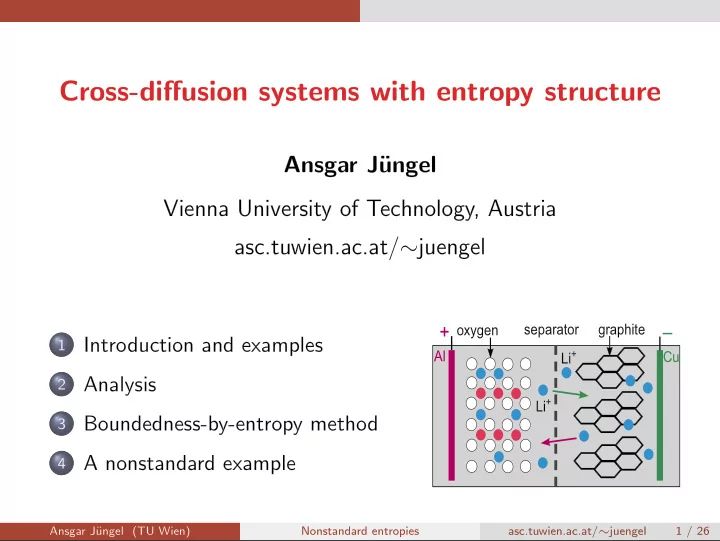
+ –

  • xygen

graphite Li+ Li+ Al Cu separator

Ansgar J¨ ungel (TU Wien) Nonstandard entropies asc.tuwien.ac.at/∼juengel 1 / 26

slide-2
SLIDE 2

Introduction and examples

Multi-species systems

Examples: Wildlife populations Tumor growth Gas mixtures Lithium-ion batteries Population herding Nature is composed of multi-species systems Relative number of publications (in 0.01%):

+ –

  • xygen

graphite Li+ Li+ Al Cu separator Ansgar J¨ ungel (TU Wien) Nonstandard entropies asc.tuwien.ac.at/∼juengel 2 / 26

slide-3
SLIDE 3

Introduction and examples

Modeling of multi-species systems

Particle models: Newton’s laws with interactions among species Markov chains: species move to neighboring cells Stochastic differential equations: using Brownian motion Kinetic equations: distribution function depends on age, size, etc. Here: Diffusive equations for population densities Reaction-diffusion systems: ∂tui − div(Di∇ui) = fi(u) in Ω, t > 0, ui(0) = u0

i ,

no-flux b.c. Flux Di∇ui only depends on ui: Fick’s law not always valid! In multicomponent systems, flux may depend on ∇u1, . . . , ∇un Cross-diffusion systems: ∂tu − div(A(u)∇u) = f (u) in Ω, t > 0, u(0) = u0, no-flux b.c. Meaning: div(A(u)∇u)i = n

j=1 div(Aij(u)∇uj), A ∈ Rn×n, u ∈ Rn

Cross-diffusion may allow for pattern formation

Ansgar J¨ ungel (TU Wien) Nonstandard entropies asc.tuwien.ac.at/∼juengel 3 / 26

slide-4
SLIDE 4

Introduction and examples

Example ➊: Cross-diffusion population dynamics

∂tu − div(A(u)∇u) = f (u) in Ω, t > 0, u(0) = u0, no-flux b.c. u = (u1, u2) and ui models population density of ith species Diffusion matrix: (aij ≥ 0) A(u) = a10 + a11u1 + a12u2 a12u1 a21u2 a20 + a21u1 + a22u2

  • Suggested by Shigesada-Kawasaki-

Teramoto 1979 to model segregation Derivation from on-lattice model Lotka-Volterra functions: fi(u) = (bi0 − bi1u1 − bi2u2)ui Diffusion matrix is not symmetric, generally not positive definite

Figure: Minneapolis-Saint Paul percentage minority population 2010

Ansgar J¨ ungel (TU Wien) Nonstandard entropies asc.tuwien.ac.at/∼juengel 4 / 26

slide-5
SLIDE 5

Introduction and examples

Example ➋: Multicomponent gas mixtures

∂tu − div(A(u)∇u) = f (u) in Ω, t > 0, u(0) = u0, no-flux b.c. Volume fractions of gas components u1, . . . , un, un+1 = 1 − n

i=1 ui

Diffusion matrix for n = 2: δ(u) = d1d2(1 − u1 − u2) + d0(d1u1 + d2u2) A(u) = 1 δ(u) d2 + (d0 − d2)u1 (d0 − d1)u1 (d0 − d2)u2 d1 + (d0 − d1)u2

  • Application: Patients with airways obstruction

inhale Heliox to speed up diffusion Proposed by Maxwell 1866/Stefan 1871 Duncan-Toor 1962: Fick’s law (Ji ∼ ∇ui) not sufficient, include cross-diffusion terms Boudin-Grec-Salvarani 2015: Derivation from Boltzmann equation for simple mixtures

Ansgar J¨ ungel (TU Wien) Nonstandard entropies asc.tuwien.ac.at/∼juengel 5 / 26

slide-6
SLIDE 6

Introduction and examples

Difficulties and objectives

∂tu − div(A(u)∇u) = f (u) in Ω, t > 0, u(0) = u0 Main features: Diffusion matrix A(u) non-diagonal (cross-diffusion) Matrix A(u) may be neither symmetric nor positive definite Variables ui expected to be bounded from below and/or above Objectives: Local-in-time existence and uniqueness of classical solutions Global-in-time existence and uniqueness of weak solutions Positivity and boundedness of solution (if physically expected) Large-time behavior, design of stable numerical schemes Mathematical difficulties: No general theory for diffusion systems Generally no maximum principle, no regularity theory Lack of positive definiteness ⇒ local/global existence nontrivial

Ansgar J¨ ungel (TU Wien) Nonstandard entropies asc.tuwien.ac.at/∼juengel 6 / 26

slide-7
SLIDE 7

Introduction and examples

Overview

1 Introduction and examples 2 Analysis 3 Boundedness-by-entropy method 4 A nonstandard example Ansgar J¨ ungel (TU Wien) Nonstandard entropies asc.tuwien.ac.at/∼juengel 7 / 26

slide-8
SLIDE 8

Analysis

Local existence analysis

∂tu − div(A(u)∇u) = f (u) in Ω ⊂ Rd, t > 0, u(0) = u0 Theorem (Amann 1990) Let aij, fi smooth, A(u) normally elliptic, u0 ∈ W 1,p(Ω; Rn) with p > d. Then ∃ unique local solution u u ∈ C 0([0, T ∗); W 1,p(Ω)), u ∈ C ∞(Ω × [0, T ∗); Rn), 0 < T ∗ ≤ ∞ A(u) normally elliptic = all eigenvalues have positive real parts Linear algebra: If H(u) symmetric positive definite such that H(u)A(u) positive definite then A(u) normally elliptic Application: Let h(u) convex and set H(u) := h′′(u). Then, if f = 0, d dt

h(u)dx =

h′(u) · ∂tudx = −

∇u : h′′(u)A(u)∇u

  • ≥0 if h′′(u)A(u) pos. def.

dx Aim: find a Lyapunov functional (entropy)

  • Ω h(u)dx

Ansgar J¨ ungel (TU Wien) Nonstandard entropies asc.tuwien.ac.at/∼juengel 8 / 26

slide-9
SLIDE 9

Analysis

State of the art

∂tu − div(A(u)∇u) = f (u) in Ω ⊂ Rd, t > 0 Global existence if . . . Growth conditions on nonlinearities (Ladyˇ zenskaya ... 1988) Control on W 1,p(Ω) norm with p > d (Amann 1989) Positivity, mass control, diagonal A(u) (Pierre-Schmitt 1997) Unexpected behavior: Finite-time blow-up of H¨

  • lder solutions (Star´

a-John 1995) Weak solutions may exist after L∞ blow-up (Pierre 2003) Cross-diffusion may lead to pattern formation (instability) or may avoid finite-time blow-up (Hittmeir-A.J. 2011) Special structure needed for global existence theory: gradient-flow or entropy structure

Ansgar J¨ ungel (TU Wien) Nonstandard entropies asc.tuwien.ac.at/∼juengel 9 / 26

slide-10
SLIDE 10

Analysis

Entropy and gradient flows

Entropy: Measure of molecular disorder or energy dispersal Introduced by Clausius (1865) in thermodynamics Boltzmann, Gibbs, Maxwell: statistical interpretation Shannon (1948): concept of information entropy Entropy in mathematics: ∼ convex Lyapunov functional Hyperbolic conservation laws (Lax), kinetic theory (Lions) Relations to stochastic processes (Bakry, Emery) and optimal transportation (Carrillo, Otto, Villani) Gradient flow: ∂tu = −gradH|u on differential manifold Example: Rd with Euclidean structure ⇒ ∂tu = −H′(u) H(u) is Lyapunov functional since ∂tH(u) = −|H′(u)|2 Gradient flow of entropy w.r.t. Wasserstein distance (Otto), entropy H(u) =

  • u log udx: ∂tu = div(u∇H′(u)) = ∆u

Ansgar J¨ ungel (TU Wien) Nonstandard entropies asc.tuwien.ac.at/∼juengel 10 / 26

slide-11
SLIDE 11

Analysis

Gradient flows: Cross-diffusion systems

Main assumption ∂tu − div(A(u)∇u) = f (u) possesses formal gradient-flow structure ∂tu − div

  • B∇ grad H(u)
  • = f (u),

where B is positive semi-definite, H(u) =

  • Ω h(u)dx entropy

Equivalent formulation: grad H(u) ≃ h′(u) =: w (entropy variable) ∂tu − div(B∇w) = f (u), B = A(u)h′′(u)−1 Consequences:

1 H is Lyapunov functional if f = 0:

dH dt =

∂tu · h′(u)

=w

dx = −

∇w : B∇wdx ≤ 0

2 L∞ bounds for u: Let h′ : D → Rn (D ⊂ Rn) be invertible ⇒

u = (h′)−1(w) ∈ D (no maximum principle needed!)

Ansgar J¨ ungel (TU Wien) Nonstandard entropies asc.tuwien.ac.at/∼juengel 11 / 26

slide-12
SLIDE 12

Analysis

Example: Maxwell-Stefan systems for n = 2

Volume fractions of gas components u1, u2, u3 = 1 − u1 − u2 ∂tu − div(A(u)∇u) = 0 in Ω, t > 0, u(0) = u0, no-flux b.c. A(u) = 1 δ(u) d2 + (d0 − d2)u1 (d0 − d1)u1 (d0 − d2)u2 d1 + (d0 − d1)u2

  • Entropy: H(u) =
  • Ω h(u)dx, where

h(u) = u1(log u1 − 1) + u2(log u2 − 1) + (1 − u1 − u2)(log(1 − u1 − u2) − 1)

Entropy variables: w = h′(u) ∈ R2 or u = (h′)−1(w) wi = ∂h ∂ui = log ui u3 , ui = ewi 1 + ew1 + ew2 ∈ (0, 1) Entropy production: dH dt (u) = −

  • 2
  • i=1

di |∇ui|2 ui + d0u1u2 |∇u3|2 u3

  • dx ≤ 0

Ansgar J¨ ungel (TU Wien) Nonstandard entropies asc.tuwien.ac.at/∼juengel 12 / 26

slide-13
SLIDE 13

Analysis

Overview

1 Introduction and examples 2 Analysis 3 Boundedness-by-entropy method 4 A nonstandard example Ansgar J¨ ungel (TU Wien) Nonstandard entropies asc.tuwien.ac.at/∼juengel 13 / 26

slide-14
SLIDE 14

Boundedness-by-entropy method

Boundedness-by-entropy method

∂tu(w)−div(B(w)∇w) = f (u(w)) in Ω, t > 0, u|t=0 = u0, no-flux b.c. d dt

h(u)dx = −

∇u : h′′(u)A(u)∇udx +

f (u) · h′(u)dx Assumptions:

1 ∃ entropy density h ∈ C 2(D; [0, ∞)), h′ invertible on D ⊂ Rn

Example: h(u) = u log u for u ∈ D = (0, ∞), u = (h′)−1(w) = ew ∈ D

2 “Degenerate” positive definiteness: h′′(u)A(u) ≥ diag(ai(ui)2)

∇u : h′′(u)A(u)∇u ≥

n

  • i=1

ai(ui)2|∇ui|2 Gives estimate for |∇(ui)mi|2 if ai(ui) ∼ umi−1

i

3 A continuous on D, ∃C > 0 : ∀u ∈ D: f (u) · h′(u) ≤ C(1 + h(u))

Needed to control reaction term f (u)

Ansgar J¨ ungel (TU Wien) Nonstandard entropies asc.tuwien.ac.at/∼juengel 14 / 26

slide-15
SLIDE 15

Boundedness-by-entropy method

Boundedness-by-entropy method

∂tu − div(A(u)∇u) = f (u) in Ω, t > 0, u(0) = u0, no-flux b.c. Assumptions:

1 ∃ convex entropy h ∈ C 2(D; [0, ∞)), h′ invertible on D ⊂ Rn 2 “Degenerate” positive definiteness: for all u ∈ D,

z : h′′(u)A(u)z ≥

n

  • i=1

ai(u)2z2

i ,

ai(u) ∼ umi−1

i

3 A continuous on D, ∃C > 0 : ∀u ∈ D: f (u) · h′(u) ≤ C(1 + h(u))

Theorem (A.J., Nonlinearity 2015) Let the above assumptions hold, let D ⊂ Rn be bounded, u0 ∈ L1(Ω) ∩ D. Then ∃ global weak solution such that u(x, t) ∈ D and u ∈ L2

loc(0, ∞; H1(Ω)),

∂tu ∈ L2

loc(0, ∞; H1(Ω)′)

Ansgar J¨ ungel (TU Wien) Nonstandard entropies asc.tuwien.ac.at/∼juengel 15 / 26

slide-16
SLIDE 16

Boundedness-by-entropy method

Boundedness-by-entropy method

Theorem (A.J., Nonlinearity 2015) Let the above assumptions hold, let D ⊂ Rn be bounded, u0 ∈ L1(Ω) ∩ D. Then ∃ global weak solution such that u(x, t) ∈ D and u ∈ L2

loc(0, ∞; H1(Ω)),

∂tu ∈ L2

loc(0, ∞; H1(Ω)′)

Remarks: Result valid for rather general model class Yields L∞ bounds without using a maximum principle Yields immediately global existence for Maxwell-Stefan systems n = 2 Boundedness assumption on D is strong but can be weakened in some cases; see example below How to find entropy functions h? Physical intuition, trial and error

Ansgar J¨ ungel (TU Wien) Nonstandard entropies asc.tuwien.ac.at/∼juengel 16 / 26

slide-17
SLIDE 17

Boundedness-by-entropy method

Ideas of proof

Approximation: solve elliptic problem for wk and uk = u(wk) 1 τ

  • uk − uk−1

− div

  • B(wk)∇wk

+ “ε

  • (−∆)swk + wk

” = f (uk) gives solutions wk ∈ Hs(Ω) ⊂ L∞(Ω) if s > d/2, s ∈ N A priori estimate from entropy inequality dHk dt +

∇uk : h′′(uk)A(uk)∇ukdx ≤ C(1 + Hk) gives uniform bounds for ∇(uk

i )mi and (uk i − uk−1 i

)/τ Aubin-Lions lemma (Chen/A.J./Liu 2014): Let u(τ)

i

be piecewise constant in time with values uk

i , mi ≥ 1 2, and

τ −1u(τ)

i

(t) − u(τ)

i

(t − τ)L1(τ,T;(Hk)′) + (u(τ)

i

)miL2(0,T;H1) ≤ C Then ∃ subsequence u(τ)

i

→ ui strongly in L2mi(0, T; L2mi) Limit (ε, τ) → 0

Ansgar J¨ ungel (TU Wien) Nonstandard entropies asc.tuwien.ac.at/∼juengel 17 / 26

slide-18
SLIDE 18

Boundedness-by-entropy method

➋ n-species Maxwell-Stefan equations

∂tui − div Ji = fi(u), ∇ui =

  • j=i

cij(ujJi − uiJj) =: (CJ)i ui(0) = u0

i ,

i = 1, . . . , n, no-flux b.c. Volume fractions ui, fluxes Ji Problem: need to invert relation ∇ui ↔ Ji but not invertible since n

i=1 ui = 1 ⇒ n i=1 ∇ui = 0

Solution: solve ∇u = CJ on ker(C)⊥ ⇒ J∗ = C −1

0 ∇u∗, where

u∗ = (u1, . . . , un−1), J∗ = (J1, . . . , Jn−1) Entropy structure: h(u∗) = n

i=1 ui(log ui − 1), un = 1 − n−1 i=1 ui

Equations: ∂tu∗ − div(B(w)∇w) = f ∗(u∗(w)) Difficulty: show that B(w) = C −1

0 h′′(u∗(w))−1 positive definite

Boundedness-by-entropy theorem applies with D = (0, 1)n−1: ∃ global weak solution with u1/2

i

∈ L2(0, T; H1), 0 ≤ ui ≤ 1,

n−1

  • i=1

ui ≤ 1

Ansgar J¨ ungel (TU Wien) Nonstandard entropies asc.tuwien.ac.at/∼juengel 18 / 26

slide-19
SLIDE 19

Boundedness-by-entropy method

➊ Population model of Shigesada-Kawasaki-Teramoto

∂tu − div(A(u)∇u) = 0 in Ω, t > 0, u(0) = u0, no-flux b.c. A(u) = a10 + a11u1 + a12u2 a12u1 a21u2 a20 + a21u1 + a22u2

  • Entropy: H(u) =
  • Ω h(u)dx =

2

i=1 ui(log ui − 1) defined on

unbounded domain D = (0, ∞)2 Entropy production: for some C > 0, if f (u) = Lotka-Volterra term dH dt [u] ≤ −C

2

  • i=1
  • (ai0 + aiiu1)|∇√u1|2 + |∇√u1u2|2

dx + C Main difficulty: We do not have (ui) bounded in L∞(Ω) but only (√ui) bounded in L6(Ω) (if space dimension ≤ 3) Theorem (Chen-A.J., SIMA 2004-2006) Let ai0 > 0 or aii > 0. Then ∃ nonnegative weak solution (u1, u2)

Ansgar J¨ ungel (TU Wien) Nonstandard entropies asc.tuwien.ac.at/∼juengel 19 / 26

slide-20
SLIDE 20

Boundedness-by-entropy method

Generalization 1: nonlinear coefficients

Macroscopic limit of random-walk on lattice with transition rates pi(u): A(u) =

  • p1(u) + u1

∂p1 ∂u1 (u)

u1

∂p1 ∂u2 (u)

u2

∂p2 ∂u1 (u)

p2(u) + u2

∂p2 ∂u2 (u)

  • pi linear: Chen-A.J. 2004

pi sublinear: Desvillettes-Lepoutre-Moussa 2014 pi superlinear: pi(u) = ai0 + ai1us

1 + ai2us 2 (i = 1, 2),

entropy density: h(u) = a21us

1 + a12us 2, s > 1

Theorem (A.J., Nonlinearity 2015) Let 1 < s < 4 and (1 − 1

s )a12a21 ≤ a11a22, H(u0) < ∞.

Then ∃ nonnegative weak solution us/2

i

∈ L2

loc(0, ∞; H1(Ω))

pi superlinear, s > 1: Desvillettes-Lepoutre-Moussa-Trescases 2015

Ansgar J¨ ungel (TU Wien) Nonstandard entropies asc.tuwien.ac.at/∼juengel 20 / 26

slide-21
SLIDE 21

Boundedness-by-entropy method

Generalization 2: more than two species

Aij(u) = (ai0 + ai1u1 + · · · + ainun)δij + aijui Entropy: H(u) =

  • Ω h(u)dx =

n

i=1 πiui(log ui − 1)

Key assumption: πiaij = πjaji (detailed balance), πi > 0 Why detailed balance? Detailed balance ⇔ (πi) reversible measure ⇔ h′′(u)A(u) symmetric ⇒ entropy H(u(t)) decreases ∀t Detailed balance not satisfied: aii “large” ⇒ H(u(t)) decreases,

  • therwise ∃ u(0) such that H(u(t)) increases

Theorem (X. Chen-Daus-A.J. 2016) Let aij > 0 and detailed balance hold. Then ∃ nonnegative weak solution u1/2

i

∈ L2

loc(0, ∞; H1(Ω)), i = 1, . . . , n

Nonlinear coefficients: Chen-Daus-A.J. 2016, Lepoutre-Moussa 2017

Ansgar J¨ ungel (TU Wien) Nonstandard entropies asc.tuwien.ac.at/∼juengel 21 / 26

slide-22
SLIDE 22

Boundedness-by-entropy method

Further consequences

∂tu − div(A(u)∇u) = f (u) in Ω, t > 0, u(0) = u0, no-flux b.c. Entropy structure: H(u) =

  • Ω h(u)dx

dH dt +

∇u : h′′(u)A(u)∇udx =

f (u) · h′(u)dx Large-time asymptotics: left integral ≥ κH, κ > 0, right integral ≤ 0 dH dt + κH ≤ 0 ⇒ H(t) ≤ H(0)e−κt, t ≥ 0 Uniqueness of weak solutions (Gajewski 1994): use semimetric d(u, v) =

  • h(u)+h(v)−2h

u + v 2

  • dx, h(u) =

n

  • i=1

ui(log ui−1) and show that ∂td(u, v) ≤ 0, d(u(0), v(0)) = 0 ⇒ u(t) = v(t) Question: Often h(u) = n

i=1 ui(log ui − 1). Are there other entropies?

Ansgar J¨ ungel (TU Wien) Nonstandard entropies asc.tuwien.ac.at/∼juengel 22 / 26

slide-23
SLIDE 23

Boundedness-by-entropy method

Overview

1 Introduction and examples 2 Analysis 3 Boundedness-by-entropy method 4 A nonstandard example Ansgar J¨ ungel (TU Wien) Nonstandard entropies asc.tuwien.ac.at/∼juengel 23 / 26

slide-24
SLIDE 24

A nonstandard example

Partial averaging in economics

Reference: talk of P. L. Lions (Vienna 2015) Forward Kolmogorov equation with volatility σ = diag(σi), zero drift ∂tf = 1 2

n

  • j=1

∂2 ∂x2

j

(σ2

j f )

in Rn, t > 0 f (x1, . . . , xn, t) is probability density of Itˆ

  • process

Assumption: σj is function of partial averages ui(x, t) =

  • R

f (x, xn, t)eλixndxn, x = (x1, . . . , xn−1) Interpretation: ui = average with respect to economic parameter xn Simplify: i = 1, 2, σ = σj, µi := λ2

i σn/2:

∂tui = 1 2∆

  • σ(u)2ui
  • + µiui

in Rn−1, t > 0, i = 1, 2 Parabolic in sense of Petrovskii if σ + u1∂1σ + u2∂2σ ≥ 0 Fulfilled if e.g. σ(u)2 = 2a(u1/u2) for some function a

Ansgar J¨ ungel (TU Wien) Nonstandard entropies asc.tuwien.ac.at/∼juengel 24 / 26

slide-25
SLIDE 25

A nonstandard example

Partial averaging in economics

∂tui = ∆

  • a(u1/u2)ui) + µiui

in Td, t > 0, ui(0) = u0

i

  • r ∂tu = div(A(u)∇u)

Assumptions: a ∈ C 1(R), a(r) ≥ r|a′(r)|, a(r) ≥ a0/(rp + r−p), examples: a(r) = rp for 0 < p ≤ 1, a(r) = 1/r Nonstandard entropy: α ≥ p + 4 H(u) =

  • Tdh(u)dx, h(u) =

u1 u2 α u2

1 +

u2 u1 α u2

2 + 2

  • i=1

(ui −log ui) Entropy production: dH dt +

  • Td

u1 u2 α−p + u2 u1 α−p (|∇u1|2+|∇u2|2)dx ≤ C(µ1, µ2)H Properties: h convex, h′′(u)A(u) positive definite Yields global existence of weak solutions (A.J.-Zamponi 2016)

Ansgar J¨ ungel (TU Wien) Nonstandard entropies asc.tuwien.ac.at/∼juengel 25 / 26

slide-26
SLIDE 26

Perspectives

The story just began...

Topics in progress: General reaction terms: global existence of renormalized solutions

(X. Chen-A.J. 2017)

Weak-strong uniqueness of renormalized solutions (X. Chen-A.J. 2018) Structure-preserving numerical schemes

(A.J.-Schuchnigg 2017, Chainais-Canc´ es-Gerstenmayer-A.J. 2018)

Derivation from many-particle Markov processes

(Fontbona-M´ el´ eard 2015, Moussa 2017, Daus-Desvillettes-Dietert 2018)

Coupling with fluid models/thermodynamics (Druet et al. 2017) Open questions: Do global weak solutions to n-species population model exist without detailed balance, for all aij > 0? How large is class of cross-diffusion systems with entropy structure? Is there any regularity theory beyond duality methods?

Ansgar J¨ ungel (TU Wien) Nonstandard entropies asc.tuwien.ac.at/∼juengel 26 / 26