
SLIDE 1
Cross Case Study of Elementary Engineering Task
John Heffernan, Ph.D. - kidsengineer.com
Cross Case Study of Elementary Engineering Task John Heffernan, - - PowerPoint PPT Presentation
Cross Case Study of Elementary Engineering Task John Heffernan, Ph.D. - kidsengineer.com Problem Statement Increasing academic focus resulting in loss of designerly play including engineering ( Zhao, 2012 ) . High need for diverse STEM workforce
John Heffernan, Ph.D. - kidsengineer.com
Increasing academic focus resulting in loss of designerly play including engineering (Zhao, 2012). High need for diverse STEM workforce (Brophy, Portsmore, Klein, & Rogers, 2008). Start at elementary (Cunningham & Hester, 2007) Children natural builders Motivating, increase STEM pipeline Integrate math and science Problems solving, modeling, collaboration
EE/CS Major - liked ELA best, Tufts W
Running, juggling, and kids Became grade 3 teacher Ed tech consultant, tech teacher, robotics Ph.D. dream (missed change with CS Unplugged, not w/ robotics)
Started with grade 6 RCX Loved the engineering, loved the social-emotional, motivation, problem-solving Excited when W eDo 1 came out - came up with K-6 curriculum - some LEGO W eDo plus my BeeBot, my W eDo and NXT open-ended Got NXT and W eDo grants for local districts, did local PD and consulting So much going on: how best to teach, what is going on developmentally, cognitively? Started extensive reading before and during Ph.D. program, led in many different directions (many dead ends and non-relevant info) Started teacher action and pilot studies, started Ph.D. program
Engineering design experiences including robotics, given sufficient time (Williams, Ma, Lai, Prejean, & Ford, 2007) and appropriate pedagogy (Sullivan, 2008) result in STEM content and process skills increases and STEM interest and self-efficacy gains W
Expert designers apply science more than novice designers (Crismond, 2001) Design based science creates affordances for the application and understanding of science concepts and practices but only with teacher scaffolding (Fortus et al., 2005; Leonard & Derry, 2011; Mitnik et al., 2009; Puntambekar & Kolodner, 2005; Atman et al., 2007) Ok, teachers important
The elements of design that are found in children’s play A fundamental component of childhood (Baynes, 1994; Petroski, 2003) Children “actively seek engagement with their surroundings” and “desire to interact and shape the environment” (Baynes, 1994, p. 12)
Children come to school with natural experience and processes in place for design (Outterside, 1993) 11 year olds still engaged in fantasy play in a design task but in a more subdued and socially acceptable way than 5 year
Robots have particular efficacy for creativity due to the nature of robotics (Slangen, Keulen, & Gravemeijer, 2010; Levy & Mioduser, 2008; Mioduser, Levy, & Talis, 2007)
T ypically defined as ‘‘a collection of inter-related processes responsible for purposeful, goal-directed behavior,’’ such as ‘‘anticipation, goal selection, planning, initiation of activity, self-regulation, mental flexibility, deployment of attention, and utilization of feedback’’ (Davidson, Amso, Anderson, & Diamond, 2006, p. 71). Most relevant to open-ended engineering design problems: cognitive flexibility, planning, and causal reasoning
Saw “non-optimal persistence" in pilot study Cognitive flexibility - "the ability to consider multiple bits of information or ideas at one time and actively switch between them when engaging in a task" (Cartwright, 2012, p. 26), more generally flexible thinking Developmental (Cartwright, 2012; Davidson et al., 2006) Needed for ill-structured problems (Cutting et al., 2011) or to invent new things (Sternberg, 2003; Stone-Macdonald et al., 2015)
“It seems plausible that difficulty in switching between alternatives might contribute to children’s difficulty with tool innovation" (Cutting et al., 2011, p. 499). Perseveration (or non-optimal persistence), though seen, was not a statistically significant factor in the first experiment and that success
However, the four and five year olds did show significant levels of task perseverance as compared to six and seven year olds in the second experiment
Older children able to integrate the domain knowledge but younger children were not, even when both pieces of required domain specific knowledge was highlighted for them (Cutting et al., 2011, p. 499) Cutting et al. conclude that, “that without this structural knowledge, young children lacked the flexibility needed to retrieve their knowledge from memory and then coordinate it in order to solve these tool innovation tasks” (Cutting, Apperly, Chappell, & Beck, 2014, p. 115).
Some positive results were found in G1 students with tightly constrained problems and familiar materials (Portsmore & Brizuela, 2011) Other studies find that young students largely skip the planning phase due to developmental constraints (Anning, 1994; Fleer, 1999) Planning may not be as effective in the more general case of open- ended engineering challenges where knowledge transfer must occur
Inference and prediction critical for engineers “Y
would make this - happen. Each step is connected”, Grade 4 Student
Elementary robotics curriculum and instruction should teach both data based and mechanism based approaches to troubleshooting (Kuhn & Dean, 2004) Curriculum needed to help students apply control of variables and
thinking (Kuhn, 2007, Sullivan 2008) The development of scientific (hence causal) reasoning is gradual, continuous, and not a discrete developmental milestone like Piagetian conservation (Kuhn et al., 1992)
Important factors for the lower self-efficacy of females and the achievement differences: stereotype threat, teacher differences in their treatment of boys and girls, the lack of acceptance of epistemological pluralism, and lack of previous experience How do these factors operate in the context of a K-6 elementary engineering curriculum?
Overall theoretical lenses to view cognitive or other processes related to design Might explain cognition and EDP in elementary engineering based on robotics
Children construct their knowledge Defines 4 universal, discrete stages of development (Piaget & Inhelder, 1969) sensorimotor (0 to 2) pre-operational (2 to 7) concrete operational (7 to 11) formal operational (11 and up)
Research showed wide individual variation in the stages and cognitive structures Piaget described were not as universal as Piaget had claimed (Bidell & Fischer, 1992; Case, 1991; Y
Executive control structures and domain specific structures (Case, 1991)
Constructionism--the N word as opposed to the V word--shares constructivism's connotation of learning as "building knowledge structures" irrespective of the circumstances of the learning. It then adds the idea that this happens especially felicitously in a context where the learner is consciously engaged in constructing a public entity, whether it's a sand castle on the beach or a theory of the universe. (Harel, 1991, p. 1) Theoretical basis for educational robotics (Papert, 2000; Papert & Harel, 1991).
While much is known about the theory and actual design processes of older students and experts, there has not been a thorough and in-depth study of elementary student design processes and it is unknown if and how the conclusions and recommendations of these studies apply at the elementary level.
Do grade 2 and grade 6 students’ engineering design processes and final products differ? If so, what are the specific differences? Do male and female students’ engineering design processes and final products differ? If so, what are the specific differences? Added: if differences are not seen by gender and grade level, what relationships do explain the differing final products and engineering design processes of elementary students? First, need an EDP model for this study
Engineering one type of more general problem solving that: uses math and science has constraints solves particular human need
Actual design processes differ from theorized, idealized, linear models (Crismond, 2001; Johnsey, 1993; McRobbie et al., 2001; W elch, 1999) Experts use more content knowledge, use general design principles, and use the EDP more effectively (Cardella, Atman, Turns, & Adams, 2008; Crismond, 2001) Design skills and processes change with age and experience - development may be important (Roden 1997, 1999; Atman, Cardella, Turns, & Adams, 2005)
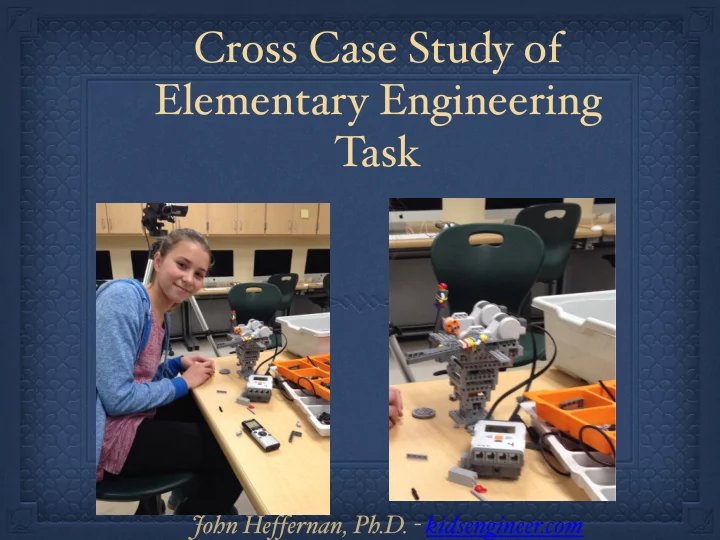
Qualitative, Cross Case, Cross-Sectional Semi-clinical video interview (Ginsburg, 1997) Talk aloud protocol (Ericsson & Simon, 1980) Filmed six typical, second grade student and six typical, grade six students doing same open-ended engineering task of amusement park ride with age-appropriate LEGO robotics materials and craft materials All students started with curriculum in K Qualitative analysis of EDP , finished rides, and EDP related codes and activity
W arm up task (roof) Programs Photos of model Design data for each finished model Video tape of sessions - yielded EDP and EDP related data
2 hours of warm up task and 8.5 hours of main task Multiple “track” issues with building and talking Transcription, time-stamping, segmenting, coding 312 pages of segmented, coded transcripts
W arm Up Task - time, function, process (rubric) Ride quality - originality, function, process (rubric) Finished Model Design Data - #parts, time, use of different parts (motors, computer, crafts, sensors, gears, etc), stability, symmetry, scale Self Efficacy
No major differences by gender or grade level! Differences noted related to LEGO Experience and EDP process But what exactly are the underlying factors? W
by gender or grade level or other factors?
[00:32:41] {moving} [00:32:49] {no_activity} Researcher:
[00:32:51[ {searching} Girl 05: Hmm. Trying to think about this. If I have this, that, that'll be upright. Yeah, that seems like it'll work. If I put one of these on each, I hope this will work. Put this on that, and that will run with ... [00:32:53] {connecting} [00:33:22] Girl 05: How am I going to connect that? It'll be like ... [00:33:26] {moving} [00:33:28] {connecting} Girl 05: Yeah, okay. Researcher: Great idea. [00:33:33] {measuring} Girl 05: Okay, where did my middle ... [00:33:37] Girl 05: Yeah. Then it'll ... [00:33:38] {connecting} [00:33:40] {moving} [00:33:42] Girl 05: Weird. [00:33:53] {no_activity}
Girl 5 Segmented Coded Example [00:32:41] [EVALUATE] {moving} [00:32:49] [PLAN] {no_activity} Researcher:
[00:32:51] [PLAN] {searching} Girl 05: Hmm. Trying to think about this. [00:32:57] [RESEARCH] Girl 5: If I have this, that, that'll be upright. Yeah, that seems like it'll work. If I put one of these on each, I hope this will work. Put this on that, and that will run with ... [00:32:53] {connecting} [00:33:22] Girl 05: How am I going to connect that? It'll be like ... [00:33:26] {moving} [00:33:28] [BUILD] {connecting} Girl 05: Yeah, okay. Researcher: Great idea. [00:33:33] {measuring} Girl 05: Okay, where did my middle ... [00:33:37] Girl 05: Yeah. Then it'll ... [00:33:38] {connecting} [00:33:40] [EVALUATE] {moving} [00:33:42] Girl 05: Weird.
* close to medium complexity
T
No clear patterns by single independent variable CR in particular may be the only direct, developmental variable in this context of age appropriate materials and instruction EDP patterns most dependent on build complexity and students tool set - 7 key factors
T
meaningful (avg. duration, frequency) Helps tell the story of the build 2 typical patterns Outlier cases
Role of development - some role in executive function/causal reasoning and designerly play (G6 n=23, G2 n=61) Parts first versus idea first - tow different approaches, both could be used by students, Boy 4: “I’m just looking for parts to see if they give me any inspiration for something new.” Sharing out side effect - caused reexamination, reworking of solutions. Prevalence of simultaneous EDP phases - BUILD and PLAN, for example. V aried by student. Transition rates - no pattern found unlike with college students (Atman et al., 2008, 2005) Role of imagination in filling in gaps - Girl 06: “I can do it when I'm drawing it.” Role of teacher prompts - neutral teacher prompts caused significant learning moments (2 examples)
Structural knowledge of LEGO connection (Constructopedia and instruction) Curriculum - executive function learning? Curriculum - domain specific process learning? Teachers (and curriculum designers) need to provide instruction and scaffolding for students in the application of: science and general problem solving, design processes knowledge, and design principles
Further analysis of subcodes and secondary codes Relative importance of and relationships between the different factors Segmenting data analysis Planning types - short and long term
Differences in final designs and EDP not due to age or gender Identified seven key factors - executive function process (planning, causal reasoning, cognitive flexibility) domain specific process (design principles, EDP knowledge, and application of math and science) and structural knowledge Robotics a rich domain for important development that includes interpersonal, creative, cognitive, and domain specific
Laminated data slides Laptop, adapter, European adapter, dongle Fixes - POV , etc missing, get to results faster, more selective individual builds?, minor fixes and cuts, explain first section more and relationship to coding and factors