Critical Information Infrastructure July 15 th 96 American president - - PDF document

critical information infrastructure
SMART_READER_LITE
LIVE PREVIEW

Critical Information Infrastructure July 15 th 96 American president - - PDF document

6/21/2012 Critical Information Infrastructure Protection: Urgent vs. Important Miguel Correia 2012 Workshop on Cyber Security and Global Affairs 2012 Workshop on Cyber Security and Global Affairs and Global Security Forum UPC Barcelona Jun.


slide-1
SLIDE 1

6/21/2012 1

Critical Information Infrastructure Protection: Urgent vs. Important

Miguel Correia

2012 Workshop on Cyber Security and Global Affairs 2012 Workshop on Cyber Security and Global Affairs and Global Security Forum UPC – Barcelona – Jun. 2012

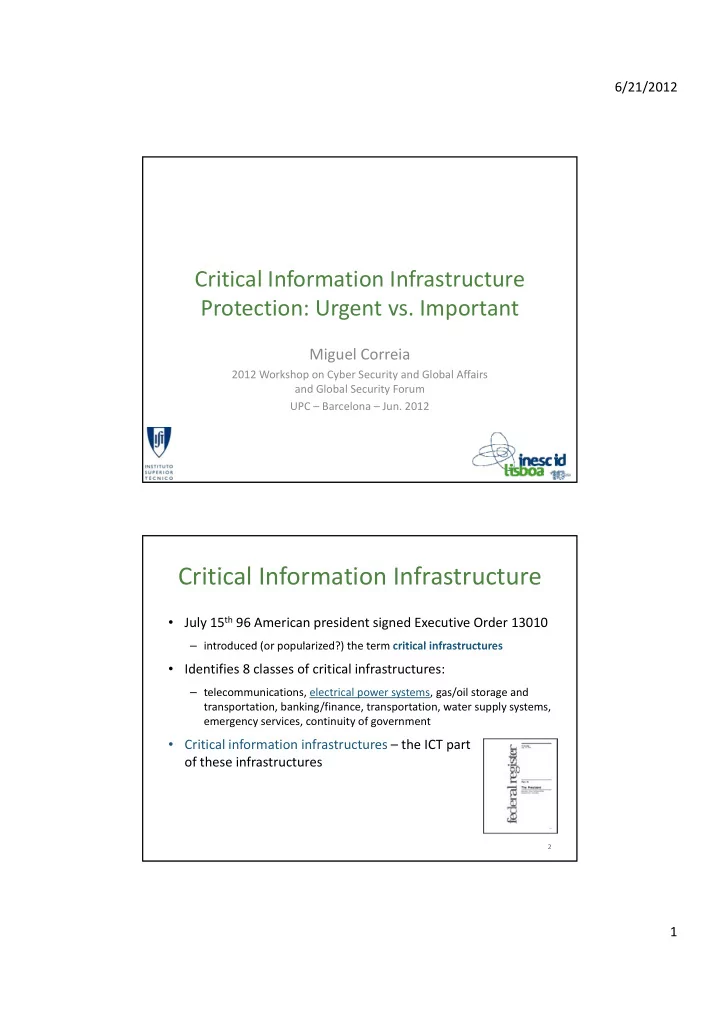
Critical Information Infrastructure

  • July 15th 96 American president signed Executive Order 13010

introduced (or popularized?) the term critical infrastructures – introduced (or popularized?) the term critical infrastructures

  • Identifies 8 classes of critical infrastructures:

– telecommunications, electrical power systems, gas/oil storage and transportation, banking/finance, transportation, water supply systems, emergency services, continuity of government

  • Critical information infrastructures – the ICT part
  • f these infrastructures

2

slide-2
SLIDE 2

6/21/2012 2

Power grid

  • Recent past:

P id d i ifi t t i ti d i t ti – Power grid undergone significant computerization and interconnection – Improved operation, but became exposed to cyber‐threats

  • Present/future:

– Smart grid: smart metering, distributed generation… ‐ ICT is core – More computerization and interconnection, higher exposure to cyber‐ threats threats

3

Power grid is under siege

  • 2003: Davis‐Besse nuclear power plant’s control systems

blocked by the Slammer/Sapphire worm blocked by the Slammer/Sapphire worm

  • 2007: experimental DHS‐sponsored cyber‐attack destructs a

power generator

  • 2009: US electrical grid allegedly penetrated by spies from

China, Russia and others

  • 2010: Stuxnet damages centrifuges in Iranian nuclear

2010: Stuxnet damages centrifuges in Iranian nuclear enrichment center

4

slide-3
SLIDE 3

6/21/2012 3

URGENT: REDUCING RISK

5

Risk is high

risk = level of threat X degree of vulnerability X impact

  • Level of threat is high – nation states, random threats,

extortion

  • Degree of vulnerability is high – as shown by the previous

cases

likelihood of successful attack

  • Impact is high – think of a city without power for hours/weeks

6

It is urgent to reduce this risk

By reducing the degree of vulnerability

slide-4
SLIDE 4

6/21/2012 4

NIST SP 800‐82

  • “Guide to Industrial Control Systems (ICS) Security”, Jun. 2011
  • Recommendations about
  • Recommendations about

– Network architecture – firewall usage, network segregation,… – Management controls – planning, risk assessment,… – Operational controls – personnel security, contingency planning, configuration management,… – Technical controls – authentication, access control, systems and communication protection,…

  • ICT security applied to CIIP

7

IEC 62351

  • “Power systems management and associated information

exchange – Data and communications security”, May 2007 exchange Data and communications security , May 2007

  • Recommendations about the security of TC57 protocols

– protection from eavesdropping, man‐in‐the‐middle, spoofing, and replay

  • ICT security applied to CIIP

8

slide-5
SLIDE 5

6/21/2012 5

Urgent to apply these standards

  • In comparison with “normal” ICT systems…
  • before applying these standards:
  • before applying these standards:

risk = level of threat X degree of vulnerability X impact

much higher! much higher! higher! higher!

9

Urgent to apply these standards

  • In comparison with “normal” ICT systems…
  • after applying these standards:
  • after applying these standards:

risk = level of threat X degree of vulnerability X impact

much higher! much higher! same higher!

10

The risk must still be more reduced!

The degree of vulnerability has to become much lower than in ICT systems

slide-6
SLIDE 6

6/21/2012 6

IMPORTANT: RESEARCH ABOUT REDUCING RISK MUCH MORE

11

Substation A Substation B

Architecture – WAN‐of‐LANs

Substation C

12

slide-7
SLIDE 7

6/21/2012 7

Substation A Substation B

CIS ‐ CRUTIAL Information Switch

Substation C

13

CIS Protection Service

  • Objective: effectively block incoming attacks
  • CIS PS works at application layer and is a distributed firewall
  • CIS‐PS works at application layer and is a distributed firewall
  • It is intrusion‐tolerant thanks to replication and diversity
  • It is self‐healing thanks to replica rejuvenation
  • It cannot be attacked even if there are 0‐day vulnerabilities

14

slide-8
SLIDE 8

6/21/2012 8

CIS Communication Service

  • Objective: circumvent faults and DDoS attacks in the WAN
  • CIS run JITER algorithm – timely‐critical messages exploit:
  • CIS run JITER algorithm – timely‐critical messages exploit:
  • Multihoming: CII facilities often connected to 2 ISPs
  • Overlay channels: messages sent indirectly through other CIS
  • Communication is timely/secure even under harsh fault/attack

scenarios

CIS C

Network fault, DD S tt k

15

CIS A CIS B CIS C CIS D

DDoS attack

New directions beyond CRUTIAL

  • Threats like Stuxnet might not be blocked by these

mechanisms; some research directions: mechanisms; some research directions:

  • Replication/rejuvenation/diversity inside the LANs

– For critical servers, e.g., SCADA servers – For control devices: Programmable Logic Controllers (PLC), Remote Terminal Units (RTU)

  • Continuous vulnerability assessment (instead of periodic

scanning) scanning)

  • Anomaly‐based endpoint assessment

16

slide-9
SLIDE 9

6/21/2012 9

Conclusions

  • The power grid and other critical information infrastructures

are vulnerable to cyber‐attacks are vulnerable to cyber attacks

  • It is urgent to do the urgent: apply standards and

recommendations

  • But ICT‐like security mechanisms are not enough: the threat

level and impact of CII failure is high, so risk remains high

  • So it is important to do what is important: to investigate novel

So it is important to do what is important: to investigate novel protection mechanisms that greatly reduce the degree of vulnerability

17

More info at my web page: google miguel correia inesc id More info at my web page: google miguel correia inesc‐id