Criteria for Evaluating an Individual Oral Presentation SCC - - PDF document

criteria for evaluating an individual oral presentation
SMART_READER_LITE
LIVE PREVIEW

Criteria for Evaluating an Individual Oral Presentation SCC - - PDF document

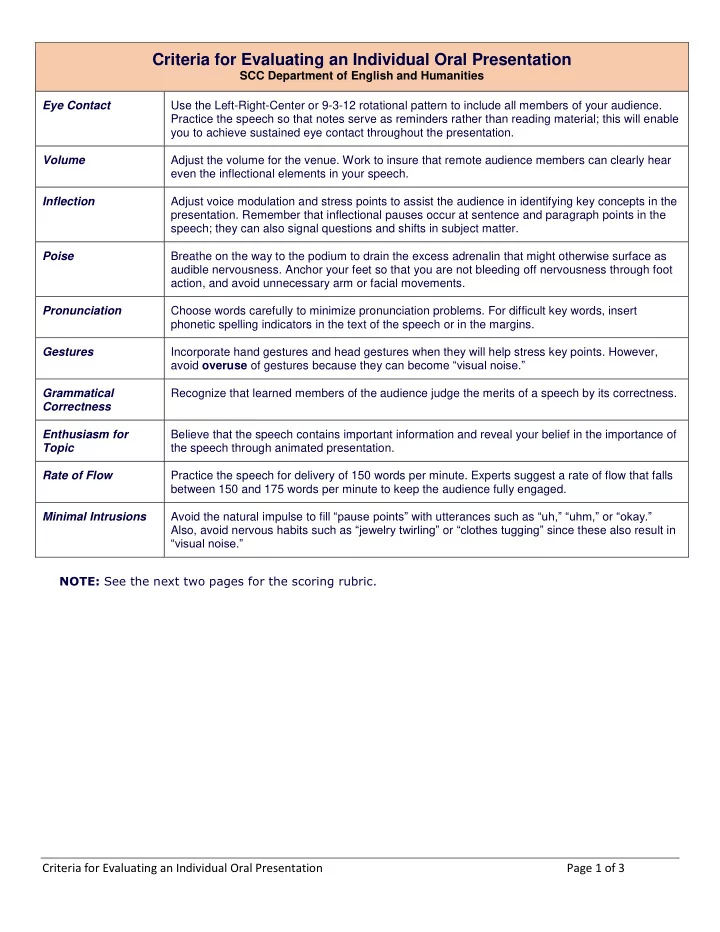
Criteria for Evaluating an Individual Oral Presentation SCC Department of English and Humanities Eye Contact Use the Left-Right-Center or 9-3-12 rotational pattern to include all members of your audience. Practice the speech so that notes serve as


slide-1
SLIDE 1

Criteria for Evaluating an Individual Oral Presentation Page 1 of 3

Criteria for Evaluating an Individual Oral Presentation

SCC Department of English and Humanities Eye Contact Use the Left-Right-Center or 9-3-12 rotational pattern to include all members of your audience. Practice the speech so that notes serve as reminders rather than reading material; this will enable you to achieve sustained eye contact throughout the presentation. Volume Adjust the volume for the venue. Work to insure that remote audience members can clearly hear even the inflectional elements in your speech. Inflection Adjust voice modulation and stress points to assist the audience in identifying key concepts in the

  • presentation. Remember that inflectional pauses occur at sentence and paragraph points in the

speech; they can also signal questions and shifts in subject matter. Poise Breathe on the way to the podium to drain the excess adrenalin that might otherwise surface as audible nervousness. Anchor your feet so that you are not bleeding off nervousness through foot action, and avoid unnecessary arm or facial movements. Pronunciation Choose words carefully to minimize pronunciation problems. For difficult key words, insert phonetic spelling indicators in the text of the speech or in the margins. Gestures Incorporate hand gestures and head gestures when they will help stress key points. However, avoid overuse of gestures because they can become “visual noise.” Grammatical Correctness Recognize that learned members of the audience judge the merits of a speech by its correctness. Enthusiasm for Topic Believe that the speech contains important information and reveal your belief in the importance of the speech through animated presentation. Rate of Flow Practice the speech for delivery of 150 words per minute. Experts suggest a rate of flow that falls between 150 and 175 words per minute to keep the audience fully engaged. Minimal Intrusions Avoid the natural impulse to fill “pause points” with utterances such as “uh,” “uhm,” or “okay.” Also, avoid nervous habits such as “jewelry twirling” or “clothes tugging” since these also result in “visual noise.” NOTE: See the next two pages for the scoring rubric.

slide-2
SLIDE 2

Criteria for Evaluating an Individual Oral Presentation Page 2 of 3

Evaluation of Group Presentation

Evaluation of Individual Oral Presentation

  • I. EVALUATION OF SPEECH COMPONENTS (30 Points)

Component Introduction Body Conclusion Possible Points Points Earned Notes and Comments Eye Contact 3 Volume 3 Inflection 3 Poise 3 Pronunciation/ Enunciation 3 Gestures 3 Grammatical Correctness 3 Enthusiasm for Topic 3 Rate of Flow 3 Minimal Intrusions 3

  • II. ADDITIONAL REQUIRED ELEMENTS (10 Points)

Instructor may require visual aids, evidence of research,

  • r handouts.

10 SPEECH COMPONENT SCORE 40

slide-3
SLIDE 3

Criteria for Evaluating an Individual Oral Presentation Page 3 of 3

  • III. EVALUATION OF TEXTUAL COMPONENTS (50 Points)

Component Quality Possible Points Points Earned Notes and Comments Introduction  Introduces the general topic.  Focuses audience attention by narrowing the topic.  Includes a central idea or thesis, which announces the key issues or concepts to be discussed. 20 Body  Development: Thoroughly supports and explains the thesis.  Expression: Uses precise language, varied sentence beginnings, and varied sentence patterns.  Coherence: Announces shifts in focus through logical transitional elements.  Organization: Uses a logical and recognizable

  • rganizational pattern.

 Unity: Each sentence supports the main idea of the section and links the concept to the overall thesis.  Language Choice: Shows concern for audience knowledge and limitations by incorporating contextual clues and parenthetical definition of unfamiliar words. 30 Conclusion  Completes the development of the thesis.  Reiterates key concepts.  Offers powerful or resonating closure. 10 Textual Component Score 60 Points Speech Component Score 40 Points

  • IV. TOTAL SCORE

100 Points