Credits Some of the material in this presentation is taken from: - - PowerPoint PPT Presentation

credits
SMART_READER_LITE
LIVE PREVIEW

Credits Some of the material in this presentation is taken from: - - PowerPoint PPT Presentation

1 2 Credits Some of the material in this presentation is taken from: Computer Architecture: A Quantitative Approach John Hennessy & David Patterson EE 457 Unit 9a Some of the material in this presentation is derived from


slide-1
SLIDE 1

1

EE 457 Unit 9a

Exploiting ILP Out-of-Order Execution

2

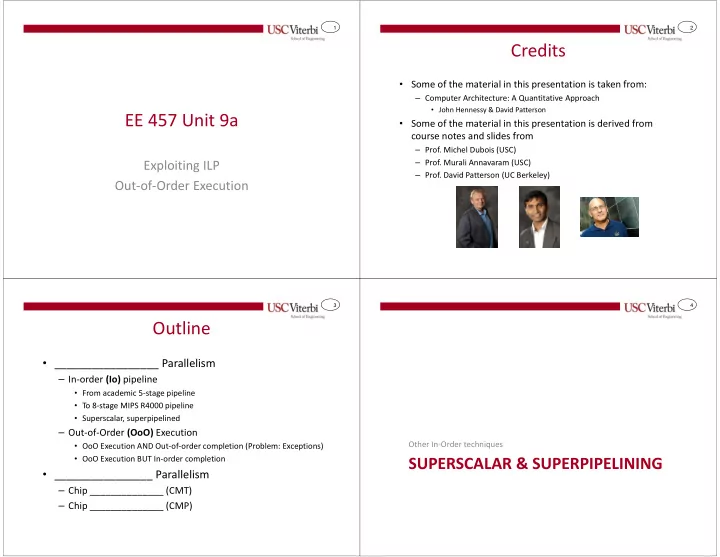
Credits

  • Some of the material in this presentation is taken from:

– Computer Architecture: A Quantitative Approach

  • John Hennessy & David Patterson
  • Some of the material in this presentation is derived from

course notes and slides from

– Prof. Michel Dubois (USC) – Prof. Murali Annavaram (USC) – Prof. David Patterson (UC Berkeley)

3

Outline

  • _________________ Parallelism

– In-order (Io) pipeline

  • From academic 5-stage pipeline
  • To 8-stage MIPS R4000 pipeline
  • Superscalar, superpipelined

– Out-of-Order (OoO) Execution

  • OoO Execution AND Out-of-order completion (Problem: Exceptions)
  • OoO Execution BUT In-order completion
  • ________________ Parallelism

– Chip ______________ (CMT) – Chip ______________ (CMP)

4

SUPERSCALAR & SUPERPIPELINING

Other In-Order techniques

slide-2
SLIDE 2

5

Overview

  • Superscalar = More than 1 instruction ___________________________

– ______uperscalar = Proc. that can issue 2 instructions per clock cycle – Success is sensitive to ability to find independent instructions to issue in the same cycle

  • Superpipelining = Many small stages to boost _________________

– Success depends of finding instructions to schedule in the shadow of data and control hazards

Instruc. Fetch Instruc. Decode Execute Data Memory Write back Instruc. Fetch Instruc. Decode Execute Data Memory Write back Instruction 1 Instruction 2 IF1 IF2 ID EX DM1 DM2 DM3 WB IF1 IF2 ID EX DM1 DM2 DM3 WB Instruction 1 Instruction 2 Superscalar: Executing more than 1 instruction per clock cycle (CPI < 1) Superpipelining: Divide logic into many short stages (______ Clock Frequency) Superscalar Superpipelining 6

2-way Superscalar

  • One ALU & Data transfer (LW/SW) instruction can be issued at the same time

I-Cache D-Cache ALU Reg. File (_ Read, _ Write) PC Addr. Calc.

2 instructions Integer Slot LD/ST Slot

Instruction Pipeline Stages

ALU or branch IF ID EX MEM WB LW/SW IF ID EX MEM WB ALU or branch IF ID EX MEM WB LW/SW IF ID EX MEM WB ALU or branch IF ID EX MEM WB LW/SW IF ID EX MEM WB 7

OUT-OF-ORDER EXECUTION

8

Instruction Level Parallelism (ILP)

  • Although a program defines a sequential ordering of instructions, in reality

many instructions can be executed in parallel.

  • ILP refers to the process of finding instructions from a single program/thread
  • f execution that can be executed in parallel
  • ________________________ is what truly limits ordering
  • _____________ instructions (no data dependencies) can be executed at the

same time)

  • _____________________ also provide some ordering constraints

lw $s3,0($s4) and $t3,$t2,$t3 add $t0,$t0,$s4

  • r $t5,$t3,$t2

sub $t1,$t1,$t2 beq $t0,$t8,L1 xor $s0,$t1,$s2 / / / / / / / / / Cycle 1: Cycle 2: Cycle 3:

Dependency Graph

Program Order (In-order) We may perform execution out-of-order

slide-3
SLIDE 3

9

Basic Blocks

  • Basic Block (def.) = Sequence of instructions that will

always be ________________

– No __________________ out – No branch targets coming ____ – Also called “straight-line” code – Average size: _____ instrucs.

  • Instructions in a basic block can be overlapped if

there are no data dependencies

  • ________ dependences really ________________ of

possible instructions to overlap

– W/o extra hardware, we can only overlap execution of instructions within a basic block

lw $s3,0($s4) and $t3,$t2,$t3 L1: add $t0,$t0,$s4

  • r $t5,$t3,$t2

sub $t1,$t1,$t2 beq $t0,$t8,L1 xor $s0,$t1,$s2 This is a basic block (starts w/ target, ends with branch) 10

Out-of-Order Motivation

  • Hide the impact of dynamic events such as a

______________

  • Out-of-Order (OoO) Execution

– Let ________________ instructions behind a stalled instruction execute – Important aspect: Completion Ordering

  • Out-of-Order completion: Let the independent instruction that has

been executed ____________________________________ before the stalled instruction completes

– Problem: Exception handling

  • In-Order completion: Let the independent instructions execute but

______________ their results until the stalled instruction completes

11

Out-of-Order Execution

  • “Execution” here means ____________ the results not

necessarily _____________ them to a register or memory

  • Completion means _____________________the results to

register file or memory

  • While we say out-of-order execution we really mean:

– In-order Issue/Dispatch (IoD) – Out-of-Order Execution (OoOE) – In-order Completion (IoC)

Issue/Dispatch Execution Completion In-order In-order Out-of-Order

12

In- or Out-of-Order Completion

  • IoI/IoD => OoOE => IoC

– In-order completion is necessary to support precise exceptions [exact state at time of exception]

  • We will present the concept of OoOC (out-of-order

completion) which is a bit easier and then come back to the desired approach of IoC

  • OoOC Issues

– _____________…we should not commit an instruction that came after (in program order) a branch – Solution: Stall dispatching instructions after a branch until we resolve the

  • utcome

LW $4,0($5) // cache miss BEQ $4,$0,L1 ADD $6,$7,$8 // What if we execute this ADD out of order

slide-4
SLIDE 4

13

Scheduling Strategies

  • _____________ Scheduling

– ___________ re-orders instructions in such a way that no dependencies will be violated and allows for OoOE

  • ____________ Scheduling

– ______ implementing the Tomasulo algorithm or other similar approach will re-order instructions to allow for OoOE

  • More Advanced Concepts

– Branch prediction and speculative execution (execution beyond a branch flushing if incorrect) will be covered later

14

Static Scheduling

  • Strengths

– Hardware simplicity [Better clock rate]

  • Power/energy advantage
  • Compiler has a global view of the program anyway, so it should be able to

do a “good” job

– Very predictable: static performance predictions are reliable

  • Weaknesses

– Requires _______________ to take advantage of new/modified architecture – Cannot foresee dynamic (data-dependent) events

  • Cache miss, conditional branches (can only recedule instructions in a basic

block)

– Cannot precompute memory addresses – No good solution for precise exceptions with out-of-order completion

15

Where to Stall?

  • In 5-stage pipeline (in-order execution) RAW

dependency was solved by

– ______________________ or – ______________

  • Dependent instructions stalled in the ID stage

if necessary

IM

Reg

ALU

DM

Reg

LW $4 ADD $1,$3,$4 stall 16

Where to Stall?

  • Simple 5-stage pipeline:

– Dependent instructions cannot be stalled in the EX stage

Instruction Register Register File

Read

  • Reg. 1 #

Read

  • Reg. 2 #

Write

  • Reg. #

Write Data Read data 1 Read data 2 Sign Extend

Pipeline Stage Register

ALU

Res. Zero 1 Sh. Left 2

+

Pipeline Stage Register D-Cache Pipeline Stage Register

1 16 32 5 5 1

rs rt rs rt rd 1 2 1 2

Forwarding Unit

ALUSrc ALUSelB ALUSelA Regwrite & WriteReg# Regwrite, WriteReg# Data Mem. or ALU result Prior ALU Result

I-Cache PC

.

PCWrite IRWrite

HDU Control Ex Mem WB

Stall

Mem WB WB

1 1 1

+

4

IF.Flush MemToReg Branch MemRead & MemWrite FLUSH Reset

Why? What if ADD was also dependent on the instruction in ____… ADD has no place to ________ that forwarded value Thus we stall in ID so we can use the ______________ to grab dependent values. Further stalling in ID incurs only 1 cycle penalty as would stalling in EX.

slide-5
SLIDE 5

17

Where to Stall?

  • But to implement OoO execution, we ________________ in the decode

stage since that would prevent any further issuing of instructions

  • Thus, now we will issue to queues for each of the multiple functional units

and have the instruction stall in the queue until it is ready IM

Reg

ALU

DM

Reg

MUL DIV

Addr Calc. Queues + Functional Units Stalling here would _______ up the pipeline 18

Forwarding in OoO Execution

  • In 5-stage pipeline later instructions carried their source register IDs into the

EX stage to be compared with _____________ register ID’s of their _______ instructions

  • But in OoO execution, we may have ______ (earlier) instructions in front of

us and cannot afford to perform so many comparisons (as well as handling the case where many earlier instructions are producing new version of a register)

  • Instead, the dispatch unit will explicitly tell the dependent instruction who to

____________ data from

File

Read data 1 Read data 2

Pipeline Stage Register

ALU

Res. Zero 1 2

Pipeline Stage Register D-Cache Pipeline Stage Register

1 32 1

rs rt rd 1 2 1 2

Forwarding Unit

ALUSrc ALUSelB ALUSelA Regwrite & WriteReg# Regwrite, WriteReg# Data Mem. or ALU result Prior ALU Result Read & mWrite

19

Tomasulo’s Plan

  • OoO Execution
  • Multiple functional units

– Integer ALU, Data memory, Multiplier, Divider

  • Queues between ID and EX stages (in place of

ID/EX register)

– Allows later instructions to keep issuing even if earlier ones are stalled

20

OoO Execution Problems

  • For the time

– No branch prediction – No speculative execution beyond a branch

  • So we simply stall on a conditional branch
  • For the time, no support for precise

exceptions

– Even then what about hazards…

slide-6
SLIDE 6

21

RAW, WAR, and WAW

  • RAW = Read After Write

– lw $8, 40($2) – add $9, $8, $7

  • WAR = Write After Read

– add $9, $8, $6  say $6 is not available yet, can LW execute? – lw $8, 40($2)

  • WAW = Write After Write

– add $9, $8, $6  say $6 is not available yet, can LW execute? – lw $9, 40($2)

Why would anyone produce one result in $9 without utilizing that result? Why would he overwrite it with another result? How is this possible? 22

WAW can easily occur

  • How is it possible?

– In OoO execution, instructions before the branch and after the branch can co-exist – Consider multiple ________ of a ________ body

L1: lw $2, 40($1) mult $4, $2, $3 sw $4, 40($1) addi $1, $1,-4 bne $1, $0,L1 for(i=MAX; i != 0; i--) A[i] = A[i] * 3;

Original Code

L1: lw $2, 40($1) mult $4, $2, $3 sw $4, 40($1) addi $1, $1,-4 bne $1, $0,L1 L1: lw $2, 40($1) mult $4, $2, $3 sw $4, 40($1) addi $1, $1,-4 bne $1, $0,L1

23

Another WAW Example

  • Say a company gives standard bonus to most of the

employees and a higher bonus to managers

  • The software may set a default value to the standard

bonus and then overwrite for the special case

int x = standard_bonus; if (____________) x = _______________; set_bonus(x);

24

RAW, WAR, and WAW

  • Some terminology to remember
  • RAW = Read After Write

– lw $8, 40($2) – add $9, $8, $7

  • WAR = Write After Read

– add $9, $8, $6 – lw $8, 40($2)

  • WAW = Write After Write

– add $9, $8, $6 – lw $9, 40($2)

RAW A true dependency WAR An _______-dependency WAW An _______-dependency Name Depdencies Note: No information is communicated in WAR/WAW hazards. If no info is communicated can we somehow solve these hazards?

slide-7
SLIDE 7

25

RAW, WAR, and WAW

  • In-order execution:

– We need to deal with RAW only

  • Out-of-order execution

– Now we need to deal with WAR and WAW hazards besides RAW – Any of these hazards seem to prevent re-ordering instructions and executing them out-of-order

26

Register Renaming

  • If we had ___ registers instead of ___ registers, then

perhaps the compiler might have used $48 instead of $8 and we could have executed the second part of the code before the first part

lw $8, 40($2) add $8, $8, $8 sw $8, 40($2) lw $__, 60($3) add $__, $__, $__ sw $__, 60($3) This is an example of a name-dependency First iteration Second iteration (using alternate register, $48)

27

Register Renaming

  • Renaming requires more registers
  • We have limited ____________ registers

– Registers the instruction set is aware of

  • We could have more __________ registers

– Actual registers part of the register file

lw $8, 40($2) add $8, $8, $8 sw $8, 40($2) lw $8, 60($3) add $8, $8, $8 sw $8, 60($3) It is clear the compiler is using $8 as a temporary register If there is a delay in obtaining $2 the first part of the code cannot proceed Unfortunately, the second part of the code cannot proceed because of the name dependency for $8 Assume Delayed

28

Increasing Number of Registers

  • Can a later implementation provide 64

registers (instead of 32) while maintaining binary compatibility with previously compiled code?

  • Answer: Yes / No
  • Why?
slide-8
SLIDE 8

29

Register Renaming

  • Rather than creating new architectural registers, let

us internally provide multiple "_______" of the same architectural register

– $8v1 = $8 version 1 – $8v2 = $8 version 2

lw $8v1, 40($2) add $8v2, $8v1, $8v1 sw $8v2, 40($2) lw $8v3, 60($3) add $8v4, $8v3, $8v3 sw $8v4, 60($3)

$8 $8v1 $8v2 $8v3 $8v4

30

Tomasulo's Approach to Renaming

  • Cannot change the number of architectural registers
  • Instead we will perform

Register Renaming through Tagging Registers

– This solves name dependency problems (WAR and WAW) while attending to true dependency (RAW) through waiting in queues – Please be sure you understand this!

31

OoO Execution & Tomasulo's Algorithm

I-Cache

Block Diagram Adapted from Prof. Michel Dubois (Simplified for EE457)

Register Status Table

Integer / Branch D-Cache Div Mul

Instruc. Queue

  • Reg. File
  • Int. Queue

L/S Queue Div Queue

  • Mult. Queue

Common Data Bus

Issue Unit

Dispatch

Fetch multiple instructions per clock cycle in PROGRAM ORDER (i.e. normal order generated by the compiler) Decode & dispatch multiple instructions per cycle tracking dependencies on earlier instructions Instructions wait in queues until their respective functional unit (the hardware that will compute their value) is free AND they have their data available (from the instructions they depend upon). These act as additional "physical registers" Results of multiple instructions can be written back per cycle. Results are broadcast to any instruction waiting for that result. Uses "tags" to track which instruction is the latest producer (version) of a register. (Helps solve RAW, WAR, WAW dependencies)

32

Tomasulo’s Algorithm

  • Dispatch/Issue unit decodes and dispatches instructions
  • For destination operand, an instruction carries a _____ (but

not the actual register name)

  • For source operands, an instruction carries either the ______

(if TAG is ___________) or _______ of the operands (but not the actual register name)

  • When an instruction executes and produces a result it

broadcasts the result and its destination TAG

– Any instruction waiting can compare its _______ tags with the __________ tag and __________ the value if they match – If entry in RST matches the TAG then this instruction is the _________ producer of the register and the value will be written to the RF

slide-9
SLIDE 9

33

Tagging process

Issue Logic

INT MUL/DIV/SQRT

INT ALU Load/ Store

sqrt $2, $10 lw $8, 40($2) add $8, $8, $8 sw $8, 40($2) lw $8, 60($3) add $8, $8, $8 sw $8, 60($3)

$1 $2 $3 $4 $5 $6 $7 $8 … $31

RF

$1 $2 $3 $4 $5 $6 $7 $8 … $31 T1: SQRT $2 Val / $10 Val

RST = Register Status Table RF = Register File RST

(Identify latest version of a reg.) 34

Tagging process: CC1

Issue Logic

INT MUL/DIV/SQRT

INT ALU Load/ Store

sqrt $2, $10 lw $8, 40($2) add $8, $8, $8 sw $8, 40($2) lw $8, 60($3) add $8, $8, $8 sw $8, 60($3)

T1 $1 $2 $3 $4 $5 $6 $7 $8 … $31

RF

$1 $2 $3 $4 $5 $6 $7 $8 … $31 T1: SQRT $2 Val / $10 Val

RST = Register Status Table RF = Register File RST

(Identify latest version of a reg.) Instruction that will write to a destination register, take a TAG and enter that TAG into the RST to track the latest version/producer 35

Tagging process: CC3

Issue Logic

INT MUL/DIV/SQRT

INT ALU Load/ Store

sqrt $2, $10 lw $8, 40($2) add $8, $8, $8 sw $8, 40($2) lw $8, 60($3) add $8, $8, $8 sw $8, 60($3)

RST

T1 T2 T3 $1 $2 $3 $4 $5 $6 $7 $8 … $31

RF

$1 $2 $3 $4 $5 $6 $7 $8 … $31 T3: ADD T2 / T2 T1: SQRT $2 Val / $10 Val T2: LW T1 / 40

RST = Register Status Table RF = Register File

Notice the RST only stores the TAG of the LATEST producer/version. Solves WAR/WAW hazards by not accepting a writeback unless it is from the latest/producer 36

Tagging process: CC5

Issue Logic

INT MUL/DIV/SQRT

INT ALU Load/ Store

sqrt $2, $10 lw $8, 40($2) add $8, $8, $8 sw $8, 40($2) lw $8, 60($3) add $8, $8, $8 sw $8, 60($3)

RST

T1 T3 T4 $1 $2 $3 $4 $5 $6 $7 $8 … $31

RF

$1 $2 $3 $4 $5 $6 $7 $8 … $31 T3: ADD T2 / T2 T1: SQRT $2 Val / $10 Val T4: LW $3 val / 60 SW T3 / T1 / 40 T2: LW T1 / 40

RST = Register Status Table RF = Register File

slide-10
SLIDE 10

37

Tagging process: CC8

Issue Logic

INT MUL/DIV/SQRT

INT ALU Load/ Store

sqrt $2, $10 lw $8, 40($2) add $8, $8, $8 sw $8, 40($2) lw $8, 60($3) add $8, $8, $8 sw $8, 60($3)

RST

T1 T5 => null $1 $2 $3 $4 $5 $6 $7 $8 … $31

RF

0x2222 $1 $2 $3 $4 $5 $6 $7 $8 … $31 T5: ADD 0x1111 / 0x1111 T3: ADD T2 / T2 T1: SQRT $2 Val / $10 Val SW T3 / T1 / 40 T2: LW T1 / 40

RST = Register Status Table RF = Register File

T5: Sum 0x2222 T5: Sum 0x2222 When latest producer writes to register, we reset RST entry to NULL (indicates that the RF has the latest value and issuing instructions can just take that value from the RF) 38

Tagging process: CC10

Issue Logic

INT MUL/DIV/SQRT

INT ALU Load/ Store

sqrt $2, $10 lw $8, 40($2) add $8, $8, $8 sw $8, 40($2) lw $8, 60($3) add $8, $8, $8 sw $8, 60($3)

RST

T1 => null $1 $2 $3 $4 $5 $6 $7 $8 … $31

RF

0x2222 $1 $2 $3 $4 $5 $6 $7 $8 … $31 T3: ADD T2 / T2 T1: SQRT $2 Val / $10 Val SW T3 / T1 / 40 T2: LW T1 / 40

RST = Register Status Table RF = Register File

T1: SQRT 0xacd0 T1: SQRT 0xacd0 39

Tagging process: CC13

Issue Logic

INT MUL/DIV/SQRT

INT ALU Load/ Store

sqrt $2, $10 lw $8, 40($2) add $8, $8, $8 sw $8, 40($2) lw $8, 60($3) add $8, $8, $8 sw $8, 60($3)

RST

$1 $2 $3 $4 $5 $6 $7 $8 … $31

RF

0xacd0 0x2222 $1 $2 $3 $4 $5 $6 $7 $8 … $31 SW 0xacf0 / 0xacd0 / 40

RST = Register Status Table RF = Register File

40

Register Renaming

Issue Logic

INT MUL/DIV/SQRT

INT ALU Load/ Store

sqrt $2, $10 add $2, $2, $2 add $2, $2, $2 add $2, $2, $2 add $2, $2, $2

RST

$1 $2 $3 $4 $5 $6 $7 $8 … $31

RF

$1 $2 $3 $4 $5 $6 $7 $8 … $31 T1: SQRT $2 Val / $10 Val

RST = Register Status Table RF = Register File

slide-11
SLIDE 11

41

Unique TAGs

  • Like SSN, we need a unique TAG
  • SSN’s are reused.
  • Similarly TAGS can be reused
  • TAGs are similar to number TOKEN

Helps to create a virtual queue. We do not need that here In State Bank of India, the cashier issues brass token to customers trying to draw money as an ID (and not at all to put them in any virtual queue / ordering). Token numbers are in random order. The cashier verifies the signature in the record rooms, returns with money, calls the token number and issues the money. Tokens are reclaimed & reused.

42

Tags (= Tokens)

  • How many tokens should the bank casheir

have to start with?

  • What happens if the tokens run out?
  • Does the cashier need to have any order in

holding tokens and issuing tokens?

  • Do they have to collect the tokens back?

43

TAG FIFO

  • To issue and collect tokens (TAGS) use a circular FIFO (First-

In/First-Out) unit

– While the FIFO order is not important here, a FIFO is the easiest to implement in hardware compared to a random order in a pile

  • Filled (with say) 64 tokens (___________) initially on reset
  • Tokens return ________________
  • Put tokens back in the FIFO and ___________

FIFO’s are taught in EE 560

1 2 …

TAG FIFO

63

wp rp

FULL

2 …

TAG FIFO

63

2 Tokens issued

1 2 …

TAG FIFO

63

1 Tokens returned

44

Organization for OoO Execution

I-Cache

Block Diagram Adapted from Prof. Michel Dubois (Simplified for EE 457) Register Status Table

Integer / Branch D-Cache Div Mul

TAG FIFO Instruc. Queue

  • Reg. File
  • Int. Queue

L/S Queue Div Queue

  • Mult. Queue

CDB

Issue Unit

Dispatch

slide-12
SLIDE 12

45

Front-End & Back-End

  • IFQ (Instruction Fetch Queue)

– A FIFO structure

  • Dispatch (Issue) Unit

– Includes RST, RF, Tag FIFO

  • Load/Store and other Issue Queues
  • Issue Units
  • Functional units
  • CDB (Common Data Bus)

– Like a public address system that everyone can see/hear when data is produced

46

More Tomasulo Algorithm

  • Front End

– Instructions are fetched – They are stored in a FIFO (IFQ) – When instruction reached the head of the IFQ it is

  • Decoded
  • Dispatched to an issue queue/functional unit
  • Even if some of the inputs are not ready (takes TAGs)
  • Back End

– Instructions in issue queues wait for their input operands – Once register operands are ready instructions can be scheduled for execution provided they will not conflict for the CDB or their functional unit – Instructions execute in their functional unit and their result is put on the CDB – All instructions in queues and the register file “watch” the CDB and grab the value they are waiting for when it is produced

47

Bottleneck in Tomasulo’s Approach

  • The _________________!!!
  • Do all instructions use the ___________?

– __________________________________

48

Issue Queue Priority

  • Priority (based on the order of arrival among

ready instructions)

– Is it necessary or is it desirable? – Local priority within queues? – Global priority across the queues?

How do we prioritize instructions that are ready?

slide-13
SLIDE 13

49

Load/Store Queue (LSQ)

  • Performs

– Address calculation – Memory disambiguation

  • _________________________ hazards due to memory

reads and writes

// Is there a dependency here? SW $2,0($5) LW $8,0($5) // What about here? SW $2, 1000($4) LW $3, 0($6) 50

Address Calculation for LW/SW

  • EE 557 approach for address calculation

– Loads & store in 2 sub-instructions

  • 1 instruction computes address and is dispatched to

integer ALU

  • 1 instruction access data cache and is issued to LSQ
  • Address is communicated from integer ALU to LSQ via

CDB forwarding using a tag

  • EE 560/457 approach

– Use a dedicated adder in the LSQ to compute address (so just 1 dispatched instruction)

51

Memory Disambiguation

  • EE 557: Issue to a cache from LSQ

– Loads can issue to a cache when their address is ready – Stores can issue to cache when both address & data is ready – Memory hazards (RAW, WAR, WAW) are resolved in the LSQ

  • Load can issue to cache if no store with same address is before it
  • Store can issue to cache if no store or load with same address before it
  • Otherwise access waits in LSQ

– If an address is unknown it is assumed to be the same

  • Worst case to enforce correctness

– The process of figuring out and comparing memory address is called “disambiguation”

52

Memory Disambiguation

RAW sw $2, 2000($0) lw $8, 2000($0) WAW sw $2, 2000($0) sw $8, 2000($0) WAR lw $2, 2000($0) sw $8, 2000($0) This later lw can proceed only if there is no store ahead of it with the same address This later sw can proceed only if there is no store ahead of it with the same address This later sw can proceed only if there is no load ahead of it with the same address

slide-14
SLIDE 14

53

LSQ Ordering

  • Maintaining instructions in the order of arrival

– Issue order/program order in a queue

  • Is this necessary and/or desirable?

– In the case of LSQ?

  • Necessary! To enforce memory disambiguation

– In the case of Integer, MUL, DIV queues?

  • _______________, so that an earlier instruction gets

executed whenever possible, thereby reducing queue pressure from too many instructions waiting on it

54

Issue Unit

  • CDB availability constraint
  • Pipelined functional unit vs. multicycle unit
  • Conflict resolution

– Round-robin priority adequate?

55

Conditional Branches

  • Dispatch unit stops dispatching until the branch is resolved
  • CDB broadcasts the result of the branch
  • Dispatching continues at the target or fall-through instruction
  • Successful branch shall cause flushing of _________
  • Since we stop dispatching instructions after a branch, does it

mean that this branch is the last instruction to be executed in the back-end?

  • Is it possible that the back-end holds simultaneously

– A. Some instructions dispatched before the branch and – B. Some instructions issued after the branch

56

Structural & Control Hazards

  • Structural Stalls

– I-Fetch must stall if the __________________ – Dispatch must stall if all entries in the desired functional unit’s ______ ______________ is occupied – Instructions cannot be scheduled in case of _________________ or functional unit

  • Control

– Dispatcher stalls when it reaches a branch – Branches are dispatched to integer queue – They wait for their operands if needed – Put their result on CDB

  • If untaken, dispatch unit resumes
  • If taken, then dispatch clears the IFQ and resumes at target
  • Precise exceptions not supported
slide-15
SLIDE 15

57

BACKUP

58

Tagging Registers: CC1

lw $8, 40($2) add $8, $8, $8 sw $8, 40($2) lw $8, 60($3) add $8, $8, $8 sw $8, 60($3) sqrt $2, $10

Orange means dispatched and SQRT is a long-latency computation

RST = Register Status Table RF = Register File

Destination Dependent source

RST

DOG DOG $1 $2 $3 $4 $5 $6 $7 $8 … $31

RF

$1 $2 $3 $4 $5 $6 $7 $8 … $31 59

Tagging Registers: CC2

lw $8, 40($2) add $8, $8, $8 sw $8, 40($2) lw $8, 60($3) add $8, $8, $8 sw $8, 60($3) sqrt $2, $10

Orange means dispatched and SQRT is a long-latency computation

RST = Register Status Table RF = Register File

Destination Dependent source

RST

DOG LION $1 $2 $3 $4 $5 $6 $7 $8 … $31

RF

$1 $2 $3 $4 $5 $6 $7 $8 … $31 DOG DOG LION 60

Tagging Registers: CC3

lw $8, 40($2) add $8, $8, $8 sw $8, 40($2) lw $8, 60($3) add $8, $8, $8 sw $8, 60($3) sqrt $2, $10

Orange means dispatched and SQRT is a long-latency computation

RST = Register Status Table RF = Register File

Destination Dependent source

RST

DOG TIGER $1 $2 $3 $4 $5 $6 $7 $8 … $31

RF

$1 $2 $3 $4 $5 $6 $7 $8 … $31 DOG DOG LION LION LION TIGER

slide-16
SLIDE 16

61

lw $8, 40($2) add $8, $8, $8 sw $8, 40($2)

Tagging Registers: CC4

lw $8, 60($3) add $8, $8, $8 sw $8, 60($3) sqrt $2, $10

Orange means dispatched and SQRT is a long-latency computation

RST = Register Status Table RF = Register File

Destination Dependent source

RST

DOG TIGER $1 $2 $3 $4 $5 $6 $7 $8 … $31

RF

$1 $2 $3 $4 $5 $6 $7 $8 … $31 DOG DOG LION LION LION TIGER TIGER 62

lw $8, 40($2) add $8, $8, $8 sw $8, 40($2)

Tagging Registers Review

  • Dispatch unit decodes and dispatches instructions
  • For destination operand, an instruction carreis a

TAG (but not the actual register name)

  • For source operands, an instruction carries either

the values (if no TAG in RST) or TAGs of the

  • perands (but not the actual register name)
  • When

lw $8, 60($3) add $8, $8, $8 sw $8, 60($3) sqrt $2, $10

RST

DOG TIGER $1 $2 $3 $4 $5 $6 $7 $8 … $31

RF

$1 $2 $3 $4 $5 $6 $7 $8 … $31 DOG DOG LION LION LION TIGER TIGER 63

Organization for OoO Execution

I-Cache

Block Diagram Adapted from Prof. Michel Dubois (Simplified for EE 457) Register Status Table

Integer / Branch D-Cache Div Mul

TAG FIFO Instruc. Queue

  • Reg. File
  • Int. Queue

L/S Queue Div Queue

  • Mult. Queue

CDB

Issue Unit

Dispatch

64

Multiple Functional Units

  • We now provide multiple functional units
  • After decode, issue to a queue, stalling if the unit is busy or

waiting for data dependency to resolve

IM

Reg

ALU

DM

Reg

MUL DIV

DM (Cache) Queues + Functional Units

slide-17
SLIDE 17

65

Functional Unit Latencies

Functional Unit Latency

(Required stalls cycles between dependent [RAW] instrucs.)

Initiation Interval

(Distance between 2 independent instructions requiring the same FU)

Integer ALU 1 FP Add 3 1 FP Mul. 6 1 FP Div. 24 25

EX

  • Int. ALU, Addr. Calc.

FP Add

  • Int. & FP MUL
  • Int. & FP DIV

A1 A2 A3 A4 M1 M2 M3 M4 M5 M6 M7

Look Ahead: Tomasulo Algorithm will help absorb latency of different functional units and cache miss latency by allowing other ready instruction proceed out-of-order An added complication of

  • ut-of-order execution &

completion: WAW & WAR hazards 66

OoO Execution w/ ROB

  • ROB allows for OoO execution but in-order completion

I-Cache

  • Br. Pred.

Buffer

Integer / Branch

  • Exec. Unit

Div Mul

ROB (Reorder Buffer) Instruc. Queue

  • Reg. File
  • Int. Queue

L/S Queue Div Queue

  • Mult. Queue

CDB

Issue Unit

D-Cache Dispatch D-Cache

L/S Buffer

Addr. Buffer

Exceptions? No problem