Creating Meaningful Tefilot In Suburban USA: One Model David Schuck - - PDF document

creating meaningful tefilot in suburban usa one model
SMART_READER_LITE
LIVE PREVIEW

Creating Meaningful Tefilot In Suburban USA: One Model David Schuck - - PDF document

Empowered Judaism: How to Build Vibrant Jewish Communities Creating Meaningful Tefilot In Suburban USA: One Model David Schuck (rabbi@thepjc.org), Rabbi, Pelham Jewish Center I. Background on Synagogue II. Incremental Change III. Nature of


slide-1
SLIDE 1

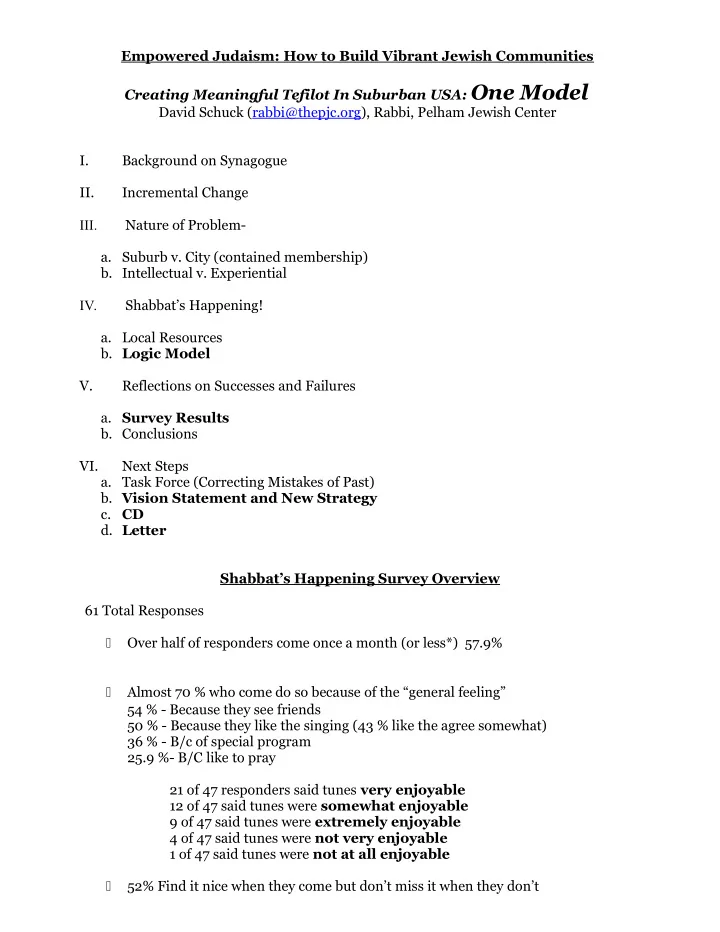
Empowered Judaism: How to Build Vibrant Jewish Communities Creating Meaningful Tefilot In Suburban USA: One Model David Schuck (rabbi@thepjc.org), Rabbi, Pelham Jewish Center I. Background on Synagogue II. Incremental Change III. Nature of Problem-

  • a. Suburb v. City (contained membership)
  • b. Intellectual v. Experiential

IV. Shabbat’s Happening!

  • a. Local Resources
  • b. Logic Model

V. Reflections on Successes and Failures

  • a. Survey Results
  • b. Conclusions

VI. Next Steps

  • a. Task Force (Correcting Mistakes of Past)
  • b. Vision Statement and New Strategy
  • c. CD
  • d. Letter

Shabbat’s Happening Survey Overview 61 Total Responses  Over half of responders come once a month (or less*) 57.9%  Almost 70 % who come do so because of the “general feeling” 54 % - Because they see friends 50 % - Because they like the singing (43 % like the agree somewhat) 36 % - B/c of special program 25.9 %- B/C like to pray 21 of 47 responders said tunes very enjoyable 12 of 47 said tunes were somewhat enjoyable 9 of 47 said tunes were extremely enjoyable 4 of 47 said tunes were not very enjoyable 1 of 47 said tunes were not at all enjoyable  52% Find it nice when they come but don’t miss it when they don’t

slide-2
SLIDE 2

36 % Enjoy it very much- important part of their week  54% are somewhat familiar with the tunes and can sing along with others 18% extremely familiar; know them by heart 14.8 % Very familiar; can sing them on my own  47 % said prayer service and singing at SH was somewhat better than typical FN 21% said much better 21 % said about the same  73% came to SH to support program 66.7 % to share dinner with others 30 % moving spiritual experience 31% wanted to see studetns again 11.9 curious  60.6 % Extremely likely to come if there’s a Shabbat dinner 23 % Very Likely  Willing to Commit 44 % twice a month (17 % already come 2 x / month) 23 % once month 16 % occasionally w /out commitment 11 % weekly (one more person than the number already coming each week) 33 of 53 happy with the 6:30 time 9 of 53 prefer 7 pm ANOTHER MOTIVATING FACTOR TO COME TO SHABBAT’S HAPPENING IS THAT IT WAS WONDERFUL FOR CHILDREN I MISS SOME OF THE OLD TUNES OR MORE VARIETY IN THE TUNES MORE FRIDAY NIGHT DINNERS FOOD NOT GOOD AND NOT KID FRIENDLY Questions

  • 1. People are coming because of the general feeling on Friday nights which is largely

dependent on song, friends, and food. How do we capitalize on this in a way that does not overtax our members (feeling like they have to support a program which is the largest motivating factor – 73%) nor overburden volunteers / Adam.

  • a. How many special Friday night programs?
  • b. What should they look like?
  • 2. 52 % of attendees do not miss the Friday night service if they don’t come. It is like a

social evening out for many (if you don’t go out to a movie on a Sat night, you don’t miss going to a movie that night). How do we make the services less about “supporting a program” and a “social event” and more like an important personal experience of enrichment that will be missed if not done on some kind of regular basis?

slide-3
SLIDE 3
  • 3. Dream big. We need lots of ideas.

Review of Mission, Strategy, and Volunteer Roles for PJC Friday Night Service Long Term Mission: To consistently attract a large group of members to the Friday night service, including people who, until now, have not regularly attend services. Davenning will be spirited with a great deal of singing. There will be a growing group of people capable skilled in being shlichei tzibbur. Short Term Mission (2008-2009): To build up the group of “regulars” who will attend Friday night services. Once this is accomplished we will be more effective in achieving our long term mission. Strategy:

  • We will offer affordable Friday night dinners once a month. We will not do any

PR for these dinners other than including them in our weekly announcements, putting them in the Hakol, and putting them on our calendar.

  • We will refocus educational efforts on the Friday night service
  • The Learning Center will now teach Kabbalat Shabbat through the new

music teacher.

  • The weekly school wide service on Thursdays will no longer be Mincha. It

is now Kabbalat Shabbat.

  • We will offer people a CD of all of the tunes that we use that we hope will

be “friendly to the ears.”

  • The Rabbi will try to organize weekly emails dealing with a theme of

Shabbat, perhaps connecting it to the Friday night vort and even a podcast.

  • The Rabbi will send out a letter articulating this vision for Friday nights at

the PJC.

  • The Rabbi will offer a class on Zmirot (Shabbat songs) twice a month so

people who are interested can familiarize themselves with the songs we sing around the shabbat table.

  • We will offer supervision for the kids during dinner and encourage parents to

keep their kids in the service. In addition to a “babysitter,” we will involve two high school kids each month and have them hang out with the kids, playing games, building relationships, etc.

  • We will experiment with assigned seating in an attempt to build community and

break up cliques.

slide-4
SLIDE 4
  • We will set up a minyan coordination so we will always know roughly how many

people to expect and then can make a few calls if the numbers are low for that

  • week. Only people who want to be on the “call list” will be contacted.

Volunteer Commitments:

Volunteer Commitment Oversee cooking or ordering the dinners for the year. Will put together all costs including food, wine, cleanup, babysitting, etc. Oversee all RSVPing. We will accept people who show up without an RSVP but still encourage RSVPing. Talk to Jessica about babysitting. We want her to engage the kids, not just be in the same room as them. If she won’t do it, X will find someone else. Est. budget for this: $75-$100. Will arrange assigned seating for the first one and evaluate. Will do this with X. Will organize 2 high school kids coming to each dinner. She will try to arrange this with X through the “madrichim” program. We will give them community service hours if need be. Will let us know what happens with cleanup. Is it Adam’s job or does he get paid extra for this? Rabbi Write and send letter about all of this Prepare weekly educational emails and perhaps podcasts Teach class on Zmirot Some changes to the service were proposed (facing the congregation, kavvanot, different tunes, etc). These three will work on these changes. Will do assigned seating for the first one and evaluate. Will do this with X. Will do the Minyan Coordination. All will be done via email with the goal of ensuring 20 people per week. He has our approval to experiment with finger food before or after services every Friday night. We’ll assess after he does it.

Dear Friends, I hope that this letter finds you well and that there are many things to look forward to in 2009. I am very excited to share a new initiative within the synagogue that I think you may find compelling. Before the summer, we assembled a task force in order to assess the Shabbat’s Happening program that we ran last year. The energy from the program was fantastic and the response from the community was

  • verwhelmingly positive. As we assessed the program and the energy it brought to the synagogue, we

decided to focus on one specific aspect during this year: the Friday night service. This letter is meant to explain our vision for the service and our strategy for continuing to invigorate the service and expand the number of people who attend regularly, that is, once, twice or more times per month. It is my dream to have a Friday night service which is uplifting, reflective, and accessible to all, and I believe that we have been making progress toward this end. For most of us, it is simply being in a community that makes coming to the service so meaningful. People chat a bit, catch up on life, and sing

  • together. There is something transformative and very powerful about locating yourself within a larger

group of people who, for one hour, let the past week slide off their backs and out of their minds. At the Friday night service, we focus on the space in which we find ourselves in that moment. Some weeks one may want to sing, and sing loudly. Other weeks that same person may just want to listen quietly. The key

slide-5
SLIDE 5

is that this space becomes sacred because it is truly the only space in one’s hectic weekly life in which the

  • bject is “to be,” and nothing else. We stop “producing” for one hour and simply sit with whatever we are

feeling. The service is now comprised of lively tunes, some silent time for reflection, and a short word of Torah or thought piece. It is fully accessible to all since we have purchased more transliterated prayer books; one does not have to be able to read Hebrew to participate. Every Friday night service is one hour, which we think is a manageable time for people who are not used to being in synagogue, especially people with

  • children. We made a lovely CD of all of the tunes that we use at the service for people who are unfamiliar

with them but would like to sing along. I am including a copy of this CD with this letter. If you already have one, please feel free to give this one to someone else or drop it off back at the PJC office. We now have Friday night dinners in the synagogue once a month which we are calling “Kehillat Shabbat” (Shabbat Community). These dinners are not intended to be large productions , but are meant to be an

  • pportunity for people to come together once a month and break bread, chat, and sing a bit. These

dinners are a casual, cooked-in-the-synagogue meal at a very reasonable price. Please look at the website and jot the dates down in your calendars, or look for the dates in our weekly announcements. The culture of our synagogue has been one in which the kids who come on Friday nights tend not to be in the sanctuary for much of the service. Since the service is only an hour, the kids are actually able to sit through the service and participate at a fairly young age, especially if they have a book with them. Perhaps in the beginning, they sit for 20 or 30 minutes and then the time inside is gradually increased. To augment their comfort with the service, we decided to familiarize them with the tunes. Every Thursday, all of the kids in the Learning Center sing Kabbalat Shabbat songs (the tunes we use on Friday nights) and the music teacher, X, teaches them the tunes and prayers in their music classes. We made this change so that the kids would feel that they had ownership over the service and so that they can participate in the praying and singing when they do attend the service. There is always plenty of time after the service (especially when there is a dinner) for the kids to play together upstairs. X has volunteered to be our Friday Night Minyan Coordinator. She will compile a list of members with whom she can be in touch by email. People on X’s list will agree to make an extra effort to attend services

  • n Friday nights when we expect a low attendance. It is of course always fine to say no if it does not work

with your weekend plans, but it would be nice to have a group of people willing to help out occasionally (If you’re interested in participating in this way, please email Sandra at (X). It is my hope that people will come together and help make this service a central aspect of the culture of the Pelham Jewish Center, both for the sake of the community as well as their own personal family lives. Attending on a regular basis will likely become an incredibly important part of your life, and a deep expression of connectedness, even if it is once a month when we have dinners. For those of us who are not used to doing this, changing a habit, even when it is just one hour a month, is very difficult to do, but I believe the rewards will far outweigh the challenges. So I hope to sing with you over the coming year, or if a singer you are not, I hope to pray with you, or if a pray-er you are not, I hope to be with you. I am reaching out to you to ask you to consider the type of commitment you are prepared to make for yourself and your community. I am, of course, always thrilled to meet with you to discuss any issues or to listen to feedback you may have. Warmly, Rabbi David A. Schuck