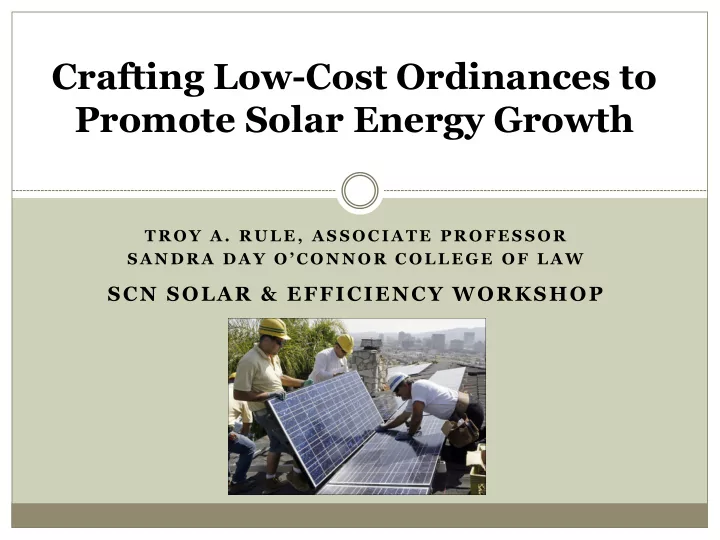
SLIDE 1 T R O Y A . R U L E , A S S O C I A T E P R O F E S S O R S A N D R A D A Y O ’ C O N N O R C O L L E G E O F L A W
SCN SOLAR & EFFICIENCY WORKSHOP
Crafting Low-Cost Ordinances to Promote Solar Energy Growth
SLIDE 2 Arizona’s Existing Energy Mix
www.solar-nation.org
SLIDE 3 Arizona: Limited Coal Resources
www.teachcoal.org
SLIDE 4
Arizona: Limited Natural Gas Resources
SLIDE 5
Arizona Solar Energy Resources
SLIDE 6 Rapid Growth in Solar PV Installations
Credit: greentechmedia.com
SLIDE 7 Utilities’ “Death Spiral” Narrative
As more customers switch to solar, utilities sell less power. Consequently, utilities must raise their rates to spread their
high fixed costs over fewer sold kilowatt hours.
These higher electricity rates make solar power even more cost-
competitive, motivating even more customers to get solar panels.
hotstocked.com
SLIDE 8 Neighbor’s Land Solar User’s Land
Property Line Solar Panels
SLIDE 9 Neighbor’s Land Solar User’s Land
Property Line Uncompensated Airspace Easement
Burdened Airspace
Solar Panels
SLIDE 10
Sunlight Law Prior to the 1970’s
The Old English “Doctrine of Ancient Lights” United Fee Ownership Rule (Ad Coelem doctrine) Fontainebleau Case (1959): No implied right to
sunlight under US Law
SLIDE 11 Modern Approaches to Solar Access
1.
“Solar Rights” Statutes
Wyoming & New Mexico
2.
Zoning/Setbacks
Ashland, Oregon (solar setbacks)
Boulder, Colorado (solar fences)
3.
Nuisance Law
Classifying solar panel shading as a public or private nuisance
4.
No statutory solar access protection
majority approach; relies upon voluntary covenants/easements
SLIDE 12
Protecting Solar Access: The Iowa Approach
Under Iowa’s statute:
1.
Neighbors are not generally liable for shading solar panels, however:
2.
If a solar panel user is unable to negotiate a voluntary solar access easement, the local government can compel the neighbor to sell the easement for its market value.
SLIDE 13 Advantages of the Iowa Approach
Consistent with existing law re: airspace rights
Does not take neighbors’ airspace rights without compensation
Addresses the solar access problem
Provides a guaranteed means of getting solar access protection Encourages rooftop solar energy development
Promotes the efficient use of scarce airspace
Rational solar users will only elect to purchase solar access
easements when they are the highest-valued use of the space.
SLIDE 14 Crafting a Solar Access Ordinance
Create a solar easement application process
Statements re: good faith negotiations & minimized neighbor impact
Provide for notice and a hearing Limit easement duration to a solar panel’s useful life Exempt neighbors’ existing vegetation/structures Require applicants to bear some city costs
SLIDE 15 Development Exactions
Exaction – a condition to development approval
requiring the developer to provide something to a local government. Exactions can be in the form of:
Required improvements (sidewalks, public art, etc. ) Property dedications (for roads, parks, etc.) Monetary exactions (cash) Linkages (e.g., day care for office buildings, affordable
housing requirements, etc.)
SLIDE 16 Promoting Solar Energy through the Development Approval Process
Development approvals could be conditioned upon :
(1) installation of on-site solar energy generating capacity;
(amounts based on number/size of lots or developed floor area)
(2) the purchase of equivalent credits in commercial-scale solar
energy facilities elsewhere in the city; OR
(3) payment of fees in lieu of on-site solar energy installations
(funds generated through such fees would support local commercial-scale
solar energy projects)
SLIDE 17
William Fischel’s “Homevoter Hypothesis”
“…[H]omeowners… tend to choose those [local government] policies that preserve or increase the value of their homes.”
SLIDE 18 $
Quantity of Housing
S1 D
Q2 Q1
S2
Impact of a Solar Energy Installation Requirement (for New Homes) on Home Prices
P2 P1 #2: This reduction in housing supply increases the equilibrium price of new homes from P1 to P2 #1: Solar mandate requirements tend to increase the cost of new housing, as reflected by upward shift in the market supply from S1 to S2
SLIDE 19 Can This Work? Some Real-World Examples
Renewable Energy Mitigation Program (Aspen and
Pitkin County, CO)
Builders of new homes larger than 5,000 sq. ft. or having
certain outdoor energy uses must:
install on-site solar/geothermal energy systems (based on sq. ft.) OR pay a fee (revenues help to fund local sustainable energy projects)
Solar Energy System Requirement (Lancaster, CA)
Requires 1.o to 1.5 kW of solar per lot/unit Allows developers to fulfill requirement off-site
SLIDE 20
Publicly-Owned Commercial-Scale Solar
City Hall, Bainbridge Island, WA
SLIDE 21 Advantages of Commercial-Scale Solar
- ver Residential-Scale Solar
Lower hard costs per kW Lower soft costs per kW
Lower permitting, sale/lease, installation, design,
interconnection, and inspection costs per kW
Fewer solar access conflicts per kW Less aesthetic impact per kW More manageable grid impacts