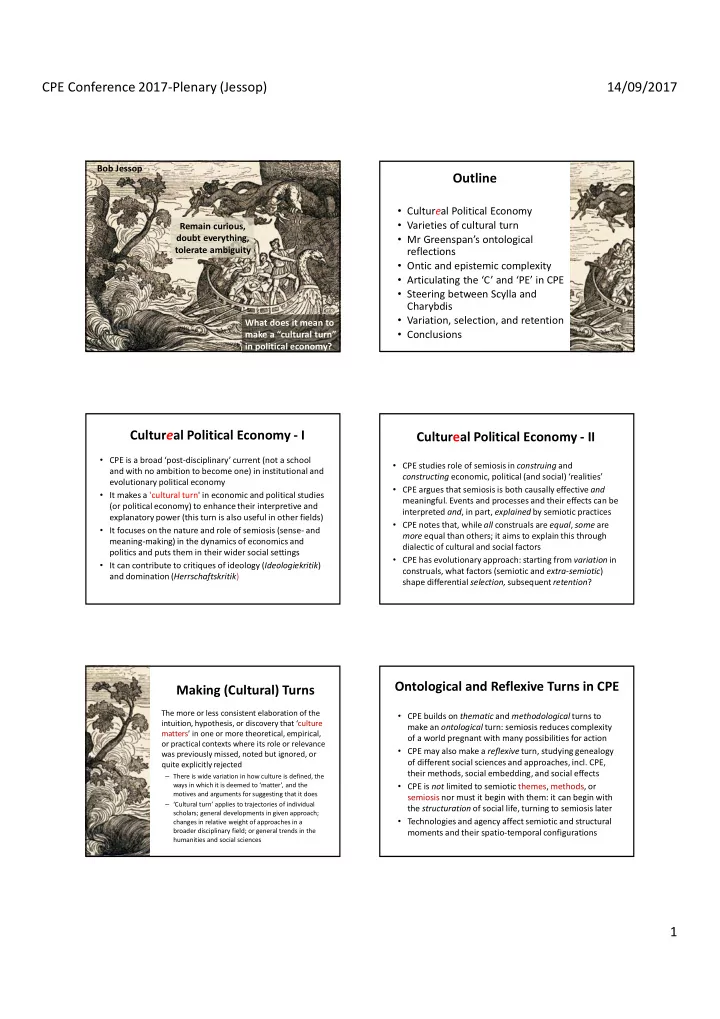
CPE Conference 2017-Plenary (Jessop) 14/09/2017 Bob Jessop Outline - - PDF document

cpe conference 2017 plenary jessop 14 09 2017
SMART_READER_LITE
LIVE PREVIEW

CPE Conference 2017-Plenary (Jessop) 14/09/2017 Bob Jessop Outline - - PDF document

CPE Conference 2017-Plenary (Jessop) 14/09/2017 Bob Jessop Outline Cultur e al Political Economy Varieties of cultural turn Remain curious, Mr Greenspans ontological doubt everything, tolerate ambiguity reflections Ontic


slide-1
SLIDE 1

CPE Conference 2017-Plenary (Jessop) 14/09/2017 1

What does it mean to make a “cultural turn” in political economy? Bob Jessop Remain curious, doubt everything, tolerate ambiguity

  • Cultureal Political Economy
  • Varieties of cultural turn
  • Mr Greenspan’s ontological

reflections

  • Ontic and epistemic complexity
  • Articulating the ‘C’ and ‘PE’ in CPE
  • Steering between Scylla and

Charybdis

  • Variation, selection, and retention
  • Conclusions

Outline Cultureal Political Economy - I

  • CPE is a broad ‘post-disciplinary’ current (not a school

and with no ambition to become one) in institutional and evolutionary political economy

  • It makes a 'cultural turn' in economic and political studies

(or political economy) to enhance their interpretive and explanatory power (this turn is also useful in other fields)

  • It focuses on the nature and role of semiosis (sense- and

meaning-making) in the dynamics of economics and politics and puts them in their wider social settings

  • It can contribute to critiques of ideology (Ideologiekritik)

and domination (Herrschaftskritik)

Cultureal Political Economy - II

  • CPE studies role of semiosis in construing and

constructing economic, political (and social) ‘realities’

  • CPE argues that semiosis is both causally effective and
  • meaningful. Events and processes and their effects can be

interpreted and, in part, explained by semiotic practices

  • CPE notes that, while all construals are equal, some are

more equal than others; it aims to explain this through dialectic of cultural and social factors

  • CPE has evolutionary approach: starting from variation in

construals, what factors (semiotic and extra-semiotic) shape differential selection, subsequent retention?

Making (Cultural) Turns

The more or less consistent elaboration of the intuition, hypothesis, or discovery that ‘culture matters’ in one or more theoretical, empirical,

  • r practical contexts where its role or relevance

was previously missed, noted but ignored, or quite explicitly rejected

– There is wide variation in how culture is defined, the ways in which it is deemed to ‘matter’, and the motives and arguments for suggesting that it does – ‘Cultural turn’ applies to trajectories of individual scholars; general developments in given approach; changes in relative weight of approaches in a broader disciplinary field; or general trends in the humanities and social sciences

Ontological and Reflexive Turns in CPE

  • CPE builds on thematic and methodological turns to

make an ontological turn: semiosis reduces complexity

  • f a world pregnant with many possibilities for action
  • CPE may also make a reflexive turn, studying genealogy
  • f different social sciences and approaches, incl. CPE,

their methods, social embedding, and social effects

  • CPE is not limited to semiotic themes, methods, or

semiosis nor must it begin with them: it can begin with the structuration of social life, turning to semiosis later

  • Technologies and agency affect semiotic and structural

moments and their spatio-temporal configurations

slide-2
SLIDE 2

CPE Conference 2017-Plenary (Jessop) 14/09/2017 2 Mr Greenspan’s Ontological Reflections

  • REP. WAXMAN: Do you feel that your ideology

pushed you to make decisions that you wish you had not made? MR GREENSPAN: remember what an ideology is: a conceptual framework for people to deal with

  • reality. Everyone has one. You have to - to exist,

you need an ideology. The question is whether it is accurate or not. ... I’ve found a flaw. I don’t know how significant or permanent it is. But I’ve been very distressed by that fact ... A flaw in the model that I perceived as the critical functioning structure that defines how the world works, so to speak (Congressional Hearing, 23 Oct 2008)

Chair, Federal Reserve, 1987-2006

Ontic and Epistemic Complexity …

  • ‘Everyone’ must simplify the natural and

social world to be able to ‘go on’ within it:

– selective observation of real world, – reliance on specific codes and programmes, – use of categories and forms of calculation, – sensitivity to specific structures of feeling, – reference to particular identities, – justification via ‘vocabularies of motives’ – conjunctural calculation of short- to long- term interests, – and so on

... and the Economy

  • The ‘actually existing economy’ is the chaotic

sum of all economic activities and cannot be grasped in all its complexity.

  • So the economy as an object of observation,

calculation, management, or governance never comprises all economic activities but is an ‘enforced selection’ of a more or less coherent subset of all economic activities

  • Simplifications may aid economic steering if

they have requisite variety and are reflexive

  • Greenspan admits to flaws in his economic

imaginary: ‘efficient market hypothesis’ is a bad simplification

Caution! Yet more Complexity

  • Economic imaginary is a ‘term of art’ that can include

technological paradigms, production norms, labour process, forms of economic organization, competition, enterprise, markets, the public sector, taxation, and so on

  • Content of economic imaginary is not pre-given but some

economic imaginary is necessary to ‘go on’ economically

  • The enforced selectivity of an imaginary may assist

successful economic steering when it has requisite variety and is reflexive – but it can also lead to steering failure due to the ‘revenge’ of what has been ignored

  • The same points hold for other types of social imaginary

Contesting Social Imaginaries - I

  • Social imaginaries have key roles in struggles for ‘hearts

and minds’ and over exploitation and domination

  • What Greenspan calls ‘ideologies’ are better seen as

personal frameworks shaping ‘lived experience’ and/or as simplifying ‘social imaginaries’ to deal with the world

  • Some imaginaries are more powerful because they are

promoted by dominant apparatuses/institutions that use technologies to advance semiosis and structuration

  • These hegemonic (or, at least, dominant) imaginaries

shape leading ways of thinking about social relations, their crisis-tendencies, and crisis-management routines

Contesting Social Imaginaries - II

  • Imaginaries are not pre-given mental

categories: they are the creative products of semiotic and material practices that have more or less performative power

  • Social forces try to make their imaginary the

hegemonic or dominant ‘frame’ in particular contexts and/or to promote it as a sub- or counter-hegemonic imaginary. Successful framing leads to an historical bloc (Gramsci)

  • This contestation and struggles re mediated

via semiosis, structuration, particular technologies, and specific agents

slide-3
SLIDE 3

CPE Conference 2017-Plenary (Jessop) 14/09/2017 3 Putting the ‘C’ into CPE - I

  • Intersubjective meaning making develops via semiosis as

a socially adequate form of communication-cooperation that presupposes and posits (further develops) language

  • Language has lexical, semantic, and pragmatic features:

more weight given to one or other depending on context

  • Not all words or signs are created equal: some are more

fundamental to structuring interaction and limiting possible combinations of social relations than others

  • These categories provide fundamental forms of thought

and modes of being in the world and thus shape social relations: they merit Ideologiekritik and Herrschaftskritik

Putting the ‘C’ into CPE - II

  • All construals are equal (semiotically); some are more equal

than others in their constitutive, constructive effects

  • The key question is how construals are mediated: how do

they vary, why are some selected as basis for action, why are some retained and institutionalized as bases for efforts to construct (transform) natural and social worlds?

  • Only construals that grasp emergent extra-semiotic

features of social worlds and mind-independent aspects

  • f the natural world are likely to be selected and retained
  • Some in turn create changes in the extra-semiotic aspects
  • f the world and related (always) tendential social logics

Structuration

  • Structuration sets limits (however achieved)
  • n the articulation of sets of social relations

such that ‘not everything that is possible is compossible’

  • This involves

– stabilizing cognitive and normative expectations – guiding individual and organizational learning – deploying disciplinary technologies – securing institutional complementarities – establishing principles of social organization – also related to structural coupling and co-evolution – and to ecological dominance of certain systems

enforced selection

structuration sense-making sedimented meaning structured complexity

variation, selection, retention Depiction of the contribution of sense- and meaning-making and structuration (setting limits to compossible sets of social relations) to the relative stability of specific socio-institutional formations

Semantic fix Structural fix Potential disjunction

Putting the ‘PE’ into CPE

  • CPE insists on specificities of at least some emergent

aspects of the form, content, and logics of social relations of ‘political economy’ and its products

  • As enforced selection, economic imaginaries ignore key

features of actually existing economies, which continue to have real effects, including:

– contradictions, dilemmas, and paradoxes – extra-economic conditions of existence and effects – spatio-temporal depth, breadth, rhythms, sequencing , etc

  • So CPE studies structuration and dynamic of economic

(and economically-relevant or conditioned) activities, thereby contributing to Herrschafts- and Ideologiekritik

Charybdis Scylla

The Good Ship CPE

slide-4
SLIDE 4

CPE Conference 2017-Plenary (Jessop) 14/09/2017 4

Constructivist Charybdis Structuralist Scylla

Grasps semiotic-material construction of social relations, reveals social embedding, notes its performative impact Grasps distinctiveness of specific economic categories and their structured/ structuring nature in wider social formations But finds it hard to define specificity

  • f economic relations relative to
  • ther relations – because they are all

discursive But reifies such categories, fetishizes economic structures as natural, and views agents as mere Träger of economic logics Strong risk of idealism, defining economic relations in terms of their manifest semiotic content Strong risk of economic determinism, explaining economic processes in terms of ‘iron laws’

“Soft Economic Sociology” “Hard Political Economy”

Social and/or Cultural?

  • Social/cultural is an analytical distinction that identifies

‘moments’ of complex world as entrypoints for analysis

  • Social = emergent properties of interaction (e.g. social

cohesion, institutional fit, structural contradiction)

  • Cultural = emergent properties of discursive formations

(e.g., style, genre chains, intertextuality)

  • Insofar as they have different emergent properties, they

are ontically (ontologically) as well as analytically distinct

  • Insofar as the social is discursively constituted and

meaningful, it is cultural; insofar as the cultural is realized in/through social relations, it is social

Variation-Selection-Retention

Variation Selection Retention

S E M I O T I C M A T E R I A L

Proliferation of crisis interpret- ations – from the “arbitrary, rationalistic, and willed” to the potentially “organic” Selection of crisis interpret- ations – based

  • n intra- and

inter-discursive plus structural, technical and agential forces Retention of more organic interpretations (or at least those with more powerful backing) via partial sedimentation of discourses and consolidation of new practices Re-politicized Discourses Unstructured complexity Sedimented Discourse Structured Complexity

How to interpret this figure

  • Dotted diagonal line indicates:

– all social relations are simultaneously semiotic and material; – ‘semiosis’ gets less important in movement from V through S to R

  • in part because semiosis becomes less contested , more sedimented;

– ‘materiality’ gets more important in movement from V through S to R as unstructured complexity is reduced through limits on compossible combinations of social relations

  • in part because governmental technologies normalize identities and conduct
  • Positioning of balloons indicates:

– overlap of successive stages of variation, selection, and retention – increased importance of materiality in this movement (understood as sedimentation of semiosis, structuration of social relations)

  • Figure starts with moment of crisis (maximum variation) rather

than with period of relative stability; it is heuristic, schematic

Selection of Imaginaries

  • Selection (and retention) of imaginaries is shaped by at

least four forms of selectivity:

  • Discursive selectivity (genre chains, styles, identities) and inter-

discursive resonance, role of ‘situated pragmatics’ and capacities to make/break discursive links

  • Social structural selectivity: uneven distribution of opportunities

to make a difference, some sites of enunciation are more dominant than others)

  • Technical selectivity: some means of advancing discourses and

social transformation are more effective than others)

  • Agential: some agents are more skilled in discursive arts, have

better strategic and tactical sense, are more able to organize support, neutralize opposition, ignore resistance

Four Selectivities

Structural

Structurally-inscribed strategic selectivities plus structurally-oriented strategic calculation Form analysis and critical institutionalism; focus on uneven distribution of constraints/opportunities

Discursive

Semiosis as enforced selection with signs as raw material of meaning

  • making. Discursive selectivities plus

strategic use of language Critical semiotic analysis of text, intertext, and context to see how semiosis construes, guides action, and constructs

Techno- logical

Technologies for appropriating and transforming nature and/or for the conduct of conduct Material, social, and spatio- temporal biases inscribed in technological capacities for action and their effects

Agential

Attribution of interpretive and causal powers to agents to make a difference in specific conjuncture by virtue of specific capacities unique to them Conjunctural analysis

  • riented to individual and

social agents in a changing balance of forces

slide-5
SLIDE 5

CPE Conference 2017-Plenary (Jessop) 14/09/2017 5 Organic Economic Imaginaries

  • An organic 'economic imaginary‘, i.e., one that has real

chances of becoming hegemonic:

– shapes economic strategies on broad range of economic, territorial, and social scales – addresses relation between market and non-market forces – informs state projects and hegemonic visions – removes political and social uncertainty – integrates private, institutional, and wider public narratives

  • It also depends on ‘organic intellectuals’ (individual or

collective), who articulate and promote its ‘essential’ unity (best understood in strategic essentialist terms)

enforced selection

structuration sense-making sedimented meaning structured complexity

improbability

paradoxes, lack of closure, scope for repoliticization contradictions, unstable fixes, and crisis-tendencies

VSR

Semantic and structural fixes form a historical bloc

Conclusions

  • Combine critical semiotic analysis with materialist

analyses to develop an innovative CPE

  • Evolutionary approach to critical semiotic analysis is

productive, redirecting it beyond the immediate and personal to institutions, inter-institutional articulation, and complex social formations over time

  • Materialist work is productive too, helping to explain

differential selection and retention of some discourses and providing insight into specific institutional dynamics

  • So seek to avoid the constructivist Charybdis and

structuralist Scylla by combining semiotic and materialist analyses

Acknowledgments

Research for our individual and joint work on CPE was supported by:

  • Economic & Social Research Council
  • EU-COST-Action
  • Rosa Luxemburg Foundation
  • The British Academy
  • The Institute for Advanced Studies,

Lancaster University

  • WISERD and Cardiff University

For further information, see:

  • http://www.bobjessop.org
  • http://wp.lancs.ac.uk/cperc-conf/
  • The three books on the right