Covid-19 Explanatory Model: A Decomposition V2 20 July 2020 V2 V2 - - PDF document

covid 19 explanatory model a decomposition v2 20 july 2020
SMART_READER_LITE
LIVE PREVIEW

Covid-19 Explanatory Model: A Decomposition V2 20 July 2020 V2 V2 - - PDF document

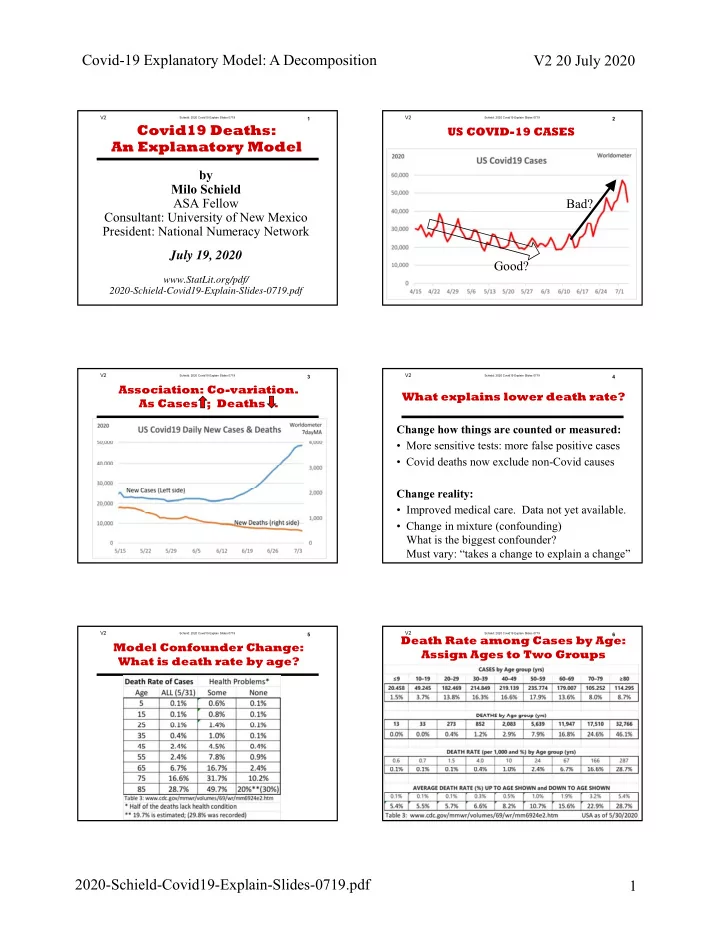
Covid-19 Explanatory Model: A Decomposition V2 20 July 2020 V2 V2 Schield: 2020 Covid19 Explain Slides 0719 1 Schield: 2020 Covid19 Explain Slides 0719 2 Covid19 Deaths: US COVID-19 CASES An Explanatory Model . by Milo Schield ASA


slide-1
SLIDE 1

Covid-19 Explanatory Model: A Decomposition V2 20 July 2020 2020-Schield-Covid19-Explain-Slides-0719.pdf 1

Schield: 2020 Covid19 Explain Slides 0719

V2 1

by Milo Schield ASA Fellow Consultant: University of New Mexico President: National Numeracy Network July 19, 2020

www.StatLit.org/pdf/ 2020-Schield-Covid19-Explain-Slides-0719.pdf

Covid19 Deaths: An Explanatory Model

Schield: 2020 Covid19 Explain Slides 0719

V2

.

2

US COVID-19 CASES

Bad? Good?

Schield: 2020 Covid19 Explain Slides 0719

V2

.

3

Association: Co-variation. As Cases ; Deaths .

Schield: 2020 Covid19 Explain Slides 0719

V2

Change how things are counted or measured:

  • More sensitive tests: more false positive cases
  • Covid deaths now exclude non-Covid causes

Change reality:

  • Improved medical care. Data not yet available.
  • Change in mixture (confounding)

What is the biggest confounder? Must vary: “takes a change to explain a change”

4

What explains lower death rate?

Schield: 2020 Covid19 Explain Slides 0719

V2

.

5

Model Confounder Change: What is death rate by age?

Schield: 2020 Covid19 Explain Slides 0719

V2

.

6

Death Rate among Cases by Age: Assign Ages to Two Groups

slide-2
SLIDE 2

Covid-19 Explanatory Model: A Decomposition V2 20 July 2020 2020-Schield-Covid19-Explain-Slides-0719.pdf 2

Schield: 2020 Covid19 Explain Slides 0719

V2

We need a simple explanatory model. Assume two groups based on risk of death:

  • Death rate: High risk (R1), Low risk (R2)

Let F1 = Fraction of cases in high risk group Deaths = Cases*[F1*R1 + (1-F1)*R2] Select death rates for each group: R1 > R2

  • Max(Deaths/Cases) = 8.2%. So let R1 = 10%
  • Min(Deaths/Cases) = 1.0%. So let R2 = 0.1%

7

The Cases-Deaths Association: Confounded by Age-Risk Mix

Schield: 2020 Covid19 Explain Slides 0719

V2

.

8

Two-Group Risk Model

Schield: 2020 Covid19 Explain Slides 0719

V2

.

9

92% of Deaths from 11% of Cases.

High Risk: Old with Health Problems

Schield: 2020 Covid19 Explain Slides 0719

V2

.

10

67% of Deaths from 4% of Cases.

High Risk: Old with Health Problems

Schield: 2020 Covid19 Explain Slides 0719

V2

  • 1. Smooth the data (7day average)
  • 2. Model the data: Predict vs. Explain
  • 3. Look for biggest confounder: Age-risk mix
  • 4. Confounder must vary as data changes.
  • 3. Choose a simple model to highlight essentials
  • 4. Check model assumptions against real data.
  • 5. Summarize results to highlight the findings
  • 6. Help officials minimize deaths and flatten the

curve without flattening the economy

11

Technical Summary

Schield: 2020 Covid19 Explain Slides 0719

V2

Look at what was done here:

  • Observational data; time series data, big data
  • Model to explain (not trying to predict)
  • Confounder that varies over time
  • Create a simple 2-parameter model

None of these are taught in traditional intro stats. These are more of the reasons why students need a confounder-based Statistical Literacy course.

12

Statistical Education needs Statistical Literacy

slide-3
SLIDE 3

Schield: 2020 Covid19 Explain Slides 0719

V2 1

by Milo Schield ASA Fellow Consultant: University of New Mexico President: National Numeracy Network July 19, 2020

www.StatLit.org/pdf/ 2020-Schield-Covid19-Explain-Slides-0719.pdf

Covid19 Deaths: An Explanatory Model

slide-4
SLIDE 4

Schield: 2020 Covid19 Explain Slides 0719

V2

.

2

US COVID-19 CASES

Bad? Good?

slide-5
SLIDE 5

Schield: 2020 Covid19 Explain Slides 0719

V2

.

3

Association: Co-variation. As Cases ; Deaths .

slide-6
SLIDE 6

Schield: 2020 Covid19 Explain Slides 0719

V2

Change how things are counted or measured:

  • More sensitive tests: more false positive cases
  • Covid deaths now exclude non-Covid causes

Change reality:

  • Improved medical care. Data not yet available.
  • Change in mixture (confounding)

What is the biggest confounder? Must vary: “takes a change to explain a change”

4

What explains lower death rate?

slide-7
SLIDE 7

Schield: 2020 Covid19 Explain Slides 0719

V2

.

5

Model Confounder Change: What is death rate by age?

slide-8
SLIDE 8

Schield: 2020 Covid19 Explain Slides 0719

V2

.

6

Death Rate among Cases by Age: Assign Ages to Two Groups

slide-9
SLIDE 9

Schield: 2020 Covid19 Explain Slides 0719

V2

We need a simple explanatory model. Assume two groups based on risk of death:

  • Death rate: High risk (R1), Low risk (R2)

Let F1 = Fraction of cases in high risk group Deaths = Cases*[F1*R1 + (1-F1)*R2] Select death rates for each group: R1 > R2

  • Max(Deaths/Cases) = 8.2%. So let R1 = 10%
  • Min(Deaths/Cases) = 1.0%. So let R2 = 0.1%

7

The Cases-Deaths Association: Confounded by Age-Risk Mix

slide-10
SLIDE 10

Schield: 2020 Covid19 Explain Slides 0719

V2

.

8

Two-Group Risk Model

slide-11
SLIDE 11

Schield: 2020 Covid19 Explain Slides 0719

V2

.

9

92% of Deaths from 11% of Cases.

High Risk: Old with Health Problems

slide-12
SLIDE 12

Schield: 2020 Covid19 Explain Slides 0719

V2

.

10

67% of Deaths from 4% of Cases.

High Risk: Old with Health Problems

slide-13
SLIDE 13

Schield: 2020 Covid19 Explain Slides 0719

V2

  • 1. Smooth the data (7day average)
  • 2. Model the data: Predict vs. Explain
  • 3. Look for biggest confounder: Age-risk mix
  • 4. Confounder must vary as data changes.
  • 3. Choose a simple model to highlight essentials
  • 4. Check model assumptions against real data.
  • 5. Summarize results to highlight the findings
  • 6. Help officials minimize deaths and flatten the

curve without flattening the economy

11

Technical Summary

slide-14
SLIDE 14

Schield: 2020 Covid19 Explain Slides 0719

V2

Look at what was done here:

  • Observational data; time series data, big data
  • Model to explain (not trying to predict)
  • Confounder that varies over time
  • Create a simple 2-parameter model

None of these are taught in traditional intro stats. These are more of the reasons why students need a confounder-based Statistical Literacy course.

12

Statistical Education needs Statistical Literacy