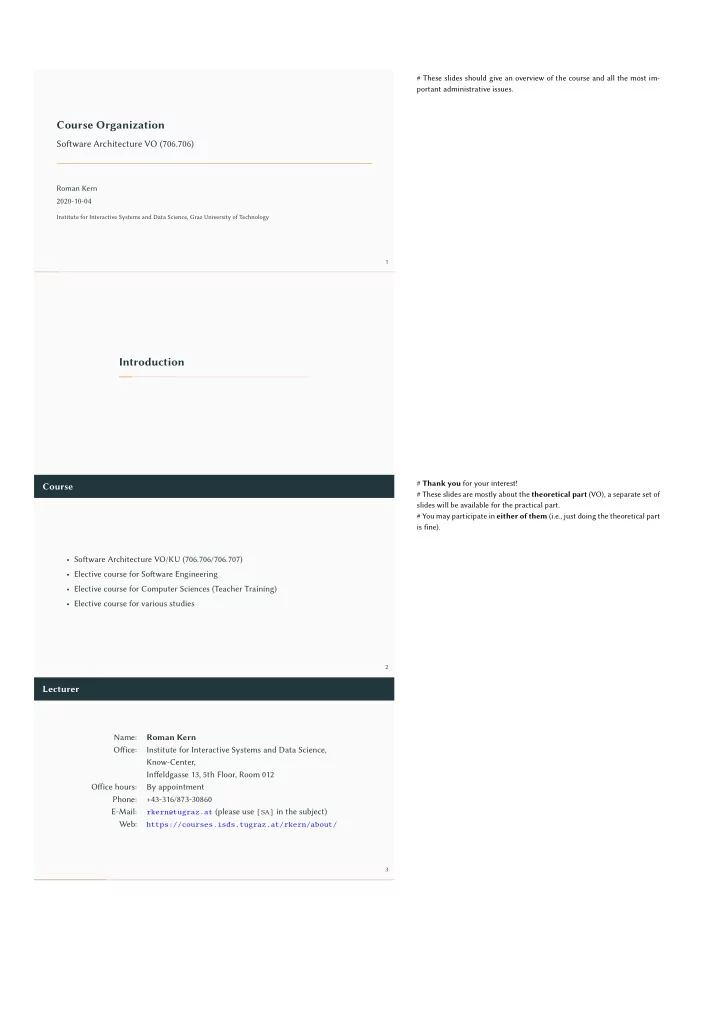
Course Organization Sofware Architecture VO (706.706) Roman Kern - - PDF document

course organization
SMART_READER_LITE
LIVE PREVIEW

Course Organization Sofware Architecture VO (706.706) Roman Kern - - PDF document

# These slides should give an overview of the course and all the most im- portant administrative issues. Course Organization Sofware Architecture VO (706.706) Roman Kern 2020-10-04 Institute for Interactive Systems and Data Science, Graz


slide-1
SLIDE 1

Course Organization

Sofware Architecture VO (706.706)

Roman Kern 2020-10-04

Institute for Interactive Systems and Data Science, Graz University of Technology 1

# These slides should give an overview of the course and all the most im- portant administrative issues.

Introduction

Course

  • Sofware Architecture VO/KU (706.706/706.707)
  • Elective course for Sofware Engineering
  • Elective course for Computer Sciences (Teacher Training)
  • Elective course for various studies

2

# Thank you for your interest! # These slides are mostly about the theoretical part (VO), a separate set of slides will be available for the practical part. # You may participate in either of them (i.e., just doing the theoretical part is fine).

Lecturer

Name: Roman Kern Office: Institute for Interactive Systems and Data Science, Know-Center, Inffeldgasse 13, 5th Floor, Room 012 Office hours: By appointment Phone: +43-316/873-30860 E-Mail:

rkern@tugraz.at (please use [SA] in the subject)

Web:

https://courses.isds.tugraz.at/rkern/about/ 3

slide-2
SLIDE 2

Language

  • Lectures in English
  • Communication in German/English
  • Project (KU): English
  • Examination: German/English

4

# English is the preferred language, based on experience from the past years, as there are lot of exchange students (e.g., Erasmus) taking part in the course. # By the default the language is English, since the main terminology of the field is English, i.e., it does not make too much sense to translate terms like “interceptor patern”. # For the practical part it depends on the language of the study assistant.

Basic info

  • Lectures: will be made available on the course website
  • … slides and videos
  • Registration for the course in TUGOnline
  • … for VU and KU individually
  • Online Q&A session
  • Weekly in the slot of the lecture
  • … Wednesday, 16:00 - 17:00
  • https://tugraz.webex.com/meet/rkern
  • … feel free to join!

5

Q&A session # The Q&A sessions are meant to provide opportunity to ask questions. # No strict requirement to participate at these sessions. # There will be sessions, when the study assistant is present to answer questions regarding the practical part (i.e., the KU).

Basic info

  • Course Homepage
  • https://courses.isds.tugraz.at/rkern/courses/sa/
  • Watch out for old homepage / slides!

6

Basic info

  • Newsgroup: tu-graz.lv.sa
  • News server: news.tu-graz.ac.at
  • Newsgroup is the preferred way of communication for this course!
  • Study assistants will actively participate in the newsgroup

7

slide-3
SLIDE 3

Goals

Goals of the course (VO)

  • To recognise the importance of sofware architecture for complex systems
  • To learn main terminology
  • To learn about the development process of a sofware architecture
  • To understand different views, different abstraction and granularity levels of

sofware architecture

  • To learn about proven sofware architectures
  • To understand sofware architecture of successful sofware systems

8

It is important to understand that developing systems is not only pro-

  • gramming. If we deal with a possible complex system we need first to think

about its overall structure and behaviour, i.e. system components, how they are connected and how they interact with each other. Once when we under- stand that we need a sofware architecture the goal is to learn how to design

  • it. We will then know that we can look on the sofware architecture from

different points of view and we want to see which are the most important

  • nes. Further, the goal is to learn about proven sofware architectures and

finally look onto some of the examples.

Content of the course (VO)

  • Definitions of systems, sofware systems, and complexity
  • Definition of sofware architecture
  • Analysis and design of sofware architecture
  • Architectural views

9

Content of the course (VO)

  • Define the goals to achieve with sofware architecture
  • Conceptual, execution, and implementation view on sofware architecture
  • Architectural paterns and relation to OO programming languages
  • Architectural styles & paterns
  • Tactics to achieve quality atributes
  • Relation to project management

10

# Also includes the contemporary topic of distributed architectures!

slide-4
SLIDE 4

Exams

Examination (VO)

Currently, there are two options

  • 1. Homework
  • 2. Online examination

For both: Qestions from all parts of the sofware architecture process, mixture of questions regarding knowing concepts, and also understanding how to apply them.

11

# Provide flexibility for all participants. # I.e., participants preferring an oral examination (e.g., experienced sofware architects)

Examination (VO)

Homework

  • Not mandatory to participate!
  • Will be made available via TeachCenter
  • Qestions for each topic, i.e., lecture

12

# Meant as on option to acquire points for the exam. # i.e., if sufficient points are gained via homework, there will be no need to an examination.

Examination (VO)

Online exam

  • Conducted via video conferencing (WebEx)
  • Instructions will be sent to participants prior to the exam
  • Slots of up to 5 people, up to one hour
  • Qestion in a round-robin style

13

# Typically a day before the exam, there is a test session to test the internet connection, tools, etc. # … please make use of these test sessions. # There are 5 theoretical questions, e.g., explain what x means, what is x?. # There are 4 questions related to a practical examples (complex sof- ware system), aimed for understanding, what is important in sa and how to achieve.

slide-5
SLIDE 5

Grading (VO)

  • 0-40 points: 5
  • 41-50 points: 4
  • 51-60 points: 3
  • 61-70 points: 2
  • 71-80 points: 1

14

# To achieve all 80 points, one needs to know the main concepts and un- derstand how the interplay is between the requirements and how there are expressed/implemented in a sofware architecture.

The End

… of the administrative part of the course!

15

# For the practical part of the course (KU), there will be a separate set of slides and video!